
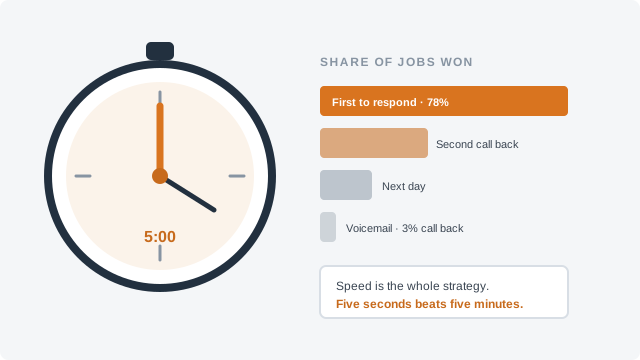
“I’m booked six weeks out. Do I still answer new leads?” Yes, every one, and with the real date. A lead you answer honestly in May can become a job in July, a referral, or the customer who signs up for your fall slot. A lead you ignore is simply gone.
What changes in busy season is not whether you answer. It is what you say: the true start date, a place on a list if she wants an earlier one, and sometimes a higher price.
How big the swing is
The Census Bureau publishes construction spending each month both seasonally adjusted and not. The not-adjusted table shows the season plainly. Here is private residential construction, including improvements, in 2025:
| Month | Spending, billions of dollars |
|---|---|
| January | 63.8 |
| March | 73.2 |
| May | 81.7 |
| July | 87.3 |
| August | 87.3 |
| October | 80.0 |
| December | 66.7 |
August came in about 37% above January. That is the whole country and every residential trade together, and it measures work being done, not inquiries, which come before the work. Your own trade’s curve may be steeper or flatter. The point is that the crunch is predictable, which means you can plan the words before you need them.
For your own trade and area, Google Trends shows when people search for it. Read it with care: Google says each point is divided by all searches in that place and time and “scaled on a range of 0 to 100,” so it shows relative interest, not a count; low-volume terms “appear as ‘0’”; and Google adds small random noise for privacy. Look at five years of a broad term like your trade’s name in your state, and note the month the climb starts. That is when the waitlist and the price decision below need to be ready.
Work out your real lead time
“About six weeks” is usually a feeling. Make it a number. Add up the crew hours in signed jobs not yet started, and divide by the productive crew hours you actually get in a week, not the hours on the time cards.
Say a deck builder has nine signed jobs averaging 60 crew hours each, 540 hours in all, and one crew that gets about 45 productive hours a week after drive time, material runs and weather. That is 12 weeks of work. If he has been telling people “six weeks,” every customer he signs from today will be let down. Do the sum every Monday; it is one of the five numbers to look at every week.
Then quote a window, not a day: “the second half of August,” with a promise to confirm the exact day a week ahead. Rain and a job that runs long will move your schedule; a window absorbs that, a day breaks.
Say it in the first reply
The start date belongs in your first answer, before she spends an evening with you on an estimate. For example:
“Thanks for the details on the fence. We’re booked into August right now, so the earliest we could start is the week of August 18. If that works, I can come out for the estimate Thursday. If you need it sooner, I’m happy to put you on our cancellation list too.”
Some people need the job done before a sale or a family event and will go elsewhere. Good: they would have been unhappy customers in week ten. Others decide a good contractor is worth waiting for, and they wait knowing the date. Put the same line wherever people find you: a “Now booking for August” note on the website and an update on your Google profile (Google Profile Photos and Posts covers how long one stays up), changed when the date moves.
Some states make the start date part of the contract itself. California’s home improvement contract law, Business and Professions Code section 7159, calls for the headings “Approximate Start Date” and “Approximate Completion Date” and a statement of what counts as substantial commencement of the work, and the Contractors State License Board’s sample contract shows all three. What a Home Improvement Contract Must Say covers the states that spell it out. A date you put in writing should be one you can keep.
A waitlist that fills cancellations
Busy season has holes in it: a customer whose financing falls through, a permit that comes late, a job you finish two days early. A short list of people who want to start sooner turns those holes into work.
Whether you may text or email that offer depends on the consent she gave; Booking Estimate Visits That Do Not No-Show covers the consent each kind of reminder needs. And before you take money to hold a place in line, know your state’s limit on down payments: the CSLB sample contract, for one, prints California’s rule that the down payment “may not exceed $1,000 or 10 percent of the contract price, whichever is less.” How Big a Deposit Can You Legally Ask For? covers the other states.
When the honest answer is a higher price
If your lead time keeps growing week after week, demand is telling you something. You can let the wait run to four months, or you can raise the price until the work you take fits the crew you have. Customers who pay more get a date they can plan around, and you get the margin to hire or to say no to the jobs that never paid well.
Two rules keep it fair. Honor every estimate already written at its price for as long as it said it would hold. And set the new price from a date, for every estimate written after it, rather than quoting by mood. Raising Your Prices Without Losing Your Customers walks through the numbers and the letter to regular customers. If a storm is what filled your calendar, read Price-Gouging Laws After a Storm before you change a price.
The leads to turn away kindly
Busy season is when the small jobs and the far-away jobs cost you the most. Say no to them out loud, quickly, with a name if you have one: “That’s outside where we work this summer, but I’d try a company closer to you.” Leads Outside Your Service Area covers referring, declining and charging to travel, and Minimum Charges and Trip Fees covers the small ones you do take.
Still answer fast
Being booked is not a reason to reply on Friday to a lead that came in on Monday; the reply with the date takes two minutes. The Five-Minute Rule is about why speed matters, and Following Up an Estimate covers the estimates waiting on a decision.
When the season turns, the list of people who heard “August” and said no is worth a short note in September, by whatever channel each of them agreed to: the date is earlier now.
General information, not legal or tax advice. Rules change and vary by state; check with the agency named above or a professional for your situation.