

Siding is the one wall trade that finds out what it quoted after the quote is signed
Three trades ask a homeowner for the same number. The painter wants her wall square footage, the pressure washing company wants it, and so do you. What the number buys is not remotely the same thing. A wash buys her a season. Paint buys her eight years. Siding is the last time that wall gets touched, and the square footage is buying a product that has to be ordered and a tear-off that has to be paid for before a single course goes up.
Which is why the money is in the three things that square footage does not contain. Every window and every door gets aluminium bent on the brake to fit its own sill, jamb and head — hand work, one opening at a time. The soffit, the fascia and the frieze are a second run measured in feet, not in square feet. And what is behind the old wall is unknown to everybody, you included, until the morning it comes off. A form that asks for the area and stops has quoted about two thirds of the job.
NapkinPrice™ runs that shop as three services on one account. Vinyl quotes off its own rate, fiber cement and the heavy boards quote off theirs, and stucco, stone veneer, storm damage and pre-1980 cement shingle go down a third path that never guesses a price at all.
The flow also asks for a photo of the house from the street, and the lead tells you to ask for that picture on the callback. Attaching the image itself to the lead is on the roadmap, which is why it is not a tick in that list.
The eight things that set a siding number
One area figure, two counts, five pick-ones, two yes/no answers and a ZIP. The hardest thing on the whole form is the wall area, so the help text does that teaching rather than pretending the question is easier than it is. You build the set once in the dashboard and every rate in it is a field you own.
Wall square footage
The base number: her wall area times your installed rate — $4.40 a square foot on the demo’s vinyl service and $8.60 on the board service. There is no length-by-height box anywhere in the engine, because no rule multiplies one answer by another, so ask for one total and let the help text teach: each wall’s length times its height, added up, round up to the nearest ten, and do not subtract the windows, because the siding still has to be cut around them and the offcuts are waste either way. A 2,000 square foot colonial usually has 1,900 to 2,200 square feet of wall. Set a floor and a ceiling on the answer and the widget refuses a silly number instead of quietly clamping it.
Which board goes on
The hard one, and the section below is about nothing else. A dropdown cannot set the per-foot rate above it, so the board family picks the SERVICE and the dropdown inside that service carries only the spread within the family — which is small enough to state as a percentage honestly. On the demo, vinyl runs 0 to +30% from standard .044 lap up to insulated foam-backed; the board service runs 0 to +48% from prefinished engineered wood up to cedar stained on site. Every one of those is a field you own.
How tall it is, and whether you can reach it
Two answers about height that behave differently on purpose. Storeys are a percentage — staging, planks, a second person steadying the run — at +14% and +26% on vinyl and +18% and +32% on the heavy board, where a 12-foot plank takes two people to place. Tell her to count the walls you have to reach rather than the floors she lives on, because a walkout basement makes the back of the house a storey taller than the front. A wall you cannot reach from a ladder at all is the second answer, and it does something different again: see the lift note under the services.
Openings wrapped, and feet of soffit
The two genuinely per-unit lines, and the pair that separates this trade from painting and pressure washing. Every window and exterior door gets coil bent on the brake to fit it — $72 an opening on vinyl, $88 in the board service where the trim is mitred composite rather than bent metal. Soffit, fascia and frieze are a separate run at $15 a linear foot, paced round the roof edge including the gable rakes and the porch. On the demo job below those two answers are $3,771 of a $13,256 subtotal, and a headline per-square-foot price contains neither of them.
What comes off, and who hauls it
Two questions, two shapes, and the difference is worth copying. Getting the old wall off is labour spread across the whole house, so it is a percentage — nothing for new construction, +6% for one layer of vinyl, +14% for nailed wood, +18% for two layers. The dumpster is a flat amount added ONCE for the job — $685 on vinyl, $810 in the board service, because cement offcuts are heavier and a dumpster is priced by weight as well as size. One capital-letters warning lives in that help text: hard grey shingle on a pre-1980 house is probably asbestos cement, and the honest instruction is to stop and pick the site-visit service.
What is behind the wall
The question this trade is judged on, and the one the demo deliberately does not charge for. A soft spot she already knows about is +7%; known water damage at a window or along the bottom course is +16%. "No idea — it has never been off" carries nothing at all, and the identical job quotes the same either way. Charging online for a guess about a wall nobody has seen, and calling it an allowance, is how this trade earned its reputation. What the help text promises instead is what actually happens: you photograph what you find, price it by the sheet at the rate on her written quote, and she says yes before you cover it back up.
How cut up the house is
Siding labour is cuts. A long straight wall goes up in full courses; a dormer cheek, a bay, a porch return and a gable rake are all short pieces measured and cut one at a time, and in fiber cement every one of them is a saw cut with dust collection. So ask her to count the shapes rather than the square feet — a box with a gable at each end, a couple of dormers and a front porch, or several gables and angles — at nothing, +8% and +18% on the demo. It is the answer that stops two houses with identical wall area quoting identically, which they never should.
Travel zone
List your ZIPs by zone — whole ZIPs or three-digit prefixes — and the widget prices the trip from the ZIP she types, most specific match first. A flat charge, a percentage, or both. The demo shop charges nothing at home in Fredericksburg, $95 up to Stafford, $180 across to Prince William and Fairfax, and $320 plus 5% to the catch-all, so the same eleven answers come back $15,271 to $18,664 at home and $16,322 to $19,950 from a ZIP in the catch-all zone. Set one zone to "outside my area" and it declines politely while still capturing the lead.
A real re-clad, start to finish
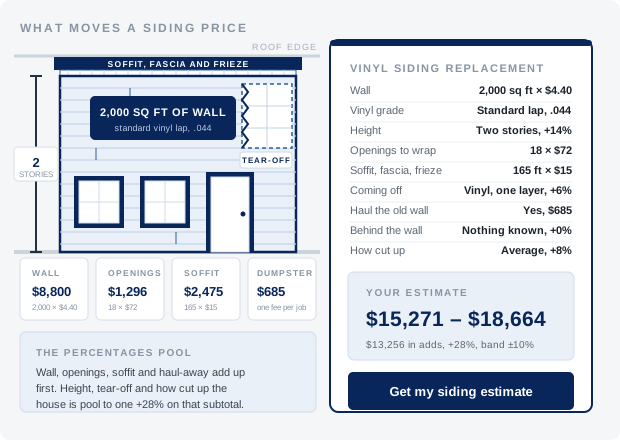
Eleven questions, about ninety seconds. This is the exact sequence running on the vinyl service of our own siding demo account — a two-story colonial in a 1990s Fredericksburg subdivision, 2,000 square feet of wall, eighteen openings to wrap, one tired layer of vinyl coming off — and the total at the bottom is what the live pricing engine returns for these answers, not a figure anybody typed into this page.
| # | What she is asked | What she answers | What it does to the price |
|---|---|---|---|
| 1 | How many square feet of wall are we siding? | 2,000 | 2,000 × the per-sq-ft rate — $4.40 on this service, so $8,800. This is THE base number |
| 2 | Which vinyl are you putting on? | Standard lap, .044 | +0%, the rate as it stands. Insulated foam-backed would be +30% |
| 3 | How tall is the house? | Two stories | A percent on the whole job: +14% |
| 4 | How many windows and doors have to be wrapped? | 18 | 18 × $72 = $1,296 — coil bent by hand, one opening at a time |
| 5 | How many feet of soffit, fascia and frieze? | 165 | 165 × $15 = $2,475 — the other genuinely per-unit line |
| 6 | What is on the house now? | Vinyl, one layer | A percent on the whole job: +6% |
| 7 | Is the old siding ours to haul away? | Yes | A flat $685 for the job, not per wall — it is one dumpster |
| 8 | What do you expect us to find behind it? | Nothing we know of | +0%. So does “no idea” — only known damage is priced |
| 9 | How cut up is the house? | A couple of dormers and a porch | A percent on the whole job: +8% |
| 10 | Any wall you cannot reach from a ladder? | No | Nothing. Yes would not add a dollar either — it raises the job floor to $9,500 |
| 11 | Got a photo of the house from the street? | Offered | Nothing. A photo never moves the price |
| The arithmetic, in the order the engine runs it | $8,800 + $1,296 + $2,475 + $685 = $13,256, then the three percentage answers pool into one and +28% applies once to all of it → $16,967.68 | ||
| She sees | $15,271 – $18,664 | ||
| What lands in your inbox, the second she submits | Name, mobile, ZIP, all eleven answers, the photo flag, and the disclaimer she was shown | ||
The $4.40, the $72, the $15, the $685 and every percentage above belong to the demo account, not to a Tailgate Office price list — you set all of them in the dashboard and you can move a per-foot rate the morning your supplier reprices a square, without touching your website. Two things about those percentages are worth reading twice: they pool rather than compound, so +14%, +6% and +8% come to +28% and not to +29.9%, and the pooled figure lands on the whole additive subtotal. The two-story band is really about the wall, but it is charged across the trim wrap, the soffit run and the dumpster as well — about $624 of this midpoint, being 14% of the $4,456 that is not wall. The help text says the answer is figured across the job rather than implying a per-foot rate, and if you would rather it did not work that way you put your height cost on a flat amount instead. What is not illustrative is the total: $15,271 to $18,664 is what the engine returns for those eleven answers, and you can reproduce it on the demo in about a minute.
Would you rather try it than read about it? We keep a working example siding company website with NapkinPrice embedded — the real engine, quoting live, on a page that is not ours. Put in those eleven answers and see the same number come back.
Try the live demo site (opens in a new tab)Vinyl on one rate; fiber cement, engineered wood and cedar on another
This is the one design decision that matters in siding, so here is the whole of it in plain words rather than a promise that it all just works.
In siding the material is the per-square-foot rate, and there are five kinds of pricing rule in the engine and none of them multiplies one answer by another. A number question can carry a per-unit rate — the wall area, the openings, the feet of soffit. A pick-one can add dollars once for the job, or take a percentage of the whole job. What it cannot do is apply its own rate to her footage, and pretending otherwise on a marketing page is how you end up with a product that does not do what the website said.
So there were two ways to price board inside one service, and we rejected both. Material as a percentage: standard vinyl to cedar shake is 2.89 times the rate, which is +189%, a number that reads as a typo on a homeowner’s screen — and because the pool lands on the whole additive subtotal, that +189% would also be charged on the dumpster fee and the soffit run, neither of which cares what the wall is clad in. Material as a flat dollar upgrade: worse, and not a compromise but a wrong answer, because a flat amount is added once per job, so a 900 square foot rancher and a 3,200 square foot colonial would pay exactly the same to change board.
What the demo does instead, and what we would set up with you, is one instant service per board family, each with its own base rate, and she picks the family before she answers a single question. It is the same advice the fencing page has given for a year about privacy fence against horse fence, and the flooring page runs the same shape. Siding’s case for it is the strongest of the three, because the two families are not only priced differently — they are different work. Vinyl hangs loose on a nail hem so it can move with the weather, and it is cut with a knife and a snap. Fiber cement is blind-nailed tight, cut with shears or a dust-collecting saw because of the silica, butt-jointed over flashing, and heavy enough that a 12-foot plank needs two people on it. A homeowner choosing between them is choosing between two trades, not two prices.
On the demo that is $4.40 a square foot for vinyl and $8.60 for the board family. The same colonial from the table above is $15,271 – $18,664 in standard vinyl, $25,830 – $32,874 in prefinished engineered wood and $30,102 – $38,312 in factory-finished fiber cement. Three numbers a single dropdown could not have produced honestly.
Vinyl and insulated vinyl — quotes instantly
$4.40 a square foot on the demo, with the dropdown moving it inside the family: standard .044 lap at the rate, premium .046 with a deeper shadow line +10%, shake or board-and-batten on the gables +18%, insulated foam-backed +30% — which takes the colonial above to $18,850 to $23,039. No trip charge, because the measure sells the job, so a $3,500 job minimum does that work instead: 200 square feet of new gable end, whose arithmetic is $880, comes back at $3,500 to $3,850. One answer raises that floor without adding a dollar — a wall you can only reach with a boom lift, because a lift is delivered, rented by the day and collected whatever the wall turns out to be worth. 700 square feet of two-story wall with six openings and sixty feet of soffit, whose arithmetic comes to $6,116.40, quotes $9,500 to $10,450 with the lift and $5,505 to $6,728 without it. And there is a ceiling above all of it: the biggest house this form will take — 3,600 square feet of insulated vinyl on three storeys, forty openings wrapped, two layers coming off — reaches $50,346.40, so past $32,000 the widget stops pricing and hands you the lead.
Fiber cement, engineered wood and cedar — quotes instantly
$8.60 a square foot, and the same eleven questions with different numbers behind them: engineered wood lap prefinished at the rate, fiber cement painted on site +14%, factory-finished +22%, shingle or shake panel +40%, cedar stained on site +48%. $88 an opening rather than $72, because the trim is mitred composite rather than coil bent on a brake. $810 to haul rather than $685, because cement offcuts are heavy and a dumpster is priced by weight. A $4,800 minimum, a wider band on purpose — 12% against 10%, since the boards vary more and so does the prep under them — and a $13,000 lift floor. A 1,250 square foot one-story Cape in factory-finished fiber cement quotes $16,407 to $20,882; the same Cape in cedar is $19,740 to $25,123. Past a $45,000 ceiling it routes to you instead.
Stucco, stone, storm damage and asbestos shingle — site visit, never priced
Site-visit mode captures the whole spec and shows no number at all, which is the only honest answer here. Stucco and EIFS remediation is a wall-assembly investigation before it is a cladding job, stone veneer is a mason’s trade with a footing and a weep detail, a storm claim is priced by an adjuster, and cement shingle from before 1980 is an abatement licence away from anything on the other two forms. It still asks what is on the wall, a rough square footage that moves no money and only tells you whether to send one person or two, what she actually needs done, and whether water is getting into the house — which sorts your visit order rather than her price. She gets your own “we will come and look” message; you get a lead worth bidding.
Neither service carries a season, and that is a decision rather than an empty field
Three fixtures in this estate already run a December-to-February winter discount — roofing, decks and painting — and the commercial logic behind all three is true of siding too: the schedule empties in January and a crew that would otherwise be idle will take the work. A fourth copy of it would have been the easy thing to write. It is declined because siding is the one exterior trade here where the off-season has a physical objection and not only a commercial one. Vinyl goes brittle in the cold and splits at the nail hem when it is fastened below about 40°F, and the caulk and the site-applied paint on fiber cement will not cure below 50°F. A published winter discount would be advertising a price for work the crew should be talking her out of, in the two months it should be talked out of. Every figure on this page is therefore the same figure in any month, which is a thing worth being able to say.
One limitation the demo owns rather than hides. Asbestos-cement shingle is on plenty of pre-1980 houses in this market and it is an abatement job, not a siding job — but no rule kind lets one dropdown answer send the visitor to a different service. So it is held by a help string in capital letters on the tear-off question, plus the six options on the site-visit service. A sentence doing a rule’s job is a weaker guard than a rule would be, and you should know which of the two you are relying on.
A service that quotes will not go live until it carries a real base fee or a real minimum. That is deliberate: a service with neither would happily return $0 to a homeowner, and one bad number on your website costs more than a day of setup. Neither siding service carries a trip charge, so on both of them it is the minimum doing that job.


There is no emergency call in siding to make up for the one you missed
Nobody rings twice about a wall they have been looking at for six years. A plumber gets a second chance because the pipe is still leaking at nine; you are on a plank at eleven with a nail gun in one hand, and the woman who called went down the list. What this trade has instead of second chances is a very small number of very large jobs: roughly 62% of contractor calls go unanswered, about 78% of jobs go to whoever responds first, and voicemail gets a callback around 3% of the time. In this trade those three numbers are not a leak. They are the month.
| What a missed siding call is worth | On the demo account |
|---|---|
| 2,000 sq ft colonial re-clad in vinyl, 18 openings wrapped | $15,271 – $18,664 |
| The same house in factory-finished fiber cement | $30,102 – $38,312 |
| A 1,250 sq ft Cape, fiber cement, one story | $16,407 – $20,882 |
| Voicemail callback rate | ~3% |
| One recovered vinyl re-clad pays for | 76 months of the bundle |
| One recovered fiber cement job pays for | 151 months |
CallMitt™ writes back from your own texting number, a local number registered to your business and not a stranger’s 800 line, and the text opens with your business name, so she replies into the same thread as her quote. The message is picked by the hour and the day, against the hours you actually keep — the demo shop runs 7 to 5, because the trailer is loaded before seven and the last course goes up while there is still light to see the line by, so a 5:20 call honestly gets the after-hours version instead of one claiming somebody is in the office.
Straight about where this stands, because it is the part a demo cannot show you. There is no SMS gateway on our side yet, no carrier registration, and no automatic missed-call detection. Today you log the missed call, CallMitt picks the right message for the hour and the day, checks your quiet hours, opt-outs and suppression list, and writes the reply into the outbox marked queued — and there it stays. It is not delivered, and a queued reply still sitting there an hour later is retired rather than sent. Everything around it is built and running now: the five messages, the business-hours, weekend, holiday and vacation rules, the quiet hours, the opt-out handling, and the thread her reply lands in beside her quote. Better you read that here than find it out in week two.
How CallMitt Works Run Your Own NumbersA siding hand is hired on two questions, and the first one is the weather
The work is on a plank at second-storey height for most of the day, in August and in February, in whatever the sky is doing. A man who has not done that does not yet know whether he can, and finding out on day one costs you a week and a half-clad house. So the first real question is not about skill at all. The second one is: has he run a brake? Bending your own coil to fit an opening nobody built square is the line between an installer and a labourer who can hang a course, and you cannot teach it in a morning.
Put “Now hiring — text CREW to your texting number” on the trailer and the yard sign. CrewFunnel™ asks seven short questions: is he 18 or older, is he up for a day on a plank in any weather, has he run a brake to bend his own trim, how many years has he done siding or exterior trim, how far out does he live, can he start inside two weeks, and tell us about the last house he sided. Three of those are knockouts — under 18, not up for the plank, or living more than the distance you will drive — and the rest come back as a weighted fit score — years in the trade heaviest, then whether he can start inside two weeks, then the brake.
Two things about that scoring are worth copying. Distance is a knockout and never a weight, because a number answer scores higher the bigger it is, so weighting miles would rank the man furthest away at the top. And free text carries no weight at all, because any non-empty answer scores full marks and a weighted text box quietly inflates every candidate who typed anything. Both are set that way on our own demo job, and every one of the seven questions carries a Spanish translation.
One honest note on delivery. There is no inbound SMS on our side yet, so today he answers those seven questions on your screening page rather than by text — same questions, same knockouts, same scoring, same pool. The keyword on the trailer takes over the day your carrier registration clears.
See how CrewFunnel works


New siding gets its review the week the whole street notices
The last panel is on, the trim is caulked, the dumpster is gone, and the house she has been embarrassed by since she bought it is a different house. For about a week everyone who drives past says so. That is the week she would write you a review. After that it is just what the house looks like, and the crew that hung it has faded along with the old paint. The outfit with sixty reviews is not sixty times better than you; somebody there asks every customer, the week the last panel goes on.
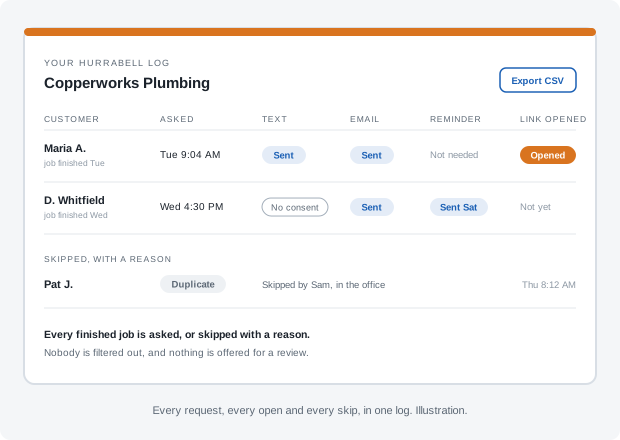
HurraBell™ does the asking. Mark the job done — from the inbox, from your phone, or from your job software through Zapier — and the customer gets one request in your words, with your own Google review link, after a delay you pick: an hour, unless you change it. Three days later, one email reminder, unless the link has been opened or the customer has got back in touch.
Review requests aren’t switched on yet, so none is sent today. When they are, the request goes by email once your Google review link is saved on the HurraBell page and your mailing address on the Account page. A text goes as well where the customer agreed to texts, and only once your carrier registration clears, the same wait as every text on this site; until then it is email only.
See how HurraBell worksOne recovered re-clad covers 76 months
And if she picks fiber cement, 151 of them. In a trade that lives on a handful of five-figure jobs a month, the arithmetic is not close — it is barely arithmetic.
The Tailgate Office Bundle
Instant quotes on your website, missed-call text-back, text-to-apply hiring, review requests, and customers, jobs, estimates and invoices in one place. 30 days free, no credit card, no setup fee, cancel from the dashboard.
Start Free TrialOnly need one of the tools? After the trial you can keep just that one at its own price; the office stays with the Bundle.
Siding questions we get asked
You can price a range, which is all the widget ever shows. The disclaimer under it is yours to write, and the demo’s says what is in the number — weather barrier, starter strip, J-channel, corner posts and bent coil on every opening she told you about — and what is not: nobody can see the sheathing behind her siding, you included, so if boards have to be replaced you show her the wall, price it by the sheet before you cover it, and she agrees the extra in writing. That is a bracket you can stand behind from the kerb, and the man who wanted a whole colonial re-clad for six thousand dollars never fills in your callback form at all.
Because the engine cannot multiply one answer by another, and we would rather tell you that than sell you a form that quietly gets fiber cement wrong. A pick-one adds dollars once or takes a percentage of the whole job; it cannot apply its own rate to her wall. As a percentage, vinyl to cedar is +189% — and it would land on the dumpster fee too. As a flat upgrade it would charge the same to change board on a rancher as on a colonial. One service per family gives each a rate that is right for it, and she picks the family first, which is how she is thinking about it anyway.
On the form, yes, deliberately. Known damage is priced — a soft spot she has already found is +7% and water damage at a window is +16% — but “no idea, it has never been off” carries zero, and the same job quotes $15,271 to $18,664 whether she answers that or “nothing we know of”. A percentage against a wall nobody has seen is a guess wearing an allowance’s clothes, and it is why homeowners assume a siding quote is fiction. What the help text promises instead is the thing that actually happens: you photograph it, price it by the sheet at the rate already on her written quote, and she says yes before it is covered up. That conversation is easier to have when you did not pre-charge her for it.
A sentence, and you should know that is what it is. The tear-off question’s help text says in capital letters that hard grey shingle that snaps rather than bends on a pre-1980 house is probably asbestos cement, and to stop and pick the site-visit service instead; that service lists it as one of its six options and its disclaimer says you test before anybody touches it. What is NOT there is a rule, because no rule kind in the engine lets one dropdown answer route the visitor to another service. A help string is a weaker guard than a rule, we have not pretended otherwise, and if that risk is unacceptable in your market the answer is to run the whole tear-off as a site visit until it is not.
One account, three services, one dashboard — and three rate cards, because the three jobs are priced on three different things even though all of them start by asking for her wall area. The painting page argues that prep is the number nobody quotes and the pressure washing page argues that the bundle is the business; siding is neither. Its square footage is buying a product that has to be ordered and a tear-off that has to be paid for, and the openings, the soffit run and what is behind the wall are where the money actually is. Set them up as separate services and the visitor picks before she sees a single question, which also stops a wash enquiry arriving priced like a re-clad.
Our demo says no, and neither instant service carries a season at all. The field is there and three other trades on this site use it, because a January discount on scheduled work is a real and defensible thing. Siding is the exception, and the reason is physical rather than commercial: vinyl splits at the nail hem when you fasten it much below 40°F, and caulk and site-applied paint on fiber cement will not cure below 50°F. A winter discount would therefore be advertising a price for the two months you should be talking her out of. An empty season field is a decision you are allowed to make, and this is what it looks like when it is made on purpose.
Call it fifteen minutes for your text-back messages and your crew hours, a minute, once review requests are switched on for your account, to paste your Google review link on the HurraBell page and your mailing address on the Account page, and about an hour to write the eleven questions and load one rate card — per square foot, per opening, per foot of soffit, your haul-away fee, your height, tear-off and complexity percentages and your minimum. Then most of another hour to clone it into the second board family with different numbers, which is the part siding has that most trades do not. A service that quotes will not go live until it carries a real base fee or minimum, which is deliberate. No onboarding call, no setup fee and no contract: $199 a month buys all four tools, and ResponsiBid’s reported $400–600 setup, as published in August 2026, is not a thing here.
Also paint exteriors, or wash them? See all the trade pages or call (301) 268-1943.
Give her the bracket before she books three Saturdays.
Set it up tonight. Free for 30 days, no card, no setup fee, cancel from the dashboard.