

Excavation is priced by the foot, after the machine gets there
Most of what a homeowner wants dug can be described from her own yard: a trench from here to there for a water line, a drain along the side of the house, a downspout run out to daylight. That is feet times a rate, with the depth, the ground and the access moving it. What every one of those jobs also has is a fixed cost before the first bucket: floating the machine there and back. Priced by the foot alone, a twenty-foot trench comes out at a number nobody can dig it for.
So this page prices the machine float as the base fee, added once and inside the number she sees, then the trench by the foot with the depth, a French drain, the soil and the access as percentages, and the dirt and the lawn as flat lines. Demolition is a second instant service on the same idea, by the square foot of the structure. And every dig starts with an 811 locate request, which the form tells her you make, at no charge, before the bucket goes in.
The flow also asks for a photo of the route, and the lead tells you to ask for those pictures on the callback. Attaching the image itself to the lead is on the roadmap, which is why it is not a tick in that list.
The eight things that set a trench number
A base fee, a length, four pick-ones, a yes or no and a ZIP. You build the set once in the dashboard and every rate in it is a field you own — you can change the float or the per-foot rate the week diesel goes up without touching your website.
The machine float
Not a question at all: the service's base fee, $450 on the demo, added once to every number before anything else. It is what moving an excavator really costs, and putting it inside the range is the difference between an honest number and a surprise at the gate.
Feet of trench
Paced out from where it starts to where it ends: $16 a foot on the demo. The help text is also where she reads that you call 811 to have the buried lines marked before you dig, every time, at no charge.
How deep
Up to two feet at the rate, two to four feet +25%, four to six feet with a trench box +60%. A water line goes below the frost line and a downspout run does not, and the help text tells her to pick the middle one if she is not sure.
A French drain
A yes or no that takes a percentage: +55% on the demo for the perforated pipe, the filter fabric and the washed stone, figured across the whole job. On a drain the materials scale with the trench, which is why it is a percentage and not a flat add.
The ground
Ordinary soil at the rate, heavy clay +10%, rocky or full of roots +35%. She knows if her yard is clay; she found out the year she planted the roses.
Access for the machine
An open yard at the rate, a gate narrower than six feet +10%, some of it dug by hand +30%. The question that decides whether a mini excavator does the job or a crew with shovels does part of it.
The extra dirt, and the lawn
Spread on the property at nothing or hauled away at $450, a pick-one that adds dollars once; and a yes or no at $300 for topsoil, seed and straw over the whole run. Two lines she can see, instead of a number she argues about after.
Travel zone
List your ZIPs by zone, whole ZIPs or three-digit prefixes, and the widget prices the trip from the ZIP she types, most specific match first, as a flat charge, a percentage, or both, on top of the float. Our demo shop charges nothing in its home counties and $200 out to the ring beyond them, so the same drain comes back $5,039 to $6,817 at home and $5,209 to $7,047 in Frederick. Set one zone to "outside my area" and it declines politely while still capturing the lead.
A real French drain, start to finish
Eight questions, about a minute. This is the exact sequence running on the trenching service of our own excavation demo account, answered for a French drain along the side of a Westminster house — and the total at the bottom is what the live engine returns for these answers, not a figure anybody typed into this page.
| # | What she is asked | What she answers | What it does to the price |
|---|---|---|---|
| — | (the service's base fee) | — | The $450 machine float, added once before anything else |
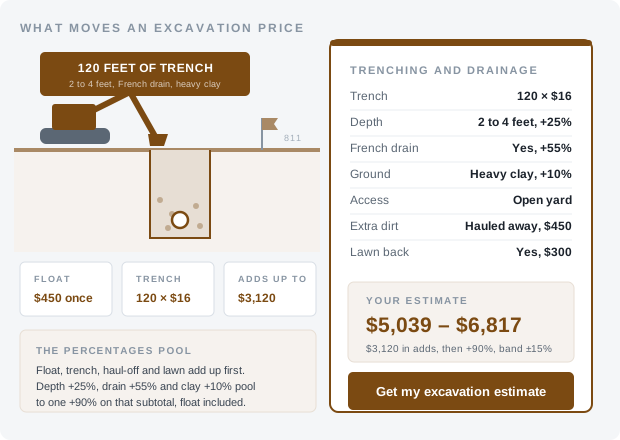
| 1 | How many feet of trench? | 120 | 120 × $16 = $1,920 |
| 2 | How deep does it go? | 2 to 4 feet | +25% on the whole job. Up to 2 feet 0%, 4 to 6 feet with a trench box +60% |
| 3 | Is it a French drain, with pipe and stone? | Yes | +55% on the whole job, for the pipe, the fabric and the stone |
| 4 | What is the ground like? | Heavy clay | +10% on the whole job. Ordinary soil 0%, rock or roots +35% |
| 5 | Can a small machine get to the trench? | Yes, an open yard | Nothing. A narrow gate +10%, hand digging +30% |
| 6 | What happens to the extra dirt? | Haul it away | A flat $450 for the job |
| 7 | Should we put the lawn back over the trench? | Yes | A flat $300: topsoil, seed and straw |
| 8 | Got a photo of the route? | Offered | Nothing. A photo never moves the price |
| The arithmetic, in the order the engine runs it | $450 + $1,920 + $450 + $300 = $3,120, then the three percentage answers pool to +90% and apply once to all of it, the float included: → $5,928 | ||
| She sees | $5,039 – $6,817 | ||
| What lands in your inbox, the second she submits | Name, mobile, ZIP, all eight answers, and the photo flag; the 811 note is in the disclaimer she saw on screen | ||
Every rate in that table belongs to the demo account, not to a Tailgate Office price list — you set all of them yourself, and you can change one without touching your website. What is not illustrative is the total: $5,039 to $6,817 is what the engine returns for those eight answers, the machine float included.
Would you rather try it than read about it? We keep a working example excavation company website with NapkinPrice™ embedded — the real engine, quoting live, on a page that is not ours. Put in those eight answers and see the same number come back.
Try the live demo site (opens in a new tab)The float is in every number, the trench and the teardown each have a rate, and the lot gets a walk
These are the decisions that matter in excavation, so here they are in plain words rather than a promise that it all just works.
The base fee is the machine float, and the engine adds it to the dollars before the percentages pool. So on the example above the +90% lands on the $450 float as well as on the trench, the dirt and the lawn. That is honest arithmetic — a deep, wet, clay trench really does take the machine longer on site — and it is why the band on this service is wider, 15%, than on a trade with nothing buried in it. The help text says the depth, the drain and the soil are figured across the job.
Demolition is its own instant service on the same float: the square feet of the structure times $9, with what it is made of as a percentage, a wood-frame garage +20%, block or brick +45%, an above-ground pool −30%, and the slab, the permit and the grading as flat lines. A 400 square foot garage with its slab, the permit and the ground seeded comes back $5,508 to $7,452. The disclaimer says the utilities are shut off and checked before anything comes down, and that an older structure is tested for asbestos and lead first.
Foundations, building pads, clearing and grading a lot never get a number online. They are priced from a walk of the site and, for a new building, the plans, so they run as a site visit that asks what the job is and roughly how big, which moves no money and only tells you how long to book the walk.
Trenching and drainage — quotes instantly
A $450 machine float as the base fee, $16 a foot, the depth, a French drain, the ground and the access as percentages, $450 to haul the dirt and $300 for the lawn. A $1,200 minimum is the floor under the final number, so a 20-foot trench that works out at $770 comes back $1,200 to $1,380. Past $30,000 it stops pricing and hands you the lead.
Demolition and haul-off — quotes instantly
The same $450 float, $9 a square foot of structure, what it is made of as a percentage, $750 for the slab, $250 for the permit and $350 to grade and seed. Its own $1,500 minimum, so a 120 square foot shed floors there, and its own $30,000 ceiling. Dumpsters and disposal fees are in the rate.
Foundations, land clearing and site work — site visit, never priced
Basements, building pads, clearing, grading and driveways are priced from a walk of the site. The form asks what the job is and roughly how big, shows no number at all, and sends her a plain "we like to see it first" note; you get a lead worth walking.
A service that quotes will not go live until it carries a real base fee or a real minimum. That is deliberate: a service with neither would happily return $0 to a homeowner, and one bad number on your website costs more than a day of setup. Both excavation services carry the float as their base fee and a minimum under it.


Nobody hears a phone over a diesel, and the call comes the morning after the storm
You are in the seat of a machine with ear protection on, or down in a trench with a laser level. She is not ringing on a quiet afternoon: her basement took on water last night, and she wants somebody out before the next rain. She books whoever sends her something first, and in a trade where a single drain is four figures and a teardown is five, the call you could not take is the week’s work.
| What a missed excavation call is worth | On the demo account |
|---|---|
| A 120-foot French drain in clay, dirt hauled | $5,039 – $6,817 |
| A 400 sq ft garage down, slab out, seeded | $5,508 – $7,452 |
| An above-ground pool removed, ground seeded | $2,083 – $2,818 |
| A 60-foot downspout run, lawn put back | $1,454 – $1,967 |
| One recovered drain pays for | 25 months of the bundle |
| One recovered downspout run pays for | 7 months |
Once texting is switched on, CallMitt™ writes back by text with your business name in the first words, so she replies into the same thread as her quote. The message is picked by the hour and the day, against the hours you actually keep — the demo crew runs 6 to 4, because the machine is warm by half past six and the trailer is loaded again by four, so a 4:30 call gets the after-hours version rather than one claiming somebody is on site — and every version asks the one thing that sorts your week: what needs digging or taking down, and where.
Straight about where this stands. The forwarded-call hook is built and waits on your texting number, so today you log the missed call and nothing is sent: a reply queued now is retired rather than delivered when your carrier registration clears. Everything around it is built and running now: the five messages, the business-hours, weekend, holiday and vacation rules, the quiet hours, the opt-out handling, and the thread her reply lands in beside her quote.
How CallMitt Works Run Your Own NumbersAn operator is hired on one question, and it is about the seat
A laborer with a shovel is a morning’s teaching. An operator who can dig a straight trench to grade beside a foundation without touching it is the business, and you cannot teach that on a customer’s yard. Has he run a mini excavator or a skid steer on a real job? A man who has will tell you which one he prefers and why. The first question is plainer: does he have a valid driver’s license, because the machine goes everywhere on a trailer.
Put “Now hiring — text CREW to your texting number” on the trailer and the yard sign. CrewFunnel™ asks seven short questions: is he 18 or older, does he have a valid driver’s license to tow the equipment trailer, has he run a mini excavator or a skid steer on a job, how many years has he done excavation or site work, how far out does he live, can he start inside two weeks, and what was the last job he worked on. Three are knockouts — under 18, no license, or living further out than you will drive — and the rest come back as a weighted fit score, years in the trade heaviest, the start date next and the machine question after it.
Two things about that scoring are worth copying. Distance is a knockout and never a weight, because a number answer scores higher the bigger it is, so weighting miles would rank the man furthest away at the top. And free text carries no weight, because any non-empty answer scores full marks and a weighted text box inflates every candidate who typed anything. Both are set that way on our demo job, and all seven questions carry a Spanish translation.
One honest note on delivery. Text-to-apply waits on your texting number, so today he answers those seven questions on your screening page rather than by text — same questions, same knockouts, same scoring, same pool. The keyword on the trailer takes over the day your carrier registration clears.
See how CrewFunnel works

A drain gets its review the first time it rains
The trench is backfilled, the seed is down under the straw, and a week later the first heavy rain runs into the drain instead of into her basement. She goes downstairs twice that night to check, and the floor is dry both times. That is the week she would write you a review. By summer it is just a strip of lawn that is a little greener than the rest. The outfit with sixty reviews is not sixty times better than you; somebody there asks every customer, the week after the first storm.
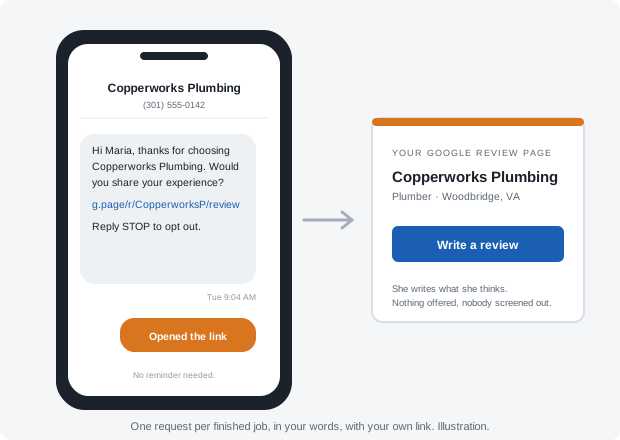
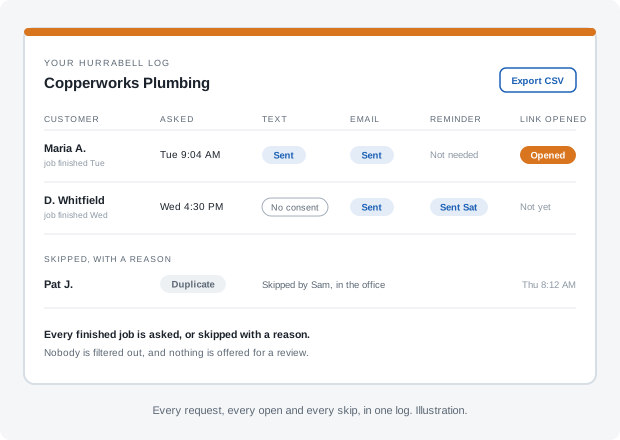
HurraBell™ does the asking. Once review requests are switched on, you mark the job done — from the inbox, from your phone, or from your job software through Zapier — and the customer gets one request in your words, with your own Google review link, after a delay you pick: an hour, unless you change it. Three days later, one email reminder, unless the link has been opened or the customer has since texted you, messaged you from your website or had a call logged on her thread.
Review requests aren’t switched on yet, so none is sent today. When they are, the request goes by email once your Google review link is saved on the HurraBell page and your mailing address on the Account page. A text goes as well where the customer ticked the box on your quote form or visit booking agreeing to a review-request text, and only once your carrier registration clears, the same wait as every text on this site; until then it is email only.
See how HurraBell worksOne recovered drain covers 25 months
A single downspout run covers 7 of them. In a trade where the shopper calls the morning after the storm, the arithmetic is not close.
The Tailgate Office Bundle
Instant quotes on your website, missed-call text-back and text-to-apply hiring (texts go out once texting is switched on), and, once switched on, a review request after every job, plus customers, jobs, estimates and invoices in one place. 30 days free, no credit card, no setup fee, cancel from the dashboard.
Start Free TrialOnly need one of the tools? After the trial you can keep just that one at its own price; the office stays with the Bundle.
Excavation questions we get asked
You can price a range, and only a range — the widget never shows a single figure. The disclaimer under it is yours to write. On the demo it says the range includes the machine float, that you put in the 811 locate request on every job at no charge and dig only after the lines are marked, and that rock, buried debris or a line nobody marked is shown to her and agreed in writing before you dig further. Nothing is dug until she has that written number.
Because it is not something she chooses: every job pays it, once. As the service's base fee it is added to the dollars first and is always inside the range she sees, which is the honest place for it. The seam is that the answers' percentages pool across it too, so a deep, wet trench marks up the float as well, and the band is a little wider because of it.
Because PHMSA's "Call Before You Dig" advice to a homeowner is to make sure the contractor she hires has the buried lines marked before anybody digs, and the question she should ask any excavator is whether you will call 811 and show her the ticket number. The demo says in the first question's help text that you make the request on every job at no charge. It costs you nothing to say and it is the thing she is most worried about.
No, and you should not. Put basements, building pads, clearing and grading on a site-visit service: it asks what the job is and roughly how big, shows no price whatsoever, and sends her a plain "we like to see it first" note. A foundation is priced from the plans and the soil, and nobody should publish a number against either.
Our demo says no, and neither instant service carries one, but this is the trade where a season is most likely to be real: frozen ground and mud both cost machine hours. If yours do, a season is a percentage on a date window you set, applied to the job before anything about her address. What you should not do is invent one to fill the box.
Call it fifteen minutes for your text-back messages and your working hours, a minute, once review requests are switched on for your account, to paste your Google review link on the HurraBell page and your mailing address on the Account page, and about an hour to write the eight questions and load one rate card — the float, per foot, your depth, drain, soil and access percentages and your dirt and lawn amounts. Then half an hour more for demolition. A service that quotes will not go live until it carries a real base fee or minimum, which is deliberate. No onboarding call, no setup fee and no contract: $199 a month buys all four tools.
Also pour concrete, pave, or pump septic tanks? See all the trade pages or ask us.
Quote the drain while her basement is still wet.
Set it up tonight. Free for 30 days, no card, no setup fee, cancel from the dashboard.