


Everything that sets a gutter price is something she can count
Feet of eave, a profile, a number of downspouts and a decision about guards. There is no square footage to work out, no attic to look in, nothing hidden under a layer of something else. That is why this trade quotes honestly off a form when plenty of others cannot — and why a homeowner who gets a real bracket at nine at night stops calling down the list.
Plenty of roofers hang gutters, and that is a real business rather than a mistake: on a tear-off the gutter is the line at the end, priced alongside the roof on the same account. If that is you, the gutter questions belong on your replacement service and the roofing page is the one to read. This page is written for the other shop — the one whose whole trailer is a coil, a machine and a run of ladders, where the gutter is not the last line on somebody else’s invoice. It is the invoice.
NapkinPrice™ runs that shop as three services on one account. The install asks eleven questions and puts a range on the screen, the cleaning carries your trip charge inside the number instead of springing it at the door, and a run that has pulled off the fascia goes down a third path that never guesses a price at all.
The flow also asks for a photo of the eaves, and the lead tells you to ask for that picture on the callback. Attaching the image itself to the lead is on the roadmap, which is why it is not a tick in that list.
The eight things that set a gutter number
Not one of these asks a homeowner for an area. Every answer is a count, a pick-one or a yes/no, and the hardest thing on the whole form is pacing the eaves — so the help text does that teaching rather than pretending the question is easier than it is. You build the set once in the dashboard and every rate in it is a field you own.
Feet of eave
The base number: her paced total multiplied by your per-foot rate, and the largest of the three genuinely per-unit lines on the install — $14 a foot on our own demo card. There is no length-by-width box anywhere in the engine, because no rule multiplies one answer by another, so ask for one total and let the help text teach: both sides and the back, a typical two-story colonial is 180 to 220 feet, within ten per cent is close enough for a range. Set a floor and a ceiling on the answer and the widget refuses a silly number instead of quietly clamping it.
Profile and material
Five-inch K-style aluminum, six-inch, half-round aluminum, half-round copper. A pick-one percentage rather than four separate rates, because the profile changes the coil, the hangers and the time on the machine together. Copper is not “a bit more” — it is plus 180% on the demo card, and that is the honest gap between a gutter that lasts twenty years and one that outlives the house. Set the number your own supplier charges you.
How high the run is
One story, two, or three and the steep banks where a ladder cannot be footed flat. Height is labor on this job and not material: taller ladders, a second pair of hands, slower work, more time moving than hanging. So it belongs on a percentage rather than a fee — nothing, plus 12% and plus 28% on the demo.
Downspouts
A plain count times your per-downspout rate, $105 on the demo. One for every 30 to 40 feet of gutter is the rule of thumb, and putting that in the help text is the difference between a 200-foot house answering five or six and a 200-foot house answering two. Let her enter 0 and say you will work it out on the measure, because half of them genuinely do not know.
Buried downspout runs
Split off from the downspout count on purpose: a line trenched out to a pop-up emitter is pipe, a trench and a morning, not a corner elbow. Its own per-unit rate, $185 each on the demo. Worth knowing the engine cannot read one answer against another, so nothing stops her entering more buried runs than she has downspouts. That is a thirty-second fix on the callback, not a reason to merge two questions that price differently.
Guards, as a tier
No guards, aluminum screen that drops in, or micro-mesh screwed to the gutter lip. A tier and not a yes/no, because those are three different products with three different margins and three different conversations — the screen keeps leaves out and still wants a rinse, the mesh stops the shingle grit and the maple seeds, which is what actually clogs a gutter. On the demo that is nothing, plus 28% and plus 75%.
Fascia and tear-off
Two answers that behave differently, on purpose. Rotten fascia is an allowance: a flat amount added once for the job — $375 for a corner, $1,250 for a full run on the demo — which you true up per board once the old gutter is down and you can see what you have got. Tear-off is a percentage instead, plus 8%, because taking three hundred feet down really is three times taking a hundred down.
Travel zone
List your ZIPs by zone — whole ZIPs or three-digit prefixes — and the widget prices the trip from the ZIP she types, most specific match first. A flat charge, a percentage, or both. Set one zone to "outside my area" and it declines politely while still capturing the lead. A job minimum backs it up, so sixty feet of gutter forty minutes out still pays for the drive.
A real install flow, start to finish
Eleven questions, about ninety seconds. This is the exact sequence running on our own gutter demo account — 200 feet on a two-story colonial in Owings Mills, six downspouts, micro-mesh guards, the old run coming down — and the total at the bottom is what the live pricing engine returns for these answers, not a figure anybody typed into this page.
| # | What she is asked | What she answers | What it does to the price |
|---|---|---|---|
| 1 | About how many feet of gutter? | 200 | 200 × the per-foot rate — $14 on the demo, so $2,800 |
| 2 | What profile and material? | 5-inch K-style aluminum | The standard profile: +0%. Half-round copper would be +180% |
| 3 | How high does the gutter line run? | Two stories | A percent on the whole job: +12% |
| 4 | How many downspouts? | 6 | 6 × $105 = $630 — the other genuinely per-unit line |
| 5 | How many of those run underground or out away from the house? | 0 | Nothing. Each one is $185 when there are any |
| 6 | Do you want gutter guards? | Micro-mesh, screwed to the lip | A percent on the whole job: +75% |
| 7 | Any fascia that has to come off first? | None that we know of | Nothing. A few feet at one corner is a flat $375 allowance |
| 8 | Tear off and haul away the old gutters? | Yes | A percent on the whole job: +8% |
| 9 | Does any of it need staging or a lift? | No | Nothing here. Yes would not add a dollar either — it raises the job floor to $2,400 |
| 10 | Is this storm damage going through insurance? | No | Nothing. It changes the callback, not the price |
| 11 | Got a photo of the eaves? | Offered | Nothing. A photo never moves the price |
| The arithmetic, in the order the engine runs it | $2,800 + $630 = $3,430, then the three percentage answers pool into one and +95% applies once to all of it → $6,688.50 | ||
| She sees | $6,087 – $7,290 | ||
| What lands in your inbox, the second she submits | Name, mobile, ZIP, all eleven answers, the insurance flag, the photo flag, and the disclaimer she was shown | ||
The $14, the $105, the $375 and the percentages above belong to the demo account, not to a Tailgate Office price list — you set every one of them in the dashboard and you can change a per-foot rate the morning the coil price moves, without touching your website. Two of those percentages are worth reading twice: they pool rather than compound, and the pooled figure lands on the whole additive subtotal, so the guard tier is charged across the downspouts as well as the gutter. That is about $470 of this midpoint, the help text says guards are figured across the job rather than implying a per-foot rate, and if you would rather it did not work that way you price guards as a flat amount instead. What is not illustrative is the total: $6,087 to $7,290 is what the engine returns for those answers, and you can reproduce it yourself on the demo in about a minute.
Would you rather try it than read about it? We keep a working example gutter company website with NapkinPrice embedded — the real engine, quoting live, on a page that is not ours. Put in those eleven answers and see the same number come back.
Try the live demo site (opens in a new tab)Three services, and only two of them ever show a price
A new run, an autumn clean-out and a gutter hanging off the fascia are three different conversations. Putting them through one form is how a company ends up quoting a re-hang like a replacement.
Seamless installation — quotes instantly
No trip charge on this one, because the measure sells the job. Instead it carries a job minimum — $750 on the demo, and twenty feet of gutter on a shed comes back at that floor rather than at the $280 its arithmetic works out to. One answer lifts that floor without adding a dollar: staging or a lift over a deck, a sunroom or a steep bank has its own call-out whatever the footage is, so sixty feet with two downspouts and a tear-off, whose arithmetic is $1,134, quotes at $2,400 to $2,616. And there is a ceiling above it all: 350 feet of half-round copper on three stories with buried runs, mesh and a full fascia run reaches a $31,045.40 midpoint, so past $15,000 the widget stops pricing and hands you the lead to quote by hand.
Cleaning and tune-up — quotes instantly
The work that keeps a gutter company fed between installs, and the reason the phone rings in October. The trip charge lives in the service base fee — $85 on the demo — so it is added once however long the list is and cannot be dodged by answering nothing to everything. Two hundred feet on two stories, last done a couple of years back, downspouts flushed, quotes at $325 to $413; add micro-mesh that has to come off panel by panel and go back on, plus a reseal at the corners, and it is $542 to $690; the cheapest answer set possible floors at $195. Its ceiling is $1,200, deliberately low: a 500-foot three-story house with screwed-down mesh routes to you instead, because that is two days with a lift and not a form quote.
Repair and re-hang — site visit, never priced
Site-visit mode captures the whole spec and shows no number at all, which is the right answer for a run that has pulled off the fascia or a section ice has folded. It still asks what it is doing, how much of the run, whether water is getting into the house or down the foundation, and for a photo — and not one of those answers moves money. They tell you whether this is a ladder and a box of screws or a section re-hung on new board, and which visit goes first. She gets your own "we will come and look" message on the confirmation screen, and you get a lead you can actually bid.
Only one of the three carries a season, and that is a decision
Aluminum coil forms on the driveway in January as readily as it does in June, and an install is scheduled work booked weeks out either way. A seasonal percentage on the install would be a number invented to fill a field, so the demo account leaves it empty.
Leaf fall is different, because it is a dated physical event rather than a mood about the weather. The oaks and maples in this metro come down from the first week of October into the last of November, and for those eight weeks every gutter crew in the county is full. That is a capacity constraint on scheduled work, which is the one thing a seasonal percentage can price honestly — so it sits on the cleaning service at plus 12% from 1 October to 30 November, it is an uplift rather than a discount, and the disclaimer says out loud that it comes off again on 1 December. The same 200-foot clean that quotes $325 – $413 in September comes back $363 – $463 booked on 15 October.
The travel zones stack on top of all of it, and they are the same engine run on the same eleven answers with nothing changed but the ZIP: Owings Mills 21117 is $6,087 to $7,290, Baltimore City 21215 is $6,164 to $7,383, Columbia 21044 in the outer ring is $6,232 to $7,465, a ZIP in the catch-all zone is $6,589 to $7,893, and a ZIP outside every zone you serve gets no price at all — a polite decline, with the lead still captured. A service that quotes will not go live until it carries a real base fee or a real minimum. That is deliberate: a service with neither would happily return $0 to a homeowner, and one bad number on your website costs more than a day of setup.

October is eight weeks long and your phone does not stop
You are thirty feet up with both hands on a length of coil, and a ladder is the one place in this trade where answering a phone is not a judgment call. Roughly 62% of contractor calls go unanswered, about 78% of jobs go to whoever responds first, and voicemail gets a callback around 3% of the time. In the eight weeks when every crew in the county is booked, those three numbers decide how much of the autumn you actually keep.
| What a missed gutter call is worth | On the demo account |
|---|---|
| 200 ft of seamless on a two-story colonial, micro-mesh, old run out | $6,087 – $7,290 |
| The same house with no guards on it | $3,746 – $4,486 |
| 200 ft cleaned out and the downspouts flushed | $325 – $413 |
| Voicemail callback rate | ~3% |
| One recovered install pays for | 30 months of the bundle |
| One recovered cleaning pays for | 1 month |
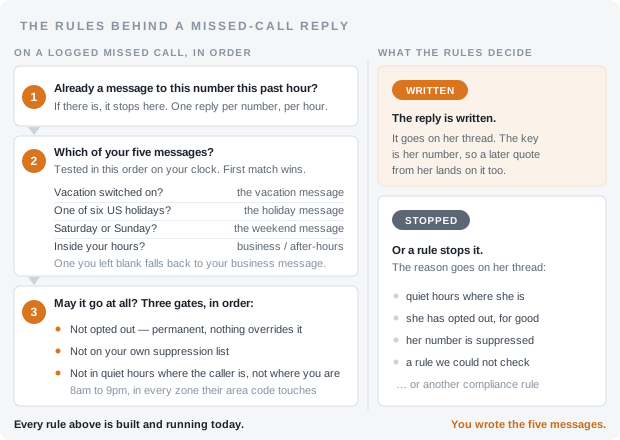
CallMitt™ writes back from your own texting number, a local number registered to your business and not a stranger’s 800 line, and the text opens with your business name, so she replies into the same thread as her quote. The message is picked by the hour and the day, against the hours you actually keep — the demo shop runs 7 to 5, because the ladders go up when the dew is off and they come down before the light goes, so a 5:20 call honestly gets the after-hours version instead of one claiming somebody is on a job.
Straight about where this stands. We have no SMS gateway yet and there is no automatic missed-call detection, so today you log the missed call and nothing is sent: a reply queued now is retired rather than delivered when your carrier registration clears. Everything around it is built and running now: the five messages, the business-hours, weekend, holiday and vacation rules, the quiet hours, the opt-out handling, and the thread her reply lands in beside her quote.
How CallMitt Works Run Your Own NumbersA gutter hand is hired on one question, and it is about the ladder
The man you want is on a 28-foot extension ladder this morning with a hundred and eighty feet of coil on the trailer behind him. He is not at a laptop with a PDF résumé, and he is not going to fill in a form with a cover-letter box on it. He will answer short questions on his phone at lunch.
Put “Now hiring — text CREW to your texting number” on the trailer and the yard sign. CrewFunnel™ asks eight short questions: is he 18 or older, is he comfortable working off a 28-foot extension ladder all day, has he got a valid driver’s license, has he run a seamless gutter machine, how many years has he hung gutter, siding or trim, how far out does he live, can he start inside two weeks, and what was the last job he worked on. Four of those are knockouts — under 18, not comfortable on the ladder, no license because the trailer goes with the crew, or living further out than you will drive — and the rest come back as a weighted fit score.
Two things about that scoring are worth copying. Distance is a knockout and never a weight, because a number answer scores higher the bigger it is, so weighting miles would rank the man furthest away at the top. And free text carries no weight at all, because any non-empty answer scores full marks and a weighted text box quietly inflates every candidate who typed anything. Both are set that way on our own demo job, and every question on it carries a Spanish translation.
One honest note on delivery. There is no inbound SMS on our side yet, so today he answers those eight questions on your screening page rather than by text — same questions, same knockouts, same scoring, same pool. The keyword on the trailer takes over the day your carrier registration clears.
See how CrewFunnel works

A gutter job is proved by the first storm and forgotten by the second
The ladders are down, the downspouts are strapped, and there is nothing to look at: gutters that work look exactly like gutters that do not. The proof comes with the first hard rain, when she stands at the window and the water goes where it is supposed to go. That is the day she would write you a review. By the second storm it is just the house staying dry, and nobody writes a review about that. The outfit with sixty reviews is not sixty times better than you; somebody there asks every customer, while the first storm is still the news.
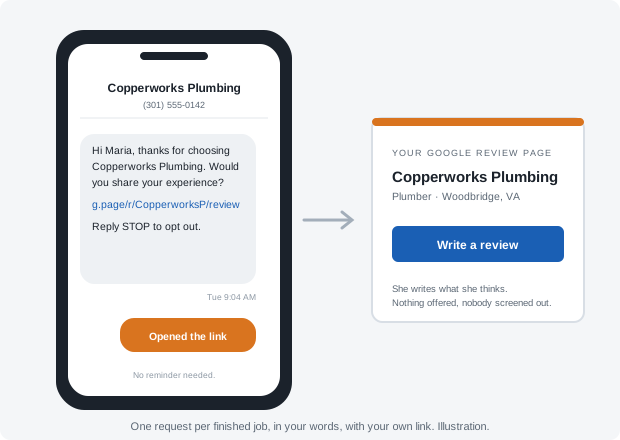
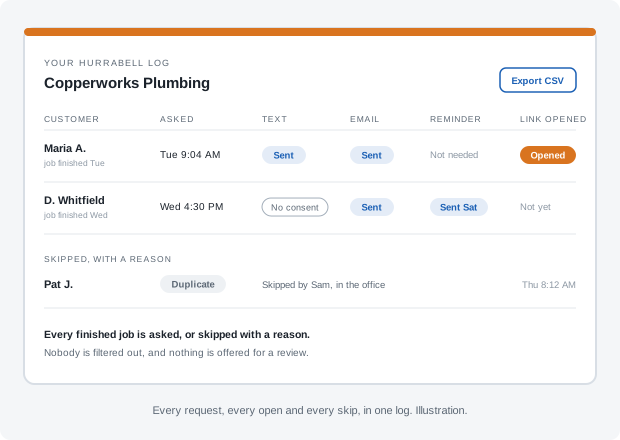
HurraBell™ does the asking. Mark the job done — from the inbox, from your phone, or from your job software through Zapier — and the customer gets one request in your words, with your own Google review link, after a delay you pick: an hour, unless you change it. Three days later, one email reminder, unless the link has been opened or the customer has got back in touch.
Review requests aren’t switched on yet, so none is sent today. When they are, the request goes by email once your Google review link is saved on the HurraBell page and your mailing address on the Account page. A text goes as well where the customer agreed to texts, and only once your carrier registration clears, the same wait as every text on this site; until then it is email only.
See how HurraBell worksOne recovered install covers 30 months
And a single recovered cleaning covers 1 month of it, which is the part worth noticing: in this trade even the small job pays the bill.
The Tailgate Office Bundle
Instant quotes on your website, missed-call text-back, text-to-apply hiring, review requests, and customers, jobs, estimates and invoices in one place. 30 days free, no credit card, no setup fee, cancel from the dashboard.
Start Free TrialOnly need one of the tools? After the trial you can keep just that one at its own price; the office stays with the Bundle.
Gutter questions we get asked
The roofing one, and nothing is lost by going there. A roofer prices gutters as part of the roof job, which is the right way round for that business — so the gutter questions live on your replacement service, or on a second service on the same account, and the account and the dashboard are identical either way. This page exists because a dedicated gutter company prices differently rather than smaller: four profiles instead of a pick between K-style and half-round, buried downspout runs split out from the downspout count, guards as a product tier rather than a yes/no, a fascia allowance, and a staging rule for the runs a ladder cannot reach. If the gutter is the whole invoice, you want that card. If it is the line at the end of a tear-off, you do not.
You can price a range, which is all the widget ever shows. The disclaimer underneath says the final number comes after you measure the eaves and count the corners, and that nothing is ordered until she has the written figure. Write the rest in your own words — seamless coil formed on the driveway so the run has no joints except at the corners, hangers screwed into sound fascia, the old run taken away — and you have a bracket you can stand behind from the kerb. She stops shopping, and the person who wanted two hundred feet of copper for eight hundred dollars never fills in your callback form at all.
A bit, and the design admits it rather than hiding it. There is no length-by-width box in the engine, because no rule kind multiplies one answer by another — so the question asks for one total and its help text does the teaching: both sides and the back, a typical two-story colonial is 180 to 220 feet, within ten per cent is fine for a range. The bounds you set mean a silly answer is refused rather than quietly clamped, and the lead records exactly what she typed, so you call back knowing what she claimed and your wheel settles it on the visit.
A tier because a drop-in screen and screwed-down micro-mesh are two different products at two different margins, and collapsing them into one yes/no means quoting the cheap one and installing the dear one. A percentage because the guard decision changes the hanger spacing, the handling and the time as well as the material. The honest consequence, which the help text does not hide: a percentage pools with the other percentage answers and lands on the whole additive subtotal, so the guard tier is charged across the downspouts too — about $470 of the demo job above. If that is not how you price guards, put a flat amount or a per-foot rate on the question instead. All three are fields you own.
That is exactly what the base fee is for. Put your trip charge on the cleaning service and it is added once per visit, before any answer, so nobody can answer their way down to nothing. It is inside the range she sees rather than appearing at the door, which is the whole point — you are telling her up front instead of surprising her. Put a job minimum underneath it as well, so a hundred feet of single-story gutter twenty minutes out never comes back under what the drive costs you.
It would be, if the season were weather. This one is a calendar: leaf fall runs into the end of November and there are only so many crew-days in it, so the plus 12% is a scheduling signal — book in September or in December and it is not there. The disclaimer says both halves out loud, including the date it comes off, which is the difference between a busy-season rate and a surprise. And note where it is not: the install carries no season at all, because coil forms the same in February and an install is booked weeks out whatever the month. An empty season field is a decision you are allowed to make.
Call it fifteen minutes for your text-back messages and your ladder hours, a minute, once review requests are switched on for your account, to paste your Google review link on the HurraBell page and your mailing address on the Account page, and about an hour to write the eleven questions and load your per-foot rate, profile percentages, downspout and buried-run rates, guard tiers and fascia allowances. A service that quotes will not go live until it carries a real base fee or minimum, which is deliberate. No onboarding call, no setup fee and no contract: $199 a month buys all four tools, and ResponsiBid’s reported $400–600 setup, as published in August 2026, is not a thing here.
Also roof, or hang siding and trim? See all the trade pages or call (301) 268-1943.
Give her the number while it is still raining.
Set it up tonight. Free for 30 days, no card, no setup fee, cancel from the dashboard.