

Masonry quotes by the square foot of wall face, and by nothing else
One number carries this trade: how much wall there is, measured on the face, length times height. Everything else is a pick-one or a count — what it is, what it is laid in, how many steps go with it, what it stands on, what comes out first. None of it is hidden under anything, which is why a mason can put an honest bracket on a website when plenty of trades cannot.
That unit is also where this page stops. A square foot of wall face is vertical. A driveway, a patio and a walkway are measured on the ground and belong to the concrete page and to the paving trade — a brick wall around a patio is yours, the patio inside it is not. And a chimney appears here exactly once: a stack rebuilt above the roofline is brick, mortar, crown and flashing, which is a mason’s work, while sweeping, inspecting, relining and fitting caps is a chimney sweep’s. Different license, different truck. The demo says so out loud rather than quoting it.
NapkinPrice™ runs that shop as three services on one account. New brick and block asks eight questions and puts a range on the screen, repointing carries your set-up charge inside the number instead of springing it at the door, and natural stone — along with anything structural — goes down a third path that never guesses a price at all.
The flow also asks for a photo of where the wall is going, and the lead tells you to ask for that picture on the callback. Attaching the image itself to the lead is on the roadmap, which is why it is not a tick in that list.
The eight things that set a masonry number
One area figure, two counts, four pick-ones and a ZIP. The hardest thing on the whole form is pacing a wall she has not built yet, so the help text does that teaching rather than pretending the question is easier than it is. You build the set once in the dashboard and every rate in it is a field you own.
Square feet of wall face
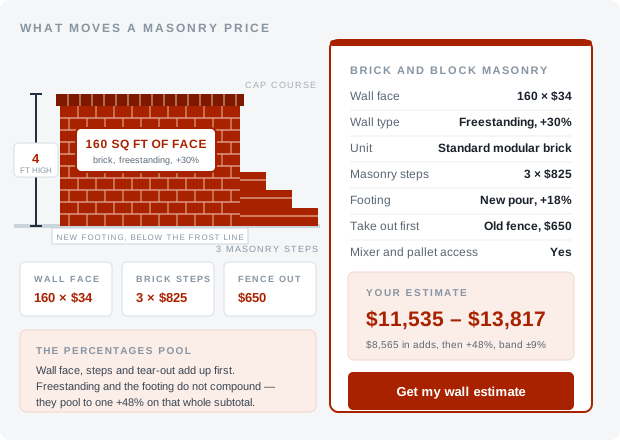
The base number the whole quote hangs off: length times height in feet, counting ONE face even when the wall is finished on both sides. There is no length-by-height box in the engine, because no rule multiplies one answer by another, so ask for one total and let the help text do the work — a 40-foot garden wall four feet high is 160 sq ft, a single-story gable end about 250, a two-car garage side wall nearer 300. Set a floor and a ceiling on the answer and the widget refuses a silly number instead of quietly clamping it. On our demo card that square foot is $34, so 160 of them with nothing else on the job comes back $4,950 to $5,930.
What is being built
Veneer, a freestanding wall, or a retaining wall. A pick-one percentage rather than three separate rates, because the answer changes the wall, the footing under it and the laying together: a veneer is one skin tied back to something already carrying the load, a freestanding wall is two skins with a cavity and a cap, and a retaining wall is a structure with a wider footing, drainage stone, fabric and rebar down the cores. Nothing, plus 30% and plus 48% on the demo.
Which unit you are laying
Concrete block, standard modular brick, oversize or specialty brick, manufactured thin stone veneer. Minus 30%, the rate itself, plus 20% and plus 32% — a spread small enough that nobody reads it as a mistake, because those four are modular units laid to a line. The same wall above comes back $9,197 to $11,016 in block and $14,029 to $16,805 in thin veneer. Natural full-bed stone is deliberately not on that list, and the section below is about why.
Masonry steps, as a count
Priced per riser and never by the square foot, because a step is a little wall with a tread on it and nobody measures one in square feet. $825 each on the demo, and it is a number question with a multiply rule, so three genuinely costs three times one. It is also where this trade stops short of flatwork: the treads and the cheek walls are masonry, the patio they lead down to is a concrete or paving job and is quoted on somebody else’s form.
What it stands on
Masonry has to sit on something below the frost line or it moves every winter and cracks. A wall going onto a sound foundation, slab or poured curb needs nothing; otherwise it is a day with a machine, digging, forming and pouring, before a single brick is laid. That is labour and concrete spread across the whole job rather than a line item, so it belongs on a percentage — plus 18% on the demo, and "not sure" is set to the same number on purpose so the honest answer is never the expensive one.
What comes out first
An allowance, added once for the job and trued up when you can see what is underneath — nothing, $650 for an old fence or a few courses, $2,200 for a whole wall or stoop to break out. Flat and not per foot, because a flat amount on a pick-one is added once however big the wall is; that is what the rule kind does, and the help text says so rather than leaving her to find out. Old masonry is the expensive one: it comes out with a breaker, it goes in a dumpster, and the dumpster has to get to it.
Access for a mixer and a pallet
A pallet of brick weighs about a ton and a half. If the only way in is through the house or down a set of garden steps, every unit and every bag goes by wheelbarrow, and that is two extra men for the whole job. So this one raises the job MINIMUM to $4,200 and adds no dollars at all: 60 square feet of brick veneer whose arithmetic is $2,040 quotes at $4,200 to $4,578, because the floor clamps the low end up rather than sitting under it.
Travel zone
List your ZIPs by zone — whole ZIPs or three-digit prefixes — and the widget prices the trip from the ZIP she types, most specific match first. A flat charge, a percentage, or both. The demo shop charges nothing inside the District, $95 out into Prince George’s and Montgomery, $175 across the river into Northern Virginia, and 5% plus $295 for everywhere else it travels. Set one zone to "outside my area" and it declines politely while still capturing the lead.
A real brick wall, start to finish
Eight questions, about a minute. This is the exact sequence running on our own masonry demo account — a forty-foot brick garden wall four feet high at a house in Brookland, freestanding and finished both sides, on a new footing, with three brick steps up to the yard and the old chain-link pulled out — and the total at the bottom is what the live pricing engine returns for these answers, not a figure anybody typed into this page.
| # | What she is asked | What she answers | What it does to the price |
|---|---|---|---|
| 1 | About how many square feet of wall face are we building? | 160 | 160 × the per-sq-ft rate — $34 on the demo, so $5,440. This is THE base number |
| 2 | What are we building? | A freestanding garden or privacy wall | A percent on the whole job: +30%. Veneer is +0%, a retaining wall +48% |
| 3 | Which unit are we laying? | Standard modular brick | The rate itself: +0%. Block −30%, specialty brick +20%, thin stone veneer +32% |
| 4 | How many masonry steps go with it? | 3 | 3 × $825 = $2,475 — the other genuinely per-unit line, counted by the riser |
| 5 | Is there a footing under it already? | No, dig and pour a new one | A percent on the whole job: +18% |
| 6 | Is there anything to take out first? | An old fence, railing or a few courses | A flat $650 allowance for the job, not per foot |
| 7 | Can a mixer and a pallet of brick get within about fifty feet of the work? | Yes | Nothing. No would not add a dollar either — it raises the job floor to $4,200 |
| 8 | Got a photo of where it is going? | Offered | Nothing. A photo never moves the price |
| The arithmetic, in the order the engine runs it | $5,440 + $2,475 + $650 = $8,565, then the two percentage answers pool into one and +48% applies once to all of it → $12,676.20 | ||
| She sees | $11,535 – $13,817 | ||
| What lands in your inbox, the second she submits | Name, mobile, ZIP, all eight answers, the photo flag, and the disclaimer she was shown | ||
The $34, the $825, the $650 and the percentages above belong to the demo account, not to a Tailgate Office price list — you set every one of them in the dashboard and you can change a per-square-foot rate the morning the brick price moves, without touching your website. Two things about those percentages are worth reading twice: they pool rather than compound, so plus 30 and plus 18 make plus 48 and not the plus 53.4 you would get by multiplying them out — which on this job would be about $463 more. And the pooled figure lands on the whole additive subtotal, so the freestanding band is charged across the steps and the fence allowance too, roughly $937 of this midpoint. The help text says the wall type is figured across the job rather than implying a per-foot rate, and the measure is where it is trued up. What is not illustrative is the total: $11,535 to $13,817 is what the engine returns for those eight answers, and you can reproduce it yourself on the demo in about a minute.
Would you rather try it than read about it? We keep a working example masonry company website with NapkinPrice™ embedded — the real engine, quoting live, on a page that is not ours. Put in those eight answers and see the same number come back.
Try the live demo site (opens in a new tab)Block, brick and thin veneer price off one rate. Stone does not, and says so.
This is the one design decision that matters in masonry, so here is the whole of it in plain words rather than a promise that it all just works.
There are five kinds of pricing rule in the engine and none of them multiplies one answer by another. A number question can carry a per-unit rate — the wall face, the steps, the brick being swapped on a repair. A pick-one can add dollars once for the job, or take a percentage of the whole job. What it cannot do is apply its own rate to her square footage, so “the material sets the per-square-foot rate” is a sentence this engine cannot say, and pretending otherwise on a marketing page is how you end up with a product that does not do what the website said.
Inside the unit-masonry family that is genuinely fine, because those four really are a percentage of each other. Block, brick, oversize brick and manufactured thin stone veneer are all modular units laid to a line off the same scaffold by the same two men, and minus 30, nothing, plus 20 and plus 32 is an honest spread that nobody reads as a mistake. The demo dropdown carries exactly that, and the same wall comes back $9,197 – $11,016 in block, $11,535 – $13,817 in brick and $14,029 – $16,805 in thin veneer.
Natural full-bed stone is not on that dropdown and cannot be. Installed, it runs two to three times brick, so an honest percentage would be plus 120 or more — and because a pooled percent lands on the whole additive subtotal, the engine would then apply it to the steps, the footing and the demolition as well, which cost the same money whatever the wall is faced in. She would be paying stone money to have a chain-link fence pulled out. Worse, the number would still be wrong, because quoting stone means quoting the stone: what is actually on the pallet, how much of it is usable face, how long a mason spends turning each piece to find it. There is no rate card for that, and there never has been.
So stone routes. It is the first case on the site-visit service, the unit question’s help text names it and says where it went, and this page never prints a per-square-foot figure for stone, because the fixture cannot compute one. That is not a workaround invented for masonry either: it is the same shape the flooring page arrived at for tile against carpet, taken one step further because one member of this family genuinely will not sit on the card at all.
Brick and block masonry — quotes instantly
New walls, veneer, steps and the footings under them. No trip charge on this one, because the measure sells the wall; instead it carries a job minimum of $1,450 on the demo, so twenty square feet of block veneer whose arithmetic is $476 comes back $1,450 to $1,581 rather than at what the arithmetic says. One answer lifts that floor without adding a dollar: no way in for a mixer and a pallet raises the minimum to $4,200. And there is a ceiling above it all — 260 square feet of thin veneer, freestanding, four steps and a new footing reaches a $23,022 midpoint, so past $20,000 the widget stops pricing and hands you the lead to quote by hand.
Repointing and masonry repair — quotes instantly
The work that actually keeps a mason fed in this metro, because the District is a city of brick rowhouses on soft lime mortar and every one of them needs the joints cut out once in a working lifetime. The set-up and trip charge lives in the service base fee — $185 on the demo — so it is added once however long the list is and cannot be dodged by answering nothing to everything. A two-story rowhouse front, 400 sq ft, forty brick swapped, lime mortar, quotes at $9,984 to $12,452; add a rusting lintel to rebuild and it is $11,171 to $13,933; a 60 sq ft patch off a ladder is $1,049 to $1,308, and the cheapest answer set possible floors at $650. Its band is wider than new work at plus or minus 11%, on purpose: nobody knows how deep the soft mortar goes until the scaffold is up.
Stone, structural and chimney rebuilds — site visit, never priced
Site-visit mode captures the whole spec and shows no number at all, which is the only honest answer to a fieldstone facade, a bulging foundation wall or a stack that has to come down to the flashing. It asks what it is, roughly how old the building is, how much of it, whether anything is actively moving and whether an engineer has already been out — and not one of those answers moves money. They tell you which visit goes first and whether you are bidding a scope or writing one. She gets your own "we will come and look" message; you get a lead worth bidding. This is also the only place a chimney appears on this account, and its help text says plainly that a sweep, an inspection, a liner or a cap is a different trade.
One service carries a winter rate. The other refuses the work, and that is the more honest answer.
Mortar will not cure below about forty degrees. That is not a mood about the weather, it is a property of the material, and the trade’s own cold-weather rules are written around it: heated mixing water, sand thawed on the pile, the finished work tented and kept above freezing for two or three days while it sets. All of that is real money on every winter job, so new work carries a seasonal plus 10% from 1 December to 15 March — a window that wraps the year end, which the engine spots on its own without anybody entering two ranges. The same wall booked on 15 January comes back $12,689 – $15,199, and the disclaimer says exactly what the ten per cent buys rather than calling it a busy-season rate.
Repointing carries no season at all, and that is a decision rather than an empty field. A new wall is a project you can tent; six hundred square feet of open rowhouse front is not. So this shop does not book repointing between December and mid-March at any price, because the mortar would not cure and the work would simply fail — and its disclaimer says that, in those words, instead of pretending a percentage covers it. An empty season field is a decision you are allowed to make, and so is a positive one; what you should not do is invent a number to fill the box.
The travel zones stack on top of all of it, and they are the same engine run on the same eight answers with nothing changed but the ZIP: Brookland 20017 is $11,535 to $13,817, College Park 20740 is $11,622 to $13,921, Arlington 22201 across the river is $11,695 to $14,008, a ZIP in the catch-all zone is $12,381 to $14,829, and a ZIP outside every zone you serve gets no price at all — a polite decline, with the lead still captured. On the repair service that trip charge is a much bigger share of a small job, and it should be: the same $1,049 to $1,308 patch quotes $1,364 to $1,701 out in the catch-all ring. A service that quotes will not go live until it carries a real base fee or a real minimum. That is deliberate: a service with neither would happily return $0 to a homeowner, and one bad number on your website costs more than a day of setup.

Mortar is workable for about ninety minutes. Your phone does not care.
A board of mud goes off whether or not somebody is calling, and a man on a line with a trowel in his hand is not stopping to answer it. Roughly 62% of contractor calls go unanswered, about 78% of jobs go to whoever responds first, and voicemail gets a callback around 3% of the time. In a trade where one wall is most of a month, those three numbers are not a rounding error.
| What a missed masonry call is worth | On the demo account |
|---|---|
| A 40 ft brick garden wall, three steps, new footing | $11,535 – $13,817 |
| A two-story rowhouse front repointed, forty brick swapped | $9,984 – $12,452 |
| A 60 sq ft patch of bad joints off a ladder | $1,049 – $1,308 |
| Voicemail callback rate | ~3% |
| One recovered wall pays for | 57 months of the bundle |
| One recovered patch pays for | 5 months |
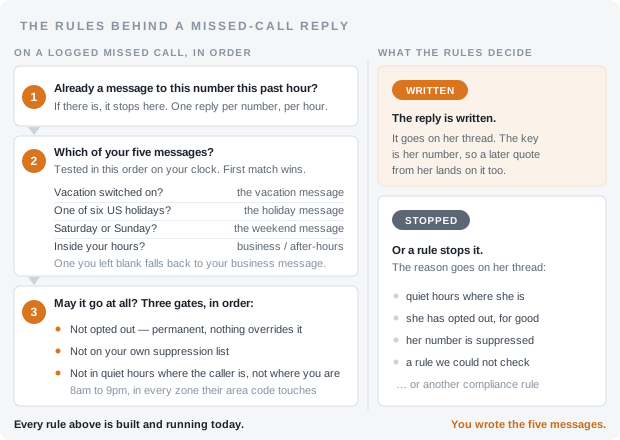
CallMitt™ writes back from your own texting number, a local number registered to your business and not a stranger’s 800 line, and the text opens with your business name, so she replies into the same thread as her quote. The message is picked by the hour and the day, against the hours you actually keep — the demo shop runs 7 to 4, because the board is loaded at first light and by four the mixer is washed out, so a 4:30 call honestly gets the after-hours version instead of one claiming somebody is on a wall.
Straight about where this stands. We have no SMS gateway yet and there is no automatic missed-call detection, so today you log the missed call and nothing is sent: a reply queued now is retired rather than delivered when your carrier registration clears. Everything around it is built and running now: the five messages, the business-hours, weekend, holiday and vacation rules, the quiet hours, the opt-out handling, and the thread her reply lands in beside her quote.
How CallMitt Works Run Your Own NumbersA mason is hired on two questions, and a résumé answers neither
The first is not a skill question at all. A standard eight-inch block weighs about thirty-five pounds and a mason sets several hundred of them in a day, in July, bent over a line. A man who has not done it does not know that yet, and finding out on day two costs you a week. The second is the one a résumé never makes clear: has he laid to a line as a mason, or has he been tending — mixing, carrying, keeping the boards full? Both are honourable and only one of them can build your wall.
Put “Now hiring — text CREW to your texting number” on the truck and the board fence. CrewFunnel™ asks eight short questions: is he 18 or older, can he lift and set a block all day, has he got a valid driver’s license, has he laid to a line rather than tended, how many years has he laid brick, block or stone, how far out does he live, can he start inside two weeks, and what was the last job he worked on. Four of those are knockouts — under 18, not up to the lifting, no license because the mixer goes with the crew, or living further out than you will drive — and the rest come back as a weighted fit score, years in the trade heaviest and the laying-to-a-line question next.
Two things about that scoring are worth copying. Distance is a knockout and never a weight, because a number answer scores higher the bigger it is, so weighting miles would rank the man furthest away at the top. And free text carries no weight at all, because any non-empty answer scores full marks and a weighted text box quietly inflates every candidate who typed anything. Both are set that way on our own demo job, and every question on it carries a Spanish translation.
One honest note on delivery. There is no inbound SMS on our side yet, so today he answers those eight questions on your screening page rather than by text — same questions, same knockouts, same scoring, same pool. The keyword on the truck takes over the day your carrier registration clears.
See how CrewFunnel works

A wall stands for generations. She notices it for about a week.
The last joint is struck, the brick is washed down, and the wall stands there looking as if it had always been part of the house. For the first week she notices it every time she pulls in, and she still remembers what was there before it. That is the week she would write you a review. After that it is just the wall, which is the highest compliment masonry gets and no help to you at all. The outfit with sixty reviews is not sixty times better than you; somebody there asks every customer, the week the pointing is done.
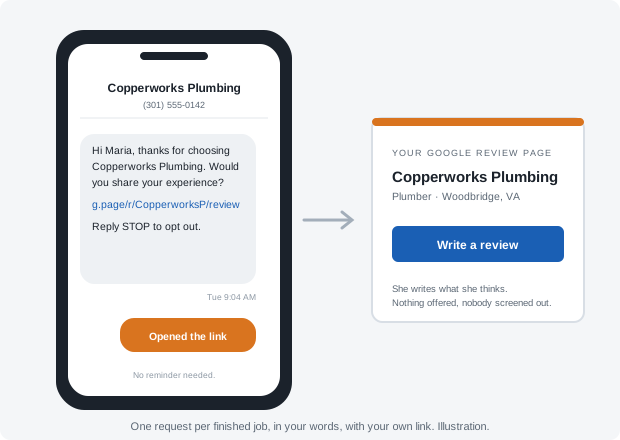
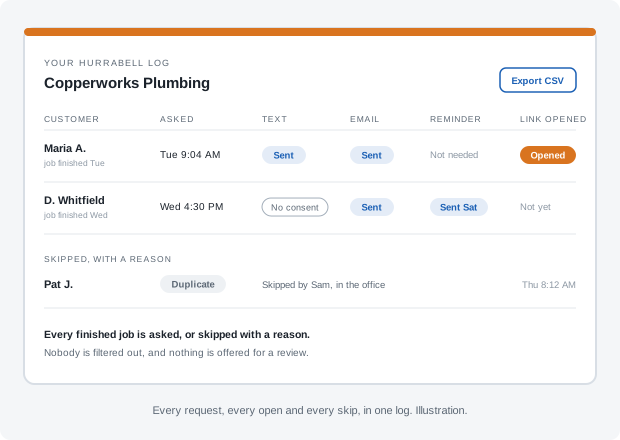
HurraBell™ does the asking. Mark the job done — from the inbox, from your phone, or from your job software through Zapier — and the customer gets one request in your words, with your own Google review link, after a delay you pick: an hour, unless you change it. Three days later, one email reminder, unless the link has been opened or the customer has got back in touch.
Review requests aren’t switched on yet, so none is sent today. When they are, the request goes by email once your Google review link is saved on the HurraBell page and your mailing address on the Account page. A text goes as well where the customer agreed to texts, and only once your carrier registration clears, the same wait as every text on this site; until then it is email only.
See how HurraBell worksOne recovered wall covers 57 months
And a single recovered patch of bad joints covers 5 of them. In a trade where one job is most of a month, the arithmetic is not close.
The Tailgate Office Bundle
Instant quotes on your website, missed-call text-back, text-to-apply hiring, review requests, and customers, jobs, estimates and invoices in one place. 30 days free, no credit card, no setup fee, cancel from the dashboard.
Start Free TrialOnly need one of the tools? After the trial you can keep just that one at its own price; the office stays with the Bundle.
Masonry questions we get asked
You can price a range, which is all the widget ever shows. The disclaimer underneath says the final number comes after you measure the wall, check what it is standing on and see how the material gets to the back of the house. Write the rest in your own words — the footing where one is needed, wall ties, weeps, a cap and the site swept — and you have a bracket you can stand behind from the kerb. She stops shopping, and the man who wanted forty feet of freestanding brick for two thousand dollars never fills in your callback form at all.
Because a percentage cannot carry it honestly, and the section above works through why. Installed, full-bed stone is two to three times brick, so the option would have to read plus 120 or more — and a pooled percent lands on the whole additive subtotal, so the engine would charge that same uplift on the steps, the footing and pulling the old fence out, none of which cost a penny more because the wall is stone. On top of that, a stone quote is a quote for the stone itself: what is on the pallet, how much is usable face, how long a mason spends turning each piece. There is no rate card for that. So it routes to a site visit, the help text on the unit question names it and says where it went, and nothing on this page prints a per-square-foot figure for stone.
A stack rebuilt above the roofline, yes — that is brick, mortar, a crown and the flashing it sits in, and it is a mason’s work. Sweeping, inspection, relining, caps and dampers, no: that is a chimney sweep, a different license and a different truck, and the demo says so on the question rather than quoting it. Driveways, patios and walkways are the other line, and it is the unit that draws it: everything priced here is a square foot of wall face, which is vertical. Ground is concrete’s and paving’s. A brick wall around a patio is ours; the patio inside it is not, and we will tell you who pours it.
It is the opposite — it is the unit the trade actually uses. A step is a little wall with a tread on it: a poured core, brick on the rise, brick on the tread and a cheek wall each side, and the cost of it barely moves with its width. So it is a number question with a per-riser rate, $825 on the demo, and three genuinely costs three times one. Asking for it in square feet would invite her to measure the stoop like a patio and hand you an area that means nothing. It also keeps this form on the right side of the line: the treads are masonry, the flatwork they lead down to is somebody else’s form.
Pooling, for a homeowner. The engine sums every percentage answer into one figure and applies it once to the additive subtotal, so a freestanding wall at plus 30 and a new footing at plus 18 make plus 48 rather than multiplying out to plus 53.4 — about $463 on the worked example above. That is arithmetic she can follow on a screen at nine at night, which matters more here than the third decimal place. The consequence that deserves saying out loud is the other half: because the pool lands on everything additive, the wall-type band is charged across the steps and the demolition allowance too, roughly $937 of that midpoint. If that is not how you price, put the wall type on a flat amount instead. It is a field you own.
Our demo does both things, deliberately, because the two services are not in the same position. New work carries a cold-weather plus 10% from 1 December to 15 March, and the disclaimer says what it buys: heated water, thawed sand and the work tented above freezing while it cures. That is a real cost, so it is a real number. Repointing carries no season and the shop simply does not book it in those months, because an open rowhouse front cannot be tented and the mortar would not cure — its disclaimer says that in words rather than pretending a percentage covers it. Refusing work honestly is a better answer than a discount for a job that would fail.
Call it fifteen minutes for your text-back messages and your yard hours, a minute, once review requests are switched on for your account, to paste your Google review link on the HurraBell page and your mailing address on the Account page, and about an hour to write the eight questions and load one rate card — your square foot of face, your step rate, your wall-type and unit percentages, your footing percent and your demolition allowances. Then most of another hour for the repointing service, which has its own base fee, its own rates and a wider band. A service that quotes will not go live until it carries a real base fee or minimum, which is deliberate. No onboarding call, no setup fee and no contract: $199 a month buys all four tools, and ResponsiBid’s reported $400–600 setup, as published in August 2026, is not a thing here.
Also pour flatwork, or lay pavers? See the concrete page, all the trade pages, or call (301) 268-1943.
Quote the wall while she is still looking at it.
Set it up tonight. Free for 30 days, no card, no setup fee, cancel from the dashboard.