
Read this first: these are not customers.
Tailgate Office™ launched in 2026. We have no published customer results yet, and nothing on this page is one. The three companies below are composites. The names are invented. The dollar figures are arithmetic built on published call data plus example figures and assumptions we spell out in the open, and your business will not match them.
When we have real pilot numbers — with a real company name and their written permission — they will replace this page. Until then, we would rather show our work than fake a track record.
One more thing to be straight about. The texting steps in the examples below describe how CallMitt™ and CrewFunnel™ behave once carrier registration and our SMS gateway are live. Today those messages queue instead of sending, and the CrewFunnel screening conversation runs as a web link rather than over text. The compliance page has the whole status.
The 2pm call that never gets returned
A two-truck residential fencing company. Owner runs a crew, quotes in the evenings, and in this example a typical job is about $4,500.
What happens today
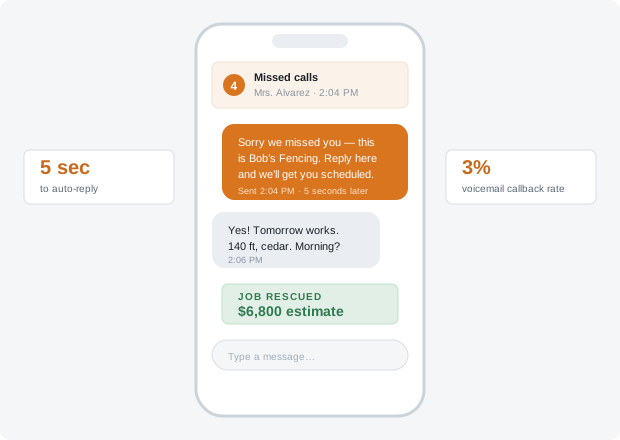
Tuesday, 2:04pm. He is setting posts. A homeowner calls about 140 feet of cedar privacy fence. It rings four times and rolls to voicemail. She does not leave one — almost nobody does — and calls the next fencing company on the map.
He will never know that call existed. It does not show up as a lost job in any report. It shows up as a slow month with no explanation.
What changes
Five seconds after the missed call, she gets a text from his own texting number, a local number in his area code, and it says who it is straight away: “Sorry we missed you — this is Ridgeline Fence. Reply here and we’ll get you on the schedule.” She replies while she is still holding the phone. He answers from the truck at 4:30.
| The arithmetic | Figure | Where it comes from |
|---|---|---|
| Inbound calls in a month | 40 | Assumed for a busy two-truck operation |
| Share that do not reach a person | 48% | Invoca, 2026 (opens in a new tab): 52% of callers to home-service businesses speak with a person, 65% once calls under 15 seconds are left out; we use the top of that 35–48% range |
| Missed calls per month | about 19 | 40 × 48% = 19.2 |
| Messages left on voicemail | <1 | Under 3% of callers who reach voicemail leave one (Invoca, 2024 (opens in a new tab)); we assume each one left is won back (our assumption) |
| Assumed reply rate to the text-back | 20% | Our assumption — deliberately conservative |
| Conversations recovered | about 4 | 19.2 × 20% = 3.84 |
| Assumed close rate on those | 30% | Our assumption |
| Jobs recovered per month | about 1 | 3.84 × 30% = 1.152 |
| Value at a $4,500 job (our example) | about $5,200 | 1.152 × $4,500 = $5,184 |
| Cost of CallMitt | $49/mo | Published price |
Illustrative example. Not a customer result. Several of those rows are our assumptions, and we have labelled them so you can argue with them. Halve the two that matter most — a 10% reply rate and a 15% close — and it still comes out to about one recovered job every three and a half months (19.2 × 10% × 15% = 0.29 a month), and one $4,500 job pays for 91 months of CallMitt. The honest floor here is “probably worth it,” not “guaranteed $5,200 a month.”
The website that has never quoted anybody
A one-truck pressure washing company with a two-year-old website. Average job around $450. Ranks page one for “pressure washing” in its county.
What happens today
320 people visited last month. Four filled out the contact form. The site is doing its job right up to the moment somebody wants a number, at which point it says “call for a free estimate.”
People shopping a $450 driveway job at 9pm are not going to call around and wait. They want a range. Whoever gives them one gets the conversation.
What changes
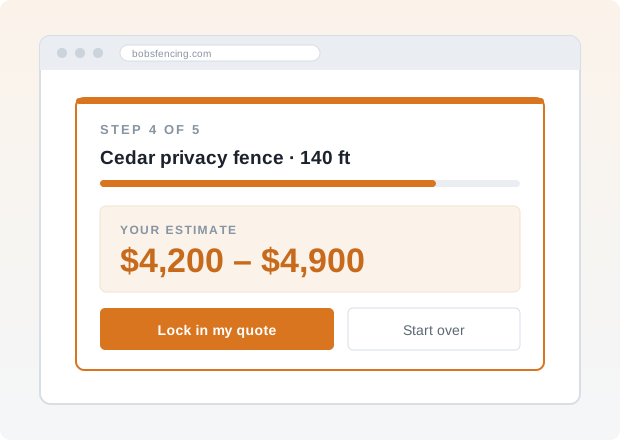
The button says “Get an instant price.” Five questions: surface, square footage, one story or two, gutters, driveway. A range appears: $380–$465. To lock it in, they leave a name and a number. That is a lead with the whole job already spec’d.
| The arithmetic | Today | With a quote widget |
|---|---|---|
| Monthly website visitors | 320 | 320 — same traffic, same spend |
| Start the quote flow (assumed 8%) | — | 26 |
| Finish it (assumed half) | — | 13 |
| Leads captured | 4 | 13 |
| Close rate (assumed 25%) | 1 job | 3 jobs |
| Revenue at $450 average | $450 | $1,350 |
| Cost of NapkinPrice | — | $99/mo |
| Time spent quoting on the phone | ~20 min per lead | 0 — spec arrives with the lead |
Illustrative example. Not a customer result. The 8% start rate and 50% completion rate are our assumptions and they are the two numbers that matter most — if your traffic is mostly people looking for your phone number rather than shopping, they will be lower. The part we are confident in is the last row: a lead that arrives with the square footage, the surface and the access already answered does not need a twenty-minute discovery call.
March, and you are three guys short
A landscaping and lawn company running four trucks. Spring hits, the schedule fills, and the crew does not exist yet.
What happens today
He posts on Indeed, which bills a sponsored post per click or per started application, at a price that depends on the market and the job (Indeed pricing page (opens in a new tab), checked October 2026). He gets resumes from people who have never held a trimmer. Many do not answer the phone. Two say they will come Thursday. Nobody comes Thursday.
Meanwhile the guy he actually wants — currently on a competitor’s crew, mildly annoyed about last Friday — is not browsing job boards. He is sitting at a light behind one of these trucks.
What changes
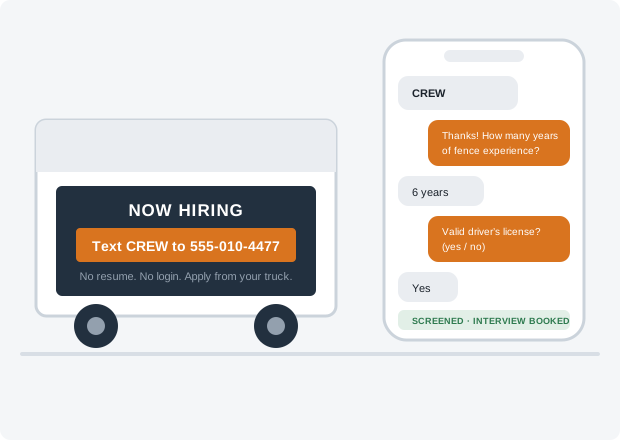
Truck doors and yard signs read “NOW HIRING — Text CREW to (555) 010-4477” — his own texting number, his keyword. Applying takes eight seconds and no resume. Screening asks six questions, drops the unqualified politely, and puts the rest on his list with a fit score, for him to book into his interview slots. (Today that conversation runs as a web link the applicant taps; it moves onto text when the carrier filing clears.)
| Three weeks in March | Job board | Text-to-apply |
|---|---|---|
| Cash cost | Per click or per started application; no published typical price | $69/mo, flat |
| Effort to apply | Account, resume, upload | One text message |
| Reaches people not job hunting | No | Yes — every truck is a billboard |
| Applicants (assumed) | 18 resumes | 15 texts |
| Pass screening | 6, after you call them | 6, screened before you look |
| Show up to the interview | 2 | 4 — a booked slot and a confirmation text (once texting is live, for those who opted in) |
| Owner hours spent | ~8 hrs of phone tag | ~1 hr reviewing and booking |
| What a short crew actually costs | Three weeks of a two-man crew doing three-man work, in your best month | |
Illustrative example. Not a customer result. Applicant counts and show rates are our assumptions. How Indeed bills comes from its own pricing page, checked October 2026; Indeed publishes no typical monthly price, so we do not print one. The line we would defend in an argument is the last one: in the trades, the cost of an unfilled seat in March dwarfs the cost of any hiring tool.
Where the numbers come from
Two kinds of figures appear above. We keep them separated on purpose.
Not ours, and checkable
Argue with these
Every one of these is a guess we made in public. Change them in the recovered-job calculator and see what your own numbers do.
Be the case study that replaces this page
We need real numbers more than we need your money right now. So we are trading: you run all four tools through a full season and let us publish what actually happened, and we make it worth your while in cash and access.
You keep veto power over every word we publish, including your company name. If the results are bad, we will publish that too — that is the entire point of doing it this way.
What a founding pilot gets
Apply as a Founding PilotMention “founding pilot” in the notes box, or email support@tailgateoffice.com.
No customer logos. Just the arithmetic.
Run your own numbers instead of ours: 30-day trial, no credit card, no setup fee, cancel from the dashboard.