

A new driveway and a sealcoat are two businesses on one phone number
One of them is a job she has been putting off for four years. The drive has gone grey, it is ragged at the edges and there is a pothole by the mailbox, and tonight she wants a bracket before she gives up a morning for an estimate. If nobody will tell her, she keeps looking.
The other call is a couple of hundred dollars and it comes in April: seal the drive, fill the cracks, get another five years out of it. That is a tank trailer and two people for half a day, not a paver, a roller and two tri-axles. The spread between those two jobs is the widest of any trade on this site, and running them through one form is how a paving company ends up quoting a sealcoat like a rebuild.
NapkinPrice™ runs them as separate services on one account. The new drive asks nine questions and puts a range on the screen, the sealcoat carries your trip charge inside the number instead of springing it at the door, and a parking lot goes down a third path that never guesses a price at all.
The flow also asks for a photo of the drive and the way in from the road, and the lead tells you to ask for those pictures on the callback. Attaching the image itself to the lead is on the roadmap, which is why it is not a tick in that list.
The eight things that set a paving number
Seven of these are a pick-one or a yes/no she can answer without leaving her chair. The eighth is square footage, and that one she has to work out — so the help text does the teaching rather than pretending the question is easier than it is. You build the set once in the dashboard and every rate in it is a field you own.
Square footage
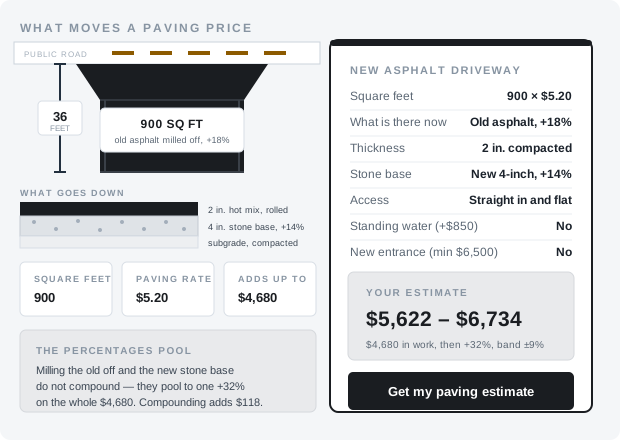
The base number: her total multiplied by your per-square-foot rate, and the only genuinely per-unit line on the job — $5.20 a square foot on our own demo card. It is also the one place the engine asks her to do arithmetic, because there is no length-by-width box; no rule multiplies one answer by another. So ask for one total and let the help text teach: a single-car drive to a detached garage is about 400 sq ft, a two-car drive nearer 900, and 200 feet of country lane at 12 feet wide is 2,400. Set a floor and a ceiling on the answer and the widget refuses a silly number instead of quietly clamping it.
What is on it now
Bare ground, old gravel, old asphalt to mill off, or old concrete to break out. A percentage rather than a flat tear-out charge, and that is the split with concrete worth understanding: a slab comes out in lumps and the machine is hired once, so a flat mobilisation plus a per-square-foot rate is right there. A mill grinds a surface and hauls it by the ton, so 2,400 square feet really is three times 800. On the demo card that is nothing, plus 10%, plus 18% and plus 28%.
Compacted thickness
Two inches for cars and a pickup, three for a dually, an RV or a long drive a delivery truck uses, four in two lifts for a yard or a farm entrance. A percentage rather than a line item, because thickness lifts the whole job at once — more tons, a deeper base and a second pass with the paver. Nothing, plus 22% and plus 45% on the demo.
What the ground under it needs
Reuse the stone base that is there, a new 4-inch crushed base compacted, regrading and fill where it holds water, or excavating with the dirt hauled away. This is the half of the job nobody ever sees and the half that decides whether the surface is still flat in ten years. Four tiers as a pick-one percent, and a help line telling her to pick the new stone base if she does not know.
How the machines get in
A paver is about eight feet wide and a loaded tri-axle weighs thirty-five tons. A gate post, a low branch or a soft verge decides how much of the drive is machine-laid and how much is barrowed and raked by hand before it goes cold — which is genuinely slower per square foot rather than a fixed call-out, so it belongs on a percentage. Straight in and flat, a slope or a bend, or tight: nothing, plus 8% and plus 18%.
Standing water
A puddle still sitting an hour after the rain is the thing that destroys asphalt — water gets under the edge, freezes and lifts it. This is the one flat adder on the service, $850 on the demo for the machine, the pipe and the day it takes to cut a swale or set a drain. A flat amount is added ONCE FOR THE JOB however long the run is, because no rule kind multiplies one answer by another, and here that happens to be exactly right: it is mobilisation, not quantity. The help text still says "once for the job" rather than letting her assume it scales.
A brand-new entrance
Cutting a new way in off a county road is not paving, it is a permit: the county decides where it goes, sizes the pipe that carries the ditch under it and inspects the stone before a foot of mix is laid. So that answer raises the job minimum and adds no dollars at all — to $6,500 on the demo, however short the drive is. Repaving an entrance that already exists does not. Concrete has the same shape on its right-of-way apron, at a much smaller number, because the paperwork there is a tie-in rather than a new culvert.
Travel zone
List your ZIPs by zone — whole ZIPs or three-digit prefixes — and the widget prices the trip from the ZIP she types, most specific match first. A flat charge, a percentage, or both. Set one zone to "outside my area" and it declines politely while still capturing the lead. These are the biggest travel figures in the estate and that is the trade rather than greed: hot mix leaves the plant near 300 degrees and has to be rolled before it drops to about 250, so past roughly forty minutes of haul you are buying from a second plant at its price or losing part of the load.
A real driveway flow, start to finish
Nine questions, about ninety seconds. This is the exact sequence running on our own paving demo account — a 900 sq ft two-car drive in Waldorf, the old asphalt milled off and a new compacted stone base under two inches of hot mix — and the total at the bottom is what the live pricing engine returns for these answers on a September date, not a figure anybody typed into this page.
| # | What she is asked | What she answers | What it does to the price |
|---|---|---|---|
| 1 | How many square feet are we paving? | 900 | 900 × the per-square-foot rate — $5.20 on the demo, so $4,680 |
| 2 | What is there now? | Old asphalt to mill off and haul away | A percent on the whole job: +18%. Old concrete would be +28% |
| 3 | How thick does the asphalt need to be? | 2 inches compacted | The baseline: +0%. Three inches would be +22% |
| 4 | What does the ground under it need? | A new 4-inch crushed stone base, compacted | A percent on the whole job: +14% |
| 5 | How do the paver and a loaded truck get in? | Straight in off the road, and flat | Nothing. Tight — trees, walls or a gate — would be +18% |
| 6 | Does water stand anywhere on it after it rains? | No | Nothing. Yes is a flat $850 for the job — the machine, the pipe and the day |
| 7 | Is this a brand-new entrance onto a public road? | No | Nothing here. Yes would not add a dollar either — it raises the job floor to $6,500 |
| 8 | Does anything have to park on it in the first week? | No | Nothing. It decides which day of the week you schedule her, not the price |
| 9 | Got a photo of the drive and the way in from the road? | Offered | Nothing. A photo never moves the price |
| The arithmetic, in the order the engine runs it | $4,680, then the two percentage answers pool into one and +32% applies once to all of it → $6,177.60 | ||
| She sees | $5,622 – $6,734 | ||
| What lands in your inbox, the second she submits | Name, mobile, ZIP, all eight answers, the photo flag, and the disclaimer she was shown | ||
The $5.20, the $850, the $6,500 and the percentages above belong to the demo account, not to a Tailgate Office price list — you set every one of them in the dashboard and you can change a per-square-foot rate the morning the liquid asphalt index moves, without touching your website. One thing about those two percentages is worth reading twice: they pool rather than compound, so milling at 18 and a new base at 14 become one +32% on the whole subtotal instead of multiplying out. Compounding them would land about $118 higher on this job, and pooling is the arithmetic a homeowner can follow on the phone. What is not illustrative is the total: $5,622 to $6,734 is what the engine returns for those answers, and you can reproduce it yourself on the demo in about a minute.
Would you rather try it than read about it? We keep a working example paving company website with NapkinPrice embedded — the real engine, quoting live, on a page that is not ours. Put in those nine answers and see the same number come back.
Try the live demo site (opens in a new tab)Three services, and only two of them ever show a price
A new drive, a spring sealcoat and a parking lot are three different conversations. The first two are eighteen times apart in money, which is why the floor under each one is set separately rather than borrowed from the other.
New asphalt driveway — quotes instantly
No trip charge on this one, because the estimate visit sells the job. Instead it carries a job minimum, and on a paving service the minimum is not a fudge — it is the crew day. A paver, a roller, two tri-axle trucks and five people cost the same on a 400 sq ft pad as on a 900 sq ft drive, and the plant will not load out less than a truck. That is $4,000 on the demo, and you can watch it work rather than take it on trust: 400 sq ft on bare ground, whose arithmetic comes to $2,080, quotes at $4,000 to $4,360, because the low end of the band clamps up to the floor instead of sitting 9% under it. Above it all is a ceiling of $18,000 — 2,400 sq ft of four-inch over an excavation, with old concrete to break out, water standing on it and tight access, reaches a $30,792.30 midpoint, and rather than publish a number that big off nine answers the widget stops and hands you the lead.
Sealcoating and crack filling — quotes instantly
The work that keeps a paving company fed between drives, and the call that comes in every April. The trip charge lives in the service base fee — $95 on the demo — so it is added once however long the list is and cannot be dodged by answering nothing to everything. A 900 sq ft drive last done three to five years ago with a few cracks cut out and filled quotes at $374 to $457; two thousand square feet left far too long, alligatored, oil primed, edged and given two coats is $1,582 to $1,933; the cheapest answer set possible floors at $245 to $270. Its band is ±10% rather than the drive’s ±9%, and its ceiling is $2,200 — deliberately low, because past that it is a parking lot and belongs on the third service.
Parking lots, private roads and commercial — site visit, never priced
Site-visit mode captures the whole spec and shows no number at all, which is the right answer for traffic counts, subgrade tests, ADA slopes, striping layouts and a phasing plan so the tenants can still park. It still asks what the lot is, roughly how big, what it needs, and whether loaded trucks, buses or a dumpster use it — and not one of those answers moves money. They tell you whether this is one day with one paver or three weeks with a milling machine. She gets your own “we will come and walk it” message on the confirmation screen, and you get a lead you can actually bid.
The winter rate is a discount, and not for concrete’s reason
A concrete crew stops in the cold because the ground is frozen on a given morning, which makes a February booking a choice; the concrete page prices that as a modest booking discount and says so. Asphalt has no choice at all. Hot mix has to leave the plant near 300 degrees and be rolled before it drops to about 250, and the mid-Atlantic plants shut from roughly the first of December to the middle of March. There is no mix to buy at any price.
So the demo account runs a seasonal rate of minus ten per cent from 1 December to 20 March, and that range wraps the year end — the start is later in the calendar than the finish — which the engine spots and matches across New Year without anybody entering two ranges. It is not a discount for filling a quiet calendar, because the calendar is not quiet, it is closed. It is this company’s entire winter sales budget handed to the customer instead of spent on April advertising: the crew that reopens in March with a full book does not lose its first three weeks selling. The same 900 sq ft drive that quotes $5,622 – $6,734 in September comes back $5,059 – $6,060 booked on 15 December, and the disclaimer says plainly that the work waits for the plant.
The sealcoat service carries no season whatsoever, and that is a decision rather than an omission. Sealer wants a dry surface and two days above fifty degrees, so in January that work does not happen at a discount — it does not happen. The same 900 sq ft seal priced on 15 December comes back $374 – $457, exactly what it is in September, because a season belongs to a service and not to an account. An empty season field is a decision you are allowed to make, and it is the right one here.
Two businesses, two floors, and neither one guesses at the other
This is the widest money spread of any trade on the site, so the furniture on the two services is deliberately different rather than the same card with the rates scaled down. The drive has no trip charge and a $4,000 crew-day floor. The seal has a real $95 trip charge sitting inside the range she sees, and a $245 floor because a tank trailer and two people do not roll out for less. Put the $95 on the drive instead and it would vanish into a five-figure number; put the $4,000 floor on the seal and the service would be unsellable. Both read honestly because they were set separately, and both small ends above are engine runs rather than sentences claiming small jobs are welcome.
The travel zones stack on top of all of it, and they are the same engine run on the same nine answers with nothing changed but the ZIP: Waldorf 20601 is $5,622 to $6,734, Clinton 20735 up the Route 5 corridor is $5,785 to $6,930, Columbia 21044 in the outer ring is $5,981 to $7,164, Arlington 22201 in the catch-all zone is $6,438 to $7,711, and a ZIP outside every zone you serve gets no price at all — a polite decline, with the lead still captured. That flat charge lands hardest where you would expect: the same 900 sq ft sealcoat that is $374 to $457 at home comes back $974 to $1,190 in Arlington, which is the widget telling a homeowner the truth about a two-hundred-dollar job an hour away. A service that quotes will not go live until it carries a real base fee or a real minimum. That is deliberate: a service with neither would happily return $0 to a homeowner, and one bad number on your website costs more than a day of setup.

Nobody hears a phone behind a roller
Once the first truck tips, the job does not pause. The mix is going off from the moment it leaves the plant, you have five people working a lane of it, and the phone in the pickup rings out. Roughly 62% of contractor calls go unanswered, about 78% of jobs go to whoever responds first, and voicemail gets a callback around 3% of the time. In a season that is nine months long and paid for in twelve, that is most of your inbound.
| What a missed paving call is worth | On the demo account |
|---|---|
| A 900 sq ft two-car drive, old asphalt milled off, new base | $5,622 – $6,734 |
| The same drive booked in December and laid in the spring | $5,059 – $6,060 |
| The same drive three inches thick instead of two | $6,559 – $7,856 |
| 900 sq ft sealed, a few cracks cut out and filled | $374 – $457 |
| Voicemail callback rate | ~3% |
| One recovered driveway pays for | 28 months of the bundle |
| One recovered sealcoat pays for | 1 month |
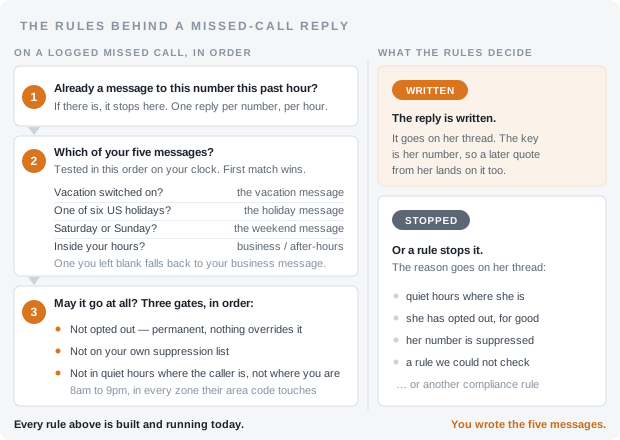
CallMitt™ writes back from your own texting number, a local number registered to your business and not a stranger’s 800 line, and the text opens with your business name, so she replies into the same thread as her quote. The message is picked by the hour and the day, against the hours you actually keep — the demo yard runs 6am to 5pm, because the plant starts loading out at six and a crew that is not in the queue by half past has lost its first load, so a call at 5:20 honestly gets the after-hours version instead of one claiming somebody is on a job.
Straight about where this stands. We have no SMS gateway yet and there is no automatic missed-call detection, so today you log the missed call and the reply is written, compliance-checked and held in your outbox where you can read it. Nothing we compose reaches a phone, and one honest detail that wording usually leaves out: a reply that has sat in the queue longer than an hour is retired rather than delivered when sending switches on, because nobody wants a month-old “sorry we missed your call” landing on a customer’s phone. Everything around it is built and running now: the five messages, the business-hours, weekend, holiday and vacation rules, the quiet hours, the opt-out handling, and the thread her reply lands in beside her quote.
How CallMitt Works Run Your Own NumbersA raker is hired on one question, and it is about the heat
Mix comes off the truck at about three hundred degrees and it is spread by hand with a lute, in August, with a roller working a few feet away. The man you want is doing exactly that this morning on somebody else’s job. He is not at a laptop with a PDF résumé, and he will not fill in a form with a cover-letter box on it. He will answer short questions on his phone at lunch.
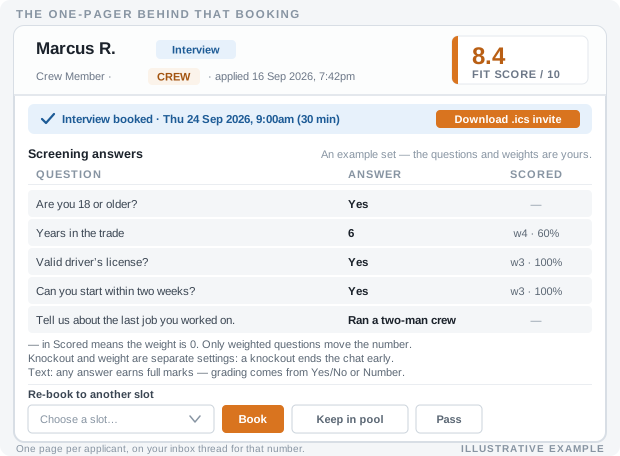
Put “Now hiring — text CREW to your texting number” on the truck and the yard sign. CrewFunnel™ asks seven short questions: is he 18 or older, is he up for raking mix at three hundred degrees in July, has he got a CDL or is he working on one, how many years has he been on a paving or excavating crew, how far out does he live, can he start inside two weeks, and what was the last job he worked on. Three of those are knockouts — under 18, not up for the heat, or living more than thirty miles out — and the rest come back as a weighted fit score out of ten.
Two things about that scoring are worth copying. Distance is a knockout and never a weight, because a number answer scores higher the bigger it is, so weighting miles would rank the man furthest away at the top. And free text carries no weight at all, because any non-empty answer scores full marks and a weighted text box quietly inflates every candidate who typed anything. Both are set that way on our own demo job, and every question on it carries a Spanish translation, which on a paving crew is not a nicety.
One honest note on delivery. There is no inbound SMS on our side yet, so today he answers those seven questions on your screening page rather than by text — same questions, same knockouts, same scoring, same pool. The keyword on the truck takes over the day your carrier registration clears.
See how CrewFunnel works
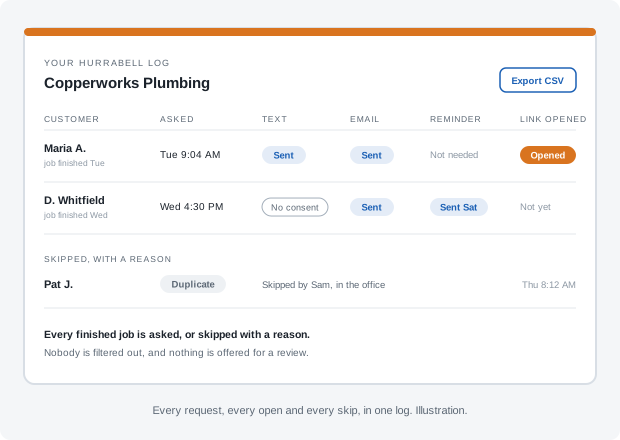
A new driveway gets its review the first time she drives on it
The roller is on the trailer, the edges are tamped, and for three days she parks on the street and looks at it. Then she pulls in for the first time, onto a drive that is black and smooth, with no pothole by the mailbox. That is the day she would write you a review. A month later it is where the car goes, and the crew that laid it is a name on an invoice. The outfit with sixty reviews is not sixty times better than you; somebody there asks every customer, the week the drive opens.
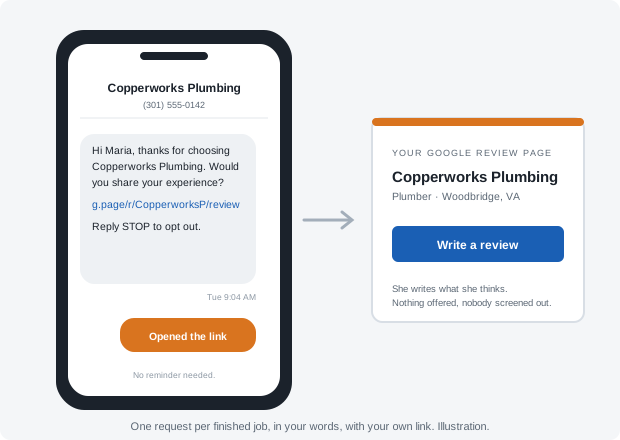
HurraBell™ does the asking. Mark the job done — from the inbox, from your phone, or from your job software through Zapier — and the customer gets one request in your words, with your own Google review link, after a delay you pick: an hour, unless you change it. Three days later, one email reminder, unless the link has been opened or the customer has got back in touch.
Review requests aren’t switched on yet, so none is sent today. When they are, the request goes by email once your Google review link is saved on the HurraBell page and your mailing address on the Account page. A text goes as well where the customer agreed to texts, and only once your carrier registration clears, the same wait as every text on this site; until then it is email only.
See how HurraBell worksOne recovered driveway covers 28 months
And a single recovered sealcoat covers 1 month of it, which is the part worth noticing: even the two-hundred-dollar job pays the bill.
The Tailgate Office Bundle
Instant quotes on your website, missed-call text-back, text-to-apply hiring, review requests, and customers, jobs, estimates and invoices in one place. 30 days free, no credit card, no setup fee, cancel from the dashboard.
Start Free TrialOnly need one of the tools? After the trial you can keep just that one at its own price; the office stays with the Bundle.
Paving questions we get asked
You can price a range, which is all the widget ever shows. The disclaimer underneath says the final number comes after you measure the drive, check where the water goes and see what is under the old surface. Write the rest in your own words — the base compacted in lifts, the edges hand-tamped to a bevel, the site raked and swept — and you have a bracket you can stand behind from the kerb. She stops shopping, and the person who wanted a nine-hundred-square-foot drive done for two thousand dollars never fills in your callback form at all.
A bit, and the design admits it rather than hiding it. There is no length-by-width box in the engine, because no rule kind multiplies one answer by another — so the question asks for one total and the help text does the teaching, with reference figures to check against: about 400 sq ft for a single-car drive, nearer 900 for a two-car, 2,400 for 200 feet of lane at 12 feet wide. Within ten per cent is close enough for a range and you wheel it yourself on the visit. The bounds you set mean a silly answer is refused rather than quietly clamped, and the lead records exactly what she typed, so you call back knowing what she claimed.
Because the two jobs are different machines. A slab is broken up, loaded in lumps and tipped, and the breaker, the skid-steer and the dumpster are hired once however much comes out — so a flat mobilisation plus a rate for the concrete is the honest shape there. A milling machine grinds a surface and hauls it away by the ton to a recycler, and there is no fixed set-up cost hiding inside it: 2,400 square feet really is three times 800. A percentage scales with the job the way the work does. Both shapes are fields you own, so if your tear-out has a mobilisation cost in it, split it the way the concrete card does.
It would be if the calendar were merely quiet. It is shut: hot mix has to leave the plant near 300 degrees and be rolled before it cools, and the mid-Atlantic plants close from about the first of December to the middle of March, so there is no mix to buy at any price. That is why the disclaimer says the booking is scheduled for the spring rather than implying anybody is laying asphalt in January. What the ten per cent actually buys is your March: a crew that reopens with a full book does not spend its first three weeks selling instead of paving, so the discount is the winter advertising budget handed to the customer. Set yours to zero if you would rather quote the same number all year, and note that the sealcoat service carries no season at all — that one really is closed for the winter with nothing to offer.
Only if you make them share a floor, which is exactly what two services stop you doing. The paving service has no trip charge and a $4,000 minimum, because that is a crew day — a paver, a roller, two tri-axles and five people cost the same on a small pad as on a big drive, and the plant will not load out less than a truck. The sealcoat service has a $95 trip charge inside the number she sees and a $245 floor, because a tank trailer and two people are a different day entirely. Set separately, both read honestly: the small paving job floors at $4,000 to $4,360 and the small seal at $245 to $270, and neither number is embarrassed by the other.
No, and you should not. Put lots, private roads and commercial work on a site-visit service: it captures what the lot is, roughly how big, what it needs and whether loaded trucks or a dumpster use it, shows no price whatsoever, and sends her your own "we will come and walk it" message. Traffic counts, subgrade tests, ADA slopes and a phasing plan that keeps half the rows open are not things to guess at off a form, and the third service on the demo account exists to prove the routing path works as well as the pricing one.
Call it fifteen minutes for your text-back messages and your yard hours, a minute, once review requests are switched on for your account, to paste your Google review link on the HurraBell page and your mailing address on the Account page, and about an hour to write the nine questions and load your per-square-foot rate, your tear-out and thickness percentages, your base tiers and your drainage allowance. A service that quotes will not go live until it carries a real base fee or minimum, which is deliberate. No onboarding call, no setup fee and no contract: $199 a month buys all four tools, and ResponsiBid’s reported $400–600 setup, as published in August 2026, is not a thing here.
Also pour concrete, or grade and excavate? See all the trade pages or call (301) 268-1943.
Quote the driveway tonight. Book the winter work in January.
Set it up tonight. Free for 30 days, no card, no setup fee, cancel from the dashboard.