
Locksmithing is two phone calls, and one of them is ninety seconds long
The first call is not shopping. She is standing outside a door with a bag in her hand, and she is ringing the first three names the search gave her until one of them picks up. She is not comparing anybody. She is finding out who answers, and the whole decision is over before a second locksmith has rung out. There is nothing to quote her that she is in a mood to read — the only thing worth winning is the ninety seconds.
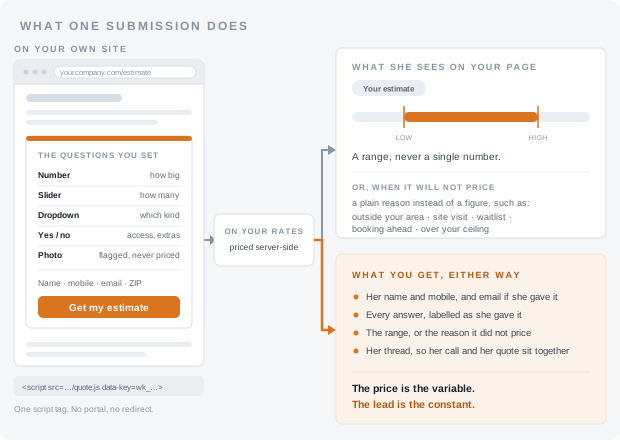
The second call has a week in it. The house sold, the keys came over a table on Friday, and every outside door still opens on whatever the last owner handed out to a dog walker and a cleaner in 2019. That customer will read a number, and she will read it at nine at night from the sofa. They are not the same person and they should not share a form. NapkinPrice™ runs them as separate services on one account — the lock change asks seven questions and an optional photo and puts a range on the screen, the lockout asks five short ones and the same optional photo, with your trip charge already inside the number, and a master key chart goes down a third path that never guesses a price at all.
Both flows offer a photo — the face of the lock, the edge of the door, or a key that still works — and the lead tells you to ask for those pictures on the callback. Attaching the image itself to the lead is on the roadmap, which is why it is not a tick in that list.
A missed lockout is not a missed call. It is the next name on the list.
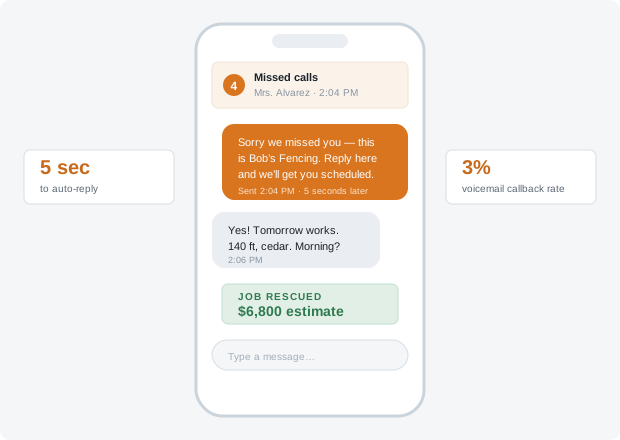
Not answering is not rudeness in this trade, it is both hands. You are at a bench or on the floor with a plug follower holding six springs in a cylinder, and the one thing you cannot do is put it down; or you are under a steering column, or forty feet up a ladder at a closer, or driving. The phone rings for eleven seconds and stops. And unlike every other trade on this site, the person who rang is not going to think about it overnight — she is going to press the next number before you are out from under the door. The one at twenty to nine on a Tuesday, coming in from work, was worth a customer and not a call-out.
| What a missed locksmith call is worth | On the demo account |
|---|---|
| Four outside doors on a house, new deadbolts and levers, keyed alike, one to bore | $877 – $1,072 |
| A house door, later today, whenever you can get there | $89 – $100 |
| The same door, right now, she is standing outside it | $94 – $120 |
| One recovered lock change pays for | 4 months of the bundle |
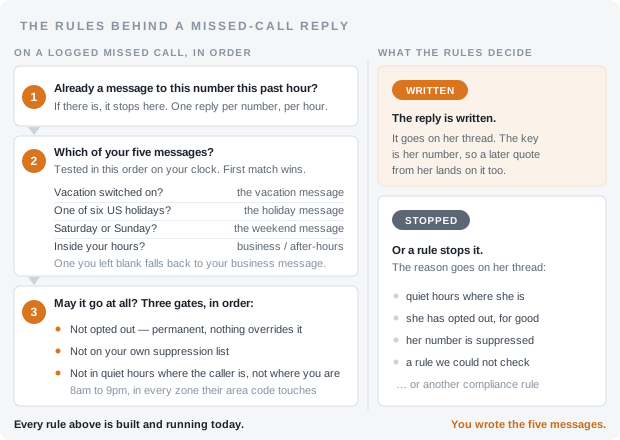
CallMitt™ writes back from your own texting number, a local number registered to your business and not a stranger’s 800 line, and the text opens with your business name, so she replies into the same thread as her quote. The message is picked by the hour and the day — the demo shop’s phone runs 8am to 8pm, so that twenty-to-nine call gets the after-hours version instead of one that says you are at a lock — and every version asks for the two things that decide whether the van turns round: the address, and what she is locked out of. Here is what is already true at 6am tomorrow:
Every missed call, in order, with the hour on it
A list you read down at six in the morning — who rang, from what number, at what time, and what was written back to her. Nothing to reconstruct off a phone that shows eleven names and no times.
A blocked message says why it was blocked
When a rule stops a message it is recorded as blocked with the reason written out in plain English — quiet hours where the caller is, an opt-out, a suppressed number. You are never left guessing whether something went out.
Her call and her website quote in one thread
The key is the phone number, so the seven lock-change answers she filled in at nine last night and the call she made at twenty past six this morning are one conversation on one screen, instead of two records nobody ever joins up.
A tally that leaves your own tests out
Every send is tagged with where it came from, and the dashboard count excludes the ones you fired at yourself while setting it up. What is on the screen is real calls, which is the only figure worth looking at.
Straight about where this stands. We have no SMS gateway on our side yet, so nothing we compose reaches a phone today — you log the missed call and the reply is written, compliance-checked and held in your outbox where you can read it. Everything around it is built and running now: the five messages, the business-hours, weekend, holiday and vacation rules, the quiet hours, the opt-out handling, and the thread her reply lands in beside her quote. Two things that wording usually leaves out, and both of them are permanent: texting runs 8am to 9pm where the caller is — we read that off their area code — and no setting on our side relaxes it, so a call outside that window is recorded as blocked with the reason rather than queued and nothing re-attempts it in the morning; and a reply held longer than an hour is retired rather than delivered when sending switches on, because nobody wants a month-old “sorry we missed your call” landing on a customer’s phone. The code that answers a forwarded call and texts the caller back is written, deployed and tested over signed webhooks — it has no phone number to answer on yet, which is a paperwork problem rather than a software one.
Do not take our word for it. Twenty to nine is inside the texting window; half past nine is not. Set the clock to half past nine on a Tuesday evening on the example business and watch the same rules record it as blocked — try it on the demo (opens in a new tab) — or open that business’s real dashboard, no signup, at the example account’s own dashboard, then click CallMitt in the left menu and read its five text-back messages and its hours for yourself.
How CallMitt Works Run Your Own NumbersFive questions, answered one-handed, and only two of them move it much
She has a phone in one hand and a bag in the other. A lockout form that asks eleven things does not get filled in, so this one asks five and an optional photo, and puts the answers where you can see them while she is still standing there. Here is the little that actually changes the price.
What she is locked out of
A house or apartment door, a garage, shed or padlock, a car or truck, a shop or storefront, or a safe or a gun cabinet. A pick-one, with the money sitting on the option rather than on the rule — $0, $0, $30, $35 and $130 on the demo. Do not draw a flat-versus-per-unit distinction on a pick-one, because the engine has none: the option she chooses adds its dollars once for the visit.
How soon she needs somebody
Later today, right now at the door, or the middle of the night. She declares it — nothing on our side reads a clock, and a page that told you otherwise would be selling a feature that does not exist. It carries a percentage of the work, 0, 20 and 45 percent on the demo, rather than a call-out fee: a flat amount is added first and is then multiplied by every percentage and by the travel zone, so the figure you typed stops being the figure she sees.
The two things you want to know before you drive
Is a key snapped off in the cylinder, and is it a high-security cylinder — Medeco, Mul-T-Lock, ASSA. Each is a yes/no with your own flat amount behind it, $40 and $55 on the demo, added once for the visit. A third asks whether she wants a spare cut on the doorstep. None of them is a guess you have to make in the van, and all three are in writing before anybody sets off.
Travel zone
List your ZIPs by zone — whole ZIPs or three-digit prefixes — and the widget prices the trip from the ZIP she types, most specific match first. A flat charge, a percentage, or both. Keep it small on a ticket this size: the demo adds a flat $25 on the outer ring and $45 plus five percent on the catch-all, which on a call this size is a few dollars rather than most of it. Set one zone to "outside my area" and it declines politely while still capturing the lead.
The options, the yes/no amounts and the percentages above belong to the demo account, not to a Tailgate Office price list — you set every one of them in the dashboard and you can move your trip charge without touching your website. What is not illustrative is the band: a house door, right now, no snapped key, no high-security cylinder and no spare, comes back $94 to $120 on the demo. The $89 trip is not added to that at the door. It is inside it, and on the cheapest answers she can give it is the bottom of the range itself — change nothing but the urgency, to later today, and the same call quotes $89 to $100. Take that right-now call out to a ZIP in the outer ring instead and it comes back $116 to $148.
What lands on your screen the second she taps send
Would you rather try it than read about it? We keep a working example locksmith website with NapkinPrice embedded — the real engine, quoting live, on a page that is not ours. Put those five answers in and watch the same band come back, then do the lock change on the other service.
Try the live demo site (opens in a new tab)Three services, and only two of them ever show a price
A doorstep opening, a house that has just changed hands and a master key chart for an office building are three different conversations. Running them through one form is how you end up quoting a keying schedule like a lockout.
Rekeys, new hardware and lock changes — quotes instantly
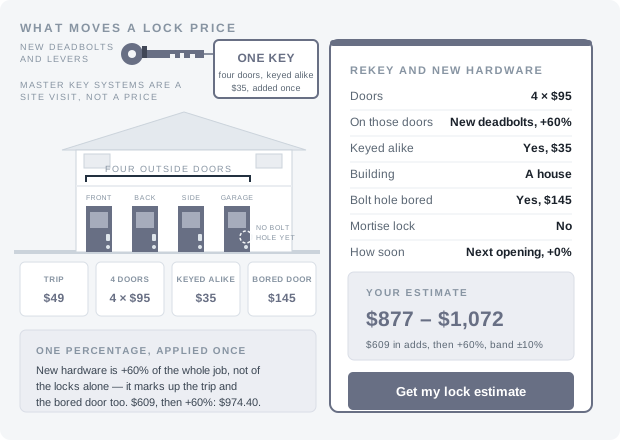
Seven questions, an optional photo, and a range on the screen. The per-opening rate is the only thing that multiplies; the hardware grade is a percentage on the whole job, and keying the house alike and boring a door for a bolt are added once, because the engine has no rule that multiplies one answer by another. A job minimum sits underneath — $149 on the demo — and one answer raises it on its own: say yes to a mortise lock in any of the doors and the floor goes to $495. That is a floor and not a fee. It adds nothing at all to the arithmetic: two doors on a house, rekeyed, keyed alike, nothing to bore and no rush, quote $247 to $301 with a no and $495 to $545 with a yes — the same sum underneath, with the bottom of the range flattened onto the new floor. Four doors on a house instead, new deadbolts and levers, keyed alike, one of them with no hole bored for a bolt yet, no mortise in any of them and no rush, come back $877 to $1,072, which is the job the drawing at the top of this page works through line by line. We stop pricing at about $3,000, and past that the lead comes to you instead of a number going to her.
Lockouts and emergency openings — quotes instantly
The trip is the business on this one, so it lives in the service base fee rather than on a question: $89 on the demo, added once for the visit, and it cannot be dodged by answering the cheapest thing to everything. A house door, later today, nothing snapped off in it, no high-security cylinder and no spare wanted, quotes $89 to $100 — the trip and nothing else. There is a ceiling here too, and it is deliberately low at $300: past that it is a drilled safe or a lock change rather than an opening, and the honest answer is your voice rather than a number off five answers.
Master key systems and access control — site visit, never priced
Site-visit mode captures the whole spec and shows no number at all, which is the right answer for a key chart that decides who may open what and who may not, or an access control install that touches the fire alarm and the egress code. The service still asks the building type, how many doors the chart has to cover, what she actually wants and whether any of those doors are fire-rated — that last one moves no money, it just tells you whether the fire marshal has to see the drawing. She gets your own "we will come and look" message; you get a lead worth bidding.
A service that quotes will not go live until it carries a real base fee or a real minimum. That is deliberate: a service with neither would happily return $0 to a homeowner, and one bad number on your website costs more than a day of setup.
You are handing somebody a key to other people’s houses
That is the whole hiring problem in one sentence, and it is not a licence problem. Delaware, Maryland and Virginia all regulate this trade and they do it three different ways, so screening on a state ticket throws out a good tech for living on the wrong side of a line. What is true everywhere is the background check and the fingerprinting, and that is a gate you run yourself and can stand behind. The second thing you are looking for is whether he has ever had a cylinder apart, because repinning one is what separates a locksmith from a helper with a drill.
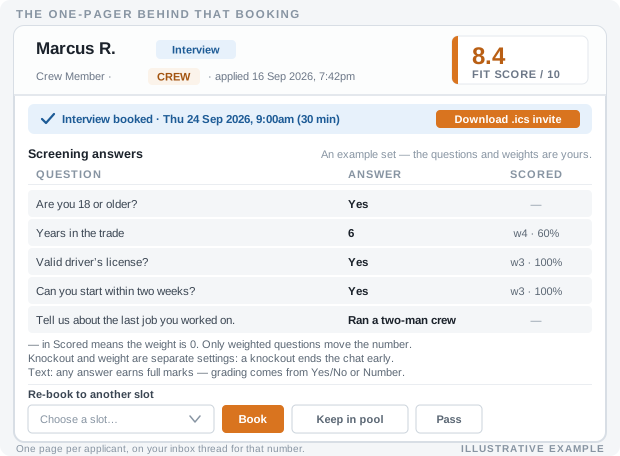
Put “Now hiring — text CREW to your texting number” on the van and the job box. CrewFunnel™ asks seven short questions: is he 18 or older, is he willing to be fingerprinted and background-checked before he carries a key, has he rekeyed a cylinder by repinning it, how many years has he done locksmith work, how far out does he live, can he start inside two weeks, and what was the last job he worked on. Three of those are knockouts — under 18, unwilling to be screened, or living more than thirty miles out — and the rest come back as a weighted fit score.
Two things about that scoring are worth copying. Distance is a knockout and never a weight, because a number answer scores higher the bigger it is, so weighting miles would rank the man furthest away at the top. And free text carries no weight at all, because any non-empty answer scores full marks and a weighted text box quietly inflates every candidate who typed anything. Both of those are set that way on our own demo job, and every question on it carries a Spanish translation.
One honest note on delivery. There is no inbound SMS on our side yet, so today he answers those seven questions on your screening page rather than by text — same questions, same knockouts, same scoring, same pool. The keyword on the van takes over the day your carrier registration clears.
See how CrewFunnel works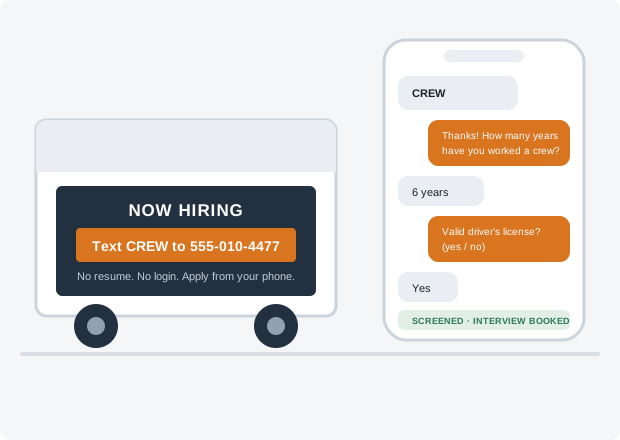
Nobody writes a review from the wrong side of a door
She was on the step at twenty to nine with a bag in one hand and her phone in the other, and twenty minutes after the van pulled up she is inside with the door shut behind her. That is the customer who would write you a review, and she would mean it. Not while the panic is on, though: ask her while she is still out there and it lands like a bill. It has to come once the relief has had a minute to settle, and before tomorrow, when you are a charge on her card and nothing more. The outfit with sixty reviews is not sixty times better than you; somebody there asks every customer, once she is back inside.
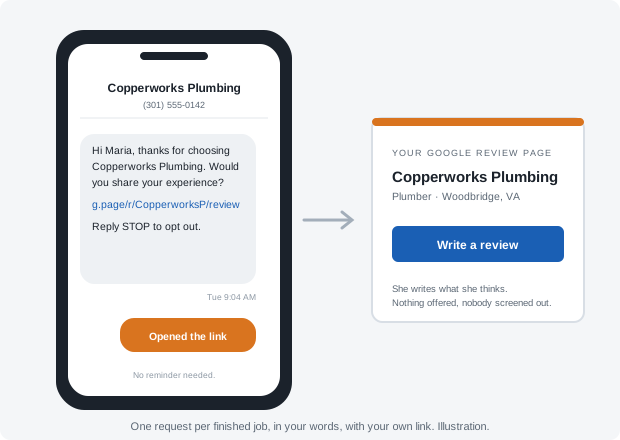
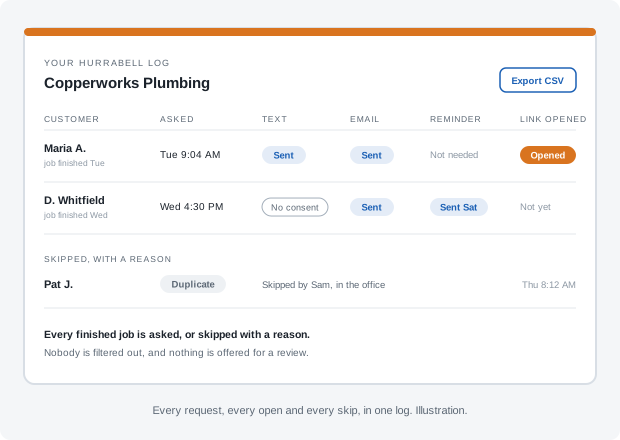
HurraBell™ does the asking. Mark the job done — from the inbox, from your phone, or from your job software through Zapier — and the customer gets one request in your words, with your own Google review link, after a delay you pick: an hour, unless you change it. Three days later, one email reminder, unless the link has been opened or the customer has got back in touch.
Review requests aren’t switched on yet, so none is sent today. When they are, the request goes by email once your Google review link is saved on the HurraBell page and your mailing address on the Account page. A text goes as well where the customer agreed to texts, and only once your carrier registration clears, the same wait as every text on this site; until then it is email only.
See how HurraBell worksOne recovered lock change covers 4 months
And a lockout you answered instead of missing is a customer whose locks you change the month after. In this trade the small call is how you get the big one.
The Tailgate Office Bundle
Instant quotes on your website, missed-call text-back, text-to-apply hiring, review requests, and customers, jobs, estimates and invoices in one place. 30 days free, no credit card, no setup fee, cancel from the dashboard.
Start Free TrialOnly need one of the tools? After the trial you can keep just that one at its own price; the office stays with the Bundle.
Locksmith questions we get asked
Yes, with one choice to make, because forwarding is how the text-back itself works. The design is that your business line stays exactly where it is and keeps ringing as it does now. You turn on forwarding for unanswered calls once, with a code the setup guide gives you, and from then on a call nobody answers in about twenty seconds passes to your own texting number, a local number in your area code registered to your business. A short greeting, in place of your voicemail, tells the caller a text is on its way, and the reply goes out from that texting number. The caller dials one number and hears back from another. It works because the text opens with your business name and thanks them for calling. A ring group or a second phone in the van is no obstacle, because the text only fires when nobody picks up, which is exactly the event you are trying to catch. An answering service is one or the other for any given hour, since an unanswered call can only forward to one place: the forwarding is your own setting, a code switches it off, and the service keeps whatever hours you give it. Where delivery stands right now is written out in full in the missed-call section above, in the paragraph headed "Straight about where this stands" — read that rather than take a sentence from a FAQ, because it is the one place on this page we keep current.
It is recorded as blocked, with the reason, and that is the end of that message. Texting runs 8am to 9pm where the caller is — read off their area code — and there is no setting on our side that relaxes it, so at two o’clock nothing is sent to her at all. Nothing re-attempts it at eight in the morning either: a blocked record is final by design rather than by accident, and no job anywhere goes back and re-queues one. And a message that did queue and then sat is retired rather than delivered once it is more than an hour old, because a "sorry we missed your call" that lands the next afternoon does more harm than silence. So say it plainly: if you advertise round-the-clock lockouts, a text-back is not your night shift — a human is. What this gives you at six in the morning is the list — who rang, at what time, and why nothing went out — so the two o’clock caller gets a call back from you before she has finished ringing round.
It stops pricing and hands you the lead. Every instant service carries a ceiling. On the demo the lock-change service is set at $3,000 — twelve openings in a rental building on Grade 2 hardware with one still to bore for a bolt goes straight past it, and she gets your own "this one needs somebody standing in front of it" message instead of a number. Two things are worth knowing about that number. It is tested against the midpoint before the range is ever drawn, so it is a decision about the job rather than about the top of a band, which also means a published high end can sit a little above the figure you set. And the lockout service carries its own, deliberately low at $300: past that it is a drilled safe or a lock change rather than an opening.
You can, but the customer has to say so, because the engine cannot. The pricing engine reads no clock at any scale — not the hour, not the day of the week, not a callout after midnight. The only temporal thing it knows is a seasonal date range that repeats every year forever, which is why this demo carries no season at all: frozen cylinders in January and the moving season in July are reasons people call, not reasons to charge more, and a date range would charge on every mild winter day for good. What does exist is a question on the form. Urgency is something she declares — later today, right now at the door, or the middle of the night — and the answer carries a percentage on the whole job, 20 and 45 percent on the demo lockout. That is honest, it is yours to set, and she agrees to it before she submits. A flat night fee is the thing to avoid: a flat is added first and is then multiplied by every percentage and by the travel zone, so the figure you typed is not the figure she gets.
On a lockout the range is almost beside the point, and that is worth saying out loud on a page that is trying to sell you a quote widget. She is not shopping. The number matters only enough that she is not afraid of it, which is why the form is five questions instead of eleven and why your trip charge sits inside the band rather than appearing at the door. The work the widget is actually doing here is capture: her number, her address, what she is locked out of and how soon, on your screen, with the hour on it, while she is still standing there. The lock change is the one where the range earns its keep — she reads it at nine at night, and the disclaimer under it says the final number comes once somebody has seen the doors and what is already in them.
It works, and it works best if you stop asking the software to be the night shift. Every call that reaches the log is stamped with the hour, and the right message for that hour and that day is the one picked — the after-hours one at twenty to nine, the weekend one on Sunday lunchtime, the holiday one on Christmas Day. Between 8am and 9pm where the caller is, quiet hours do not stand in the way of it. Outside that window the call is recorded and the reason nothing went out is recorded with it, which is what you want a phone system to do at three in the morning rather than what most of them do, which is nothing. The five messages are yours to write, so the after-hours one can ask for the address and say whether you are actually turning out tonight, and the genuine emergency identifies itself instead of going to the next name.
Call it fifteen minutes for your five text-back messages and your hours, a minute, once review requests are switched on for your account, to paste your Google review link on the HurraBell page and your mailing address on the Account page, and about an hour to write the five lockout questions and the seven on the lock change, load your trip charge, your per-opening rate and your travel zones, and set your two ceilings. A service that quotes will not go live until it carries a real base fee or a real minimum, which is deliberate. Your own texting number waits on your carrier registration clearing, which is a filing rather than a build. Automatic missed-call detection waits on that same number; the code that answers a forwarded call and texts the caller back is written, deployed and tested over signed webhooks, and it has nothing to answer on yet. No onboarding call, no setup fee and no contract: $199 a month buys all four tools.
Also cut car keys, or fit access control? See all the trade pages, read the compliance page, or call (301) 268-1943.
Answer the door she is standing outside at twenty to nine. Quote the lock change she books the month after.
Set it up tonight. Free for 30 days, no card, no setup fee, cancel from the dashboard.