

Flooring is the one trade where the material is the rate
Square feet times a rate is the easiest quote arithmetic on this site, and flooring almost gets to use it. What breaks it is that the rate is not yours alone to pick — it belongs to the material. Click-together vinyl plank installs for something near $4 a square foot. Porcelain tile or solid oak sanded and finished in place is nearer $15. That is not a surcharge, it is a different trade with a different crew, a different substrate and three times the hours.
So this page does something the other trade pages do not have to: it tells you up front how that is handled, because it changes how you build the form. You run one instant service per material family, each with its own per-square-foot rate, and the visitor picks the family first. Everything else — rooms, treads, tear-out, subfloor prep, trim, furniture — is the same set of questions on both.
The flow also asks for a photo of the floor she has now, and the lead tells you to ask for those pictures on the callback. Attaching the image itself to the lead is on the roadmap, which is why it is not a tick in that list.
The eight things that set a flooring number
One area figure, four straight counts, two pick-ones and a ZIP. You build the set once in the dashboard and every rate in it is a field you own — you can change a per-square-foot rate the morning your supplier raises plank without touching your website.
Square footage
The base number the whole quote hangs off: her floor area times your installed per-square-foot rate. Tell her in the help text to add up length times width room by room, round up to the nearest ten and not to subtract for the island or the closets — you would rather order a box over than run short two rows from the wall. On rectangular rooms homeowners land within about ten per cent of a real measure, which is what a range is for.
Material family
The hard one, and the section below is about nothing else. No rule in this engine multiplies one answer by another, so a material dropdown cannot set your per-foot rate — it can only add dollars once or take a percentage of the whole job. Inside one family that is fine, because the spread is small: carpet with a new pad sits a little under click plank and rigid-core a little over. Across families it is three to one, so each family gets its own service and its own rate.
Rooms and areas
Two hundred square feet in one room is a faster day than the same footage spread over four, because every room is set out from its own center line, cut at its own doorway and trimmed on its own walls. Count rooms, halls and landings and multiply by your own per-room figure. This one is a number question with a multiply rule, so it genuinely doubles when she says eight rooms instead of four.
Stair treads
The most under-charged item in the trade and the one online calculators leave out completely. A tread is cut, nosed and glued by hand and the riser under it is a second piece, so stairs are priced per tread and never by the square foot. Ask for treads rather than flights: homeowners say "one flight" when they mean thirteen separate pieces of careful work.
Tear-out, in two halves
Pulling up the old floor is two costs that behave differently, so ask them as two questions. The trailer, the tip ticket and the tack strip are a flat fee for the job — a yes/no with your disposal amount behind it, added ONCE however many rooms she has, because that is what a flat rule does here. The labour of getting it up is genuinely by the foot, so it wants its own number question and a per-square-foot rate. Ask only the first and you undercharge a whole-house rip-out; ask only the second and you eat the dump ticket.
Subfloor prep
Solid and dry, a few soft spots to patch, self-levelling across a room, or springy with water damage to repair. A percentage on the whole job rather than a line item, because prep is labour spread across every room and it slows the floor, the trim and the stairs together. It is also the answer most likely to move when you measure, so the help text is where you ask her to be honest rather than optimistic: a click floor telegraphs every dip underneath it.
Trim, transitions and furniture
Shoe moulding, thresholds and the strips where the new floor meets the tile that is staying, priced per linear foot off the walls of the rooms getting done plus the doorways. Moving the furniture is the other half of this card and a different shape: a yes/no with a flat amount for the job, because the engine adds a flat amount once and not once per room. Say what that buys — beds, sofas and dressers shifted room to room and put back, she empties the china cabinet — and nobody argues on the day.
Travel zone
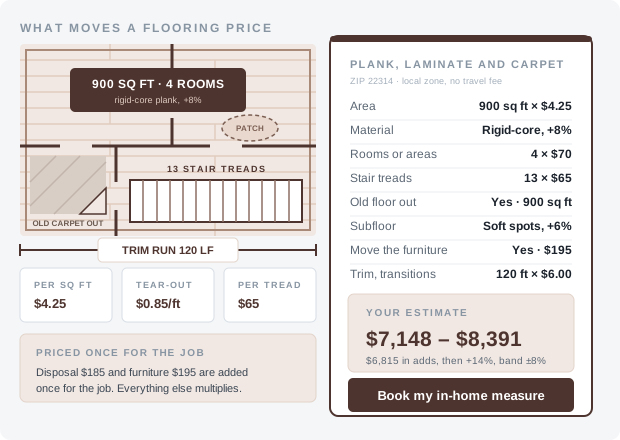
List your ZIPs by zone — whole ZIPs or three-digit prefixes — and the widget prices the trip from the ZIP she types, most specific match first, as a flat charge, a percentage, or both. Our demo shop charges nothing inside Alexandria and Fairfax County and $70 out to the ring beyond it, so the same 900 square foot floor comes back $7,148 to $8,391 at home and $7,212 to $8,466 in Arlington. Set one zone to "outside my area" and it declines politely while still capturing the lead.
A real plank floor, start to finish
Ten questions, about ninety seconds. This is the exact sequence running on the plank, laminate and carpet service of our own flooring demo account, answered for 900 square feet of rigid-core vinyl through an Alexandria townhouse — and the total at the bottom is what the live engine returns for these answers, not a figure anybody typed into this page.
| # | What she is asked | What she answers | What it does to the price |
|---|---|---|---|
| 1 | How many square feet of floor? | 900 | 900 × the per-sq-ft rate — $4.25 on the demo, so $3,825. This is THE base number |
| 2 | Which floor are you putting down? | Rigid-core waterproof vinyl plank | +8% on the whole job. Within this family only: click plank 0%, laminate -6%, carpet with a new pad -20% |
| 3 | How many rooms or areas? | 4 | 4 × $70 = $280 — per-room set-out and cuts, and genuinely per unit |
| 4 | How many stair treads? | 13 | 13 × $65 = $845 — hand-cut per tread, never folded into the footage |
| 5 | Is there an old floor to pull up? | Yes | A flat $185 disposal fee for the job, not per room |
| 6 | If so, how many square feet come out? | 900 | 900 × $0.85 = $765 — the per-foot half of the tear-out, which a flat fee cannot express |
| 7 | What is the subfloor like? | A few soft spots or dips to patch | +6% on the whole job. Levelling a room is +14%, springy or water damaged +26% |
| 8 | Do you want us to move the furniture? | Yes | A flat $195 for the job |
| 9 | How many linear feet of trim and transitions? | 120 | 120 × $6 = $720, supplied and fitted |
| 10 | Got a photo of the floor you have now? | Offered | Nothing. A photo never moves the price |
| The arithmetic, in the order the engine runs it | $3,825 + $280 + $845 + $185 + $765 + $195 + $720 = $6,815, then the two percentage answers pool to +14% and apply once to all of it: → $7,769.10 | ||
| She sees | $7,148 – $8,391 | ||
| What lands in your inbox, the second she submits | Name, mobile, ZIP, all ten answers, the photo flag, and the disclaimer she was shown | ||
Every rate in that table belongs to the demo account, not to a Tailgate Office price list — you set all of them yourself, and you can change a per-square-foot rate without touching your website. What is not illustrative is the total: $7,148 to $8,391 is what the engine returns for those ten answers, and a contractor in that market would quote roughly $7,000 to $8,500 for that job.
Would you rather try it than read about it? We keep a working example flooring company website with NapkinPrice™ embedded — the real engine, quoting live, on a page that is not ours. Put in those ten answers and see the same number come back.
Try the live demo site (opens in a new tab)Plank, laminate and carpet on one rate; hardwood, tile and stone on another
This is the one design decision that matters in flooring, so here is the whole of it in plain words rather than a promise that it all just works.
There are five kinds of pricing rule in the engine and none of them multiplies one answer by another. A number question can carry a per-unit rate — the square footage, the rooms, the treads, the feet of trim. A pick-one can add dollars once for the job, or take a percentage of the whole job. What it cannot do is apply its own rate to her footage, and pretending otherwise on a marketing page is how you end up with a product that does not do what the website said.
That leaves two honest ways to price material, and we tried both. The first is one base rate with a material percentage on top: truthful, but ugly. Getting from $4 a square foot plank to $15 a square foot tile is about +275%, and a percentage that size reads as a mistake on a homeowner’s screen. Worse, the percentage pool applies to the whole additive subtotal, so it marks up the tear-out, the trim and the furniture fee along with the floor — she would be paying tile money to have her carpet carried out.
The second is what our demo does and what we would set up with you: one instant service per material family, each with its own base rate, and the material dropdown inside it carrying only the spread within that family. The base rate covers the common materials; the premium ones inside the family carry a percentage small enough to be believable. Nothing implies one rate covers marble and carpet alike, because it does not, and the visitor picks the family before she answers a single question. Nor is that a workaround invented for flooring: it is the same advice the fencing page has given for a year about residential privacy against horse fence.
On our demo that is $4.25 a square foot for plank, laminate and carpet, and $8.75 for hardwood, tile and stone — plus a third service, for refinishing and repairs, that never shows a price at all.
Plank, laminate and carpet — quotes instantly
$4.25 a square foot on the demo, with the dropdown moving it inside the family: click plank at the rate, rigid-core +8%, laminate -6%, carpet with a new pad -20%. No trip charge, because the measure sells the floor, so the job minimum does that work instead. A minimum is the floor under the FINAL number, applied after every rule and the travel zone — so a 40 square foot carpet closet that prices out at $192 comes back as $950 to $1,026 instead. Past $20,000 it stops pricing, hands you the lead and shows her your own "bigger than we can quote online" message.
Hardwood, tile and stone — quotes instantly
$8.75 a square foot: engineered hardwood at the rate, nailed down +8%, solid oak finished on site +22%, porcelain or ceramic +26%, natural stone, slate or marble +50%. The same ten questions, a $1,750 minimum, and a wider band on purpose — 11% against 8% — because layout, borders and pattern work get decided standing in the room. The subfloor percentage bites harder here too, and it should: tile cracks over a subfloor that moves. 340 sq ft of porcelain with the old tile out comes back $4,930 to $6,148; 700 sq ft of site-finished oak, $9,973 to $12,438.
Refinishing, repairs and commercial floors — site visit, never priced
Site-visit mode captures the whole spec and shows no number whatsoever, which is the only honest answer to sanding a floor nobody has seen. How much wood is left above the nails, whether the boards have been sanded thin already, whether the cupping is a leak that is still leaking — none of that comes off a dropdown. It still asks five questions, including a rough square footage that moves no money and only tells you whether to book one visit or three. She gets your own "we will come and look" message; you get a lead worth bidding.
A service that quotes will not go live until it carries a real base fee or a real minimum. That is deliberate: a service with neither would happily return $0 to a homeowner, and one bad number on your website costs more than a day of setup. Neither flooring service carries a trip charge, so on both of them it is the minimum doing that job.

A flooring lead is worth a month of software
Nobody in this trade misses calls on purpose. You miss them with a saw running in somebody’s dining room, or because the counter is unmanned while the crew loads the van. Meanwhile roughly 62% of contractor calls go unanswered, about 78% of jobs go to whoever responds first, and voicemail gets a callback around 3% of the time. Flooring has no emergencies to make up for that — nobody calls twice about a floor they have already put off for four years.
| What a missed flooring call is worth | On the demo account |
|---|---|
| 900 sq ft of plank, stairs, tear-out and trim | $7,148 – $8,391 |
| 340 sq ft of porcelain tile, old tile out | $4,930 – $6,148 |
| 700 sq ft of site-finished oak, three rooms | $9,973 – $12,438 |
| Voicemail callback rate | ~3% |
| One recovered plank floor pays for | 35 months of the bundle |
| One recovered tile job pays for | 24 months |
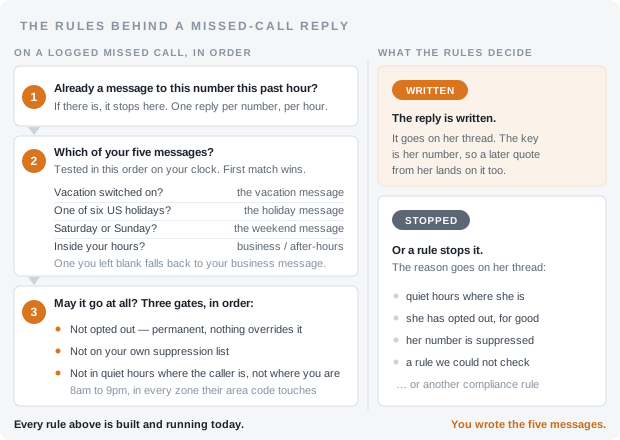
CallMitt™ writes back from your own texting number, a local number registered to your business and not a stranger’s 800 line, and the text opens with your business name, so she replies into the same thread as her quote. The message is picked by the hour and the day — the demo showroom runs 9 to 6, so a 6:15 call gets the after-hours version rather than one that says you are on a floor — and every version asks the two things that let you sort your week: which rooms, and roughly how many square feet.
Straight about where this stands. We have no SMS gateway yet and there is no automatic missed-call detection, so today you log the missed call and nothing is sent: a reply queued now is retired rather than delivered when your carrier registration clears. Everything around it is built and running now: the five messages, the business-hours, weekend, holiday and vacation rules, the quiet hours, the opt-out handling, and the thread her reply lands in beside her quote.
How CallMitt Works Run Your Own NumbersAn installer is hired or lost on two questions
The first is not a skill question at all. Fitting a floor is a full day on your knees cutting and pulling up somebody else’s old flooring, and knees are what end careers in this trade; a man who has not done it does not know that yet, and finding out on day two costs you a week. The second separates an installer from a helper: has he cut and fitted stair treads and risers? Anybody can float a plank across an open room. A tread is scribed, nosed and glued by hand, and a sixteenth of an inch shows from the hallway for the next twenty years.
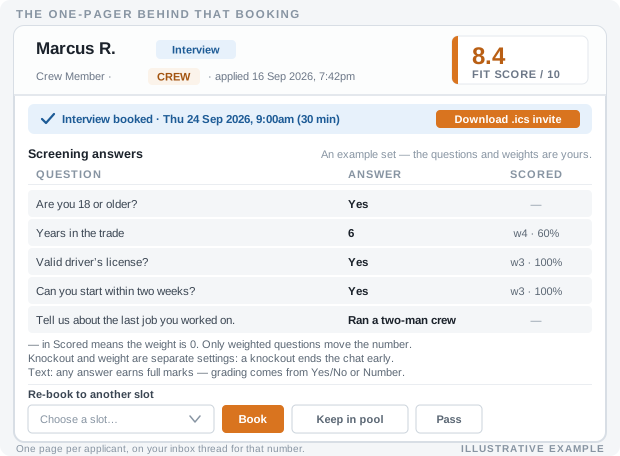
Put “Now hiring — text CREW to your texting number” on the van and the showroom door. CrewFunnel™ asks seven short questions: is he 18 or older, is he up for a day on his knees, has he fitted stair treads, how many years has he installed flooring, how far out does he live, can he start inside two weeks, and what was the last floor he installed. Three are knockouts — under 18, unwilling to do the work, or living further out than you will drive — and the rest come back as a weighted fit score, years in the trade heaviest and the stair question next.
Two things about that scoring are worth copying. Distance is a knockout and never a weight, because a number answer scores higher the bigger it is, so weighting miles would rank the man furthest away at the top. And free text carries no weight, because any non-empty answer scores full marks and a weighted text box inflates every candidate who typed anything. Both are set that way on our demo job, and all seven questions carry a Spanish translation.
One honest note on delivery. There is no inbound SMS on our side yet, so today he answers those seven questions on your screening page rather than by text — same questions, same knockouts, same scoring, same pool. The keyword on the van takes over the day your carrier registration clears.
See how CrewFunnel works
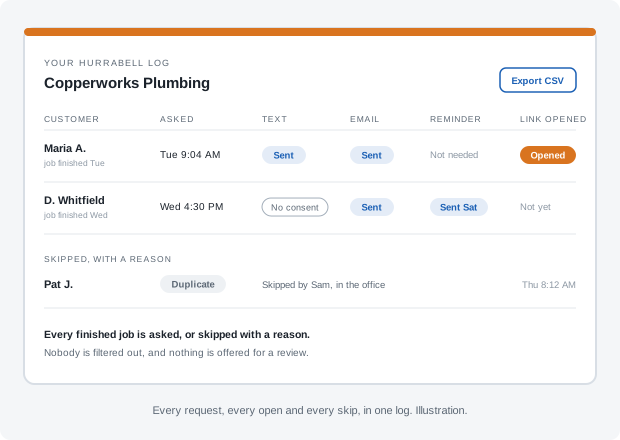
A new floor gets its review the day the furniture goes back
The last plank is tapped in, the transitions are down, and by four o’clock the sofa is back where it was. She is walking on the new floor in her socks before she has opened the invoice. That is the evening she would write you a review. By the weekend half of that floor is under a rug, and the three days she lived out of one room are something she no longer brings up. The outfit with sixty reviews is not sixty times better than you; somebody there asks every customer, the day the furniture goes back.
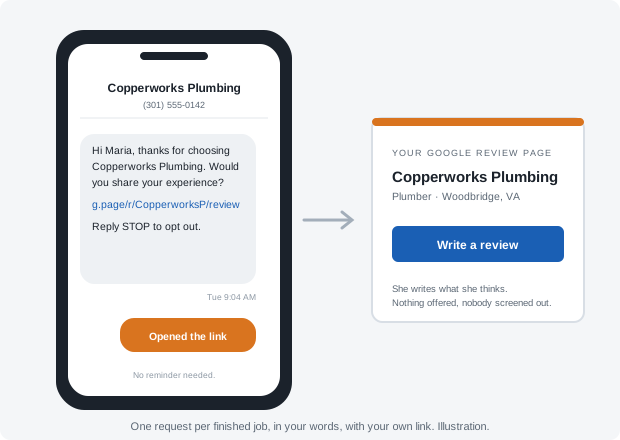
HurraBell™ does the asking. Mark the job done — from the inbox, from your phone, or from your job software through Zapier — and the customer gets one request in your words, with your own Google review link, after a delay you pick: an hour, unless you change it. Three days later, one email reminder, unless the link has been opened or the customer has got back in touch.
Review requests aren’t switched on yet, so none is sent today. When they are, the request goes by email once your Google review link is saved on the HurraBell page and your mailing address on the Account page. A text goes as well where the customer agreed to texts, and only once your carrier registration clears, the same wait as every text on this site; until then it is email only.
See how HurraBell worksOne recovered plank floor covers 35 months
A single tile bathroom covers 24 of them. In a trade where the average job runs four figures and the shopper is measuring at 9pm, the arithmetic is not close.
The Tailgate Office Bundle
Instant quotes on your website, missed-call text-back, text-to-apply hiring, review requests, and customers, jobs, estimates and invoices in one place. 30 days free, no credit card, no setup fee, cancel from the dashboard.
Start Free TrialOnly need one of the tools? After the trial you can keep just that one at its own price; the office stays with the Bundle.
Flooring questions we get asked
You can price a range, and only a range — the widget never shows a single figure. The disclaimer under it is yours to write. On the demo it says underlayment, shoe moulding, thresholds and hauling the old floor away are in the number when she asks for them, the price is confirmed when you measure, and the one thing nobody can see from here is the subfloor: if it needs levelling or a board replaced, you show her first and she agrees the extra in writing. Nothing is ordered until she has that written number.
Because the engine cannot multiply one answer by another, as the section above explains, and we would rather tell you that than sell you a form that quietly gets tile wrong. A pick-one adds dollars once or takes a percentage of the whole job; it cannot apply its own rate to her footage, and as a percentage tile against plank is about +275%. One service per family gives each a base rate that is right for it, and she picks the family first — which is how she thinks about it anyway.
It is a simplification, and the help text says so in her words rather than hiding it: the disposal fee is the trailer and the tip ticket for the job, and moving furniture is a day rate rather than a per-room charge. The reason is in the engine — a flat amount on a yes/no or a pick-one is added once. What does scale is everything asked as a number: square feet, rooms, treads, old floor coming out, feet of trim. If a whole-house rip-out really costs you three dump runs, run large jobs as their own service with their own fee.
They are closer than you think on rectangular rooms, and the ones who are wildly out are usually wrong in a useful direction. Tell her to add up length times width room by room, round up to the nearest ten and not to subtract for the island or the closets. The lead records exactly what she typed, so when you measure 1,040 against her 900 the conversation is about the difference rather than the whole number. It also filters the man who wanted 900 square feet of white oak for $2,000, and he was never your customer.
No, and you should not. Put refinishing, board repairs, cupping, water damage and commercial floors on a site-visit service: it captures what she is looking at, a rough square footage, what is on the floor now, whether the house is older than 1940 and the photo flag, shows no price whatsoever, and sends her your own "we will come and look" message. You get a lead worth bidding, and nobody has published a number against a floor that may have been sanded three times already.
Our demo says no, and neither of its instant services carries one. The crew is inside a house in February for the same money as in July, and the one seasonal pattern this trade has — everybody wants the floor down before Thanksgiving — is a scheduling problem rather than a pricing one. The field is there if your costs genuinely swing: a season is a percentage on a date window you set, applied to the job before anything about her address. But inventing one to fill the box is the fastest way to end up with a number you cannot defend in October.
Here is the honest state of it. The design is that your business line stays exactly where it is and keeps ringing as it does now. You turn on forwarding for unanswered calls once, with a code the setup guide gives you, and from then on a call nobody answers in about twenty seconds passes to your own texting number, a local number in your area code registered to your business. A short greeting, in place of your voicemail, tells the caller a text is on its way, and the reply goes out from that texting number. The caller dials one number and hears back from another. It works because the text opens with your business name and thanks them for calling. Forwarding to a mobile, a ring group or a second phone is no obstacle, because the text only fires when nobody picks up. Where the forwarding for unanswered calls gets switched on depends on how your phones are set up: on a mobile it is the code you dial, and on a desk line or an office phone system it is a setting you ask your phone company for. An answering service can keep its hours, because the forwarding is your own setting and can be switched off again. What is running today is the half that needs no carrier: you log the missed call, CallMitt picks the right message for the hour and the day, checks your quiet hours, opt-outs and suppression list, and queues it. Automatic detection and actual delivery switch on for your account when its A2P 10DLC registration clears. Better you read that here than find it out in week two.
Call it fifteen minutes for your text-back messages and your counter hours, a minute, once review requests are switched on for your account, to paste your Google review link on the HurraBell page and your mailing address on the Account page, and about an hour to write the ten questions and load one rate card — per square foot, per room, per tread, your tear-out fee and rate, your subfloor percentages and your trim. Then most of another hour to clone it into the second family with different numbers, which is the part flooring has that the other trades do not. A service that quotes will not go live until it carries a real base fee or minimum, which is deliberate. No onboarding call, no setup fee and no contract: $199 a month buys all four tools, and ResponsiBid’s reported $400–600 setup, as published in August 2026, is not a thing here.
Also fit tile in bathrooms, or run a remodel crew? See all the trade pages or call (301) 268-1943.
Quote the floor while she is still standing in the room.
Set it up tonight. Free for 30 days, no card, no setup fee, cancel from the dashboard.