
Nobody buys windows in one sitting
She has been meaning to do the windows since the February heating bill. Two companies have been in the house, she sat through a ninety-minute presentation, got a number she did not believe, and did nothing. Tonight she is on your website at nine o’clock trying to work out whether this is a $6,000 job or a $16,000 one, and every site she has opened says “call for a free consultation.”
The other call is not planned at all: a pane is broken, the weather is coming in, and she is ringing glass shops until a human answers. NapkinPrice™ runs both as separate services on one account — the replacement asks nine questions and puts a range on the screen, the repair carries your trip charge inside the number instead of springing it at the door, and a bay window or a new opening cut into a wall goes down a third path that never guesses a price.
The flow also asks for a photo of the windows from outside, and the lead tells you to ask for those pictures on the callback. Attaching the image itself to the lead is on the roadmap, which is why it is not a tick in that list.
The eight things that set a window and door number
Seven of these are a count or a pick-one and the eighth is a ZIP code, which is what makes this trade quotable online: no area arithmetic, nothing to go outside with a tape measure for. You build the set once in the dashboard and every rate in it is a field you own.
Window count
The base number, and one of only two genuinely per-unit lines on the service: your per-window rate times the openings she is replacing. On the demo that rate is $630, meaning one standard-size double-hung installed. Ask for openings, not rooms — a double-hung, a casement and a picture window are one each.
Frame material
Vinyl, fiberglass or wood-clad, as a percentage on the whole estimate rather than a line item, because material changes the unit, the hardware and the hours together. It is also where the honest limit sits: the engine has no rule that multiplies one answer by another, so there is no price-per-window-type here. One rate, and a percentage that moves it.
Glass package
Clear double pane, low-E with argon, or triple, as another percentage on the whole estimate. Low-E and argon is what most people end up with and what they feel beside a south-facing window in August. Set the percent your supplier actually charges you: clear to triple is not a rounding error.
How high the openings are
Ground floor, second storey as well, or third storey and anything over a roof or porch. Access is labour, not material: a unit goes up a ladder in two pairs of hands, and staging goes up before a sash comes out. Ask for the highest opening — most revised estimates turn on that answer.
Full-frame or insert
Out to the studs, or a pocket insert into the sound old frame. Full-frame is the right answer when the sills are soft or the frames are out of square, and it is mostly labour, so it belongs on a percentage rather than a fee. Say in the help text that an insert keeps her trim and costs less.
Capping and interior trim
Bent aluminum outside so the trim never needs painting, and new casing and sill inside. Both are flat amounts, and here is the part nobody should paper over: a flat amount is added ONCE PER JOB, not once per opening, because no rule in the engine multiplies one answer by another. So the figure is a typical house’s worth of trim, four capped openings and fourteen carry the same line online, and the help text says so in her words: we true it up when we measure.
Entry and patio doors
A door is not a window and should not be priced as one, so it gets its own count and its own rate — $2,475 a door installed on the demo. Because it is a count with a multiply behind it, two doors really is twice the doors. The percentages above lift the door line with everything else.
Travel zone
List your ZIPs by zone — whole ZIPs or three-digit prefixes — and the widget prices the trip from the ZIP she types, most specific match first. A flat charge, a percentage, or both. Set one zone to “outside my area” and it declines politely while still capturing the lead. A job minimum backs it up.
A real replacement flow, start to finish
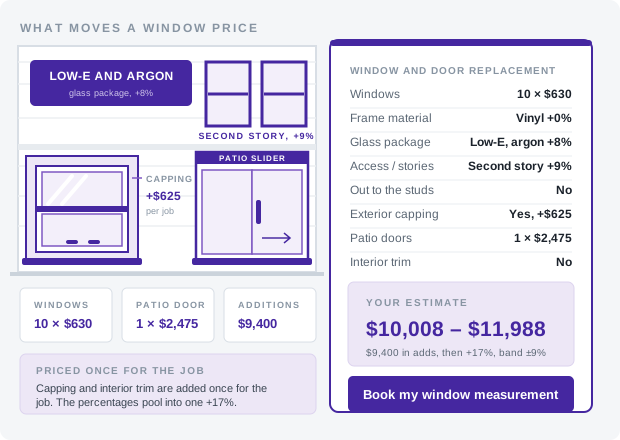
Nine questions, about a minute, and the last is a photo prompt that moves no money. This is the exact sequence running on our own window and door demo account — and the total at the bottom is what the live engine returns for these answers, not a figure anybody typed into this page.
| # | What she is asked | What she picks | What it does to the price |
|---|---|---|---|
| 1 | How many windows are we replacing? | Ten | 10 × the per-window rate — $630 each on the demo, so $6,300 |
| 2 | What frames do you want? | Vinyl | The per-window rate is built on vinyl: +0% |
| 3 | Which glass package? | Double pane, low-E and argon | A percent on the whole job: +8% |
| 4 | Where are the windows? | Second story as well | Another percent on the whole job: +9% |
| 5 | Take the old frames out to the studs? | No | Nothing — an insert, so no full-frame percent |
| 6 | Cap the outside trim in aluminum? | Yes | A flat $625 for the job, not per opening |
| 7 | How many entry or patio doors? | One | 1 × the per-door rate — $2,475 on the demo |
| 8 | New interior trim to match? | No | Nothing — the rule only fires on yes |
| 9 | Got a photo of the windows from outside? | Offered | Nothing. A photo never moves the price |
| The arithmetic, in the order the engine runs it | $6,300 + $625 + $2,475 = $9,400, then the two percentage answers pool and apply once to all of it — the door and the capping included: +17% → $10,998.00 | ||
| She sees | $10,008 – $11,988 | ||
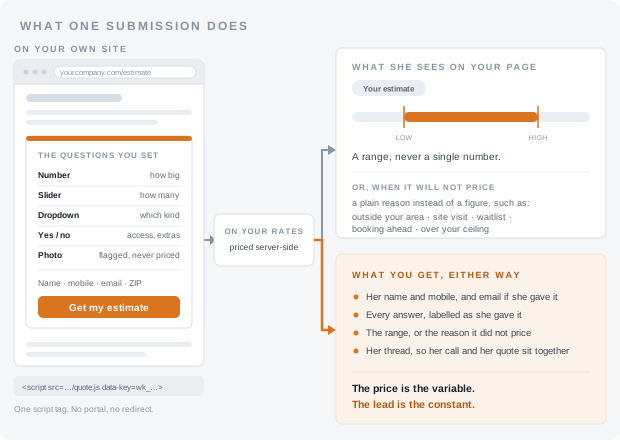
| What lands in your inbox, the second she submits | Name, mobile, ZIP, all nine answers, the photo flag, and the disclaimer she was shown | ||
Those rates and percentages belong to the demo account, not to a Tailgate Office price list — you set every one of them in the dashboard, and you can change your per-window rate without touching your website. What is not illustrative is the total: $10,008 to $11,988 is what the engine returns for those nine answers, and you can reproduce it on the demo in a minute. Note what the percentages do: they move the whole estimate at once, not one window, because nothing in the engine multiplies one answer by another.
Would you rather try it than read about it? We keep a working example window and door company website with NapkinPrice embedded — the real engine, quoting live. Put in those nine answers and see the same number come back.
Try the live demo site (opens in a new tab)Three services, and only two of them ever show a price
A whole-house replacement, a broken pane and a bay window are three different conversations. Running them through one form is how you end up quoting a glass wall like a bedroom sash.
Replacement — quotes instantly
No trip charge here: the measure is free and it sells the job. Instead it carries a job minimum, so a single ground-floor window never comes back under it — $950 on the demo, and the low end of that band is the floor itself rather than 9% below it. Above the ceiling it stops pricing: past $26,000 the widget routes the lead to you instead of publishing a number that big off nine answers. Eighteen wood-clad triple-pane windows on a third storey, full-frame, with capping, two doors and new trim comes out at $33,823.90 on the demo — exactly the job it refuses to quote.
Glass, screen and hardware repair — quotes instantly
The trip charge lives in the service base fee, so it is added once however many openings you look at and cannot be dodged by answering the smallest option to everything. On the demo that is $79, inside the range rather than appearing at the door. A cracked pane in a standard ground-floor opening quotes $346 to $422 for the next slot; the same pane upstairs and needed tonight quotes $501 to $612, because urgency and ladder work are both percentages. One question raises the floor instead of adding dollars: soft or out-of-square wood means carpentry before glazing, so it lifts the job minimum to $650.
Bays, glass walls and new openings — site visit, never priced
Site-visit mode captures the whole spec and shows no number at all, which is the right answer for a bow window, a wall of folding glass doors, a basement egress, or an opening cut into a wall that is holding something up. It still asks what she is looking at, how many openings, what the wall is made of, and whether a historic or HOA review applies — that last one moves no money, it tells you whether a review sits in front of the schedule. She gets your own "we will come and measure" message, and you get a lead you can bid.
A service that quotes will not go live until it carries a real base fee or a real minimum. That is deliberate: a service with neither would happily return $0 to a homeowner who answered zero windows and zero doors, and one bad number on your website costs more than a day of setup. It is also why the replacement service carries a $950 floor rather than nothing at all.
The broken-pane call is the one you cannot afford to miss
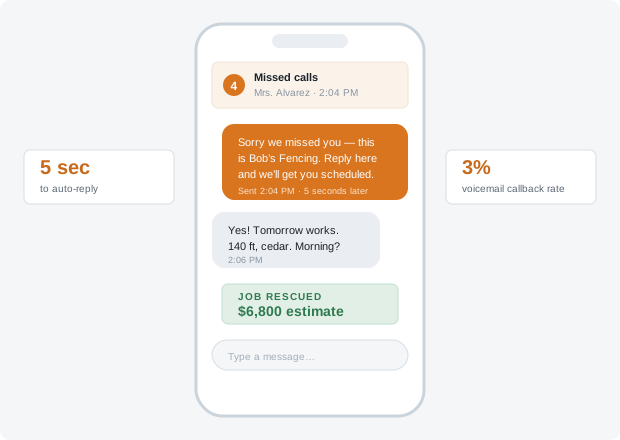
A window open to the weather is the closest thing this trade has to a burst pipe. It is dark, it is raining, and she is dialling down the search results until a human picks up. Roughly 62% of contractor calls go unanswered, about 78% of jobs go to whoever responds first, and voicemail gets a callback around 3% of the time. The repair is worth a few hundred dollars — but she is standing in a house with ten original windows in it, and you are the company that showed up.
| What a missed window call is worth | On the demo account |
|---|---|
| Ten windows and a patio door, low-E glass, two storeys | $10,008 – $11,988 |
| A cracked pane, ground floor, next available slot | $346 – $422 |
| The same pane, upstairs, needed tonight | $501 – $612 |
| Voicemail callback rate | ~3% |
| One recovered replacement pays for | 50 months of the bundle |
| One recovered pane pays for | 1 month, and it is how you get invited back for the ten |
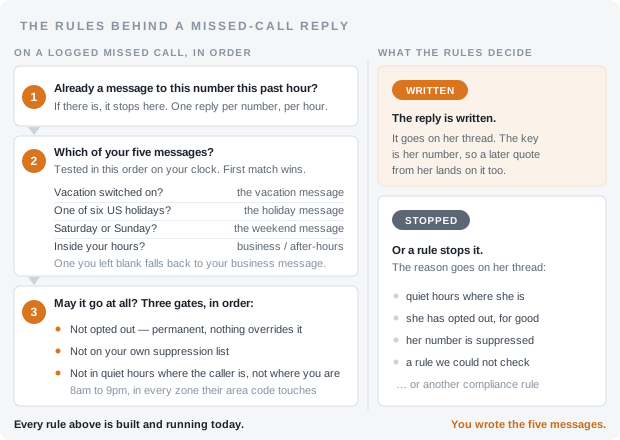
CallMitt™ writes back from your own texting number, a local number registered to your business and not a stranger’s 800 line, and the text opens with your business name, so she replies into the same thread as her quote. The message is picked by the hour and the day — the demo shop runs 8am to 5pm, because you cannot take a window out of a wall at seven in the morning — so a 7pm call gets the after-hours version rather than one saying you are out on an install. Every version asks the question that sorts your evening: is the opening open to the weather?
Straight about where this stands. We have no SMS gateway yet and there is no automatic missed-call detection, so today you log the missed call and nothing is sent: a reply queued now is retired rather than delivered when your carrier registration clears. Everything around it is built and running now: the five messages, the business-hours, weekend, holiday and vacation rules, the quiet hours, the opt-out handling, and the thread her reply lands in beside her quote.
How CallMitt Works Run Your Own NumbersAn installer is hired or lost on two questions
A sealed glass unit is sixty to a hundred and twenty pounds of something that cuts, carried up a ladder by two people who have to agree on when to let go. And the trade turns on one skill: a unit shimmed plumb and square locks with one finger, and a unit that is not will be a callback for as long as the house stands. So the questions that matter are whether he is willing to do that work, and whether he has ever made a window lock without forcing it.
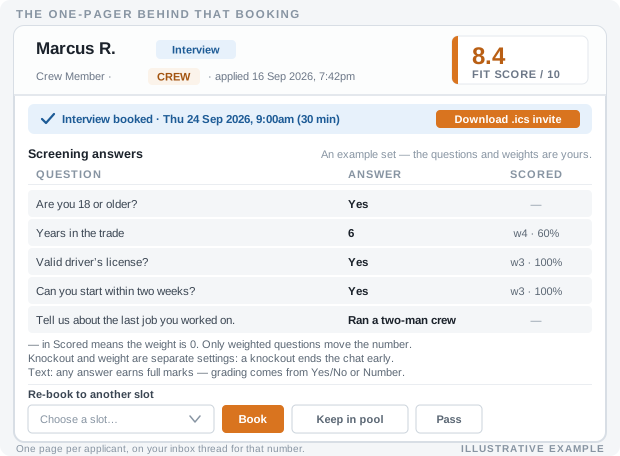
Put “Now hiring — text CREW to your texting number” on the van and the showroom glass. CrewFunnel™ asks seven short questions: is he 18 or older, is he up for carrying glass off ladders and staging, has he shimmed a window plumb and square, how many years installing windows or doors, how far out does he live, can he start inside two weeks, and what was the last job he worked on. Three are knockouts — under 18, unwilling to do the ladder work, or living more than a set distance away — and the rest come back as a weighted fit score.
Two things about that scoring are worth copying. Distance is a knockout and never a weight, because a number answer scores higher the bigger it is, so weighting miles would rank the man furthest away at the top. And free text carries no weight, because any non-empty answer scores full marks and a weighted text box inflates every candidate who typed anything. Both are set that way on our demo job, and all seven questions carry a Spanish translation.
One honest note on delivery. There is no inbound SMS on our side yet, so today he answers those seven questions on your screening page rather than by text — same questions, same knockouts, same scoring, same pool. The keyword on the van takes over the day your carrier registration clears.
See how CrewFunnel works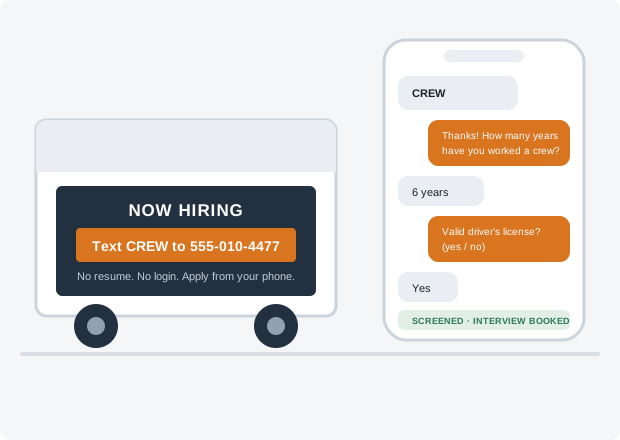
New windows earn their review the first night the draft is gone
She signs off with the capping on, the old units in the trailer and the house still smelling of caulk. That night the wind picks up, she walks past the living-room window in her socks, and the draft she has lived with for years is simply not there. That is the night she would write you a review. The heating bill that shows the difference will not land for a month or more, and by then you are one more van she cannot quite put a name to. The outfit with sixty reviews is not sixty times better than you; somebody there asks every customer, while the house still smells of caulk.
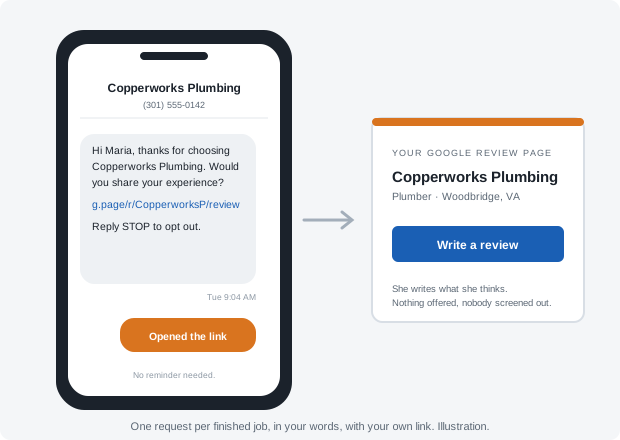
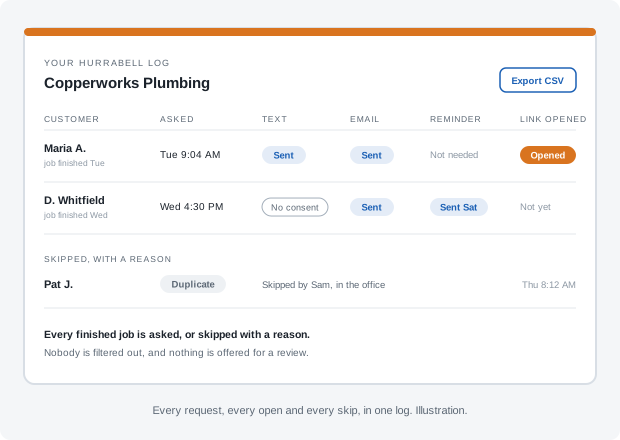
HurraBell™ does the asking. Mark the job done — from the inbox, from your phone, or from your job software through Zapier — and the customer gets one request in your words, with your own Google review link, after a delay you pick: an hour, unless you change it. Three days later, one email reminder, unless the link has been opened or the customer has got back in touch.
Review requests aren’t switched on yet, so none is sent today. When they are, the request goes by email once your Google review link is saved on the HurraBell page and your mailing address on the Account page. A text goes as well where the customer agreed to texts, and only once your carrier registration clears, the same wait as every text on this site; until then it is email only.
See how HurraBell worksOne recovered window job covers 50 months
That is the low end of one ten-window quote against the whole front office. Even the pane you fixed on a wet Tuesday evening covers 1 of them, and it is why she calls you about the rest of the house.
The Tailgate Office Bundle
Instant quotes on your website, missed-call text-back, text-to-apply hiring, review requests, and customers, jobs, estimates and invoices in one place. 30 days free, no credit card, no setup fee, cancel from the dashboard.
Start Free TrialOnly need one of the tools? After the trial you can keep just that one at its own price; the office stays with the Bundle.
Window and door questions we get asked
You can price a range, and only a range. The widget shows a bracket and the disclaimer under it says the final number comes after you measure every opening, because a window is ordered to the opening it goes in. Write that line in your own words: removal, disposal, sealing the perimeter and the interior caulk line are in every window you quote; rot behind an old frame is quoted separately before you start; nothing is ordered until she has the written number.
Because the engine has no rule that multiplies one answer by another, and we would rather tell you here than let you find out on a Tuesday. Count × price-for-that-type is exactly that forbidden multiply. So the demo carries one per-window rate — a standard double-hung installed — and moves it with percentages for frame, glass, access and full-frame work. If you want per-type rates, run a service per type: she picks the type first, and each service has its own per-unit rate. Both work today, and neither lies to her.
It is a simplification, and the help text says so in her own words rather than hiding it: the capping figure is a typical house’s worth of trim, and we true it up when we measure. The reason is in the engine — a flat amount on a yes/no or a pick-one is added once per job, because no rule multiplies one answer by another. Only a count with a multiply behind it is genuinely per unit, which is why the windows and the doors are counts and the capping is not. If four capped openings against fourteen matters to your margin, split it into two services.
Yes, and it is worth knowing why. Windows and doors are separate number questions with their own rates, and both allow zero, so she can ask for one patio slider and nothing else. No rule fires on a number answered zero, so the windows contribute nothing — on the demo one patio door on its own quotes $2,252 to $2,698, and one ground-floor window comes back at $950 to $1,036 because the service minimum catches it.
She is shopping you either way. The difference is whether she does it with your bracket in front of her or with nothing but the other company’s ninety-minute presentation. A homeowner who sees a real range at 9pm, with an honest note about what the measure confirms, stops calling down the list — and the person who wanted ten windows for $4,000 never fills in your callback form at all.
Here is the honest state of it. The design is that your business line stays exactly where it is and keeps ringing as it does now. You turn on forwarding for unanswered calls once, with a code the setup guide gives you, and from then on a call nobody answers in about twenty seconds passes to your own texting number, a local number in your area code registered to your business. A short greeting, in place of your voicemail, tells the caller a text is on its way, and the reply goes out from that texting number. The caller dials one number and hears back from another. It works because the text opens with your business name and thanks them for calling. Forwarding to a mobile, a ring group or a second phone is no obstacle, because the text only fires when nobody picks up. Where the forwarding for unanswered calls gets switched on depends on how your phones are set up: on a mobile it is the code you dial, and on a desk line or an office phone system it is a setting you ask your phone company for. An answering service can keep its hours, because the forwarding is your own setting and can be switched off again. What is running today is the half that needs no carrier: you log the missed call, CallMitt picks the right message for the hour and the day, checks your quiet hours, opt-outs and suppression list, and queues it. Automatic detection and actual delivery switch on when your A2P 10DLC registration clears.
Call it fifteen minutes for your text-back messages and your hours, a minute, once review requests are switched on for your account, to paste your Google review link on the HurraBell page and your mailing address on the Account page, and about an hour to write the nine questions and load your per-window rate, per-door rate, material and glass percentages and your capping and trim fees. A service that quotes will not go live until it carries a real base fee or minimum, which is deliberate. No onboarding call, no setup fee and no contract: $199 a month buys all four tools, and ResponsiBid’s reported $400–600 setup, as published in August 2026, is not a thing here.
Also hang garage doors, or side in siding? See all the trade pages or call (301) 268-1943.
Answer the 7pm call. Quote the ten windows.
Set it up tonight. Free for 30 days, no card, no setup fee, cancel from the dashboard.