
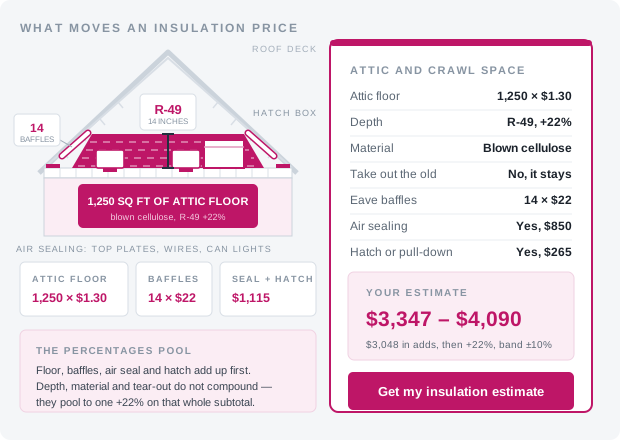

An attic quotes off one number she can pace, and a depth she can pick
The base number here is the footprint under the roof — not the floor area of the house, which is the one thing worth teaching her before she types. Everything after it is a pick-one, a count or a yes/no: how deep you are going, what you are blowing, whether the old material comes out, how many eave bays need a baffle, whether the top plates get sealed first, whether the hatch gets boxed. Nothing is hidden under a layer of something else, which is why this trade can put an honest bracket on a website while plenty of others cannot.
That unit is also where the first card stops. Blown-in is measured against the floor you are covering. Spray foam is measured against the surface the foam lands on, which on the same house is a different measurement — a roof deck is about a fifth bigger than the attic floor beneath it — and it is a different truck, a different crew and a different day. So foam is not an option on the attic dropdown. It is the second service, with its own rate card, and the section below is the whole argument for why.
NapkinPrice™ runs that shop as three services on one account. The attic and crawl space card asks eight questions and puts a range on the screen, the foam card asks seven and prices off its own surface rate, and vermiculite, knob-and-tube and whole-house retrofits go down a third path that never guesses a price at all. Every number any of them shows is the price of the work, before any rebate.
The flow also asks for a photo down the hatch, and the lead tells you to ask for that picture on the callback. Attaching the image itself to the lead is on the roadmap, which is why it is not a tick in that list.
The eight things that set an attic number
One area figure, one count, three pick-ones, two yes/nos and a ZIP. The hardest thing on the whole form is working out how big the attic is, so the help text does that teaching rather than pretending the question is easier than it is. You build the set once in the dashboard and every rate in it is a field you own.
Square feet of attic floor
The base number the whole quote hangs off, and the one place the form asks her to do any arithmetic: there is no length-by-width box in the engine, because no rule multiplies one answer by another. So ask for one total and let the help text teach — it is the footprint under the roof and not the living area, a single-story rancher is roughly the whole house, a Cape Cod attic is usually 500 to 800, a two-car garage ceiling is nearer 450. On our demo card that square foot is $1.30, so 1,250 of them at the usual R-38 depth in blown cellulose — nothing taken out, no baffles, no air sealing, no hatch — comes back $1,463 to $1,788. Set a floor and a ceiling on the answer and the widget refuses a silly number instead of quietly clamping it.
How deep you are going
R-value is depth, and depth is material volume, so it belongs on a percentage of an area-driven subtotal rather than on its own rate. A top-up to about R-30 is minus 25%, R-38 is the rate itself, R-49 — what code asks for in this state — is plus 22% and R-60 is plus 45% on the demo. The help text does not hide the consequence: that percentage lands on the whole job, so it moves the air sealing and the baffles along with the insulation, and the measure is where it is trued up.
What you are blowing, or laying
Blown cellulose at the rate, blown fiberglass minus 8%, fiberglass batts between the joists minus 12%, mineral wool batts plus 80%. Those four really are a percentage of each other — same hopper or same pallet, same crew, same day — and one identical 1,250 sq ft attic at R-38 — air-sealed, nothing taken out, no baffles, no hatch — comes back $2,228 to $2,723 in cellulose, $1,960 to $2,396 in batts and $4,010 to $4,901 in mineral wool. Mineral wool is the wide one and the help text says so out loud: it is about twice cellulose and it comes on a pallet. Spray foam is deliberately not on this list, and the section below is why.
Whether the old material comes out
A percentage and not an allowance, on purpose: taking an old attic out scales with the same floor area that putting a new one in does, so a flat dollar figure would be wrong at both ends. Nothing when it stays and you blow over it — which is most attics — plus 45% for a vacuum truck, a hose out a window and the bags away, plus 80% when there is rodent contamination to clean and sanitize. The worked example below with the old attic vacuumed out instead comes back $4,581 to $5,599.
Eave baffles, as a count
The chutes that stop the new depth burying the soffit vents, because a deeper attic with blocked eaves is a wetter attic. A plain count times your per-baffle rate, $22 on the demo, and a number question with a multiply rule, so fourteen genuinely costs fourteen times one. Let her answer 0 and say nothing is added, because plenty of attics already have them and she can see that from the hatch.
Air sealing the top plates and can lights
A flat amount added once for the job — $850 on the demo — and not a per-square-foot line, because a bigger attic is more holes but it is the same trip, the same foam gun and the same fire-rated collars. It is also the answer that makes the rest of the job work: insulation slows heat, air sealing stops the draught that carries it. Utility programs know that and will not pay for the insulation unless the sealing was done first, which the help text says because it is a fact about the job — not because the widget does anything at all with a rebate.
The hatch or the pull-down stairs
An uninsulated pull-down stair is a two-foot hole in the middle of everything she just paid for, so it is its own yes/no with a flat $265 on the demo — once for the job, on the one opening, trued up on the measure if there turn out to be two. Flat rather than percentage because the box and the weatherstrip cost the same whether the attic is 800 square feet or 2,800.
Travel zone
List your ZIPs by zone — whole ZIPs or three-digit prefixes — and the widget prices the trip from the ZIP she types, most specific match first. A flat charge, a percentage, or both. The demo shop charges nothing on its own island, $75 across the Bay Bridge into Anne Arundel and Howard, and 5% plus $145 for everywhere else it travels. Set one zone to "outside my area" and it declines politely while still capturing the lead.
A real attic, start to finish
Eight questions, about a minute. This is the exact sequence running on our own insulation demo account — a 1970s rancher on Kent Island, 1,250 square feet of attic floor topped up to R-49 in blown cellulose over what is already there, fourteen eave bays baffled, the top plates and the can lights sealed first and the pull-down stairs boxed — and the total at the bottom is what the live pricing engine returns for those answers on a day outside the spring window, not a figure anybody typed into this page.
| # | What she is asked | What she answers | What it does to the price |
|---|---|---|---|
| 1 | About how many square feet of attic or crawl space floor are we covering? | 1,250 | 1,250 × the per-sq-ft rate — $1.30 on the demo, so $1,625. This is THE base number |
| 2 | How deep are we going? | R-49, what the code asks for here | A percent on the whole job: +22%. R-38 is +0%, a top-up −25%, R-60 +45% |
| 3 | What are we blowing, or laying? | Blown cellulose | The rate itself: +0%. Blown fiberglass −8%, batts −12%, mineral wool +80% |
| 4 | Is there old insulation to take out first? | No, it stays and we blow over it | +0%. A vacuum-out is +45%, rodent contamination to clean and sanitize +80% |
| 5 | How many rafter bays need a baffle at the eaves? | 14 | 14 × $22 = $308 — the other genuinely per-unit line, counted by the bay |
| 6 | Air-seal the top plates, the wire penetrations and the can lights first? | Yes | A flat $850 for the job, added once however big the attic is |
| 7 | Box and weatherstrip the attic hatch or the pull-down stairs? | Yes | A flat $265 for the job, on the one opening |
| 8 | Got a photo looking into the attic from the hatch? | Offered | Nothing. A photo never moves the price |
| The arithmetic, in the order the engine runs it | $1,625 + $308 + $850 + $265 = $3,048, then the three percentage answers pool into one and +22% applies once to all of it → $3,718.56 | ||
| She sees | $3,347 – $4,090 | ||
| What lands in your inbox, the second she submits | Name, mobile, ZIP, all eight answers, the photo flag, and the disclaimer she was shown | ||
The $1.30, the $22, the $850, the $265 and the percentages above belong to the demo account, not to a Tailgate Office price list — you set every one of them in the dashboard and you can move a per-square-foot rate the morning the cellulose price does, without touching your website. Two things about those percentages are worth reading twice. They pool rather than compound, so several answers sum into one figure instead of multiplying out. And the pooled figure lands on the whole additive subtotal, so the R-49 depth is charged across the baffles, the air-sealing day and the hatch as well — $1,423 of lines that cost the same money at any depth, which is about $313 of this midpoint. The help text says the depth is figured across the job rather than implying a per-foot rate, and the measure is where it is trued up. What is not illustrative is the total: $3,347 to $4,090 is what the engine returns for those eight answers today, the same job booked between 1 April and 31 May comes back $3,112 to $3,804 on the spring rate, and you can reproduce either one yourself on the demo in about a minute.
Would you rather try it than read about it? We keep a working example insulation company website with NapkinPrice™ embedded — the real engine, quoting live, on a page that is not ours. Put in those eight answers and see the same number come back.
Try the live demo site (opens in a new tab)Blown-in prices off the floor. Foam prices off the surface it lands on.
This is the one design decision that matters in insulation, so here is the whole of it in plain words rather than a promise that it all just works.
There are five kinds of pricing rule in the engine and none of them multiplies one answer by another. A number question can carry a per-unit rate — the attic floor, the baffles, the sprayed surface. A pick-one can add dollars once for the job, or take a percentage of the whole job. What it cannot do is apply its own rate to her square footage, so “the material sets the per-square-foot rate” is a sentence this engine cannot say, and pretending otherwise on a marketing page is how you end up with a product that does not do what the website said.
Between blown-in and foam that gap is three gaps, not one. The price: blown cellulose at R-38 is a little over a dollar for every square foot of attic floor it covers, and two inches of closed-cell is several times that for every square foot of surface it is sprayed on. The crew and the rig: a hopper on a tailgate and one installer with a hose, against a box truck with a proportioner, heated hoses, a drum set you cannot half-use and two operators in supplied-air hoods. And the unit itself, which is the one that settles it — blown-in is measured against the floor you are covering, foam against the surface it is sprayed on, and on the same house those are different numbers. No percentage can bridge that third gap, because a percentage cannot change what is being measured.
Inside each family a percentage is genuinely honest, and the demo proves it both ways. On the attic card, blown cellulose, blown fiberglass, batts and mineral wool run from minus 12% to plus 80%, and the widest one is labelled for what it is rather than buried. On the foam card, open-cell and closed-cell share one rate for a reason worth printing because it is counter-intuitive: closed-cell is about two and a half times open-cell per board foot, but it is sprayed at half the depth or less, so per square foot of wall they land under two to one. One identical 1,400 sq ft of open wall on a gut — nothing stripped out, no containment, her own drywall going over it — comes back $2,268 – $2,828 in open-cell filling the 2x4 cavity and $4,361 – $5,439 in two-inch closed-cell — 1.92 to 1, which a single dropdown can carry without lying.
So it is one instant service per rate card, the same shape the flooring page arrived at for tile against carpet and the siding page for fiber cement against vinyl. The consequence is worth stating plainly, because it is the part a marketing page usually fudges: this page never prints one per-square-foot figure “for insulation”. There is a rate per square foot of attic floor on one card and a rate per square foot of sprayed surface on the other, they are two crews on two different days, and no ratio between those two numbers means anything at all.
Attic and crawl space insulation — quotes instantly
Blown cellulose, blown fiberglass, fiberglass batts and mineral wool, priced off the square foot of floor you are covering — $1.30 of it on the demo card. No trip charge, because the measure sells the job; a $975 job minimum does that work instead, so a 250 sq ft crawl topped up to about R-30 in batts with nothing else on it, whose arithmetic is $205, comes back $975 to $1,073 rather than at what the arithmetic says. There is a ceiling above it too: 2,800 square feet taken to R-60 in mineral wool with a rodent clean-out, sixty baffles, the air sealing and the hatch reaches an $18,528.75 midpoint, so past $13,000 the widget stops pricing and hands you the lead to quote by hand.
Spray foam insulation — quotes instantly, on its own card
Open-cell and closed-cell, priced off the square foot of surface the foam actually lands on, at the two-inch closed-cell spec most of this work is sold at. Its own rate on its own card, not a version of the attic one. Seven questions: the area, the foam and its depth as one spec, where it is going, whether old material has to be stripped out, whether it needs a thermal barrier, whether the living space gets sealed off, and an optional photo that moves nothing. A 1,100 sq ft roof deck in open-cell at 5.5 to 7 inches, sprayed from inside the attic, nothing stripped out, no coating over it and the living space sealed off, quotes at $2,964 to $3,697 — the foam line inside that is $2.73 a square foot of deck, where the trade's own range for open-cell at that depth is $2.50 to $3.20. 900 sq ft of crawl wall and rim in two-inch closed-cell, stripped out first, no coating, sealed off, is $4,829 to $6,023; a rim joist floors at its $1,650 minimum; past $16,000 it routes.
Vermiculite, knob-and-tube and whole-house retrofits — site visit, never priced
Site-visit mode captures the whole spec and shows no number at all, and two of its cases are not "too big to quote" — they are "must not be quoted". Grey pebbly attic material may be vermiculite, which has to be sampled by a lab before anybody disturbs it, and knob-and-tube wiring cannot legally be buried in insulation until an electrician has retired it. A price on either would be the most dangerous number on your website. It asks what brought her, how old the house is, how many floors and whether anything has been tested already, and not one answer moves money. She gets your own "we will come and look" message; you get a lead worth bidding.
The rebate is your best argument and the worst thing you could put inside the number
Utility programs and the federal efficiency credit are real, they pay a meaningful part of an attic job, and they are the reason a homeowner finally books one. They are also why this is the easiest trade on the site to start lying in. This engine has no concept of a credit, a rebate, a utility program or a finance term — it knows base fees, per-unit rates, flat adds, percentages, a minimum, a season and a travel zone, and nothing else. Rebates change yearly and vary by utility, so a hard-coded one would be wrong within twelve months and wrong for half your service area today.
So the demo account keeps one rule without exception, and so does this page: every figure you have read is the price of the work, before any rebate or credit she may go on to claim. Both service disclaimers say that in her words — we do not calculate rebates here, this number is not net of one, we tell you which programs your job qualifies for when we measure and you claim them yourself. The programs are named in exactly one help text, on the air-sealing question, and only to say a utility will not pay for the insulation unless the sealing was done first, which is a fact about the job rather than a fact about the price. A prospect who works out for herself that the real number will be lower has been sold honestly. One shown a net figure the widget cannot reproduce has been sold a bug.
One service carries a discount in spring. The other refuses the work in winter, and that is the more honest answer.
This phone follows the heating bill. It rings from the first cold snap in September through January, it rings again in July when the upstairs will not cool, and between the last heating bill and the first cooling bill it barely rings at all. So the attic service carries a minus 7% spring shoulder rate from 1 April to 31 May — a discount and not an uplift, because it is what the office gives up to keep two people busy in the weeks nobody is thinking about their attic, and the cheapest month to insulate really is the month you are not worried about it. The worked example above is $3,347 to $4,090 today and $3,112 – $3,804 booked on 20 April. A plain window like that one needs no special handling; so does the wrap-around kind our concrete and masonry demos run, and the engine spots which is which on its own.
The foam service carries no season at all, and that is a decision rather than an empty field. Closed-cell foam is a chemical reaction with a temperature window: the drums are held warm and the substrate has to be above about fifty degrees or the foam will not adhere or cure. You cannot buy your way past that, so this shop does not price around it — the crew moves the date, and the disclaimer says exactly that instead of pretending a percentage covers it. An empty season field is a decision you are allowed to make; what you should not do is invent a number to fill the box.
The travel zones stack on top of all of it, and they are the same engine run on the same eight answers with nothing changed but the ZIP: Stevensville 21666 is $3,347 to $4,090, Annapolis 21401 across the Bay Bridge is $3,414 to $4,173, a ZIP in the catch-all zone is $3,645 to $4,454, and a ZIP outside every zone you serve gets no price at all — a polite decline, with the lead still captured. One more seam worth naming because it cuts the other way on the foam card: a pooled percentage lands on everything additive, and the foam options are negative, so on the open-cell example above the pool discounts the $420 containment along with the foam, about $92 of it. Pooling instead of compounding is worth $237 on that same job. A service that quotes will not go live until it carries a real base fee or a real minimum. That is deliberate: a service with neither would happily return $0 to a homeowner, and one bad number on your website costs more than a day of setup.

A phone does not reach into an attic, and the call that books is the one at half seven at night
Your installer is on his knees at the far gable in a respirator with a hose in both hands, and the office shut at five. Roughly 62% of contractor calls go unanswered, about 78% of jobs go to whoever responds first, and voicemail gets a callback around 3% of the time. In a trade where the call comes in the evening, off a heating bill, those three numbers decide how much of the season you keep.
| What a missed insulation call is worth | On the demo account |
|---|---|
| 1,250 sq ft attic to R-49, air-sealed, baffled, hatch boxed | $3,347 – $4,090 |
| The same attic with the old material vacuumed out first | $4,581 – $5,599 |
| 1,100 sq ft of roof deck in open-cell foam, containment in | $2,964 – $3,697 |
| Voicemail callback rate | ~3% |
| One recovered attic pays for | 16 months of the bundle |
| One recovered foam job pays for | 14 months |
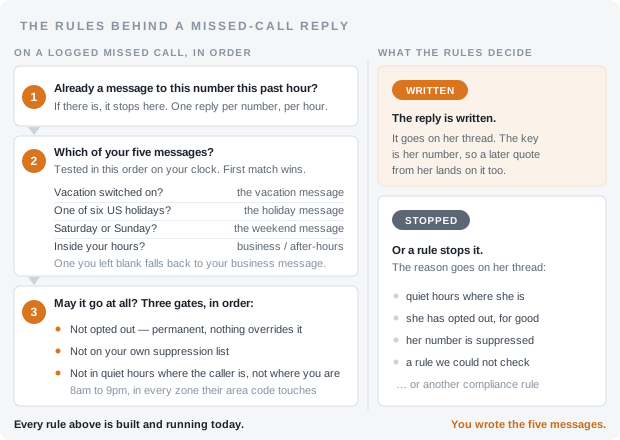
CallMitt™ writes back from your own texting number, a local number registered to your business and not a stranger’s 800 line, and the text opens with your business name, so she replies into the same thread as her quote. The message is picked by the hour and the day, against the hours you actually keep — the demo shop answers 8 to 5, because the crew is loading at half six and the last measure of the day is booked for half four, so that half-seven call honestly gets the after-hours version instead of one claiming somebody is by the phone.
Straight about where this stands. We have no SMS gateway yet and there is no automatic missed-call detection, so today you log the missed call and nothing is sent: a reply queued now is retired rather than delivered when your carrier registration clears. Everything around it is built and running now: the five messages, the business-hours, weekend, holiday and vacation rules, the quiet hours, the opt-out handling, and the thread her reply lands in beside her quote.
How CallMitt Works Run Your Own NumbersAn installer is hired on one question, and it is not about insulation
The work is a 130-degree attic in August or a twenty-four-inch crawl space in February, in a respirator and a disposable suit, dragging a hose behind you. Most people who leave this trade leave over that rather than over the pay, and a résumé never tells you which kind of person you are looking at. Ask it first, in one sentence, before anybody gives up an afternoon.
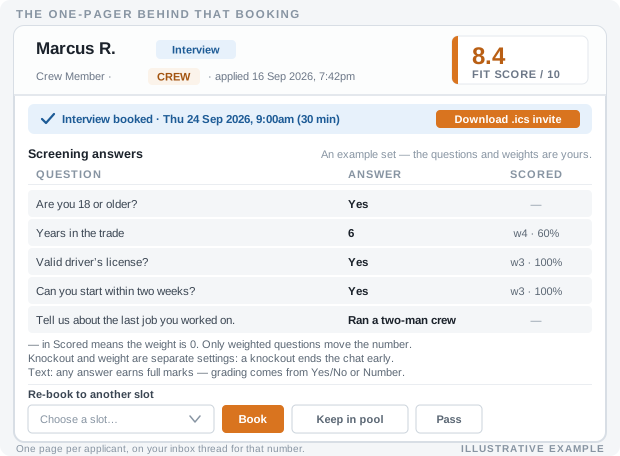
Put “Now hiring — text CREW to your texting number” on the truck and the yard sign. CrewFunnel™ asks seven short questions: is he 18 or older, is he up for hot attics and tight crawl spaces in a respirator and a suit, has he run a blowing machine or a foam rig, how many years has he done insulation or weatherization work, how far out does he live, can he start inside two weeks, and what was the last job he worked on. Three of those are knockouts — under 18, not up for the attics, or living further out than you will drive — and the rest come back as a weighted fit score, years in the trade heaviest, the start date next and the equipment question after it.
Two things about that scoring are worth copying. Distance is a knockout and never a weight, because a number answer scores higher the bigger it is, so weighting miles would rank the man furthest away at the top. And free text carries no weight at all, because any non-empty answer scores full marks and a weighted text box quietly inflates every candidate who typed anything. Both are set that way on our own demo job, and every question on it carries a Spanish translation.
One honest note on delivery. There is no inbound SMS on our side yet, so today he answers those seven questions on your screening page rather than by text — same questions, same knockouts, same scoring, same pool. The keyword on the truck takes over the day your carrier registration clears.
See how CrewFunnel works
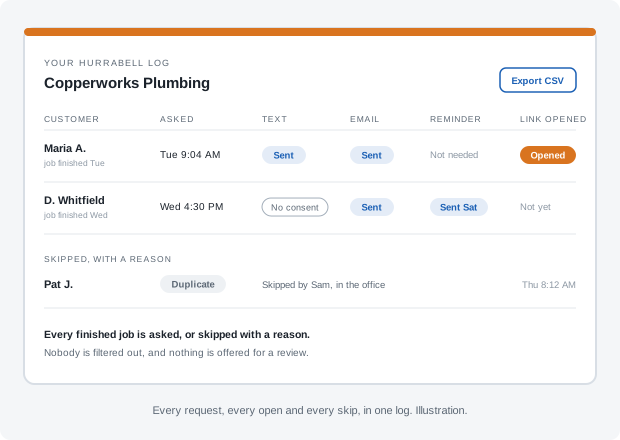
Insulation is proved by the next bill, but the review is won the day the crew leaves
The hoses are rolled up, the hatch is boxed, and from the hallway the attic looks the way it did yesterday. The proof is a month off, on a utility bill. But the day she would write you a review is today, when the crew that spent the afternoon above her ceiling left the house cleaner than they found it and the upstairs bedroom is already holding its heat. By the time the bill lands she will credit the weather. The outfit with sixty reviews is not sixty times better than you; somebody there asks every customer, before the weather gets the credit.
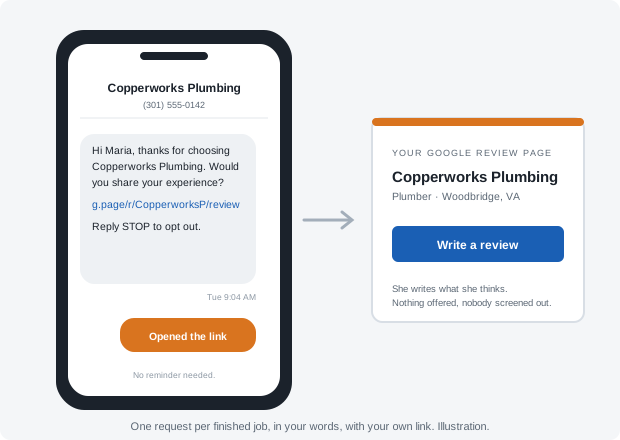
HurraBell™ does the asking. Mark the job done — from the inbox, from your phone, or from your job software through Zapier — and the customer gets one request in your words, with your own Google review link, after a delay you pick: an hour, unless you change it. Three days later, one email reminder, unless the link has been opened or the customer has got back in touch.
Review requests aren’t switched on yet, so none is sent today. When they are, the request goes by email once your Google review link is saved on the HurraBell page and your mailing address on the Account page. A text goes as well where the customer agreed to texts, and only once your carrier registration clears, the same wait as every text on this site; until then it is email only.
See how HurraBell worksOne recovered attic covers 16 months
And one recovered foam job covers 14 of them. In a trade whose phone rings hardest in the eight weeks after the first cold snap, the arithmetic is not close.
The Tailgate Office Bundle
Instant quotes on your website, missed-call text-back, text-to-apply hiring, review requests, and customers, jobs, estimates and invoices in one place. 30 days free, no credit card, no setup fee, cancel from the dashboard.
Start Free TrialOnly need one of the tools? After the trial you can keep just that one at its own price; the office stays with the Bundle.
Insulation questions we get asked
You can price a range, which is all the widget ever shows. The disclaimer underneath says the number is confirmed once you are in the attic, have checked the depth that is already there and have looked for knob-and-tube. Write the rest in your own words — baffles at the eaves, a clean site and the bags hauled away included — and you have a bracket you can stand behind from the kerb. She stops shopping, and the caller who wanted a 2,800 square foot attic taken to R-60 for eight hundred dollars never fills in your callback form at all.
Because no percentage could carry it honestly, and the section above works through why. It is three gaps at once: foam is several times the money, it is a different rig and a different crew on a different day, and — the one that settles it — it is measured against a different surface. Blown-in is priced against the floor you cover; foam is priced against the surface it lands on, and a roof deck is about a fifth bigger than the attic floor beneath it. No percentage can change what is being measured. So there are two rate cards, she picks the family before she answers a question, and this page never prints a single per-square-foot figure "for insulation".
No, and it should not. The number you see is the price of the work, before any utility or federal money you go on to claim. The engine has no concept of a credit or a rebate; it knows rates, flat adds, percentages, a minimum, a season and a travel zone. Rebates also change yearly and vary by utility, so a figure net of one would be wrong within a year and wrong for half a service area today. What our demo shop does instead is the honest version: quote the job, then tell you at the measure which programs it qualifies for so you can claim them yourself. The only place the programs are named in the form is the air-sealing help text, and only to say a utility will not pay for the insulation unless the sealing was done first.
It is the same problem, stopped one step before it becomes one, and it is worth knowing where that line is. Mineral wool genuinely is about twice blown cellulose, it comes on a pallet rather than in a hopper, and the help text says exactly that rather than leaving a homeowner wondering whether the number is broken. One identical 1,250 sq ft attic at R-38, air-sealed, with nothing taken out, no baffles and no hatch, is $2,228 to $2,723 in cellulose and $4,010 to $4,901 in mineral wool. Plus 80 is about as far as a percentage can stretch and still read as a price. Past that it is a service, which is precisely what foam got. If your own spread is wider than ours, split the card rather than stretching the number.
Pooling, for a homeowner. The engine sums every percentage answer into one figure and applies it once to the additive subtotal, which is arithmetic she can follow on a screen at nine at night. The consequence deserves saying out loud in both directions, and this trade shows both. On the attic job the R-49 depth is charged across the air sealing, the baffles and the hatch as well, which cost the same at any depth — about $313 of that midpoint. On the foam card the material options are negative, so the pool discounts the containment along with the foam, about $92 on the worked example, and pooling rather than compounding is worth $237 on that same job. Both are disclosed in the help text, and the measure is where they are trued up. If that is not how you price, put the answer on a flat amount instead. It is a field you own.
That is exactly what it is, and saying so is the point. April and May are this trade's dead weeks — the last heating bill is behind her and the first cooling bill is not here yet — and a blowing crew with nothing booked costs the same as one that is out. So the attic service takes 7% off from 1 April to 31 May, the disclaimer says so in plain words, and the best argument on the whole page falls out of it: the cheapest month to insulate is the month you are not worried about it. Note where it is not. The foam service carries none, because cold is not a discount question there — closed-cell will not adhere or cure on a substrate under about fifty degrees, so that crew moves the date rather than pricing around it, and its disclaimer says that instead.
Call it fifteen minutes for your text-back messages and your office hours, a minute, once review requests are switched on for your account, to paste your Google review link on the HurraBell page and your mailing address on the Account page, and about an hour to write the eight attic questions and load one rate card — your square foot of floor, your baffle rate, your depth and material percentages, your removal percentages and your air-sealing and hatch amounts. Then most of another hour for the foam service, which has its own rate, its own seven questions and a wider band. A service that quotes will not go live until it carries a real base fee or minimum, which is deliberate. No onboarding call, no setup fee and no contract: $199 a month buys all four tools, and ResponsiBid’s reported $400–600 setup, as published in August 2026, is not a thing here.
Also service the equipment that is fighting the cold attic? See the HVAC page, all the trade pages, or call (301) 268-1943.
Answer her while the bill is still on the table.
Set it up tonight. Free for 30 days, no card, no setup fee, cancel from the dashboard.