

Height, trunk, what is underneath, and how a chipper gets to it
Most of a removal price is set by facts a homeowner already has. She can compare the crown to her own roofline, put a piece of string round the trunk four feet up, see what is standing under the drop, and tell you whether the truck parks on the drive or a hundred feet away at the kerb. None of that needs an arborist, which is why this trade can put an honest bracket on a website at nine at night.
What does need an arborist is the wood. Decay up the middle, a bad union at fifteen feet, a lean that is newer than it looks — nobody reads those off a form and nobody reads them off a photograph either. So the demo account is built on that split rather than pretending it away: the trees that come down in a garden with room to work are quoted, and the ones standing over a roof or with the service drop through the crown are not quoted at all. They are a visit, and sometimes a crane.
NapkinPrice™ runs that shop as three services on one account. Removal and stump grinding asks eight questions and puts a range on the screen, pruning and storm clean-up carries your mobilisation charge inside the number instead of springing it at the kerb, and the crane, house and wire work goes down a third path that never guesses a price at all.
The flow also asks for a photo of the tree and what is under it, and the lead tells you to ask for those pictures on the callback. It does not change the number, the help text says so in those words, and attaching the image itself to the lead is on the roadmap — which is why it is not a tick in that list.
The eight things that set a tree number
Two counts, four pick-ones, a yes/no and a ZIP. Nobody is asked to measure anything they cannot measure from the lawn, and the one question that needs teaching — the trunk — gets it in the help text rather than being dressed up as easier than it is. You build the set once in the dashboard and every rate in it is a field you own.
How many trees are coming down
The base count, and the first of only two genuinely per-unit lines on the service: your per-tree rate multiplied by how many are going, $380 on our own demo card. Ask for trunks out of the ground rather than stems, because a multi-stem clump growing off one root plate is one tree and a homeowner will answer four. Everything else on this form is a property of the JOB rather than of each tree, and understanding that before you load a rate card is most of the setup.
How tall the biggest one is
A flat step, added once for the job and not once per tree, because no rule in this engine multiplies one answer by another. Nothing up to roof height, then $280, $640, $980 and $1,650 over eighty-five feet on the demo. That means it is set on the biggest tree and a second big one is trued up on the measure — say so in the help text and nobody is surprised in the garden. And nobody is asked to measure it: a two-storey roof is about twenty-five feet, and the tulip poplar over a Howard County back garden is usually seventy to eighty.
Trunk diameter at chest height
A tape or a piece of string round the trunk about four feet up, divided by three. Nothing under twelve inches, then plus 8, 16, 26 and 38 per cent. It is a percentage rather than a rate because a fat trunk at a given height is more wood, more cuts, a bigger stump and a slower day all at once — the help text says it is figured across the job rather than implying it is a line item, which is the honest way round given where a pooled percent lands.
What is standing underneath it
Open lawn with room to drop it whole, nothing; a fence, a shed or the drive under it, plus 12%; close enough to the house that it comes down in pieces, plus 28%. Two answers are deliberately missing from that list, and the help text names where they went: a tree standing directly over the house and a tree with the service wire running through its crown are on the site-visit service, because neither of them can be priced from a form at any percentage.
Where the chipper and the truck can park
The answer that surprises people most, and the one that most often decides whether a job is a day or two. Every log and every brush pile has to reach the chipper somehow: on the drive beside the tree is nothing, a hundred feet of drag out to the street is plus 8%, and a back garden where everything goes through a gate by hand is plus 24%. That last one is three men walking rather than cutting, and it is labour, so it belongs on a percentage rather than a fee.
A lane closure at the street
The rule kind worth copying. A tree that has to be worked from the carriageway means a county permit, a cone truck and two flaggers standing in the road all day, whatever the tree turns out to weigh — so yes raises the job MINIMUM to $2,200 and adds not one dollar. A thirty-five-foot maple at the kerb whose arithmetic is $1,363 quotes $2,200 to $2,464; the identical answers with that one set to no come back $1,199 to $1,527. A threshold, not a rate, because that is what the cost actually is.
The stump, and where the wood goes
Two answers with two different shapes. Stumps are a plain count at $185 each, the other genuinely per-unit line, and answering 0 fires nothing at all so it needs no yes/no in front of it — dropping the single stump out of the worked example below moves it from $2,244 – $2,856 to $2,023 – $2,574. The wood is a pick-one flat amount added once for the job: nothing to leave the rounds stacked for somebody who burns, $210 to chip the brush and take the logs, $330 to take the lot.
Travel zone
List your ZIPs by zone — whole ZIPs or three-digit prefixes — and the widget prices the trip from the ZIP she types, most specific match first. A flat charge, a percentage, or both. The demo shop charges nothing across Howard County, $45 up to Baltimore County and the city line, $95 out into Montgomery, Prince George’s, Anne Arundel and Frederick, and 5% plus $160 for everywhere else it travels. Set one zone to "outside my area" and it declines politely while still capturing the lead.
A real removal, start to finish
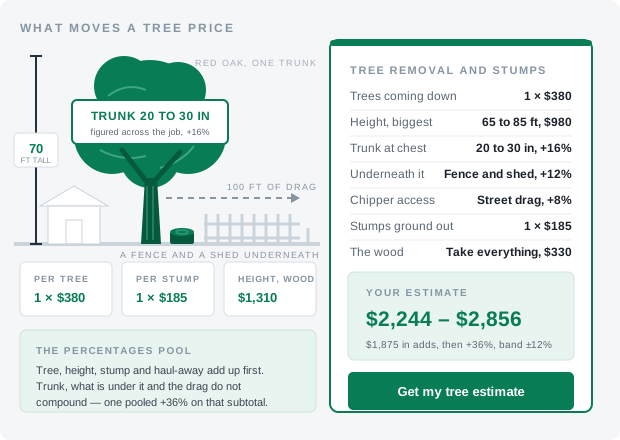
Eight questions and a photo prompt, about a minute. This is the exact sequence running on our own tree demo account — a seventy-foot red oak at a house in Ellicott City, a twenty-eight-inch trunk, the neighbour’s fence under the drop, the chipper on the street with a hundred feet of drag, one stump ground out and everything taken away — and the total at the bottom is what the live pricing engine returns for these answers, not a figure anybody typed into this page.
| # | What she is asked | What she answers | What it does to the price |
|---|---|---|---|
| 1 | How many trees are coming down? | 1 | 1 × the per-tree rate — $380 on the demo. This is THE base number |
| 2 | How tall is the biggest one? | 65 to 85 ft | A flat $980 for the job, not per tree |
| 3 | How thick is the trunk at chest height? | 20 to 30 inches | A percent on the whole job: +16% |
| 4 | What is standing underneath it? | A fence, a shed or the drive | A percent on the whole job: +12%. Over the house is not on this list at all |
| 5 | Where can the chipper and the truck park? | On the street, up to 100 ft of drag | A percent on the whole job: +8% |
| 6 | Is it at the street, where a lane has to be closed? | No | Nothing. Yes would not add a dollar either — it raises the job floor to $2,200 |
| 7 | How many stumps do you want ground out? | 1 | 1 × $185 — the other genuinely per-unit line. 0 fires no rule at all |
| 8 | What happens to the wood? | Take everything, chips and logs | A flat $330 for the job |
| 9 | Got a photo of the tree and what is under it? | Offered | Nothing. A photo never moves the price |
| The arithmetic, in the order the engine runs it | $380 + $980 + $185 + $330 = $1,875, then the three percentage answers pool into one and +36% applies once to all of it → $2,550.00 | ||
| She sees | $2,244 – $2,856 | ||
| What lands in your inbox, the second she submits | Name, mobile, ZIP, all eight answers, the photo flag, and the disclaimer she was shown | ||
The $380, the $980, the $185, the $330 and the percentages above belong to the demo account, not to a Tailgate Office price list — you set every one of them in the dashboard and you can move a per-tree rate the morning your dump fees go up, without touching your website. Two things about those percentages are worth reading twice. They pool rather than compound, so plus 16, plus 12 and plus 8 make plus 36 and not the plus 40.3 you would get by multiplying them out, which on this job would be about $81 more. And the pooled figure lands on the whole additive subtotal, so the trunk, the fence and the drag are charged across the stump and the haul-away too — roughly $185 of this midpoint. The help text says the trunk is figured across the job rather than implying a per-inch rate, and the measure is where it is trued up. What is not illustrative is the total: $2,244 to $2,856 is what the engine returns for those eight answers, and you can reproduce it yourself on the demo in about a minute.
Would you rather try it than read about it? We keep a working example tree company website with NapkinPrice™ embedded — the real engine, quoting live, on a page that is not ours. Put in those eight answers and see the same number come back.
Try the live demo site (opens in a new tab)The picture is for the truck. The number comes from the six facts.
This is the trade where a homeowner most expects a photograph to produce a price, so here is the whole of that in plain words rather than a promise that it all just works.
Be exact about what the photo does here: nothing. There are five kinds of pricing rule in the engine and not one of them reads an image. A photo question carries no rule at all, the pricing function never sees it, and the lead records that a picture was offered rather than carrying a file. Both quoting services on the demo ask for one anyway, and both say in their own help text, in those words, that it does not change the number above. A marketing page that hinted otherwise would be describing a product that does not exist.
What the picture is for is the truck. An arborist looking at a leaning silver maple over a shed learns which rope, which saws and whether to ring the crane company before he drives out — and on a storm call that is worth a great deal. It is worth it on the callback, which is where it sits. What it cannot tell him is whether the union at fifteen feet is sound, whether there is a column of decay up the middle, or whether that lean is six months old or sixty years. A form cannot tell him either, and neither one is going to pretend.
So the number is a range built from what she genuinely has: the height band, the trunk at chest height, what is standing underneath, how a chipper and a truck reach it, the stump and where the wood goes. Six measurable things, an honest bracket, and a written price once somebody has stood under the tree. The removal disclaimer says exactly that, and names decay, a bad union and a fresh lean as the three things nobody can see from a driveway or a photograph.
And where those facts run out, the form stops instead of guessing. A tree standing directly over the house and a tree with the service drop running through its crown are not options on the “what is underneath” question at all — the help text names them, says they are not quoted from a form, and says which service they went to. The first turns on whether a crane can set up within reach, which is a judgement made standing in the street; the second waits on the utility before anybody climbs. This page never prints a price for either, because the fixture cannot compute one.
Removal and stump grinding — quotes instantly
No trip charge on this one, because the estimate sells the day; instead it carries a job minimum of $450 on the demo, so a small dogwood in an open garden comes back $450 to $504 rather than at what its arithmetic says. One answer lifts that floor without adding a dollar: a tree at the kerb where a lane has to be closed is a permit, a cone truck and two flaggers whatever the tree weighs, so it raises the minimum to $2,200. And there is a ceiling above it all — four poplars over eighty-five feet, dragged through a gate by hand, go past $7,500 and the widget stops pricing and hands you the lead to quote by hand, while three of the same come back $6,145 to $7,820.
Pruning, deadwood and storm clean-up — quotes instantly
The work that keeps a crew fed between removals, and the reason the phone rings at seven on a Saturday evening. The mobilisation charge lives in the service base fee — $195 on the demo — so it is added once however many trees are on the list and cannot be dodged by answering the cheapest thing to everything. A sixty-foot white oak deadwooded and thinned by a climber, brush chipped and taken away, quotes at $1,030 to $1,366; one limb off a small tree from the ground with nothing hauled is $452 to $599; a canopy raise off the drive with a bucket truck, wanted this week, is $1,055 to $1,398. Its band is wider than removal at plus or minus 14%, on purpose: nobody knows what is in a broken crown until a climber is in it. Its ceiling is $3,800, so a whole yard cleared after a storm routes to you instead.
Crane work, trees over the house and wires — site visit, never priced
Site-visit mode captures the whole spec and shows no number at all, which is the only honest answer to a red oak standing over a bedroom or a maple with the service drop through its crown. It asks six things — what the situation is, how many trees, how close the nearest building is, whether a crane could set up, whether the wire is the drop to the house, and for a photo — and not one of those answers moves money, because there is no money here to move. They tell you which visit goes first and whether to ring the crane company or the utility before you drive out. She gets your own "we will come and look" message; you get a lead worth bidding.
Neither service carries a season, and that is a decision rather than an empty field
The storm is the event that fills a tree company’s board, and it is exactly the thing a seasonal rate cannot price. A season in this engine is a date range that repeats every year forever, so a “storm premium” would charge a surcharge through every quiet week of every August and nothing at all for the February ice or the August derecho that actually buries you. There is no weather input, no event flag and no way to switch a rate on for one week. So both quoting services carry an empty season field on purpose — the same decision the electrical page made, for the same reason.
The lever that is honest is a question on the form. “How soon do you need us” prices the next opening at nothing, this week at plus 15% and today at plus 35%, because today means moving somebody else and costing that crew their afternoon. It fires on the day the storm happens rather than on a calendar. The same broken limb hanging sixty-five feet up quotes $1,390 – $1,843 for the next opening, $1,501 – $1,990 this week and $1,649 – $2,186 today. The rest of what a storm does to your week is volume rather than price, and volume is the section below.
The travel zones stack on top of all of it, and they are the same engine run on the same eight answers with nothing changed but the ZIP: Ellicott City 21042 is $2,244 to $2,856, Catonsville 21228 over the county line is $2,284 to $2,906, Germantown 20874 is $2,328 to $2,962, a ZIP in the catch-all zone is $2,497 to $3,178, and a ZIP outside every zone you serve gets no price at all — a polite decline, with the lead still captured. A service that quotes will not go live until it carries a real base fee or a real minimum. That is deliberate: a service with neither would happily return $0 to a homeowner, and one bad number on your website costs more than a day of setup.

The wind drops at seven on a Saturday, and forty people ring six tree companies
Nobody is in your office. Nobody is in anybody’s office. Roughly 62% of contractor calls go unanswered, about 78% of jobs go to whoever responds first, and voicemail gets a callback around 3% of the time. On a normal Tuesday those three numbers cost you a job. On the evening after a storm they decide which company gets the whole of the next week.
| What a missed tree call is worth | On the demo account |
|---|---|
| A 70 ft red oak over a fence, one stump, everything taken away | $2,244 – $2,856 |
| A broken limb hanging 65 ft up, wanted today | $1,649 – $2,186 |
| A 60 ft oak deadwooded and thinned, brush taken | $1,030 – $1,366 |
| Voicemail callback rate | ~3% |
| One recovered removal pays for | 11 months of the bundle |
| One recovered pruning job pays for | 5 months |
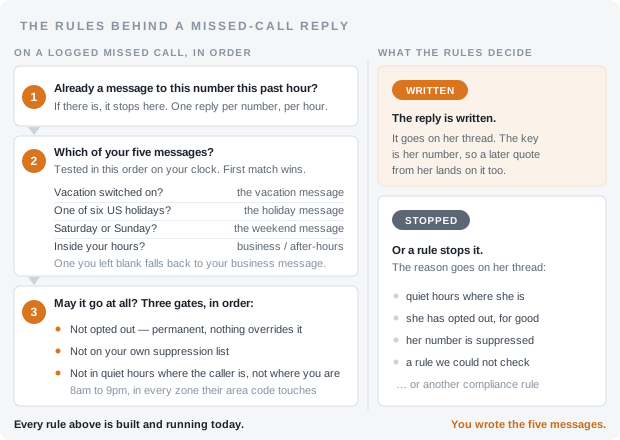
CallMitt™ writes back from your own texting number, a local number registered to your business and not a stranger’s 800 line, and the text opens with your business name, so she replies into the same thread as her quote. The message is picked by the hour and the day, against the hours you actually keep — the demo shop runs 7 to 4, because the saws start when the noise ordinance lets them and the chipper is washed out before the light goes, so a 4:30 call honestly gets the after-hours version instead of one claiming somebody is on a rope. That version asks whether anything is on the house or hanging over somewhere she walks, which is how the genuine emergency identifies itself.
Straight about where this stands. We have no SMS gateway yet and there is no automatic missed-call detection, so today you log the missed call and nothing is sent: a reply queued now is retired rather than delivered when your carrier registration clears. A message that queues and then sits is retired rather than delivered once it is more than an hour old, because a “sorry we missed you” that lands the next afternoon does more harm than silence. Everything around it is built and running now: the five messages, the business-hours, weekend, holiday and vacation rules, the quiet hours, the opt-out handling, and the thread her reply lands in beside her quote.
How CallMitt Works Run Your Own NumbersA climber is hired on two questions, and a résumé asks neither
The first is whether he will leave the ground at all, on a rope, with a saw running. Plenty of good groundmen will not, and that is a perfectly honest answer — but finding it out on day two costs you a week of a three-man crew. The second is the one a résumé never makes clear: has he actually worked off a climbing rope and saddle, or has he cut branches down off a ladder? Both people say “tree work”. Only one of them is going up your oak.
Put “Now hiring — text CREW to your texting number” on the chip truck and the yard sign. CrewFunnel™ asks seven short questions: is he 18 or older, is he up for climbing on a rope and running a saw off the ground, has he worked from a rope and saddle before, how many years has he done tree work, how far out from the yard does he live, can he start inside two weeks, and what was the last job he worked on. Three of those are knockouts — under 18, not willing to leave the ground, or living further out than you will drive — and the rest come back as a weighted fit score, years in the trade heaviest and the start date next.
Two things about that scoring are worth copying. Distance is a knockout and never a weight, because a number answer scores higher the bigger it is, so weighting miles would rank the man furthest away at the top. And free text carries no weight at all, because any non-empty answer scores full marks and a weighted text box quietly inflates every candidate who typed anything. Both are set that way on our own demo job, and every question on it carries a Spanish translation.
One honest note on delivery. There is no inbound SMS on our side yet, so today he answers those seven questions on your screening page rather than by text — same questions, same knockouts, same scoring, same pool. The keyword on the truck takes over the day your carrier registration clears.
See how CrewFunnel works


A tree is reviewed the day the light comes back into the kitchen
The stump is ground out, the chips are raked off the lawn, the crew has blown the drive clean, and for the first time in years there is afternoon light in the kitchen. That is the day she would write you a review, standing at the sink looking at a sky she forgot was there. A week later the view is just the view, and the oak she worried about every time the wind got up is a thing that used to be there. The outfit with sixty reviews is not sixty times better than you; somebody there asks every customer, while the light is still new.
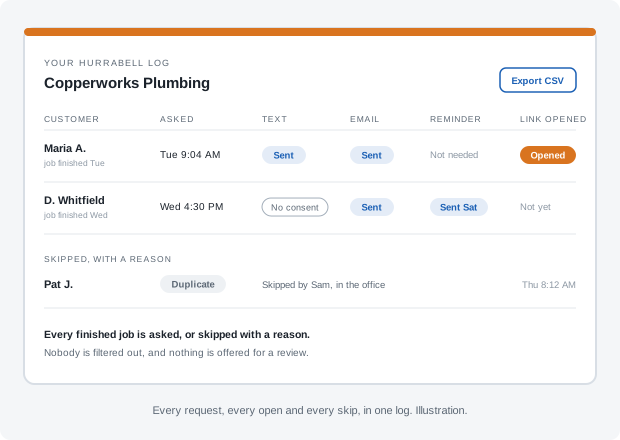
HurraBell™ does the asking. Mark the job done — from the inbox, from your phone, or from your job software through Zapier — and the customer gets one request in your words, with your own Google review link, after a delay you pick: an hour, unless you change it. Three days later, one email reminder, unless the link has been opened or the customer has got back in touch.
Review requests aren’t switched on yet, so none is sent today. When they are, the request goes by email once your Google review link is saved on the HurraBell page and your mailing address on the Account page. A text goes as well where the customer agreed to texts, and only once your carrier registration clears, the same wait as every text on this site; until then it is email only.
See how HurraBell worksOne recovered removal covers 11 months
And a single recovered pruning visit covers 5 of them. After one storm evening the arithmetic stops being close.
The Tailgate Office Bundle
Instant quotes on your website, missed-call text-back, text-to-apply hiring, review requests, and customers, jobs, estimates and invoices in one place. 30 days free, no credit card, no setup fee, cancel from the dashboard.
Start Free TrialOnly need one of the tools? After the trial you can keep just that one at its own price; the office stays with the Bundle.
Tree questions we get asked
No, and the help text on the question says so in those words. No rule kind in this engine reads an image — the photo question carries no rule at all, the pricing function never sees it, and the lead records that a picture was offered rather than carrying a file. What the photo does is tell you which rope, which saws and whether to ring the crane company, which is worth having on the callback and is exactly where it sits. The price comes from the height band, the trunk at chest height, what is standing underneath, how a chipper reaches it, the stump and where the wood goes — and then from an arborist standing under the tree, because decay, a bad union and a fresh lean do not photograph.
You can price a range, which is all the widget ever shows. The disclaimer underneath says the final number comes after an arborist stands under it, and it names what he is looking for. Write the rest in your own words — the permit where the county wants one, the site swept, the hole backfilled — and you have a bracket you can stand behind from the kerb. She stops ringing down the list, and the person who thought a seventy-foot oak over a fence was four hundred dollars finds that out on your website rather than on your morning.
Those two are not on the quoting form at all, and that is the point of the third service. A tree over the roof turns on whether a crane can set up within reach of it, which is a judgement somebody makes standing in your street; a tree with the service drop through its crown waits on the utility to come and drop the line before anybody climbs. Neither is a percentage on a form. So the "what is standing underneath it" question does not offer them, its help text names them and says which service they went to, and that service shows no price at all — it takes the spec, and you ring back to book the visit.
Not as a season, and we are not going to pretend otherwise. A seasonal rate here is a date range that repeats every year forever, so a storm premium would charge every quiet week of every August and nothing at all for the ice storm that actually buries you. There is no weather input and no event flag. What does exist is a question on the form: how soon do you need us, with today at plus 35% and this week at plus 15% over the next opening, because moving somebody else costs that crew their afternoon. That fires on the day. The rest of what a storm does is volume, not price, which is why the answer to it on this page is the phone.
It raises the job minimum to $2,200, which is a different thing from adding a fee and a better description of what the cost actually is. Working a tree from the carriageway means a county permit, a cone truck and two flaggers standing in the road all day whatever the tree turns out to weigh — so the floor moves and the arithmetic underneath is left alone. A thirty-five-foot maple at the kerb whose additions and percentages come to $1,363 quotes $2,200 to $2,464; change nothing but that answer and it comes back $1,199 to $1,527. Set your floor where your smallest street job actually stops being worth doing.
Pooling, for a homeowner. The engine sums every percentage answer into one figure and applies it once to the additive subtotal, so a twenty-eight-inch trunk at plus 16, a fence underneath at plus 12 and a hundred feet of drag at plus 8 make plus 36 rather than multiplying out to plus 40.3 — about $81 on the worked example above. That is arithmetic she can follow on a screen at nine at night, which matters more here than the third decimal place. The consequence worth saying out loud is the other half: because the pool lands on everything additive, the trunk band is charged across the stump and the haul-away too, roughly $185 of that midpoint. If that is not how you price, put the trunk on a flat amount instead. It is a field you own.
Call it fifteen minutes for your text-back messages and your saw hours, a minute, once review requests are switched on for your account, to paste your Google review link on the HurraBell page and your mailing address on the Account page, and about an hour to write the eight removal questions and load one rate card — your per-tree rate, your height steps, your trunk and access percentages, your stump rate and your haul-away amounts. Then most of another hour for the pruning service, which has its own base fee, its own urgency percentages and a wider band. A service that quotes will not go live until it carries a real base fee or minimum, which is deliberate. No onboarding call, no setup fee and no contract: $199 a month buys all four tools, and ResponsiBid’s reported $400–600 setup, as published in August 2026, is not a thing here.
Also clear lots, or grind stumps for other crews? See the landscaping page, all the trade pages, or call (301) 268-1943.
Give her the number while she is still standing under it.
Set it up tonight. Free for 30 days, no card, no setup fee, cancel from the dashboard.