
Your numbers, not our marketing numbers
Everything updates as you type. Nothing gets sent anywhere — this runs entirely in your browser.
Four questions
Estimate is fine. Round numbers are fine.
—
Your weekly volume times your miss rate, across 4.33 weeks.
—
Revenue per month sitting in calls nobody answered. Not all of it is lost — some people call back.
—
Recovered revenue per month
—
Jobs per month you would otherwise never have heard about
—
How long the recovered work takes to cover this month’s bundle.
—
What one month of recovered work pays for at $199 a month.
—
Gross profit on the recovered work, not revenue. This is the number your accountant cares about.
These are estimates built on industry averages and two stated assumptions, not a guarantee. Your market, your reviews and how fast you answer the replies all move the number.
The two assumptions: 55% of your missed calls are real new-job prospects (the rest are suppliers, spam and the same person dialling twice), and a 5-second text-back gets 30% of those back into a live conversation you would otherwise never have had. Both are deliberately conservative — explained below.
And one thing this page owes you: text-back sending switches on with our carrier A2P 10DLC registration. Until it clears, CallMitt™ logs the missed call and composes the reply for you to read rather than delivering it (one held more than an hour is never sent) — so treat every figure above as what the finished send path is worth, not as this month’s receipt.
Why we knock two big holes in our own number
Every vendor calculator you have ever used multiplies missed calls by your average job and shows you a terrifying six-figure total. That number is fiction, and you know it, so you close the tab.
Ours subtracts twice before it says anything.
Cut 1: only 55% of missed calls are prospects
Your call log is full of the lumber yard, the guy about the warranty on a job from 2023, three robocalls about your truck’s extended warranty, and Mrs. Alvarez calling twice in four minutes because she is impatient. We count her once, and we throw the rest out.
Cut 2: only 30% of the rest were truly lost
Plenty of missed callers leave a voicemail, call back tomorrow, or catch you in the truck at 5pm. Those were never lost, so the text-back does not get credit for them. We only count the 30% who would have quietly dialled the next fencing company on Google — because roughly 78% of jobs go to whoever responds first.
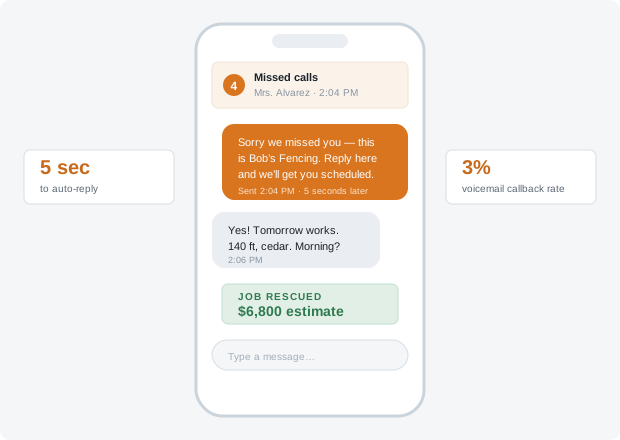
A two-truck pressure-washing outfit, worked end to end
The numbers below are a worked scenario using the same arithmetic the calculator runs. It is a made-up company, plainly labelled as one, because we would rather do arithmetic in public than invent a testimonial.
| Calls per week | 18 | What they told us they get in spring |
| Percent missed | 45% | Two guys on wands, nobody in an office |
| Average job | $650 | House wash plus a driveway |
| Close rate | 40% | Of people they actually reach |
| Missed calls per month | 35 | 18 × 45% × 4.33 weeks |
| Of those, real prospects | 19 | Cut 1: 55% of 35 |
| Revenue riding on those calls | $5,015 | 19 prospects × 40% close × $650 (carried unrounded at 19.3) |
| Conversations the text-back recovers | 6 | Cut 2: 30% of 19 |
| Jobs recovered per month | 2.3 | 6 conversations × 40% close |
| Recovered revenue per month | $1,505 | 2.3 jobs × $650 |
| Days to pay back the $199 | 4 days | $199 ÷ $1,505 × 30.31 days |
| Months of bundle one month covers | 7.6 | $1,505 ÷ $199 |
Two and a bit extra house washes a month. That is the whole pitch. If they only recovered one job every three months they would still be ahead, which is why we price at $199 instead of $499 and why we do not ask for a card to start the trial.
Where every number in here comes from
Four industry figures do the heavy lifting. Here is what each one is, and how much weight we put on it.
62%
of contractor calls go unanswered
Widely reported across home-service call-tracking studies. It is an average across trades, and it is higher for one-truck operations than for shops with an office manager. We do not use it in the math at all — it is only the default suggestion next to the miss-rate field. Your own call log beats it every time, so use that.
78%
of jobs go to whoever responds first
The single most consistent finding in lead-response research, in home services and outside it. This is the reason Cut 2 is set at 30% rather than 5%: if speed decides most jobs, then being the first text a homeowner sees is worth real money. We still assume the other 70% were never yours to lose.
3%
is the callback rate on voicemail
This is the system almost every contractor is running right now by default. Whatever you think your voicemail is doing for you, it is doing about three percent of it. It is not in the formula either — it is context for why the missed-call bucket is worth attacking.
$300–3,000
is the typical home-service job
The range we see quoted across trades, from a driveway wash at the bottom to a fence or roof section at the top. The calculator ignores this entirely and uses whatever you type in the average-job box, because your ticket is your ticket.
These are third-party industry figures, widely cited in home-services research as of August 2026. We have not independently audited the underlying studies, and we are not going to pretend otherwise. That is exactly why the calculator lets you overwrite every one of them with your own numbers.
What this calculator deliberately does not count
All of these are real. None of them are in the number above, because we cannot put a defensible figure on them.
Website visitors who never call
The calculator is about the phone. NapkinPrice™ works on the other 98% of your traffic — the people who looked at your gallery at 9pm and left because there was no price anywhere. That is a separate, usually larger, pile of money.
The cost of an empty seat in a truck
A crew position unfilled since April is a truck running at half capacity all season. CrewFunnel™ exists for that. We are not going to guess what your unfilled position costs, but you can.
Repeat work and referrals
A recovered customer who is happy calls you again next spring and tells their neighbour. Every recovered job here is counted exactly once, at face value.
Your evenings
Not answering the same three questions by phone at 8:40pm has a value. We have no idea how to price it, so it is worth zero in the math above and considerably more than that in real life.
Reviews you never got
You cannot get a five-star review from a homeowner who never reached you. Not counted.
Your actual gross margin
The big orange number is revenue, not profit. The margin card assumes 40% because that is a common mid-point in the trades — if yours is 28%, do that division yourself and the answer is still comfortably above $199.
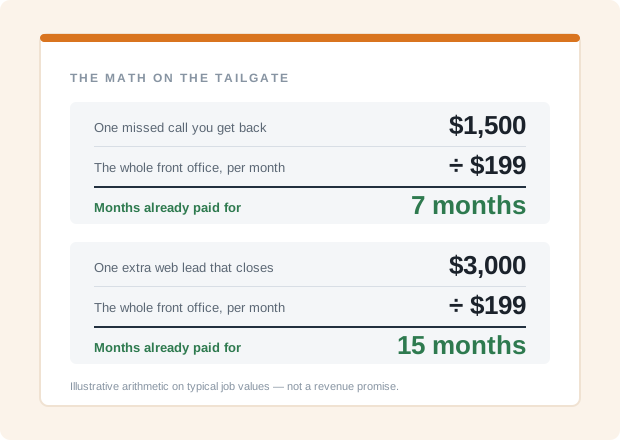
If you would rather skip the arithmetic
The whole product costs $199 a month, which is $6.54 a day. Here is the break-even in the only unit that matters.
Thirty days free, no card. If the dashboard shows you zero missed calls worth chasing at the end of it, do not buy it — and tell us why, because that would be genuinely useful information.
Start Free Trial See full pricingThe office your truck never had.
Set it up tonight. It quotes tomorrow's leads, and every missed call you log gets answered from one inbox. Free for 30 days, no card required.