

A pumper counts tanks, not lids, and that is where people get it wrong
Two lids in the grass is not two jobs. A two-compartment tank has two lids and is still one tank — that is the commonest way a homeowner miscounts her own system — while a pressure-dose setup or a sand mound really does have a second, smaller dose tank with the pump in it. The count is the only genuinely per-unit number on the form. Everything else is a pick-one about the visit: roughly how big it is, how long it has been, whether anybody can still find the lid, and whether the effluent filter comes out while the hose is already in the tank. None of it is hidden under anything, which is why a pumper can put an honest bracket on a website tonight.
It is also why the boundary matters here more than on most trades. From the tank inlet outwards is yours: the tank, the effluent filter, the distribution box, the pump and the field. The drain under the house and the lateral that runs out to the tank are a plumber’s — a different license and a different truck — and the plumbing page already says the same thing from its own side. The tell is the tank itself: if the lowest fixture in the house is backing up and the tank is nowhere near full, the blockage is between the house and you. Our demo account puts that sentence on a question and hands the caller over rather than quoting it.
NapkinPrice™ runs that business as three services on one account. The pump-out asks eight questions and puts a range on the screen, the inspection for a sale or a loan prices the thing that is actually urgent about it, and a drain field — along with a failed system and a bare lot that has never had one — goes down a third path that never guesses a price at all.
The flow also asks for a photo of the lid and one taken far enough back to show where the tank is from the driveway, and the lead tells you to ask for those pictures on the callback. Attaching the image itself to the lead is on the roadmap, which is why it is not a tick in that list.
The eight things that set a pump-out’s number
One count, four pick-ones, two yes/nos and a ZIP. The hardest question on the form is the first one — how many tanks there are — so the help text does that teaching rather than pretending it is obvious. You build the set once in the dashboard and every rate in it is a field you own.
How many tanks
The base number and the only per-unit line on the service: her count times your per-tank rate, $175 on our own demo card. Ask for tanks rather than lids and say why in the help text, because a two-compartment tank has two lids and is one tank, while a pressure-dose system or a mound has a separate dose tank and is two. Set a floor and a ceiling on the answer and the widget refuses a silly number instead of quietly clamping it. On the demo the count runs 1 to 4, and past four this is a campground rather than a house.
How big the tank is
A pick-one percentage rather than four rates, because gallons scale the whole visit — more in the truck, longer on the hose, more at the plant — rather than being a second unit of work. Nothing for the 1,000 gallon tank almost every house here has, minus 12% for a 750 or an older one, plus 18% for a 1,250 and plus 35% for 1,500 and up. Its help text is where you disclose that the base fee sits inside the percentage pool, so the truck charge is marked up along with everything else.
Years since the last pump-out
Three to five years is the normal interval for a family of four. The longer it has been the deeper the sludge, and deep sludge is more time on the hose, more back-flushing to break it up and sometimes a second pass. Nothing, plus 15% and plus 35% on the demo. Say in the help text that it is figured across the visit rather than per tank, because a pooled percentage lands on the whole subtotal and the driver trues it up at the lid.
How we get to the lid
Half of a bad pump-out is finding the lid and digging it out, and that is labour rather than material, so it belongs on a percentage. A riser brings the lid up to the grass and it opens in a minute; a buried lid is a probe, a spade and twenty minutes with the turf lifted and put back; two buried lids, or a tank nobody has opened since the house was built, is a locate before any of that. Nothing, plus 25% and plus 50%.
The effluent filter
A flat amount on a pick-one: nothing, $45 to pull, wash and refit the filter that is in there, $165 to supply and fit a new one. It is the cheapest part of the system and the one that saves the most expensive part of it, and it is worth doing on the visit she has already booked rather than on a second one. Say out loud that it is priced for ONE filter on the job and not once per tank — a flat adder is added once however many tanks there are, so a second screen in a dose tank is trued up on site.
A cracked or buried lid
A yes/no with your own flat amount behind it — $385 on the demo, for a watertight riser and a bolted-down lid brought up to the grass while the hole is already open, which is the only time it is cheap. A cracked concrete lid is the one genuinely dangerous thing in somebody’s garden, and a buried one means paying to dig for it every three years for as long as she owns the house. Priced once for the job, on the tank you are pumping.
Backing up, or sewage showing
The answer that raises the job MINIMUM to $525 and adds no dollars at all. Coming out to a tank that is already over, pumping it down and then finding out why is a different visit from a scheduled pump-out, and it has never come in under that figure — so the plain annual job, whose arithmetic is $340, quotes at $525 to $578 with a yes on this question, because the floor clamps the low end up rather than sitting under it. The help text is also where you tell her that if the tank turns out to be nowhere near full the blockage is a plumber’s, and that you will say so at the lid rather than after the invoice.
Travel zone
List your ZIPs by zone — whole ZIPs or three-digit prefixes — and the widget prices the trip from the ZIP she types, most specific match first. A flat charge, a percentage, or both. The demo shop charges nothing at home in Cecil County, 6% down Route 40 into Harford, 10% over the Susquehanna into northern Baltimore County and Carroll, 14% round to Kent and Queen Anne’s, and 22% everywhere else it travels. Percentages and no flat adder, deliberately: a third of what this account sells routes with no price, and a dollar figure has no business sitting in a lead that never produced one. Set one zone to "outside my area" and it declines politely while still capturing the lead.
A real pump-out, start to finish
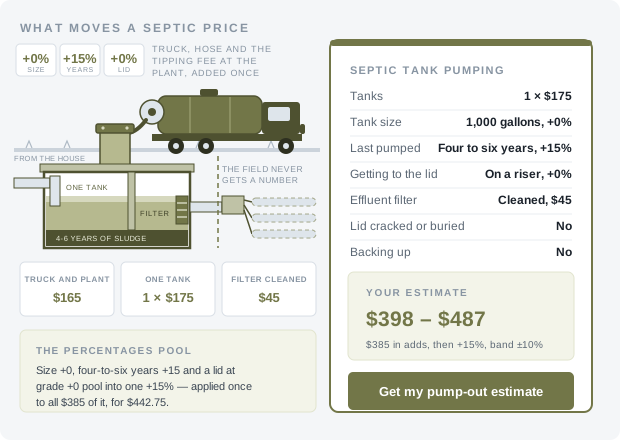
Eight questions, about a minute. This is the exact sequence running on our own septic demo account — one 1,000 gallon tank at a house outside Elkton, the lid already on a riser at grade and sound, four to six years since the last pump-out, nothing backing up, with the effluent filter pulled, washed and refitted while the hose is already in the tank — and the total at the bottom is what the live pricing engine returns for these answers and nothing else, not a figure anybody typed into this page.
| # | What she is asked | What she answers | What it does to the price |
|---|---|---|---|
| 1 | How many tanks are we pumping? | 1 | 1 × the per-tank rate — $175 on the demo. The only per-unit line here |
| 2 | How big is the tank? | About 1,000 gallons | The standard case: +0%. A 750 is −12%, a 1,250 is +18%, 1,500 and up is +35% |
| 3 | When was it last pumped? | Four to six years ago | A percent on the whole job: +15%. Never since we moved in is +35% |
| 4 | How do we get to the lid? | At grade, on a riser | Nothing. A buried lid is +25%; two buried, or a lost tank, is +50% |
| 5 | Do the effluent filter while the tank is open? | Clean and refit it | A flat $45 for the job, not per tank. A new filter fitted is $165 |
| 6 | Is the lid cracked, or buried with no riser? | No | Nothing. Yes adds a flat $385 for a watertight riser and a bolted lid |
| 7 | Is it backing up, or is sewage showing in the yard? | No | Nothing. Yes would not add a dollar either — it raises the job floor to $525 |
| 8 | Got a photo of the lid, or of where the tank is? | Offered | Nothing. A photo never moves the price |
| The arithmetic, in the order the engine runs it | $165 truck + $175 tank + $45 filter clean = $385, then the three percentage answers pool into one and +15% applies once to all of it → $442.75 | ||
| She sees | $398 – $487 | ||
| What lands in your inbox, the second she submits | Name, mobile, ZIP, all eight answers, the photo flag, and the disclaimer she was shown | ||
The $175, the $45, the $385 and the percentages above belong to the demo account, not to a Tailgate Office price list — you set every one of them in the dashboard. Three things about that arithmetic are worth reading twice. The percentages pool rather than compound: dig a buried lid out on the same job and the plus 15 for sludge and the plus 25 for digging make plus 40, not the plus 43.75 you would get by multiplying them out, and the engine returns $485 – $593 for exactly that. The base fee sits inside the pool, so the $165 truck carries the same 15% as everything else — a bigger share on a small ticket than it looks, which is why the tank-size question’s help text says so. And the pooled figure lands on the whole additive subtotal, so the sludge band is charged across the filter as well: run the same job with the filter left alone and the engine returns a midpoint of $391.00 against this one’s $442.75, so the $45 filter clean actually costs $51.75 here. What is not illustrative is the total: $398 to $487 is what the engine returns for those answers, and you can reproduce it yourself on the demo in about a minute.
Would you rather try it than read about it? We keep a working example septic website with NapkinPrice™ embedded — the real engine, quoting live, on a page that is not ours. Put in those eight answers and see the same number come back.
Try the live demo site (opens in a new tab)The pump-out quotes cleanly. A drain field does not, and says so.
This is the one design decision that matters in this trade, so here is the whole of it in plain words rather than a promise that it all just works.
A pump-out is a known quantity before anybody arrives. You know how many tanks there are, roughly how big they are, how long it has been and whether anybody can lift the lid, and those four answers really do carry the price. That is why this trade sits at the honest end of the estate: eight questions produce $398 – $487 for the job above, $315 – $374 for a plain annual pump-out on a 1,000 gallon tank done inside three years, lid at grade and sound, with the filter left alone, and $580 – $708 for the same job above with two tanks emptied on one visit, and all three are numbers you would say on the phone.
A drain field is not that, and the reason is worth saying properly. A field is priced by what is under the ground and by what the county will let you do: how the soil percolates, whether a repair area was ever set aside on the original permit, where the well and the property lines are, whether the lot will take a gravity trench or has to have a sand mound built on top of it, and what the health department wants before it signs. That last one is not even a measurement — it is somebody else’s decision. The published market range for the work is eight to twenty-five thousand dollars and for a pump-out three to six hundred, and both of those are trade figures rather than anything this engine produced. The spread on a field is not shyness about the number. It is the number.
So the field routes. It is the first case on the site-visit service, that service carries six questions and not one pricing rule, and this page never prints a per-foot, per-trench or per-system figure for a field, because the fixture cannot compute one. That is the same discipline the chimney page keeps for a stainless liner and the masonry page keeps for natural full-bed stone: the engine has five kinds of pricing rule and none of them can carry a job whose cost lives under somebody’s lawn and in a permit file.
The same service is where the boundary with the plumber is drawn, and it is drawn to agree with plumbing rather than to argue with it. The first question’s help text gives the tell in one line: if the lowest fixture in the house is backing up and the tank is nowhere near full, the blockage is between the house and the tank, and that is a plumber’s work. If the tank is full to the lid, it is yours. Neither account quotes the other’s job, and a homeowner who lands on the wrong one is told so on the question rather than after the visit.
Tank pumping and effluent filter service — quotes instantly
The work that fills the book, and it is deliberately the one this account leads with. The truck, the hose and the tipping fee at the plant live in the base fee — $165 on the demo — so it is added once however many tanks there are and cannot be answered around. A plain annual pump-out, one 1,000 gallon tank done inside the last three years, lid at grade and sound, nothing backing up and the filter left alone, is $315 to $374. The visit most people actually book, the same tank four to six years on with the filter pulled and washed, is $398 to $487; supply and fit a new filter instead and it is $523 to $639; dig a buried lid out first and it is $485 to $593; never pumped since they moved in is $468 to $572; a 1,500 gallon tank is $520 to $635; two tanks on one visit is $580 to $708. The cheapest answer set possible — a 750 gallon tank done inside three years, lid at grade, nothing else — floors at $315 to $347 rather than at the $299.20 its arithmetic works out to. And there is a ceiling: two big tanks never pumped, both lids lost, a new filter, a riser and sewage in the yard reaches $2,343, so past $2,000 the widget stops pricing and hands you the lead to quote by hand.
Septic inspection for a sale or a loan — quotes instantly
The tank located and opened, sludge and scum measured off the baffles, the filter checked, the distribution box lifted where you can get at it, the field walked and probed, and a written report with the photographs in it. Its own base fee of $195 for the trip, the probe and the report, its own $425 minimum, and a band of plus or minus 8% — TIGHTER than the pump-out, on purpose, because a fixed visit and a fixed report is a better-known job than a tank nobody has opened. One tank for a sale, lids at grade and the field mown, on the county’s own form, wanted inside five business days, quotes at $552 to $648; change nothing but the date and say you are at the settlement table this week and it is $644 to $756; the same house where nobody knows where the tank or the field is, is $759 to $891; two tanks for a lender that will not close without it, lids buried, is $1,071 to $1,258. The cheapest report possible — one tank for a sale, lids at grade and the field mown, your own form, any time in the next fortnight — floors at $425 to $459 rather than at its $380 arithmetic. Four tanks nobody can find, on a lender’s form, at the settlement table reaches $2,268.25 and routes, because past $1,500 that is a survey and a survey gets a visit first.
Drain fields, failed systems and new installs — site visit, never priced
Site-visit mode captures the whole spec and shows no number at all, which is the only honest answer to a field that will not take water, a system a county or a lender has just failed, a dose pump that has quit, or a bare lot that has never had a system on it. It asks what it is doing, what kind of system is out there, roughly how far the tank is from where a truck can park, whether anybody has opened it in the last year and whether sewage is surfacing right now — and not one of those answers moves money. The distance question says out loud that the answer is for loading the truck and not for the price, which is the whole argument for this service in one sentence. The mode is in the service name because the picker shows the name and nothing else. She gets your own "we will come and look" message; you get a lead worth bidding.
Not one of the three services carries a season, and that is the harder decision.
A seasonal percentage is honest when a dated physical event creates a capacity constraint on deferrable work. The chimney page has one because people light the first fire on the first cold weekend and from 1 October every sweep in the county is booked for twelve weeks, and the gutter page applied the same test to leaf fall. Septic has no such date. A pump-out is genuinely deferrable, but its demand is set by the last pump-out and by how many people are living in the house, not by the calendar. There is a March and April bump when the frost comes out and the wet fields show themselves, and that is a demand intuition rather than a dated capacity constraint. It is not enough, so the field is left empty on purpose.
The inspection service refuses one for a reason that transfers word for word from the chimney page: a settlement date does not care what the weather is doing. Charging a seller 15% more in October because other people are having tanks pumped is a surcharge dressed up as a season. What that service prices instead is the thing that genuinely is urgent about it — how soon the report is needed, at nothing, plus 20% or plus 40% — as its own visible question she can see and answer. Run the same sale inspection in the middle of November and it is still $552 to $648, to the dollar. Its disclaimer says so in words: no seasonal rate applies here at any time of year.
And a season may never go on the routing service at all, which is the half of this the engine hides. A site visit throws the midpoint away, so a season there moves no money — but the thread that lands in your inbox is written outside that branch, so a routing service with a season row writes a percentage into a lead that has no price. The travel-zone line carries the same trap one step further along: it prints a dollar amount whenever a zone charges a flat trip fee, routed leads included. That is why every zone on this account is a percentage and not one of them charges flat dollars. On a business where a third of the work routes, a dollar figure in a lead that never produced a price is the one thing worth engineering out.
The zones stack on top of all of it, and they are the same engine run on the same eight answers with nothing changed but the ZIP: Elkton 21921 is $398 to $487, Aberdeen 21001 is $422 to $516, Westminster 21157 is $438 to $536, Chestertown 21620 is $454 to $555, a ZIP in the catch-all ring is $486 to $594, and a ZIP outside every zone you serve gets no price at all — a polite decline, with the lead still captured. On a small job the trip is a much bigger share and it should be: the same $315 to $374 annual pump-out quotes $373 to $456 out in the catch-all ring, and the sale inspection goes from $552 to $648 up to $673 to $791. A service that quotes will not go live until it carries a real base fee or a real minimum. That is deliberate: a service with neither would happily return $0 to a homeowner, and one bad number on your website costs more than a day of setup.
The hose is running and the phone is in the truck
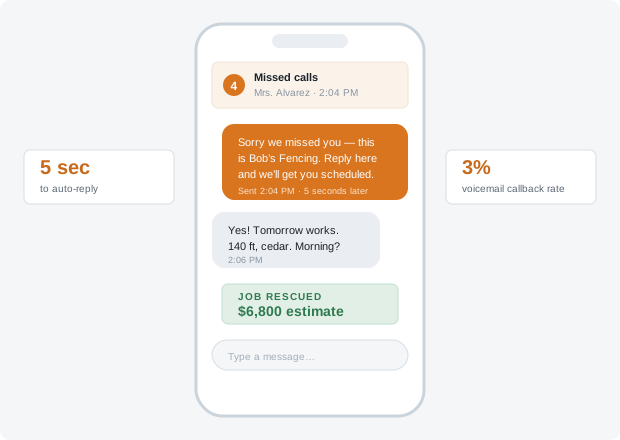
There is nowhere in this trade where answering a phone is a judgment call: you are stood over an open tank with both hands on a four-inch line, or you are flat out in somebody’s lawn with a probe looking for a lid. Roughly 62% of contractor calls go unanswered, about 78% of jobs go to whoever responds first, and voicemail gets a callback around 3% of the time. A homeowner whose drains are slow is not leaving one message and waiting; she is working down the list until somebody picks up.
| What a missed septic call is worth | On the demo account |
|---|---|
| One 1,000 gallon tank pumped, four to six years on, filter cleaned | $398 – $487 |
| A plain annual pump-out, lid at grade, filter left alone | $315 – $374 |
| A buried lid dug out with a watertight riser fitted while it is open | $970 – $1,186 |
| A sale inspection, county’s own form, inside five business days | $552 – $648 |
| Two tanks inspected for a lender that will not close without it | $1,071 – $1,258 |
| Voicemail callback rate | ~3% |
| One recovered pump-out pays for | 2 months of the bundle |
| One recovered riser job pays for | 4 months |
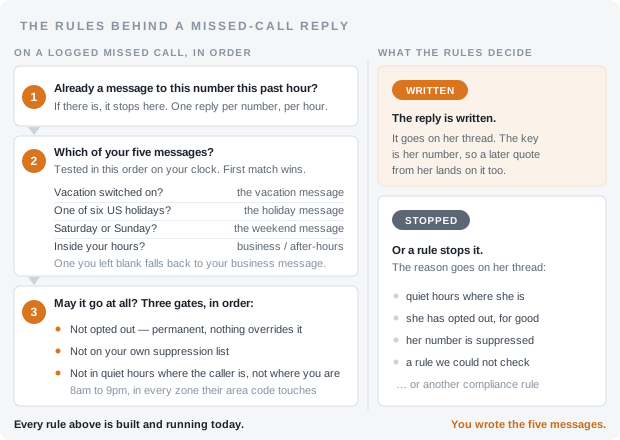
CallMitt™ writes back from your own texting number, a local number registered to your business and not a stranger’s 800 line, and the text opens with your business name, so she replies into the same thread as her quote. The message is picked by the hour and the day, against the hours you actually keep — the demo shop runs 7 to 4, because the truck rolls at seven for the tank that has to be done before somebody leaves for work, and the plant that takes the load shuts its gate at four, so a full tanker with nowhere to go is a truck that does not work tomorrow. A 4:20 call honestly gets the after-hours version instead of one claiming somebody is still on a route.
Straight about where this stands, and this is the one paragraph on this page that is about us rather than about you. We have no SMS gateway yet and there is no automatic missed-call detection, so nothing reaches a homeowner’s handset today — you log the missed call and the reply is composed and held against your rules, and the sending half waits on your carrier registration. Everything around it is built and running now: the five messages, the business-hours, weekend, holiday and vacation rules, the quiet hours, the opt-out handling, and the thread her reply lands in beside her quote.
How CallMitt Works Run Your Own NumbersA pumper is hired on two questions, and a résumé answers neither
The first one is not about experience. It is standing over an open tank in February with a four-inch hose in both hands, in the mud, with the smell all day and no part of the job where it gets better. Plenty of people will tell you they are fine with that across a table. Finding out on day two that they are not costs you the day and the whole route behind it. The second is the credential that actually gates who can drive the truck at all: a Class B CDL with the tanker endorsement. Somebody who has started on it is worth more than somebody who has never heard of it, and a résumé almost never makes clear which one you are reading.
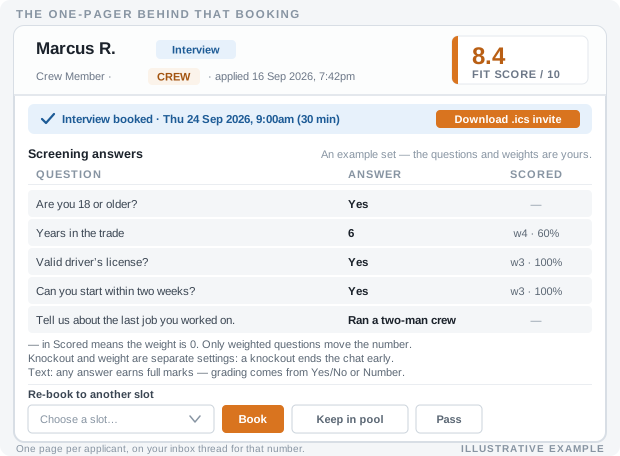
Put “Now hiring — text CREW to your texting number” on the truck and the yard sign. CrewFunnel™ asks seven short questions: is he 18 or older, is he up for open tanks and hose in the mud in any weather, has he got the Class B with the tanker endorsement or started working toward it, how many years has he pumped tanks or installed systems, how far out does he live, can he start inside two weeks, and what was the last job he worked on. Three of those are knockouts — under 18, not up for the work, or living further out than you will drive — and three come back as a weighted fit score, years in the trade heaviest and the start date next.
Two things about that scoring are worth copying. Distance is a knockout and never a weight, because a number answer scores higher the bigger it is, so weighting miles would rank the man furthest away at the top. And free text carries no weight at all, because any non-empty answer scores full marks and a weighted text box quietly inflates every candidate who typed anything. Both are set that way on our own demo job.
One honest note on delivery. There is no inbound SMS on our side yet, so today he answers those seven questions on your screening page rather than by text — same questions, same knockouts, same scoring, same pool. The keyword on the truck takes over the day your carrier registration clears.
See how CrewFunnel works
Nothing to see is the whole job, and the review is the only proof it happened
The tank is pumped, the lid is back, the sod is tamped down over it, and by evening the only sign you were there is a set of wheel marks on the drive. Nobody photographs a pump-out. The one thing that will ever show the next customer the work was done properly is what this one writes about it, and she will write it this week or not at all: by next month the system is back to being something she does not think about. The outfit with sixty reviews is not sixty times better than you; somebody there asks every customer, before the grass grows back.
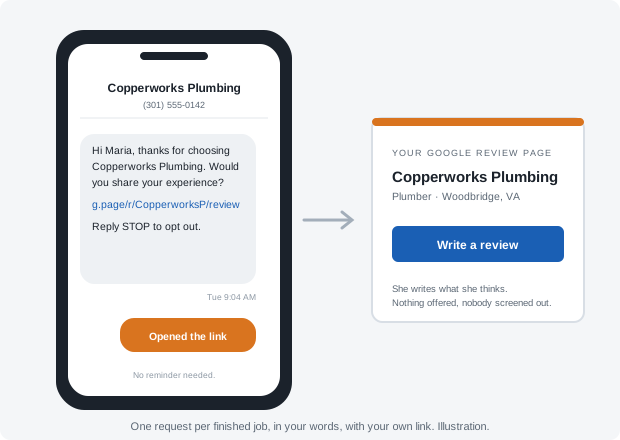
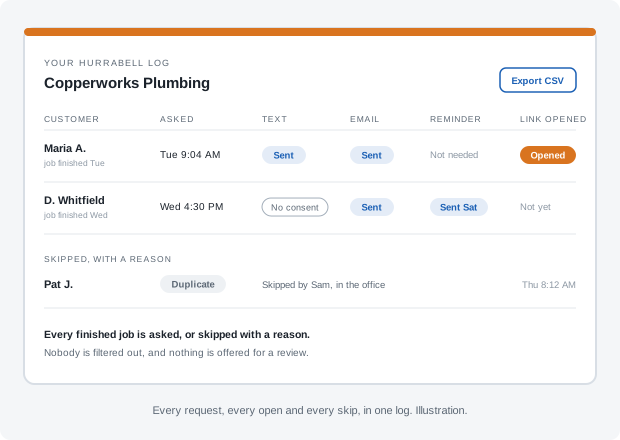
HurraBell™ does the asking. Mark the job done — from the inbox, from your phone, or from your job software through Zapier — and the customer gets one request in your words, with your own Google review link, after a delay you pick: an hour, unless you change it. Three days later, one email reminder, unless the link has been opened or the customer has got back in touch.
Review requests aren’t switched on yet, so none is sent today. When they are, the request goes by email once your Google review link is saved on the HurraBell page and your mailing address on the Account page. A text goes as well where the customer agreed to texts, and only once your carrier registration clears, the same wait as every text on this site; until then it is email only.
See how HurraBell worksOne recovered pump-out covers 2 months
And a single recovered annual pump-out on a lid already at grade covers 1 of them. In a trade of small tickets booked a route at a time, that is the arithmetic that matters.
The Tailgate Office Bundle
Instant quotes on your website, missed-call text-back, text-to-apply hiring, review requests, and customers, jobs, estimates and invoices in one place. 30 days free, no credit card, no setup fee, cancel from the dashboard.
Start Free TrialOnly need one of the tools? After the trial you can keep just that one at its own price; the office stays with the Bundle.
Septic questions we get asked
You can price a range, which is all the widget ever shows. On this trade the range is tighter than most, because the four things that set the price — how many tanks, roughly how big, how long it has been and whether anybody can lift the lid — are all knowable before the truck leaves the yard. The disclaimer underneath says the rest in your words: the tank drawn down to the bottom rather than skimmed, both baffles checked, the filter looked at, the lid sealed before you leave, and that if you find a cracked baffle, a collapsed lid or a field that will not take water you stop, show her, and quote that after a visit rather than on the form. She stops shopping, and the person who wanted a tank pumped for ninety dollars never fills in your callback form at all.
Because the engine cannot carry it honestly, and pretending otherwise is how you end up with a product that does not do what the website said. A field is priced by what is under the ground and by what the county will permit: how the soil percolates, whether a repair area was ever set aside on the original permit, where the well and the property lines are, and whether the lot will take a gravity trench or has to have a mound built on it. That last one is somebody else’s decision rather than a measurement. Eight to twenty-five thousand dollars is the honest market spread and the spread is the answer. So it routes to a site visit, the service carries six questions and not one pricing rule, and nothing on this page prints a per-foot or per-system figure for a field. The same shape the chimney page uses for a liner and the masonry page uses for natural stone.
At the tank inlet, and the demo says so on a question rather than finding out at the invoice. The tank, the effluent filter, the distribution box, the pump and the field are yours. The drain under the house and the lateral running out to the tank are a plumber’s — a different license and a different truck. The tell is the tank itself: if the lowest fixture in the house is backing up and the tank is nowhere near full, the blockage is between the house and you, and the honest move is to say so at the lid and hand her over. The plumbing page draws the same line from its own side, in its own words, and the two accounts meet at the tank inlet without either one crossing it. Most systems need one of you, not both, and telling her which is worth more than a quote she has to unpick later.
Because a season has to be a dated capacity constraint on deferrable work, and this one is not. The chimney account carries plus 15% from 1 October because people light the first fire on the first cold weekend and every sweep in that county is then booked for twelve weeks. There is a bump here when the frost comes out and the wet fields show themselves in March and April, but that is a feeling about demand rather than a date, and an empty season field is a decision you are allowed to make. It matters most on the inspection: a settlement date does not care what the weather is doing, and a seller is not the one whose tank is full. That service prices the thing that actually is urgent — how soon the report is needed — as its own question she can see and change, so the same sale inspection is $552 to $648 in July and $552 to $648 in November.
Because that is what the rule kind does, and the help text says so rather than leaving her to find out. A flat amount on a dropdown or a yes/no is added once for the job however many tanks she entered — so $45 is one filter cleaned, on the tank you are pumping, and a second screen in a dose tank is trued up on site. Only the tank count multiplies. The seam worth naming is the other direction: a pooled percentage lands on the whole additive subtotal, riser included. Add the $385 riser to the plain annual pump-out, where no percentage is running, and the midpoint moves by exactly $385.00. Add the same riser to a job already carrying plus 40% for sludge and a buried lid and the midpoint moves by $539.00 instead. The access band belongs there — digging a lid out and then setting a riser over the hole genuinely is one job — and if that is not how you price a riser, a per-unit rate on its own question is a field you own.
It handles it the way you would on the phone: by refusing to quote it like a scheduled pump-out. Backing up is a yes/no that raises the job MINIMUM to $525 and adds no dollars at all, because coming out to a tank that is already over, pumping it down and then finding out why is a different visit and it has never come in under that. The plain annual job, whose arithmetic is $340, comes back at $525 to $578 with a yes on that question — the floor clamps the low end up rather than sitting under it. One limitation worth knowing before you sell against it: the engine has no dimension below a calendar date, so there is no way to express an after-hours or a weekend rate anywhere in this product. A 2am call out is real work in this trade and nothing here prices it. The form takes the lead, the minimum keeps the number honest, and the night rate is a conversation you still have yourself.
Call it fifteen minutes for your text-back messages and your working hours, a minute, once review requests are switched on for your account, to paste your Google review link on the HurraBell page and your mailing address on the Account page, and about an hour to write the eight pump-out questions and load one rate card — your per-tank rate, your tank-size and sludge percentages, your lid-access bands, your filter amounts and your riser. Then most of another hour for the inspection service, which has its own base fee, its own per-tank rate, its own urgency question and a tighter band. A service that quotes will not go live until it carries a real base fee or minimum, which is deliberate. No onboarding call, no setup fee and no contract: $199 a month buys all four tools, and ResponsiBid’s reported $400–600 setup, as published in August 2026, is not a thing here.
Run the drain lines out to the tank as well? See the plumbing page, all the trade pages, or call (301) 268-1943.
Give her the number before she rings the next one.
Set it up tonight. Free for 30 days, no card, no setup fee, cancel from the dashboard.