
A handyman sells hours. The list is what fills them.
Every other trade on this site prices one thing done well: a roof, a driveway, a panel change. A handyman’s job is a basket — a faucet and two doors and a hole in the drywall, all on the same afternoon — and that is why this trade is the hardest quoting fit in the whole estate. The answer is not to price the basket. It is to price the hours, because hours are what you actually sell, and then to let her tick what is going in them.
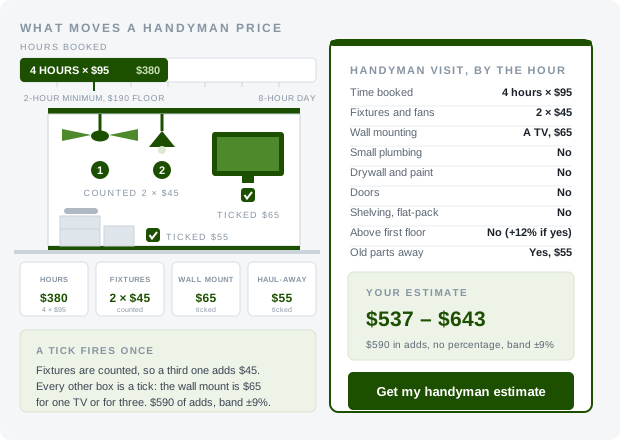
So question one is how long to book, at your hourly rate with a two-hour minimum under it, and everything after it is an adder on top of the hours rather than instead of them. Each tick is the hardware, the fittings, the consumables and the supply-house run that one task drags in — the mount and the lag bolts, the supply lines and the wax ring, the compound and the primer. She buys the TV, the faucet and the fixture; you bring everything that fastens them to the house. That sentence is what makes a $65 adder honest instead of a markup nobody explained.
NapkinPrice™ runs that shop as three services on one account. The hourly visit prices a list, a flat-price menu prices the caller who has exactly one thing wrong and does not want to buy two hours to get it fixed, and a whole-house list or a rental turnover goes down a third path that never guesses a price at all.
The flow also asks for a photo of the list, or of the worst thing on it, and the lead tells you to ask for those pictures on the callback. Attaching the image itself to the lead is on the roadmap, which is why it is not a tick in that list.
The ten things that set a handyman’s number
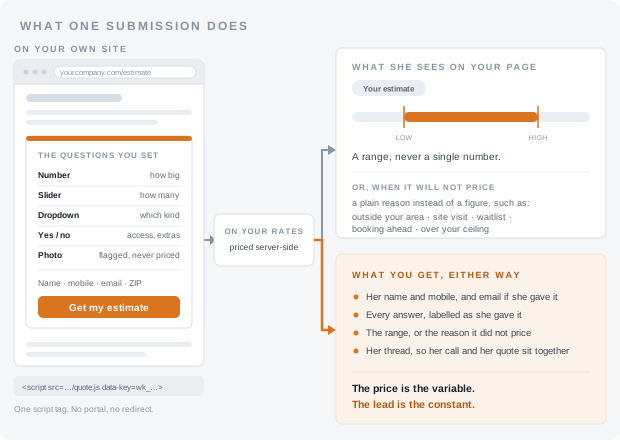
Two counts, seven tick boxes, an optional photo and the ZIP she types. Six of those boxes add a real amount you set; the seventh is a percentage, because ladder work is slower on everything on the list rather than a part you have to buy. You build the set once in the dashboard and every rate in it is a field you own.
How long should we book
The core, and the only line on the form that prices labour: her hours times your rate, $95 on our own demo card, with a two-hour minimum visit underneath it. The floor lives in the service minimum rather than inside that rule, which matters more than it sounds — a visitor who books the minimum and answers No to every box still lands on $190 rather than on a number that embarrasses you. Set the answer 2 to 10 and the widget refuses a silly one instead of quietly clamping it. The help text does the teaching: two hours is one or two small jobs, four is half a day and four or five of them, eight is a full day, and guess high because you only charge the time you work.
Fixtures, fans and switches — the one thing we count
$45 each on the demo, 0 to 12, a per-unit rate rather than a tick. This is the answer to the seam every checklist has: a flat adder fires once for the job, so a tick box can never say "three of them". Fixtures are the item people genuinely buy in threes — a hallway, a landing and a porch light, all bought on the same Saturday — so this one is counted. Answering 0 costs nothing at all: the engine breaks out of a number rule at zero rather than charging a fixture’s worth of nothing.
Anything going on a wall
$65 on the demo for the mount, the lag bolts, finding the studs and tidying the cable down the back. A flat amount on a yes/no, which means it is added ONCE for the visit: one TV and three TVs are the same $65, and the help text says so where she is standing rather than leaving her to discover it at the door. That is the honest cost of having no multi-select, and the section below spends its whole length on it instead of hiding it.
Small plumbing
$70 for supply lines, a wax ring, tape, washers and the run to the supply house. She buys the faucet or the toilet; you bring what fastens it to the house. That distinction is the whole argument for a parts adder — price a handyman’s line as though it included the appliance and every figure on this page would be wrong by a hundred dollars. Once for the visit, and the help text draws the boundary out loud: a leak inside a wall or under a slab is not a handyman job and the demo says so rather than opening it up.
Drywall, doors and the flat-pack
Three separate boxes and three separate amounts, all flat, all once per visit. $55 for compound, tape, mesh, primer and matching her paint. $45 for shims, screws, strike plates, weatherstrip and a closer if hers has given up. $50 for the anchors, brackets and cleats that never come in the box. Each one’s help text says where the box stops — a whole ceiling is a painter, a dropped exterior door wants looking at first, and a wall of shelving is not a twenty-minute job whatever the tick says.
Above the first floor, or off a ladder
A percentage rather than a fee, +12% on the demo, and the shape is the argument. A stairwell light, second-floor ceilings, soffit trim, anything over a deck rail: it is slower on every item on the list and it wants a second pair of hands, so it lifts the visit rather than adding a part you never bought. A pooled percent lands on the whole additive subtotal, so the fittings get lifted too — which is fair here, because carrying them up the ladder is precisely the thing being charged for. Roof work is off the list at any price, and the help text says that too.
Take the old parts away
$55 and the van leaves with the old fixtures, the boxes and the offcuts; say no and it is stacked neatly in the garage. It is the small box nearly everybody ticks, and it belongs on the form rather than appearing on the invoice afterwards. Once for the visit — and the help text draws the line a homeowner will otherwise test on the day: a fridge or a mattress is a hauler, not you.
Travel zone
List your ZIPs by zone — whole ZIPs or three-digit prefixes — and the widget prices the drive off the ZIP she types, most specific match first. A flat charge, a percentage, or both. The demo van charges nothing in Newark and northern New Castle County, $35 for the rest of Delaware, $65 over either state line into Cecil County or southern Chester County, and 5% plus $95 for everywhere else it will travel. Set one zone to "outside my area" and it declines politely while still capturing the lead.
A real half-day list, start to finish
Ten questions, about a minute. This is the exact sequence running on our own handyman demo account — four hours booked at a Newark townhouse, two light fixtures swapped, a 55-inch TV hung on the living-room wall, and the old fittings and packaging taken away — and the total at the bottom is what the live pricing engine returns for these ten answers and nothing else, not a figure anybody typed into this page.
| # | What she is asked | What she answers | What it does to the price |
|---|---|---|---|
| 1 | How long should we book? | 4 hours | 4 × the hourly rate — $95 on the demo. The only line here that prices labour |
| 2 | How many light fixtures, ceiling fans or switches? | 2 | 2 × $45. The one counted line: one fixture is $45 less, three is $45 more |
| 3 | Hang a TV, mirror, cabinet or shelf on the wall? | Yes | A flat $65 for the visit — the same $65 if it were three TVs |
| 4 | Any small plumbing — faucet, shower head, running toilet? | No | Nothing. Yes adds a flat $70 for the fittings and the supply run |
| 5 | Patch and paint drywall? | No | Nothing. Yes adds a flat $55 |
| 6 | Doors — sticking, latching badly, weatherstripping? | No | Nothing. Yes adds a flat $45 |
| 7 | Shelving, closet rods, blinds or flat-pack? | No | Nothing. Yes adds a flat $50 |
| 8 | Is any of it above the first floor, or off a ladder? | No | Nothing. Yes lifts the whole visit by 12% instead of adding a fee |
| 9 | Take the old parts and the packaging away? | Yes | A flat $55, once for the visit |
| 10 | Got a photo of the list, or of the worst thing on it? | Offered | Nothing. A photo never moves the price |
| The arithmetic, in the order the engine runs it | $380 of hours + $90 of fixtures + $65 for the TV + $55 for the haul-away = $590, no percentage answered, and the $190 floor sits well underneath | ||
| She sees | $537 – $643 | ||
| What lands in your inbox, the second she submits | Name, mobile, ZIP, all ten answers, the photo flag, and the disclaimer she was shown | ||
The $95, the $45 and every adder above belong to the demo account, not to a Tailgate Office price list — you set each of them in the dashboard. Three things about that arithmetic are worth reading twice. There is no trip charge on this service at all: the two-hour minimum is the trip, which is why booking two hours and answering No to everything comes back $190 – $207, with the low end clamped at the floor rather than sitting 9% under it. The minimum is a floor on the final number and not a base fee added to it, so it disappears the moment the list is real. And there is a ceiling: ten hours with four fixtures and every single box ticked goes past $1,600, at which point the widget stops pricing and hands you the lead to quote by hand, because that is a project rather than a punch list. What is not illustrative is the total — $537 to $643 is what the engine returns for those ten answers, and you can reproduce it yourself on the demo in about a minute.
Would you rather try it than read about it? We keep a working example handyman website with NapkinPrice™ embedded — the real engine, quoting live, on a page that is not ours. Put in those ten answers and see the same number come back.
Try the live demo site (opens in a new tab)A job is a basket, and the widget has no multi-select. Here is what we did instead.
This is the one design decision that matters in this trade, so here is the whole of it in plain words rather than a promise that it all just works.
The control this trade wants is a list of checkboxes: tick five things, pay for five things. The quoting engine does not have one. It has five question types — a number, a slider, a pick-one, a yes/no and a photo — and five kinds of pricing rule, and adding a sixth type is not a setting somebody flips. It is the widget, the question editor, the seeder, the preflight checker and the database schema, plus re-validating every account already quoting on the old shape. So we did not add one, and we are not going to write a page that implies we did.
What we built instead is a curated checklist of yes/no questions, each carrying a flat amount you set. Tick five boxes and you get five real adds, every one of them a number the contractor chose rather than a percentage of something else. That is a multi-select in everything but the compactness of the control. Underneath it sits the hourly core, and the two halves need each other: the hours are what you are actually selling, and the checklist is what tells you — and her — whether the hours she booked are anywhere near enough.
Now the seam, because it is real and it is better said here than discovered at her door. A flat adder fires once per job. Tick “hang a TV” and it is $65 whether it is one TV or three, because a yes/no has no way to say how many. Three answers were available: pretend it scales, split the list into eleven separate services nobody would ever click through, or count the one item where multiples are the norm and say plainly that the rest fire once. The third is what is built. Fixtures, fans and switches are counted at $45 each, and the same half-day list moves exactly one rate at a time: $496 – $594 with one fixture, $537 – $643 with two, $578 – $692 with three. There is no equivalent run for two TVs, and that absence is the point — it is shown rather than described. Everything else is trued up on the call, before she is booked rather than after, and the help text on every one of those boxes says so where she is standing.
The other half of the answer is a second service, because half the people who ring a handyman have exactly one thing wrong and do not want to buy two hours to get it fixed. That is a flat-price menu with the $89 call-out inside the number rather than added at the door. It is deliberately priced so the comparison is honest instead of flattering: one TV mounted off the menu is $206 – $242, a fan swap on its own is $234 – $274, and both of those inside a single two-hour visit — two hours booked, one counted fixture, the wall-mount box ticked — is $273 – $327. Two menu jobs is nearly always dearer than one visit, the demo shows her both forms, and it tells her in as many words to compare them before booking.
The hourly visit — quotes instantly
The service that prices a list, and the one the trade actually runs on. No base fee: the two-hour minimum is the trip, so the cheapest possible visit — two hours, nothing ticked — floors at $190 to $207 instead of returning a number below what it costs you to turn up. The half-day list above is $537 to $643. Answer yes to the ladder question on that same list and the 12% lifts it to $601 to $720. A full day — eight hours, three fixtures, a TV and small plumbing, old parts away — is $987 to $1,183. Past a $1,600 ceiling it stops pricing and routes the lead to you, because ten hours with every box ticked is a project being quoted as a punch list.
One job, one price — quotes instantly
A ten-item menu for the caller with exactly one thing wrong, and the CallMitt story for this trade: one job, rung to four handymen, and the one who texts back inside the hour gets it. The $89 call-out lives in the base fee where it is added once and cannot be answered away, there is a $185 floor under it — flat-pack assembly lands there at $185 to $200 rather than at its own arithmetic — and the band is plus or minus 8% rather than 9%, because one known job off a menu is better known than a list. A fan swapped with the part collected on the way and the old one taken away is $303 to $355; a toilet replaced today or tomorrow, same extras, is $385 to $452. Past $900 you are buying hours, not a menu item, and it says so.
Whole-house lists and turnovers — site visit, never priced
Site-visit mode captures the whole spec and shows no number at all, which is the only honest answer once a "list" is really a room, or a landlord has a unit to turn over between tenants. It asks what it is looking at, roughly how many separate jobs there are and whether there is a date it has to be finished by — and not one of those answers moves money. The job count is a number question with no pricing rule on it whatsoever, which is legal, deliberate, and worth having: it tells you whether to send one person for a day or two for three. She gets your own "we will come and walk it" message; you get a lead worth bidding.
There is no busy-season rate on this account, and that is a decision rather than an empty field
The calendar is real enough. A one-van handyman is booked three weeks out by the middle of April and ringing people back in January, and every other trade page on this site that carries a season had one just as real. But the test is not whether demand moves; it is whether the cost of the work moves with it. Spring changes how long she waits for you. It does not change what an hour of your time costs to sell, and it does not change what a wax ring costs at the supply house. The chimney page applies the same test and comes out the other way, because a sweep in November is a capacity constraint on deferrable work with a date on both ends. A season invented here to fill the field would have been the only dishonest number in the fixture, so the field is empty and this paragraph is why.
The travel zones stack on top of all of it, and they are the same engine run on the same ten answers with nothing changed but the ZIP: Newark 19711 is $537 to $643, Wilmington 19805 is $569 to $681, Elkton 21921 over the Maryland line is $596 to $714, Kennett Square 19348 in southern Chester County is the same $596 to $714, a Howard County ZIP out in the catch-all ring is $650 to $779, and a ZIP outside every zone you serve gets no price at all — a polite decline, with the lead still captured. A service that quotes will not go live until it carries a real base fee or a real minimum. That is deliberate: a service with neither would happily return $0 to a homeowner, and one bad number on your website costs more than a day of setup.
Nobody in this trade has a free hand for the phone
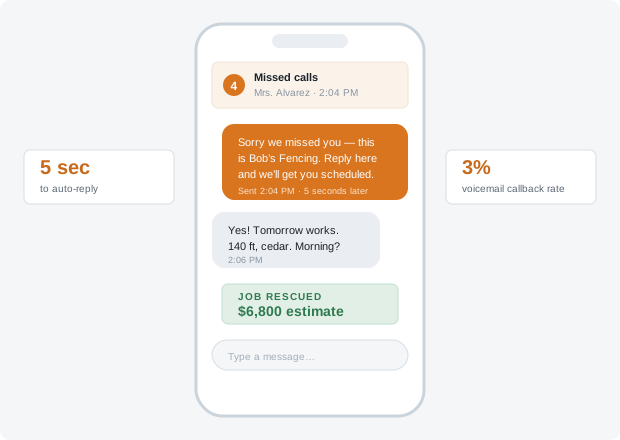
You are holding a door square while you shim it, or up a ladder with a fixture over your head, or on your back under a sink with a basin wrench. There is no version of this job where answering is easy, and a handyman works alone — there is no counter, no dispatcher, nobody else in the truck. Roughly 62% of contractor calls go unanswered, about 78% of jobs go to whoever responds first, and voicemail gets a callback around 3% of the time. Her list is going to somebody today; the only question is whose.
| What a missed handyman call is worth | On the demo account |
|---|---|
| A half day — four hours, two fixtures, a TV and the haul-away | $537 – $643 |
| A full day — eight hours, three fixtures, a TV, small plumbing, old parts away | $987 – $1,183 |
| A fan swapped off the menu, part collected, old one taken away | $303 – $355 |
| A toilet off the menu today or tomorrow, part collected, old one gone | $385 – $452 |
| Voicemail callback rate | ~3% |
| One recovered half-day list pays for | 2 months of the bundle |
| One recovered full day pays for | 4 months |
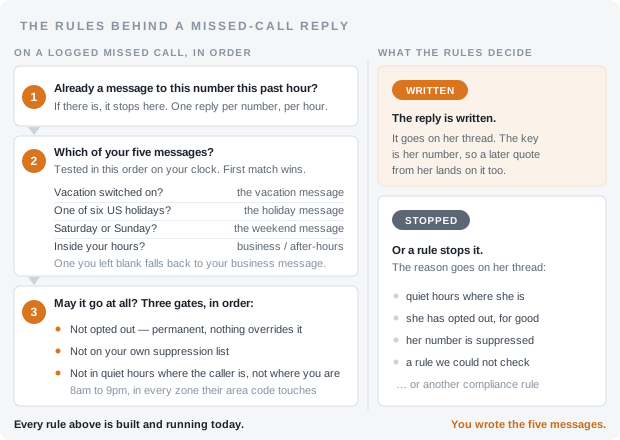
CallMitt™ writes back from your own texting number, a local number registered to your business and not a stranger’s 800 line, and the text opens with your business name, so she replies into the same thread as her quote. The message is picked by the hour and the day, against the hours you actually keep — the demo van runs 7 to 5, because the first job is always the one that wants daylight and by five he is in traffic with somebody’s old kitchen cabinets in the back. A 5:20 call honestly gets the after-hours version instead of one claiming somebody is about to pick up. Every version asks for the same two things: her list, even roughly, and her town.
Straight about where this stands. We have no SMS gateway yet and there is no automatic missed-call detection, so today you log the missed call and nothing is sent: a reply queued now is retired rather than delivered when your carrier registration clears. Everything around it is built and running now: the five messages, the business-hours, weekend, holiday and vacation rules, the quiet hours, the opt-out handling, and the thread her reply lands in beside her quote.
How CallMitt Works Run Your Own NumbersA handyman is hired on breadth and on what is in his van
This is the one trade where no single skill is the test. The man you want leaves a house with a door planed, a fixture hung and a faucet swapped in the same afternoon, out of a van he stocked himself — and a résumé makes neither of those things clear. Somebody who has only ever worked as one pair of hands on somebody else’s crew arrives with nothing but a tool belt and waits to be told what to do, and you find that out at eight o’clock on a Monday with a customer watching.
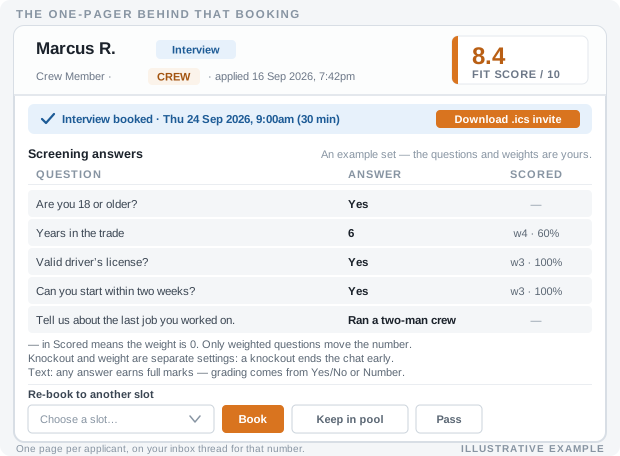
Put “Now hiring — text CREW to your texting number” on the van and the yard sign. CrewFunnel™ asks seven short questions: is he 18 or older, does he have his own hand and power tools and a truck or van to carry them, has he done drywall, a door, a light fixture and a faucet in the same day, how many years has he done home repair or maintenance, how far out does he live, can he start inside two weeks, and what was the last job he worked on. Three of those are knockouts — under 18, arriving with an empty van, or living further out than you will drive — and three come back as a weighted fit score, years in the trade heaviest and the start date next.
Two things about that scoring are worth copying. Distance is a knockout and never a weight, because a number answer scores higher the bigger it is, so weighting miles would rank the man furthest away at the top. And free text carries no weight at all, because any non-empty answer scores full marks and a weighted text box quietly inflates every candidate who typed anything. Both are set that way on our own demo job, and every question on it carries a Spanish translation.
One honest note on delivery. There is no inbound SMS on our side yet, so today he answers those seven questions on your screening page rather than by text — same questions, same knockouts, same scoring, same pool. The keyword on the van takes over the day your carrier registration clears.
See how CrewFunnel works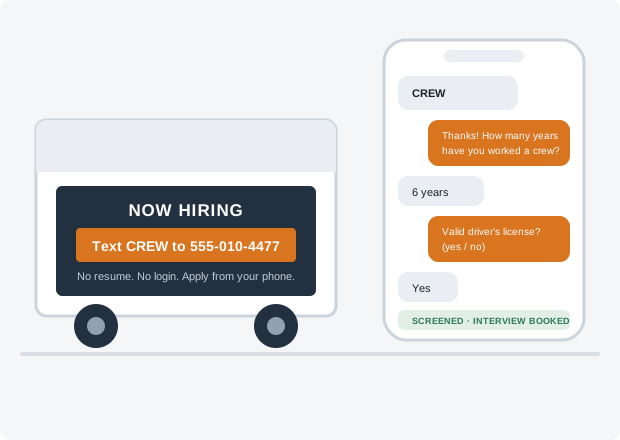
Nobody reviews a faucet. She reviews the afternoon the whole list got done.
The faucet has stopped dripping, both doors close, the hole in the drywall is gone, and a list that sat on the fridge since spring is in the bin. No single line of it is worth a review. The afternoon is: one visit, the whole list, nothing left for next time. That is the evening she would write about you, and by next weekend she has started a new list and forgotten who finished the old one. The outfit with sixty reviews is not sixty times better than you; somebody there asks every customer, once for the whole visit.
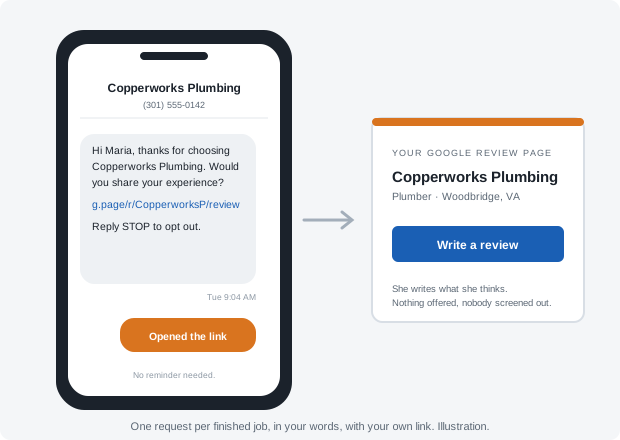
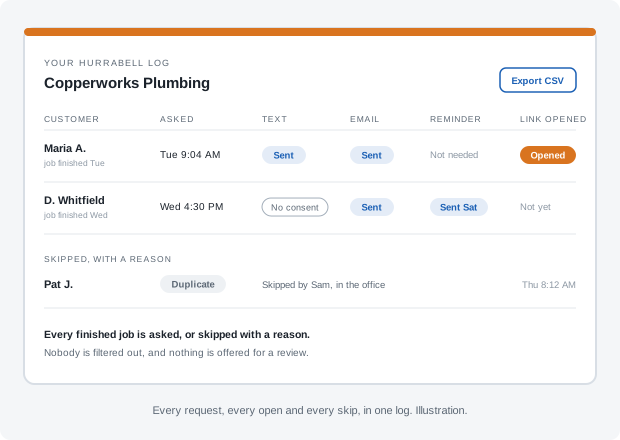
HurraBell™ does the asking. Mark the job done — from the inbox, from your phone, or from your job software through Zapier — and the customer gets one request in your words, with your own Google review link, after a delay you pick: an hour, unless you change it. Three days later, one email reminder, unless the link has been opened or the customer has got back in touch.
Review requests aren’t switched on yet, so none is sent today. When they are, the request goes by email once your Google review link is saved on the HurraBell page and your mailing address on the Account page. A text goes as well where the customer agreed to texts, and only once your carrier registration clears, the same wait as every text on this site; until then it is email only.
See how HurraBell worksWhat it costs
One van, one phone, one person doing the quoting at nine at night. The pricing is built for that, not for a twelve-truck fleet.
The Tailgate Office Bundle
Instant quotes on your website, missed-call text-back, text-to-apply hiring, review requests, and customers, jobs, estimates and invoices in one place. 30 days free, no credit card, no setup fee, cancel from the dashboard.
Start Free TrialOnly need one of the tools? After the trial you can keep just that one at its own price; the office stays with the Bundle.
Handyman questions we get asked
By not trying to price the list. It prices the HOURS, which is what you actually sell, and then lets her tick what is going in them. Four hours at your rate, plus the fittings each ticked item drags in, is a number you would say on the phone — and it is the same number you would say, because it came off your own rate card. The half-day list on this page is $537 to $643 and the cheapest visit on the account is $190 to $207, which is two hours and nothing else. Where it genuinely cannot answer, it stops: a whole-house punch list or a rental turnover goes to a site-visit service that shows no number at all, and anything over $1,600 routes the lead to you rather than publishing a guess. The disclaimer does the rest in your words — we confirm the list and the number at your door before anything comes out of the van, and if the list runs longer than the hours you booked we tell you before the clock does.
It is a real limitation and we would rather you read it here than find it on a job. A flat adder fires once per job, so ticking "hang a TV" adds $65 whether it is one TV or three. Three things are done about it, none of them cosmetic. The one item people genuinely buy in multiples — light fixtures, ceiling fans and switches — is a COUNT rather than a tick, at $45 each: the same half-day list is $496 to $594 with one, $537 to $643 with two and $578 to $692 with three. Every other box says "once for the visit" in its own help text, where she is standing rather than in a footnote. And the demo page carries a section headed "the one thing this form cannot do, said out loud" that names the TV case specifically. Three TVs gets trued up on the call, before she is booked. That is an honest seam, disclosed; it is not a bug hiding behind a checkbox.
Because it is not a setting, and this is the kind of thing worth being straight about. The engine ships five question types and five kinds of pricing rule, and they are closed lists. A sixth type touches the public widget, the widget JavaScript, the question editor, the seeder, the preflight checker and the database schema, and it forces every account already quoting to be re-validated against the new shape. That is a release, not an afternoon. A checklist of yes/no boxes each carrying its own amount is a multi-select in everything but the compactness of the control, it ships today, and it prices to the dollar. When a genuine multi-select arrives it will collapse those boxes into one control without changing a single rate you set.
No, and that is the second service. "One job, one price" is a ten-item menu — a TV mounted, a fan swapped, a toilet or a faucet replaced, a grab bar fitted, flat-pack assembled — with the $89 call-out inside the number rather than added at the door. It has its own $185 floor and a tighter band, plus or minus 8%, because a known job off a menu is better known than a list. What makes it honest is that it is not priced to beat the hourly service: one TV mounted is $206 to $242, a fan swap on its own is $234 to $274, and both of those inside one two-hour visit — two hours booked, one counted fixture, the wall-mount box ticked — is $273 to $327. Two menu jobs is nearly always dearer than one visit, and the demo tells her to compare them before she books. You will lose the occasional forty dollars saying that and keep the customer for a decade.
No, and saying so is what makes them defensible. The hours are labour. Each adder is the hardware, the fittings, the consumables and the supply-house run that one task drags in: the mount and the lag bolts, the supply lines and the wax ring, the compound and the primer, the weatherstrip, the anchors that never come in the box. She buys the TV, the faucet and the light fixture. If she would rather you collected the part, that is its own question on the menu service — $35 for the run, and the part on the invoice at what you paid for it with the receipt in her hand. Price a handyman parts line as though it included the appliance and every figure on this page would be wrong by more than a hundred dollars.
Because a season should price a cost that actually moves, and this one does not. Spring changes how long she waits for you; it does not change what an hour costs to sell or what a wax ring costs at the supply house. Charging 15% more in April because the phone is busy is a surcharge dressed up as a season, and a homeowner works that out roughly one job later. The field is there and you may use it — the chimney demo carries plus 15% from October to December, because a sweep is deferrable work squeezed into twelve weeks of capacity, and that page argues its case the same way. On this account the field is deliberately empty, and the fixture says why in a comment rather than leaving the next person to wonder. What this trade prices instead is the thing genuinely worth a premium: the menu service asks how soon she needs it, and today-or-tomorrow carries plus 20% as a question she can see and change.
Call it fifteen minutes for your text-back messages and your working hours, a minute, once review requests are switched on for your account, to paste your Google review link on the HurraBell page and your mailing address on the Account page, and about an hour for the hourly service: your rate, your minimum visit, your fixture rate and the six or seven things you are willing to put on a checklist with a real amount against each. Then most of another hour for the menu, which is ten flat prices and its own call-out. The checklist is the part worth doing slowly, because every box you add is a promise about what you will turn up and do — and the boxes you leave OFF are the ones that keep your Saturdays. A service that quotes will not go live until it carries a real base fee or minimum, which is deliberate. No onboarding call, no setup fee and no contract: $199 a month buys all four tools, and ResponsiBid’s reported $400–600 setup, as published in August 2026, is not a thing here.
Bigger than a punch list? See the remodeling page, all the trade pages, or call (301) 268-1943.
Give her the number while she is still holding the list.
Set it up tonight. Free for 30 days, no card, no setup fee, cancel from the dashboard.