
An awning is priced by the foot of width, and by how far it reaches
A retractable awning is width times a rate, with how far it comes out from the wall, the motor, the wall it hangs on and the hood moving it, and a homeowner can measure the width with a tape from her own patio door. An aluminum patio cover is the same idea in square feet, with the roof style, attached or freestanding, the posts and the permit. Both are quotable from a form. A screen room or a louvered roof that opens and closes is a design, and is not.
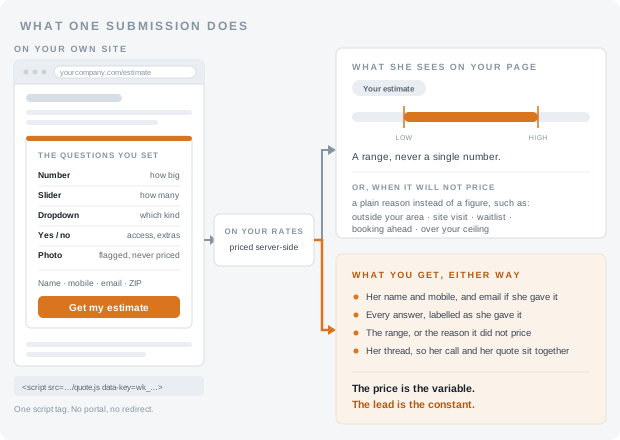
So this page prices awnings by the foot and patio covers by the square foot, as two instant services, and sends screen rooms, louvered roofs and shade sails to a measure that never shows a number. It also carries a season, which most trades should leave empty and awnings plainly earn: they sell in April, so an order placed between November and February fills the spring schedule, and the awning service gives a winter booking rate for it.
The flow also asks for a photo of the wall, and the lead tells you to ask for those pictures on the callback. Attaching the image itself to the lead is on the roadmap, which is why it is not a tick in that list.
The eight things that set an awning number
A width, four pick-ones, a yes or no, a season and a ZIP. You build the set once in the dashboard and every rate in it is a field you own — you can change the per-foot rate the season your fabric costs change without touching your website.
Width
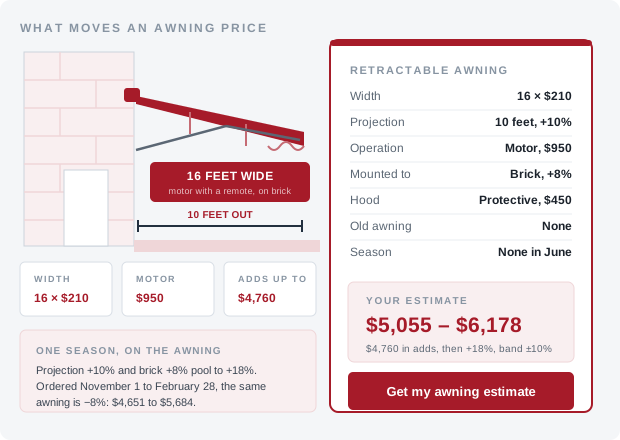
The width of the patio or deck it shades, along the house wall: $210 a foot on the demo for a lateral-arm awning in solution-dyed acrylic. Most are 12 to 20 feet, and the help text says so, which catches the typo before it becomes a quote.
Projection
How far it comes out: eight feet at the rate, ten feet +10%, twelve to thirteen feet +22%. A longer arm needs a stronger frame and heavier brackets all the way along.
Crank or motor
A pick-one that adds dollars once: a hand crank at nothing, a motor with a remote at $950, a motor with a remote and a wind sensor at $1,250. The wind sensor rolls it in on its own when the gusts come, which is the answer to the question she should be asking.
The wall
A wood-frame wall with siding at the rate, brick or stone +8%, the soffit or the roof on brackets +15%. Where the brackets go decides how long the install takes and what it is anchored into.
The hood
No hood at nothing, a protective hood at $450, a full cassette at $900. It keeps the rain and the leaves off the fabric when it is rolled in, and she will have seen both on the street.
The old awning
A yes or no with a flat amount behind it: $250 on the demo for removal, disposal and sealing the old bracket holes, added once for the job.
The season
Not a question: a date window on the service. The demo awning carries a winter booking rate, minus 8% from November 1 to February 28, applied to the job after her answers and before the travel zone. The window wraps the year end and the engine handles that on its own.
Travel zone
List your ZIPs by zone, whole ZIPs or three-digit prefixes, and the widget prices the trip from the ZIP she types, most specific match first, as a flat charge, a percentage, or both. Our demo company charges nothing in its home counties and $150 across the bridge, so the same awning comes back $5,055 to $6,178 at home and $5,190 to $6,343 in Annapolis. Set one zone to "outside my area" and it declines politely while still capturing the lead.
A real motorized awning, start to finish
Seven questions, under a minute. This is the exact sequence running on the awning service of our own demo account, answered for a sixteen-foot motorized awning on a brick wall in Easton, on any date from March to October — and the total at the bottom is what the live engine returns for these answers, not a figure anybody typed into this page.
| # | What she is asked | What she answers | What it does to the price |
|---|---|---|---|
| 1 | How wide, in feet? | 16 | 16 × $210 = $3,360. This is THE base number |
| 2 | How far out from the wall? | 10 feet | +10% on the whole job. 8 feet 0%, 12 to 13 feet +22% |
| 3 | Hand crank or motor? | Motor with a remote | A flat $950. With a wind sensor $1,250 |
| 4 | What will it be mounted to? | Brick or stone | +8% on the whole job. Siding 0%, soffit or roof brackets +15% |
| 5 | A hood over the rolled-up fabric? | A protective hood | A flat $450. A full cassette $900 |
| 6 | Is there an old awning to take down? | No | Nothing. Yes adds $250 |
| 7 | Got a photo of the wall? | Offered | Nothing. A photo never moves the price |
| The arithmetic, in the order the engine runs it | $3,360 + $950 + $450 = $4,760, then the two percentage answers pool to +18% and apply once to all of it: → $5,616.80. No season covers a date from March to October | ||
| She sees | $5,055 – $6,178 | ||
| What lands in your inbox, the second she submits | Name, mobile, ZIP, all seven answers, and the photo flag | ||
Every rate in that table belongs to the demo account, not to a Tailgate Office price list — you set all of them yourself, and you can change one without touching your website. What is not illustrative is the total: $5,055 to $6,178 is what the engine returns for those seven answers outside the winter window, and $4,651 to $5,684 inside it.
Would you rather try it than read about it? We keep a working example awning and patio cover company website with NapkinPrice™ embedded — the real engine, quoting live, on a page that is not ours. Put in those seven answers and see the same number come back for the date you try it.
Try the live demo site (opens in a new tab)The awning has a winter rate. The patio cover has a permit. The screen room has a measure.
These are the decisions that matter for an awning company, so here they are in plain words rather than a promise that it all just works.
A season in this engine is a percentage on a date window you set, applied to the job after her answers and before anything about her address. Most trades should leave it empty rather than invent one. Awnings are the exception that earns it: they sell when the sun comes back, so a crew with an empty January will take a winter order at a better price to fill May. The demo’s awning carries minus 8% from November 1 to February 28, so the same awning ordered on December 1 comes back $4,651 to $5,684. The window wraps the year end and the engine spots that on its own.
The patio cover carries no season, on purpose: it is a permitted structure on footings, and the county decides its date. It is its own instant service, $38 a square foot for solid aluminum, lattice minus 15% and insulated panels +35%, freestanding +20%, $180 a post for its footing, $450 for a fan wiring channel and $350 for the permit. A 12 by 20 solid cover on three posts with fan wiring and the permit comes back $9,205 to $11,715. Screen rooms, louvered roofs and shade sails go to a measure that asks what she is thinking about and roughly how big, and shows no number.
Retractable awnings — quotes instantly
$210 a foot of width on the demo, the projection and the wall as percentages, the motor at $950 or $1,250, the hood at $450 or $900, and minus 8% when it is ordered between November and February. A $1,800 minimum is the floor under the final number, so an eight-foot crank awning that works out at $1,680 comes back $1,800 to $1,980. Past $12,000 it stops pricing and hands you the lead.
Aluminum patio covers — quotes instantly
$38 a square foot, the roof style and attached or freestanding as percentages, $180 a post, $450 for fan wiring and $350 for the permit. Its own $3,500 minimum, $40,000 ceiling and a 12% band, and no season, because a permitted structure is dated by the county.
Screen rooms, louvered roofs and shade sails — measure, never priced
Site-visit mode captures the request and shows no number at all, which is the honest answer to a louvered roof designed for her patio. It asks what she is thinking about and roughly how many square feet, which only tells you how long to book the visit.
A service that quotes will not go live until it carries a real base fee or a real minimum. That is deliberate: a service with neither would happily return $0 to a homeowner, and one bad number on your website costs more than a day of setup. Neither priced service carries a trip charge, so on both of them it is the minimum doing that job.
Nobody answers the phone at the top of a ladder with an awning on their shoulder
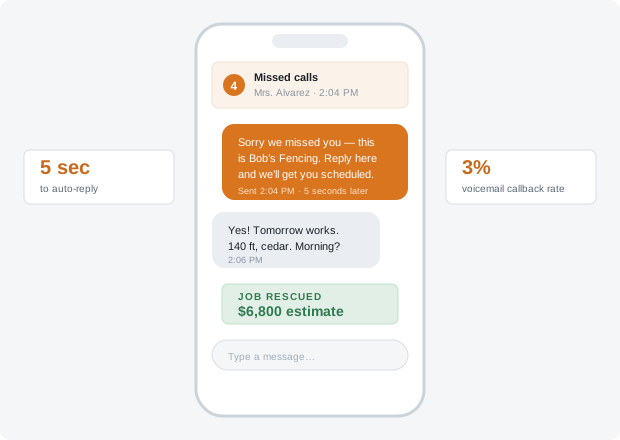
You are two people up two ladders holding a hundred pounds of awning against a brick wall, and the phone in your pocket stays there. She is on her hot patio on a Saturday afternoon, she has decided this is the year, and she is working down a list. The company that sends her something first is the one that gets to measure, and in April that is the whole season.
| What a missed awning call is worth | On the demo account |
|---|---|
| A 16-foot motorized awning on brick, with a hood | $5,055 – $6,178 |
| The same awning ordered in December | $4,651 – $5,684 |
| A 12 by 20 aluminum patio cover, permit pulled | $9,205 – $11,715 |
| A 12-foot hand-crank awning on siding | $2,268 – $2,772 |
| One recovered awning pays for | 25 months of the bundle |
| One recovered crank awning pays for | 11 months |
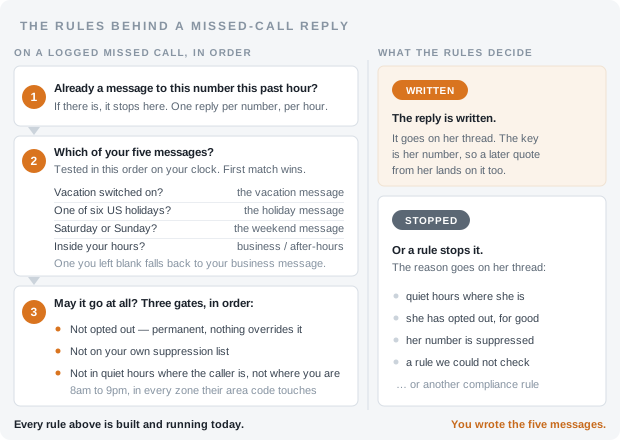
Once texting is switched on, CallMitt™ writes back by text with your business name in the first words, so she replies into the same thread as her quote. The message is picked by the hour and the day, against the hours you actually keep — the demo company answers 8 to 5, because installs start when the dew is off the wall and finish before the light goes, so a 5:20 call gets the after-hours version rather than one claiming somebody is in the shop — and every version asks the two things that sort your week: how wide the patio is, and what she has in mind.
Straight about where this stands. The forwarded-call hook is built and waits on your texting number, so today you log the missed call and nothing is sent: a reply queued now is retired rather than delivered when your carrier registration clears. Everything around it is built and running now: the five messages, the business-hours, weekend, holiday and vacation rules, the quiet hours, the opt-out handling, and the thread her reply lands in beside her quote.
How CallMitt Works Run Your Own NumbersAn awning installer is hired on two questions, and the first one is about the ladder
The work is a ladder for most of the day and a hundred pounds of awning lifted into place with a partner, and a man who has not done it does not know yet whether he will keep doing it. That is the first question. The second separates an installer from a helper: has he anchored into brick, or found the framing behind siding, himself? An awning bracket in the siding alone is the one that comes down in the first storm, and you cannot teach that on a customer’s wall.
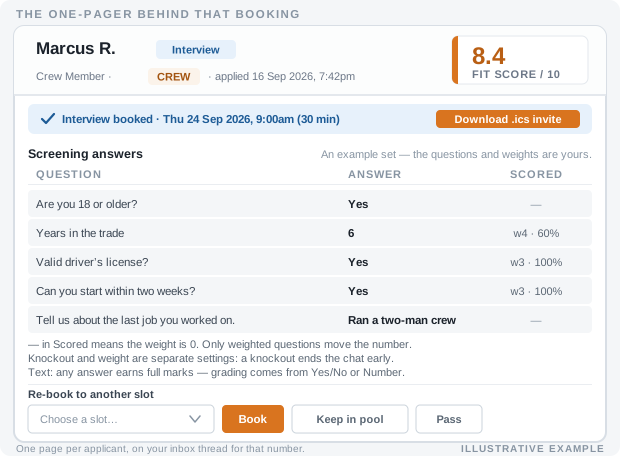
Put “Now hiring — text CREW to your texting number” on the truck and the showroom door. CrewFunnel™ asks seven short questions: is he 18 or older, is he comfortable on a ladder all day lifting an awning into place with a partner, has he anchored into brick or found the framing behind siding himself, how many years has he done exterior installation work, how far out does he live, can he start inside two weeks, and what was the last job he worked on. Three are knockouts — under 18, not up for the ladder, or living further out than you will drive — and the rest come back as a weighted fit score, years in the trade heaviest, the start date next and the anchoring question after it.
Two things about that scoring are worth copying. Distance is a knockout and never a weight, because a number answer scores higher the bigger it is, so weighting miles would rank the man furthest away at the top. And free text carries no weight, because any non-empty answer scores full marks and a weighted text box inflates every candidate who typed anything. Both are set that way on our demo job, and all seven questions carry a Spanish translation.
One honest note on delivery. Text-to-apply waits on your texting number, so today he answers those seven questions on your screening page rather than by text — same questions, same knockouts, same scoring, same pool. The keyword on the truck takes over the day your carrier registration clears.
See how CrewFunnel works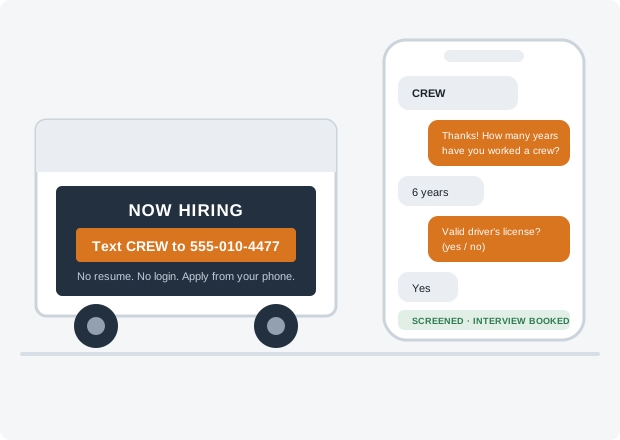
An awning gets its review the first evening dinner is outside
The awning is up, she runs it out with the remote twice just to watch it, and that evening dinner is on the patio for the first time all summer. That is the week she would write you a review. By August the shade is just how the patio is, and the crew who hung it are a name on the warranty card. The outfit with sixty reviews is not sixty times better than you; somebody there asks every customer, the week the awning goes up.
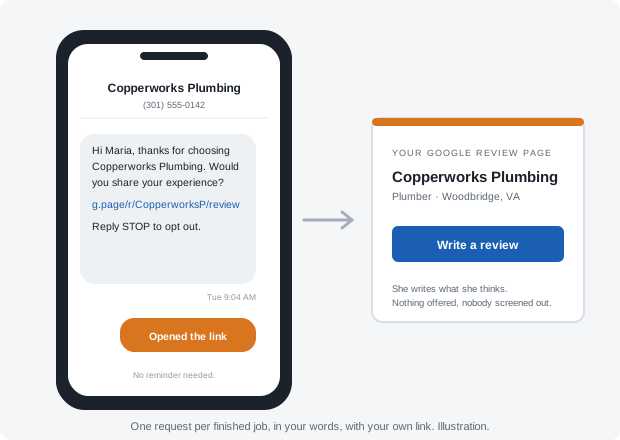
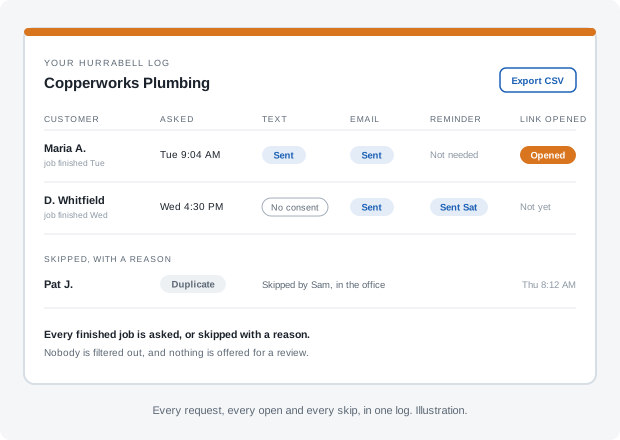
HurraBell™ does the asking. Once review requests are switched on, you mark the job done — from the inbox, from your phone, or from your job software through Zapier — and the customer gets one request in your words, with your own Google review link, after a delay you pick: an hour, unless you change it. Three days later, one email reminder, unless the link has been opened or the customer has since texted you, messaged you from your website or had a call logged on her thread.
Review requests aren’t switched on yet, so none is sent today. When they are, the request goes by email once your Google review link is saved on the HurraBell page and your mailing address on the Account page. A text goes as well where the customer ticked the box on your quote form or visit booking agreeing to a review-request text, and only once your carrier registration clears, the same wait as every text on this site; until then it is email only.
See how HurraBell worksOne recovered awning covers 25 months
Even a hand-crank awning covers 11 of them. In a trade that sells most of its year in a few spring weeks, the arithmetic is not close.
The Tailgate Office Bundle
Instant quotes on your website, missed-call text-back and text-to-apply hiring (texts go out once texting is switched on), and, once switched on, a review request after every job, plus customers, jobs, estimates and invoices in one place. 30 days free, no credit card, no setup fee, cancel from the dashboard.
Start Free TrialOnly need one of the tools? After the trial you can keep just that one at its own price; the office stays with the Bundle.
Awning and patio cover questions we get asked
You can price a range, and only a range — the widget never shows a single figure. The disclaimer under it is yours to write. On the demo it says the range is for a lateral-arm awning in solution-dyed acrylic, measured, made and installed, that retractable awnings are made for sun and light rain and are rolled in for high wind and storms, and that the price is confirmed at a free measure where she picks the fabric. Nothing is ordered until she has that written number.
Because the awning's season is real: it sells when the sun comes back, and a winter order fills the spring schedule, so minus 8% from November to February buys you a booked May. The patio cover is a permitted structure on footings, and the county decides when it goes up, so a discount would promise a date you do not control. A season is one percentage on one date window, per service.
What the demo's disclaimer tells her: a retractable awning is made for sun and light rain and is rolled in for high wind and storms, and a motor with a wind sensor does that for her. The question she should ask any awning company is how much wind the awning is made for and what the warranty covers, so answer it in your disclaimer in your own words, with your manufacturer's figures.
No, and you should not. Put screen rooms, louvered roofs and shade sails on a measure service: it asks what she is thinking about and roughly how big, shows no price whatsoever, and sends her a plain "we like to see it first" note. A louvered roof is engineered for the patio it sits on, and nobody should publish a number against that.
The help text says most awnings are 12 to 20 feet and the form accepts 8 to 40, so a typo of 160 never reaches a price. The lead records exactly what she typed, so at the measure the conversation is about the difference rather than the whole number.
Call it fifteen minutes for your text-back messages and your working hours, a minute, once review requests are switched on for your account, to paste your Google review link on the HurraBell page and your mailing address on the Account page, and about an hour to write the seven questions, load the awning's rate card and set its winter window. Then half an hour more for the patio cover. A service that quotes will not go live until it carries a real base fee or minimum, which is deliberate. No onboarding call, no setup fee and no contract: $199 a month buys all four tools.
Also build decks and patios, or replace windows and doors? See all the trade pages or ask us.
Quote the shade while she is still squinting at the patio.
Set it up tonight. Free for 30 days, no card, no setup fee, cancel from the dashboard.