
This trade sells two numbers, and a website that shows one of them is hiding the other
A pest control sale is an initial treatment, and then a smaller amount every month or every quarter for as long as she keeps it. Those are two different prices about two different visits, and the reason homeowners ring six companies on a Sunday night is that almost nobody publishes either one. The first treatment is three hours: the house walked, the crawlspace and the attic hatch opened, the outside banded, baits placed, a written list of the ways in. A plan visit is forty minutes and the truck was already in the county.
So the demo account runs them as two services, each quoting its own visit and saying so in its own disclaimer. Our own example house — 2,200 sq ft in Culpeper on a crawlspace, mice under the sink, the standard exterior band — comes back at $403 – $493 for the initial treatment and $59 – $71 per visit on a monthly plan after it. Neither number is ever added to the other on the screen, because they are not one job.
NapkinPrice™ is honest about what it can and cannot do here, and that shapes the whole account. The engine prices ONE job, once. It has no idea what a contract term is, no concept of a monthly total and no way to compute a first-year value — so this page never prints one. What it does have is a frequency dropdown carrying negative percentages, which is a per-visit discount and a claim you can check in three runs of the demo.
Both forms ask for a photo of what she is seeing and the lead tells you to ask for it on the callback. Attaching the image itself to the lead is on the roadmap, which is why it is not a tick in that list.
The eight things that set a plan visit
Five pick-ones, two yes/nos and a ZIP. Nothing on this form is per-unit — there is no count, no square-foot rate and no multiply rule anywhere on it — because a pest visit is priced by what the house IS, not by how many of something it has. You build the set once in the dashboard and every rate in it is a field you own.
What the regular visit covers
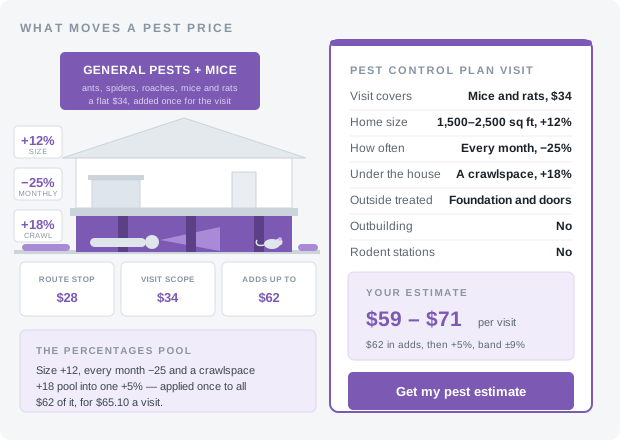
A flat amount added once for the visit, and the biggest single lever on the form: $12 for an outside barrier only, $20 for general pests, $34 for general pests plus mice and rats, $48 for general pests plus German roaches in the kitchen, on our own demo card. Write the help text to say pick what you want handled EVERY time, not what you saw once — the answer people give otherwise is the insect they are looking at, and that is the initial treatment’s question rather than this one.
How big the home is
Heated square footage in four bands, as a percentage rather than four rates: nothing under 1,500, plus 12%, plus 26% and plus 42% over 4,000. It moves a visit because a bigger house has more perimeter to band, more eaves to sweep and more rooms to walk. The same four bands appear on the initial treatment form too, deliberately, so a visitor who runs both can see it is one ladder and not two.
How often you come back
THE question this trade is here for, and the percentages on it are NEGATIVE: minus 25% for every month, minus 16% for every other month, minus 8% for every quarter, and nothing for one visit with no plan. The saving is written into the option label so she reads it as she picks. Every one of those is a discount on the price of a VISIT and nothing else — a quarterly visit still costs more than a monthly one, because the tech was here thirteen weeks ago instead of four and he is doing the whole house again.
What is under the house
The single biggest difference between two houses of the same size in this county, and it is a percentage: nothing on a slab, plus 8% for a basement, plus 18% for a crawlspace and plus 30% for a crawlspace somebody has to crawl the length of. A slab has no underside to treat. A basement is a room with a door. A crawlspace is a man on his back in a Tyvek suit with a light, and it is where the mice, the moisture and the termites actually live.
How much of the outside you treat
Most of pest control happens outside, which surprises people. The foundation line and the door thresholds are the standard band at nothing; the eaves and the garage are plus 10%; a fence line or a wood pile is plus 22%. That last one is the wooded-lot answer — a stack of split oak against the house is the best ant habitat anybody ever built, and treating around it is the difference between a barrier and a suggestion.
A detached garage, shed or pool house
A yes/no with a flat $18 on the demo, and it is priced for ONE outbuilding per visit. A flat amount on a yes/no is added once for the job, so three sheds are trued up on site rather than guessed here — say that in the help text and nobody is surprised at the door. A detached building is genuinely a second stop: its own perimeter, its own eaves and usually its own mouse problem, because that is where the bird seed is.
Rodent stations checked every visit
The other yes/no, a flat $14, for tamper-resistant stations opened, logged and rebaited each time. Worth it on a property with a barn, a creek or a field behind it, and worth it for a year after any mouse problem she has already had — the ones that got in came from somewhere and that somewhere is still there. Both of these flats sit inside the percentage pool, so the monthly discount comes off them as well.
Travel zone
List your ZIPs by zone — whole ZIPs or three-digit prefixes — and the widget prices the trip from the ZIP she types, most specific match first. The demo shop charges nothing in Culpeper County, $10 up to Warrenton, $22 across to Prince William and Fredericksburg, and $38 plus 5% everywhere else it travels. Read that last one twice before you copy it: on a $65 route stop a $38 travel fee is more than half the ticket, which is why the plan territory this shop actually sells is the two inner zones. Set one zone to "outside my area" and it declines politely while still capturing the lead.
A real plan visit, start to finish
Eight questions, about a minute. This is the exact sequence running on our own pest control demo account — the 2,200 sq ft house in Culpeper on a crawlspace, general pests plus mice and rats, the standard exterior band, on a monthly plan — and the total at the bottom is what the live pricing engine returns for these eight answers and nothing else, not a figure anybody typed into this page.
| # | What she is asked | What she answers | What it does to the price |
|---|---|---|---|
| 1 | What should the regular visit cover? | General pests plus mice and rats | A flat $34, added once for the visit. Outside only is $12, German roaches $48 |
| 2 | About how big is the home? | 1,500 to 2,500 sq ft | A percent on the whole visit: +12%. Over 4,000 sq ft is +42% |
| 3 | How often would you like us back? | Every month (save 25%) | A NEGATIVE percent: −25%. Every quarter is −8%, no plan at all is 0% |
| 4 | What is under the house? | A crawlspace | A percent on the whole visit: +18%. A slab is nothing, a long crawl +30% |
| 5 | How much of the outside do we treat? | The foundation line and the doors | The standard band: +0%. Add a fence line or a wood pile and it is +22% |
| 6 | Include a detached garage, shed or pool house? | No | Nothing. Yes adds a flat $18 to each visit, for one outbuilding |
| 7 | Rodent stations checked at every visit? | No | Nothing. Yes adds a flat $14 to each visit |
| 8 | Got a photo of what you are seeing? | Offered | Nothing. A photo never moves the price |
| The arithmetic, in the order the engine runs it | $28 route stop + $34 scope = $62, then +12%, −25% and +18% pool into one +5% applied once to all of it → $65.10 | ||
| She sees | $59 – $71 per visit | ||
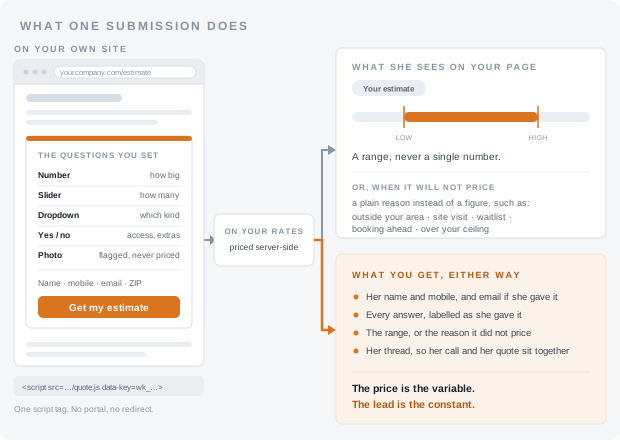
| What lands in your inbox, the second she submits | Name, mobile, ZIP, all eight answers — including which plan tier she picked — the photo flag, and the disclaimer she was shown | ||
The $28, the $34, the $18, the $14 and every percentage above belong to the demo account, not to a Tailgate Office price list — you set all of them in the dashboard. Three things about that arithmetic are worth reading twice. The percentages pool rather than compound, so plus 12, minus 25 and plus 18 make plus 5 and not the 1.12 × 0.75 × 1.18 you would get by multiplying them out, which lands under water at −0.88% and $61.45; here that is a difference of $3.65 a visit, and on a bigger spread it is a lot more. A discount and an uplift on the same form therefore cancel cleanly, which is the whole reason the negative percentage is safe to use. And the pooled figure lands on the entire additive subtotal including the base fee, so the $28 route stop is discounted 25% along with everything else on a monthly plan — which is fair here, because the stop really is shorter when the tech was there four weeks ago. What is not illustrative is the total: $59 – $71 per visit is what the engine returns for those eight answers, and you can reproduce it yourself on the demo in about a minute.
Would you rather try it than read about it? We keep a working example pest control website with NapkinPrice™ embedded — the real engine, quoting live, on a page that is not ours. Put in those eight answers, then change the frequency answer and watch only that number move.
Try the live demo site (opens in a new tab)The frequency ladder does your selling. It does not do your arithmetic.
The same house, the same seven answers, one changed: the plan she picks. Four runs of the real engine, and the only thing that moves between them is the negative percentage sitting in the option label she just read.
| What the option says | The percentage behind it | What the engine returns |
|---|---|---|
| Every month (save 25%) | −25% | $59 – $71 per visit |
| Every other month (save 16%) | −16% | $64 – $77 per visit |
| Every quarter (save 8%) | −8% | $69 – $82 per visit |
| One visit, no plan | 0% | $73 – $88 |
There is no fifth column on that table and there is not going to be one. This page will not print a monthly figure for a quarterly plan, will not multiply a per-visit figure by twelve, and will not show a first-year value. The cleaning page does print an annual column beside its own ladder and it is honest there, because a cleaner’s visit count really is fixed by the frequency the customer just picked — twenty-six visits is twenty-six visits. It is not honest here. A pest plan runs until it is cancelled, the term is the thing you are actually selling, and a first-year total printed beside an instant quote reads as a commitment the form never asked her for.
What the negative percentage says instead is true and it is checkable in three runs of the demo: the same visit is $59 – $71 monthly, $69 – $82 quarterly and $73 – $88 with no plan at all. Note which way round that is. Quarterly costs MORE per visit than monthly, because a tech who was there four weeks ago sweeps the eaves and tops up a couple of baits, and a tech who was there thirteen weeks ago is doing most of the house again. It is also exactly why nobody should divide the quarterly number by three to invent a monthly one — those are not the same visit. Leave the “no plan” option in at zero, too. A discount with nothing visible to be a discount from is just a price.
The ladder holds its shape on cheaper work as well, which is the test of whether a percentage was the right rule. Drop the mice and rats and take general pests only on the same house and it is $46 – $55 a visit monthly and $50 – $60 every other month. And the plan price holds while the plan runs: there is no term and no cancellation fee on the demo account, because the engine has no way to express a clawback and this estate does not write disclaimers for things the product cannot do.
The plan visit — quotes instantly
services[0] on the account, and it is the recurring visit rather than the bigger initial on purpose: the frequency dropdown belongs on the service whose price it discounts. The $28 route stop is in the base fee because it is the one thing on the form nobody can answer around. Our example house is $59 to $71 a visit monthly and $73 to $88 with no plan. Put it on a slab instead of a crawlspace and it is $49 to $59; give it a crawl somebody has to crawl the length of and it is $66 to $79; move it up to 2,500–4,000 sq ft and it is $67 to $80; add the fence line and the wood pile and it is $72 to $86; add one outbuilding and it is $76 to $92; add rodent stations and it is $73 to $87. The cheapest answer set possible — an outside barrier only, under 1,500 sq ft, on a slab, monthly — floors at $45 to $49 rather than at the $30 its arithmetic works out to. And the ceiling is $185 a visit, set where it can actually fire: German roaches in a 4,000 sq ft house on a long crawl with the full exterior, an outbuilding and stations, on no plan, reaches $209.52 and stops, because that is a job somebody should price by hand rather than a route stop.
The initial treatment — quotes instantly
The long visit, and the one that is not a route stop: two to three hours, the whole house walked, the crawlspace and the attic hatch opened, the outside banded, the eaves swept, baits placed, and a written list of the ways in. Its own $115 base fee for the trip and the inspection hour, its own $295 minimum, and a band of plus or minus 10% — WIDER than the plan visit’s 9%, on purpose, because the first visit is the one with surprises in it. Mice in that 2,200 sq ft house is $403 to $493; general pests is $300 to $366; a wasp nest is $295 to $331, where the low end is the service floor rather than the arithmetic; German roaches is $472 to $577. Sealing the ways in adds a flat $165 and takes the mice job to $593 to $725; treating the attic adds $110 and takes it to $530 to $648; both together is $720 to $880. A big but ordinary initial — German roaches in a 3,000 sq ft house, crawlspace, full exterior, sealed and the attic done — still quotes, at $974 to $1,191. Past the $1,200 ceiling it stops: the worst answer set on the form reaches $1,288 and routes.
Termites, bed bugs and wildlife — site visit, never priced
Site-visit mode captures the whole spec and shows no number at all, which is the only honest answer to any of the four things on it. A termite job is priced from the linear feet around the foundation, the construction type and whether it is a liquid barrier or a bait system — and the footage is the one figure a homeowner is always wrong about, because she is pacing the outside of a house with a bump-out on it. A WDI letter for a settlement is a signed document with a deadline and it gets a phone call. Bed bugs are priced by room, by method and by how far they have already gone, which nobody knows until somebody looks. An animal in the attic is trapping under a state permit, on a schedule the animal sets, and it always ends in carpentry. The form asks for the footage anyway and says out loud that the answer is for loading the truck and not for the price — which is this service’s whole argument in one sentence.
Neither priced service carries a season, and that is a decision rather than an empty field
The demand curve is real and it is dated. The phone starts in the first warm week of April with ants and carpenter bees, runs through wasps and mosquitoes all summer, and spikes again on the first hard frost when the mice come in. Every one of those is a genuine reason a homeowner calls, and not one of them is a reason to charge her more. The gutter page and the chimney page both put a percentage on their busy twelve weeks, and they can, because what they are pricing is a capacity constraint on SCHEDULED work — a choice she makes and a cost she avoids by booking in July. Nobody decides to have mice in November. A season on the initial treatment would charge the most to the person with the worst problem in the week she has it.
The plan visit cannot carry one at all, for a reason that goes to what a plan IS. A plan price that moves with the calendar is not a plan. The whole promise of that service is a number that does not change when the problem does, and seasoning it would mean an existing customer’s July visit costing more than her January one for no work she asked for — after she has already signed. So both services ship with an empty season field, every figure on this page is date-free and stable, and the trade’s real seasonal fact is stated in words where it belongs: on the frequency question’s own help text, which tells her the quarterly plan is the one most likely to miss the fortnight in April when the ants arrive.
The travel zones stack on top of all of it, and they are the same engine run on the same eight answers with nothing changed but the ZIP: Culpeper 22701 is $59 to $71, Warrenton 20186 is $68 to $82, Fredericksburg 22401 is $79 to $95, a ZIP in the catch-all ring is $97 to $116 — 63% above the home zone on a route stop — and a ZIP outside every zone you serve gets no price at all, a polite decline with the lead still captured. Keep the outer fees honest and small or do not sell plans out there: on a $65 visit a $38 travel fee is more than half the ticket, and the cheapest plan on the whole form goes from $45 to $49 at home to $63 to $76 in the catch-all zone. A service that quotes will not go live until it carries a real base fee or a real minimum. That is deliberate: a service with neither would happily return $0 to a homeowner, and one bad number on your website costs more than a day of setup.
You are in a crawlspace on your back and the phone is in the truck
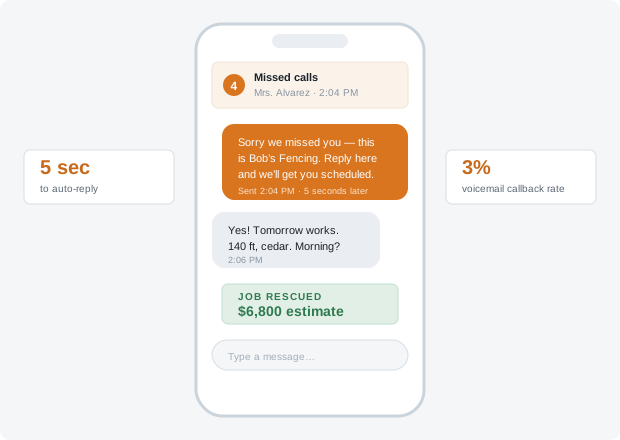
Half this job happens where a phone cannot follow: under a house in a Tyvek suit, up an attic ladder with a light, or banding an exterior with a pump running. Roughly 62% of contractor calls go unanswered, about 78% of jobs go to whoever responds first, and voicemail gets a callback around 3% of the time. The woman who found droppings on Sunday night is ringing four companies, and first is the only place on that list worth being.
| What a missed pest call is worth | On the demo account |
|---|---|
| One initial treatment, mice, 2,200 sq ft on a crawlspace | $403 – $493 |
| The same visit with the ways in sealed and the attic done | $720 – $880 |
| German roaches, 3,000 sq ft, full exterior, sealed and the attic | $974 – $1,191 |
| One plan visit on a monthly plan — and then the next one, and the next | $59 – $71 per visit |
| Voicemail callback rate | ~3% |
| One recovered initial treatment pays for | 2 months of the bundle |
| One recovered roach job pays for | 4 months |
That fourth row is the one to read properly, because it is the row this page refuses to turn into a number. The plan visits behind a recovered initial are worth far more than the initial was — that is the whole economics of the trade — but nobody knows how many of them there will be, the form never asks, and the engine cannot compute a term. So the table stops at what one visit costs and leaves the multiplying to you, on paper, with your own retention figure in front of you.
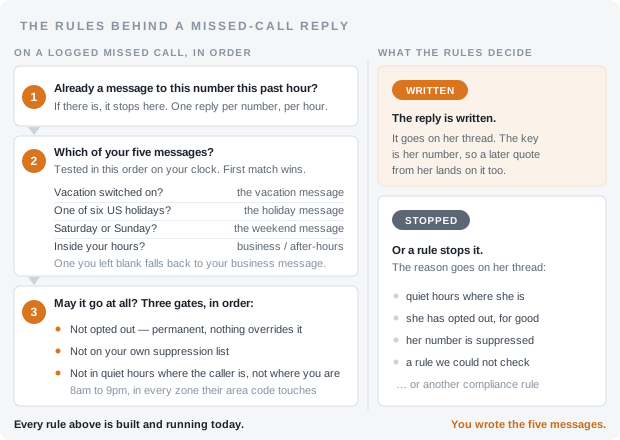
CallMitt™ writes back from your own texting number, a local number registered to your business and not a stranger’s 800 line, and the text opens with your business name, so she replies into the same thread as her quote. The message is picked by the hour and the day, against the hours you actually keep — the demo shop runs 7 to 5, because half of this work is outside and the outside gets done before the heat. A 5:20 call honestly gets the after-hours version instead of one claiming somebody is on the way.
Straight about where this stands. We have no SMS gateway yet and there is no automatic missed-call detection, so today you log the missed call and nothing is sent: a reply queued now is retired rather than delivered when your carrier registration clears. Everything around it is built and running now: the five messages, the business-hours, weekend, holiday and vacation rules, the quiet hours, the opt-out handling, and the thread her reply lands in beside her quote.
How CallMitt Works Run Your Own NumbersA pest tech is hired on one question, and it is about August under a house
The man you want is on his back in a crawlspace in the third week of July, in a suit, with a light in his teeth. Plenty of people will tell you they are fine with that in the office. Finding out on day two that they are not costs you the day and every stop behind it on the route. The second thing a résumé never makes clear is the credential: in Virginia it is VDACS registration, and somebody who has already started on it is worth more than somebody who has never heard of it.
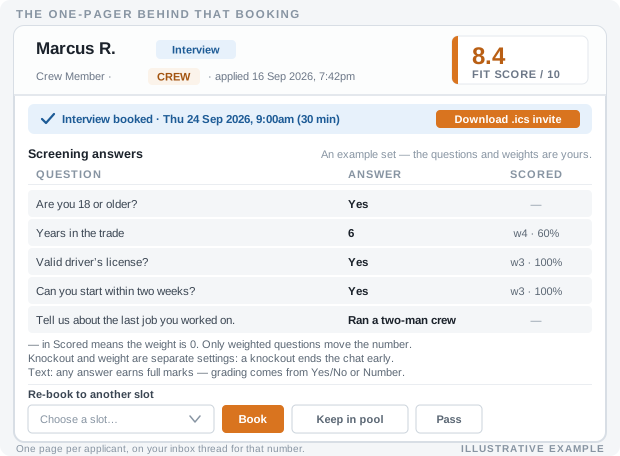
Put “Now hiring — text CREW to your texting number” on the truck and the yard sign. CrewFunnel™ asks seven short questions: is he 18 or older, is he up for crawlspaces and attics in the heat most days, is he VDACS registered or started on it, how many years has he done pest work, how far out does he live, can he start inside two weeks, and what was the last job he worked on. Three of those are knockouts — under 18, not up for the crawlspaces, or living further out than you will drive — and three come back as a weighted fit score, years in the trade heaviest and the start date next.
Two things about that scoring are worth copying. Distance is a knockout and never a weight, because a number answer scores higher the bigger it is, so weighting miles would rank the man furthest away at the top. And free text carries no weight at all, because any non-empty answer scores full marks and a weighted text box quietly inflates every candidate who typed anything. Both are set that way on our own demo job, and every question on it carries a Spanish translation — which in this trade is not a nicety.
One honest note on delivery. There is no inbound SMS on our side yet, so today he answers those seven questions on your screening page rather than by text — same questions, same knockouts, same scoring, same pool. The keyword on the truck takes over the day your carrier registration clears.
See how CrewFunnel works
The review comes from the quiet week after, not from the day you treated
The day of the treatment is not the day. She is still finding them, and a request that lands that evening reads like a victory lap. The day is about a week on, when she opens the cupboard under the sink, sees nothing, and notices she has stopped checking. That is the week she would write you a review. A month later no bugs is just what the house is like. The outfit with sixty reviews is not sixty times better than you; somebody there asks every customer, in the quiet week.
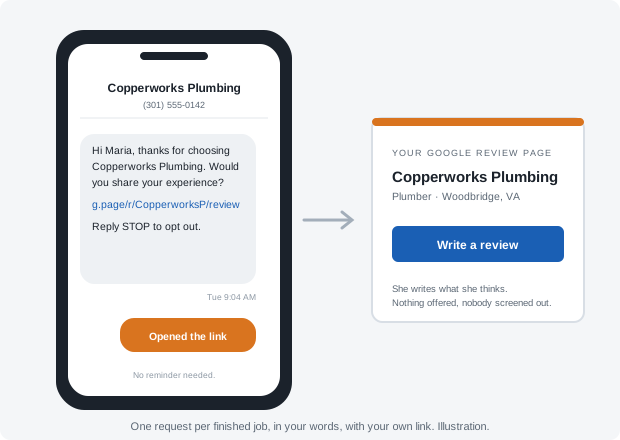
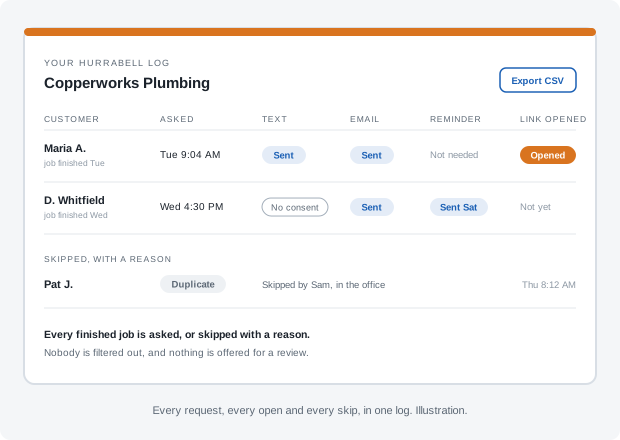
HurraBell™ does the asking. Mark the job done — from the inbox, from your phone, or from your job software through Zapier — and the customer gets one request in your words, with your own Google review link, after a delay you pick: an hour, unless you change it. Three days later, one email reminder, unless the link has been opened or the customer has got back in touch.
Review requests aren’t switched on yet, so none is sent today. When they are, the request goes by email once your Google review link is saved on the HurraBell page and your mailing address on the Account page. A text goes as well where the customer agreed to texts, and only once your carrier registration clears, the same wait as every text on this site; until then it is email only.
See how HurraBell worksOne recovered initial treatment covers 2 months
The roach job with the attic and the seal-up covers 4. Everything the plan visits after them are worth is yours to work out, because this page will not pretend the form asked how long she stays.
The Tailgate Office Bundle
Instant quotes on your website, missed-call text-back, text-to-apply hiring, review requests, and customers, jobs, estimates and invoices in one place. 30 days free, no credit card, no setup fee, cancel from the dashboard.
Start Free TrialOnly need one of the tools? After the trial you can keep just that one at its own price; the office stays with the Bundle.
Pest control questions we get asked
It shows the price of ONE visit, and both disclaimers say that in those words — not a month, not a quarter, not a year. The engine prices one job, once; it has no concept of a recurring charge, a contract term or a monthly total, and adding one would be a guess anyway because nobody knows the term at the form. So the plan service quotes a visit at $59 to $71 monthly, and the initial treatment quotes the first visit at $403 to $493, and the two are never added together on the screen. What carries the recurring story instead is the discount, which is a per-visit saving and a claim you can check: change the frequency answer and nothing else, and the same visit goes $59 to $71 monthly, $69 to $82 quarterly, $73 to $88 with no plan.
It is the right way round and it is the argument for the whole ladder. A tech who was at the house four weeks ago sweeps the eaves, walks the band and tops up a couple of baits. A tech who was there thirteen weeks ago is doing most of the treatment again — the band has weathered, the webs are back and whatever was getting in has had a season to do it. Quarterly is still cheaper over a year because there are four visits instead of twelve; it is just not cheaper per visit, and the two claims are different. This is also exactly why nothing on this page divides a quarterly figure by three to show a smaller monthly one. They are not the same visit and a number built that way would be fiction.
Onto the third service, where it is quoted after somebody looks, and it never shows a price. A termite job is priced from the linear feet around the foundation, how the house is built and whether you are putting in a liquid barrier or a bait system — and the footage is the one figure a homeowner is always wrong about, because she is pacing the outside of a house that has a bump-out and a side-load garage on it. The honest market spread is $1,200 to $3,500, and that spread IS the answer rather than shyness about it. Bed bugs are the same shape for different reasons: by room, by method, and by how far they have already gone. Neither is a number the fixture can compute, so neither is a number this page prints as a quote.
The animals are ours and the insulation is not, and the demo account says so on the question rather than after the visit. Trapping is done under a state permit, on a schedule the animal sets, and it always ends in carpentry — so it sits on the site-visit service with the termites and the bed bugs. Once they are out and the hole is closed, the fouled insulation is stripped and replaced by an insulation contractor: a different truck, a different quote, and it is priced on the insulation page’s own account, where rodent contamination is a plus-80% answer on the tear-out question. The wildlife question’s help text hands it over in as many words. Neither account can quote the other’s work and neither pretends to.
A percentage is the rule that keeps working when the rest of the form moves. Your monthly discount is 25% of whatever that visit is worth, so it scales with the house instead of being a flat $15 that is generous on a small one and insulting on a big one. It also pools rather than compounds, which matters more here than anywhere else in the estate: on the worked example the plus 12 for size, the minus 25 for the plan and the plus 18 for the crawlspace add to plus 5, not to 1.12 × 0.75 × 1.18. A discount and an uplift on the same form therefore cancel cleanly and predictably, and a homeowner can follow the arithmetic on a napkin. If you would rather price a tier as a rate, a separate service per frequency is a field you own — it is just four forms to maintain instead of one dropdown.
No, it is the arithmetic being visible, and it is the most useful thing on this whole page for anybody thinking about route density. On the demo account the catch-all zone is $38 plus 5%, and on a $65 route stop that is more than half again — the same visit is $59 to $71 in Culpeper and $97 to $116 out in the catch-all ring, 63% more for identical work. That is not a pricing error. It is the reason a pest company sells plans in two counties and drives to the third one only for initial treatments and termite work. Set your zones so the number tells you that before your route does, and set one zone to "outside my area" so the far ones decline politely while the lead is still captured.
Call it fifteen minutes for your text-back messages and your working hours, a minute, once review requests are switched on for your account, to paste your Google review link on the HurraBell page and your mailing address on the Account page, and about an hour to write the seven plan-visit questions and load one rate card — your scope amounts, your size bands, your frequency percentages, your foundation and exterior bands and your two flats. Then most of another hour for the initial treatment, which has its own base fee, its own minimum, its own wider band and its own seal-up and attic amounts. The third service is twenty minutes because nothing on it prices. A service that quotes will not go live until it carries a real base fee or minimum, which is deliberate. No onboarding call, no setup fee and no contract: $199 a month buys all four tools.
Insulate the attic once the animals are out? See the insulation page, all the trade pages, or call (301) 268-1943.
Give her the two numbers before she rings the next one.
Set it up tonight. Free for 30 days, no card, no setup fee, cancel from the dashboard.