
Appliance repair is two calls on one phone line, and the quote starts with the price of turning up
The first call is not shopping. The fridge is warm, the washer is full of water, or the oven died with a tray in it, and she is working down whoever Google put at the top of the list. She is booking whoever answers, and she is not leaving a voicemail to do it.
The second call has been coming for a fortnight. The machine is eleven years old, it has been making a noise since spring, and what she actually wants to know is whether this is worth fixing at all or whether she is buying a new one. That question is not a form’s to answer, and pretending otherwise is how this trade gets a bad name. NapkinPrice™ runs it the way the trade actually works: a flat fee for the visit, named on your website before anybody rings, and the repair quoted in a band around it — and anything sealed-system, built-in or commercial goes down a third path that never guesses a number at all.
The form also asks for a photo of the model and serial plate, and the lead tells you to ask for it on the callback, because the model number is what decides which part rides out on the van. Attaching the image itself to the lead is on the roadmap, which is why it is not a tick in that list.
A missed appliance call is not one lost job. It is a hole in tomorrow’s route.
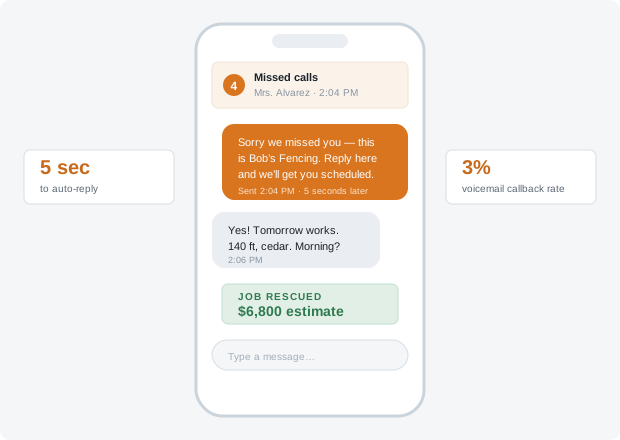
Not answering is not rudeness in this trade, it is the job. Your hands are inside a machine that is pulled out into the middle of somebody’s kitchen with its back off, or you are under a counter with a dishwasher half out on its hoses, and you cannot walk away from either of those to take a call. This trade does not lose one big job a week, it loses a call at a time, six or eight days running, and each one was a slot on a route that was going past her street anyway.
| What a missed appliance call is worth | On the demo account |
|---|---|
| A service call: a tech out, the fault found, the repair priced before anything comes apart | $89 – $96 |
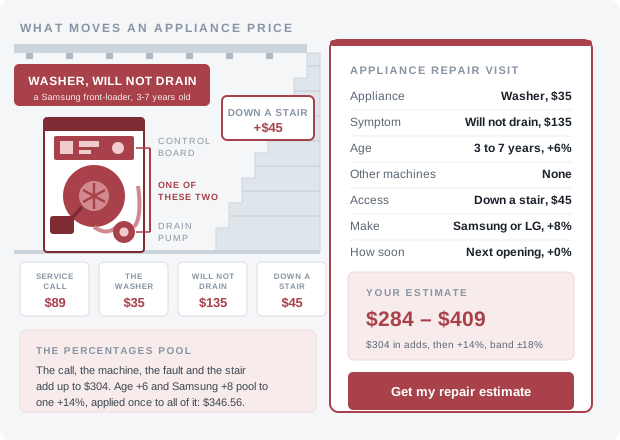
| A five-year-old washer that will not drain, down a basement stair | $284 – $409 |
| The same visit with two more machines seen while the van is already outside | $537 – $772 |
| One recovered turnover visit pays for | 2 months of the bundle |
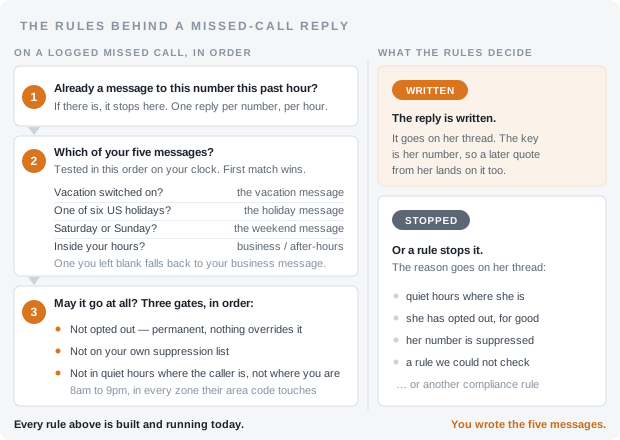
CallMitt™ writes back from your own texting number, a local number registered to your business and not a stranger’s 800 line, and the text opens with your business name, so she replies into the same thread as her quote. The message is picked by the hour and the day — the demo shop’s phone runs 8am to 6pm, so the call at twenty past six gets the after-hours version, which says when you actually start and tells her to shut the valve behind the machine rather than pretending somebody is about to pick up. That hour is the one this trade lives on, and it is the one the rules serve best: it is after your day and still inside the window texting is allowed in. Here is what is already true at 6am tomorrow:
Every missed call, in order, with the hour on it
You log the call and it takes its place in a list you can read down at six in the morning — who rang, from what number, at what time, and what was composed back. Nothing to reconstruct off a phone that shows nine names and no times, which is what a Tuesday looks like in this trade.
A blocked message says why it was blocked
When a rule stops a message it is recorded as blocked with the reason written out in plain English — quiet hours where the caller is, an opt-out, a suppressed number. You are never left guessing whether something went out.
Her call and her website quote in one thread
The key is the phone number, so the form she filled in about the warm fridge at nine last night and the call she made at ten past six this morning are one conversation on one screen, instead of two records nobody ever joins up.
A tally that leaves your own tests out
Every send is tagged with where it came from, and the dashboard count excludes the ones you fired at yourself while setting it up. What is on the screen is real calls, which is the only figure worth looking at.
Straight about where this stands. We have no SMS gateway on our side yet, so nothing we compose reaches a phone today — you log the missed call and the reply is written, compliance-checked and held in your outbox where you can read it. Everything around it is built and running now: the five messages, the business-hours, weekend, holiday and vacation rules, the quiet hours, the opt-out handling, and the thread her reply lands in beside her quote. Two things that wording usually leaves out, and both of them are permanent: texting runs 8am to 9pm where the caller is — we read that off their area code — and no setting on our side relaxes it, so a call outside that window is recorded as blocked with the reason rather than queued and nothing re-attempts it in the morning; and a reply held longer than an hour is retired rather than delivered when sending switches on, because nobody wants a month-old “sorry we missed your call” landing on a customer’s phone. The code that answers a forwarded call and texts the caller back is written, deployed and tested over signed webhooks — it has no phone number to answer on yet, which is a paperwork problem rather than a software one.
Do not take our word for it. Set the clock to a late evening on the example business and watch the same rules record it as blocked — try it on the demo (opens in a new tab) — or open that business’s real dashboard, no signup, at the example account’s own dashboard, then click CallMitt in the left menu and read its five text-back messages and its hours for yourself.
How CallMitt Works Run Your Own NumbersThe eight things that set an appliance number
Which machine it is
A microwave, a dryer, a washer, a dishwasher, a range or wall oven, an ice maker, a fridge or freezer. A pick-one, with the money sitting on the option rather than on the rule — $0, $20, $35, $40, $55, $60 and $70 on the demo. Do not draw a per-unit distinction on a pick-one, because the engine has none: the option she chooses adds its dollars once for the job.
What it is doing
The most load-bearing question on the account, because the symptom is what predicts the part and the part is most of the money. A door or gasket, will not start, leaking, will not drain or spin, an error code, a noise, not cooling or not heating — $85 to $185 on the demo, priced once for the job. It is also the question that sorts your morning: anything with a burning smell in it goes to the front of the list.
How old it is
Under three years, three to seven, eight to twelve, over twelve. This is a percentage on the whole job rather than a line item, because age changes everything together — clips snap when you undo them, gaskets have gone hard, and more parts are discontinued and have to come from a rebuilder. Zero, 6, 12 and 18 percent on the demo.
Any other machine on the same trip
The one genuinely per-unit line on this service — your rate for a second machine multiplied by however many she names, $135 each on the demo. Answer zero and nothing fires at all: not the rate, not a flat amount, not a percentage. That is the behaviour you want, because zero is the normal answer and a form that charged for a machine she does not have would be lying.
How hard it is to get at
Most of a repair is reaching the back of the machine. Open floor, down a stair, stacked in a closet or under a counter, or built into cabinetry behind a panel-ready front — $0, $45, $75 and $140 on the demo, priced once for the visit, because a stacked pair has to come out and go back in whatever you end up replacing.
What make it is
This is about the parts channel, not the badge. Mainstream parts are on the van or at a counter across town the same day; European and premium built-in parts are ordered, cost more and sometimes take a week. That is why it is a percentage on the whole job rather than a fee — zero, 8, 16 and 28 percent on the demo.
How soon she needs somebody
Urgency is something the customer declares, so it is a dropdown with a percentage on it — nothing for the next opening, nothing for tomorrow, 22 percent for today. A same-day slot costs the tech their next two appointments, and that is a percentage of the job rather than a flat call-out fee: a flat is added first and is then multiplied by every percentage and by the travel zone, so the figure you typed stops being the figure she gets.
Travel zone
List your ZIPs by zone — whole ZIPs or three-digit prefixes — and the widget prices the trip from the ZIP she types, most specific match first. A flat charge, a percentage, or both. Set one zone to "outside my area" and it declines politely while still capturing the lead. A job minimum backs it up, so a small repair forty minutes out still pays for the drive.
A real repair flow, start to finish
Eight questions, about a minute. This is the exact sequence running on our own appliance repair demo account — and the total at the bottom is what the live pricing engine returns for these answers, not a figure anybody typed into this page.
| # | What she is asked | What she picks | What it does to the price |
|---|---|---|---|
| 1 | Which appliance is it? | Washer | The option carries the money: $35, once for the job |
| 2 | What is it doing? | Will not drain, or will not spin | $135 — the symptom is what predicts the part |
| 3 | How old is it? | 3 to 7 years | A percent on the whole job: +6% |
| 4 | Any OTHER appliance you want repaired while we are there? | None | Nothing at all. A zero fires no rule — not the $135 per extra machine, not a flat, not a percent |
| 5 | Where is it, and how hard is it to get at? | Down a stair — basement or second floor | $45, once for the visit however long it takes |
| 6 | What make is it? | Samsung or LG | A percent on the whole job: +8% |
| 7 | How soon do you need us? | Next opening, usually within two business days | Nothing. Today is the answer that carries a percentage |
| 8 | Got a photo of the model and serial plate? | Offered | Nothing. A photo never moves the price |
| The arithmetic, in the order the engine runs it | The $89 service call is the base rather than an extra, so $89 + $35 + $135 + $45 = $304, then the two percentage answers pool and apply once to all of it: +14% → $346.56 | ||
| She sees | $284 – $409 | ||
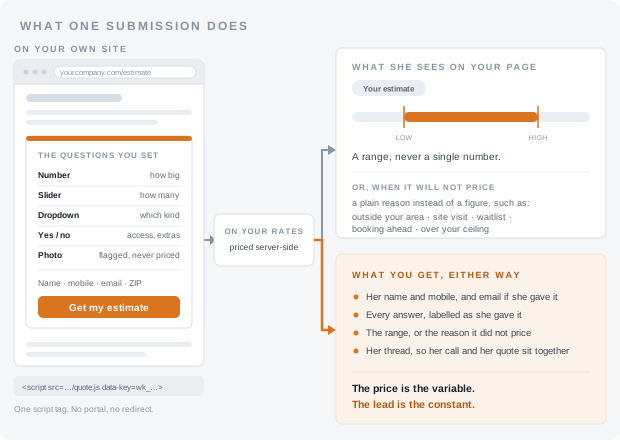
| What lands in your inbox, the second she submits | Name, mobile, ZIP, all eight answers, the photo flag, and the disclaimer she was shown | ||
The symptom prices, the access charges and the percentages above belong to the demo account, not to a Tailgate Office price list — you set every one of them in the dashboard and you can change what a control board costs you without touching your website. What is not illustrative is the total: $284 to $409 is what the engine returns for those eight answers, and you can reproduce it yourself on the demo in about a minute.
Would you rather try it than read about it? We keep a working example appliance repair company website with NapkinPrice embedded — the real engine, quoting live, on a page that is not ours. Put in those eight answers and see the same number come back.
Try the live demo site (opens in a new tab)Three services, and only two of them ever show a price
A washer that will not drain, a second opinion before she buys a new fridge, and a sealed-system fault on a panel-ready column are three different conversations. Running them through one form is how you end up quoting a compressor like a door switch.
Repair visit, diagnosed and fixed on the same trip — quotes instantly
The $89 service call is the base of this number rather than an extra at the door, so it is inside every figure the form prints and it is charged once however many machines you open. Underneath it is a job minimum of $149 on the demo, and the low end of the band pins to that floor rather than sitting 18% below the midpoint: a microwave door latch works out at a $174 midpoint and comes back $149 to $205, flattened at the bottom by the floor instead of sliding under it. Above the ceiling it stops pricing: past $720 on the demo the widget routes the lead to you, because at that number the real conversation is whether to repair the machine at all. The ceiling is tested on the midpoint before the band is drawn, so a job that clears it can still print a top end above it — a turnover visit with three machines on it has a midpoint under $720 and still publishes $537 to $772.
Service call, the fault found and the repair priced — quotes instantly
This is the honest answer to a trade whose average job is not worth a five-minute form. The fee is a real number, not a range — $89 on the demo, and it buys the van, the tech and the meter. Decline the repair at the door and $89 is all you pay; go ahead on the same visit and it comes off. Because the fee lives in the service base fee it is added once however many machines he looks at, so a second opinion on the dryer while he is standing in front of the washer comes back $123 to $145, not another $89. There is a ceiling here too, at $400, past which it is a property survey booked with the office.
Sealed-system, built-in and commercial — site visit, never priced
Site-visit mode captures the whole spec and shows no number at all, which is the right answer for refrigeration work that needs recovery and a certificate, a panel-ready column that has to come out of its cabinetry and go back square, or a restaurant that loses service while you are in it. The service still asks the unit type, how many are on site, whether something is down right now and whether you can work on it in normal hours — that last one moves no money, it just tells you whether this is a 6am job. She gets your own "we will come and look" message; you get a lead worth bidding.
A service that quotes will not go live until it carries a real base fee or a real minimum. That is deliberate: a service with neither would happily return $0 to a homeowner, and one bad number on your website costs more than a day of setup.
A tech you can send out alone is the whole ceiling on this business
There is no state appliance licence to screen on, which sounds like good news and is not: it means the only filter is the interview, and you find out on the third house whether he meters a component or swaps parts until something works. The one real ticket in this trade, EPA 608, bites on sealed-system work — and on this account sealed-system work routes to a site visit rather than being quoted, so asking for a card the shop does not require would only knock out the people it wants.
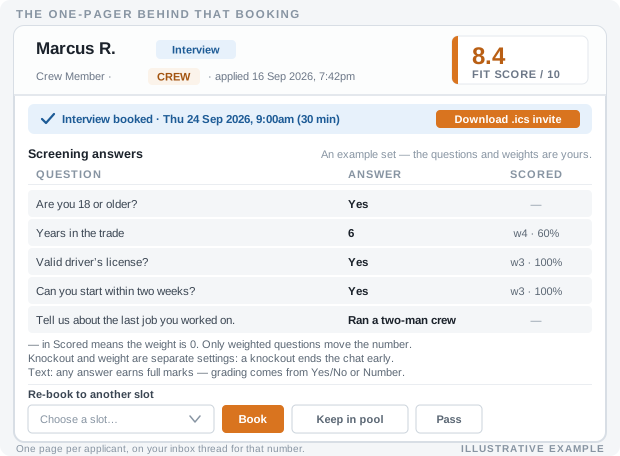
Put “Now hiring — text CREW to your texting number” on the van and the parts counter. CrewFunnel™ asks seven short questions: is he 18 or older, is he up for six to eight houses a day in other people’s kitchens pulling machines out and putting them back, has he metered a component against the wiring diagram to find a fault rather than swapping parts until it works, how many years has he repaired appliances, how far out does he live, can he start inside two weeks, and what was the last job he worked on. Three of those are knockouts — under 18, not up for the shape of the day, or living more than a set distance away — and the rest come back as a weighted fit score, with the metering question scored rather than knocked out because a good parts-changer is trainable and an unwilling one is not.
Two things about that scoring are worth copying. Distance is a knockout and never a weight, because a number answer scores higher the bigger it is, so weighting miles would rank the man furthest away at the top. And free text carries no weight at all, because any non-empty answer scores full marks and a weighted text box quietly inflates every candidate who typed anything. Both of those are set that way on our own demo job, and every question on it carries a Spanish translation.
One honest note on delivery. There is no inbound SMS on our side yet, so today he answers those seven questions on your screening page rather than by text — same questions, same knockouts, same scoring, same pool. The keyword on the van takes over the day your carrier registration clears.
See how CrewFunnel works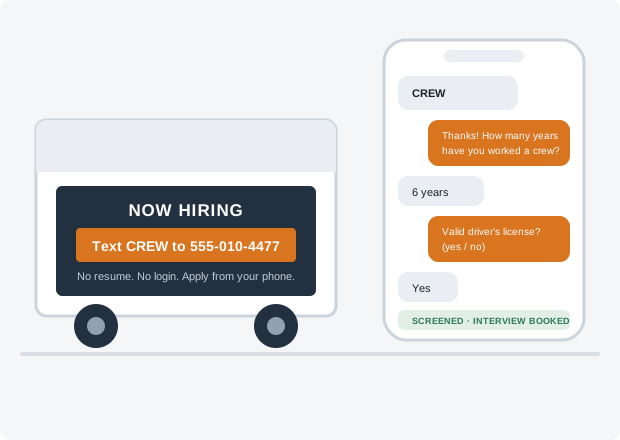
A dryer that runs again gets its review the same afternoon, or never
The dryer is running again by mid-afternoon, the van is already on its way to the next kitchen, and she is standing in the laundry room with a load tumbling that has sat wet since Tuesday. That is the hour she would write you a review: the machine works, the tech was in and out in under an hour, and the relief has not worn off yet. By the time that load is folded she is on to dinner, and by Thursday the dryer is just the dryer again. The outfit with sixty reviews is not sixty times better than you; somebody there asks every customer, before the next load is folded.
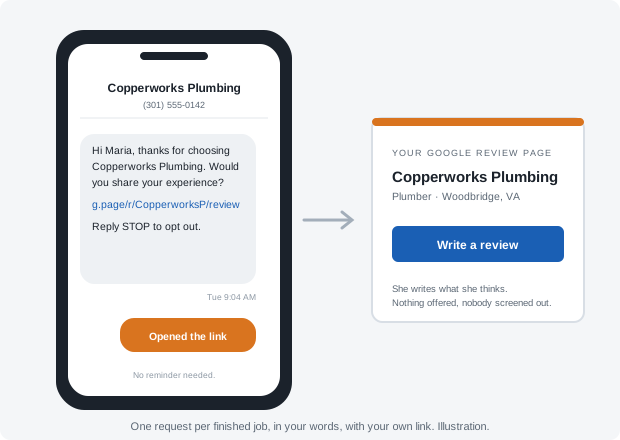
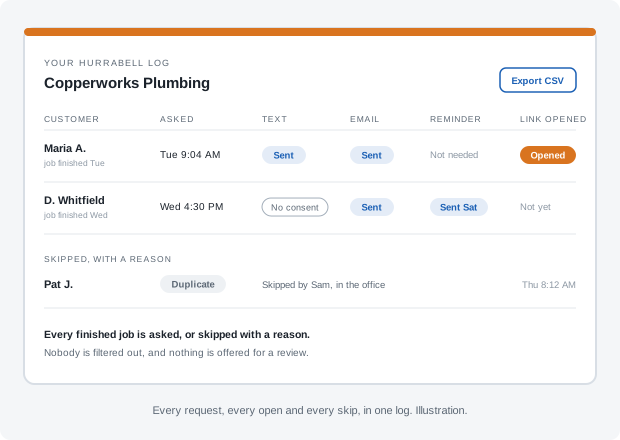
HurraBell™ does the asking. Mark the job done — from the inbox, from your phone, or from your job software through Zapier — and the customer gets one request in your words, with your own Google review link, after a delay you pick: an hour, unless you change it. Three days later, one email reminder, unless the link has been opened or the customer has got back in touch.
Review requests aren’t switched on yet, so none is sent today. When they are, the request goes by email once your Google review link is saved on the HurraBell page and your mailing address on the Account page. A text goes as well where the customer agreed to texts, and only once your carrier registration clears, the same wait as every text on this site; until then it is email only.
See how HurraBell worksOne recovered turnover visit covers 2 months
And in a trade that loses a call at a time rather than a job at a time, three recovered service calls in a month cover the month they happened in. This is not a close arithmetic.
The Tailgate Office Bundle
Instant quotes on your website, missed-call text-back, text-to-apply hiring, review requests, and customers, jobs, estimates and invoices in one place. 30 days free, no credit card, no setup fee, cancel from the dashboard.
Start Free TrialOnly need one of the tools? After the trial you can keep just that one at its own price; the office stays with the Bundle.
Appliance repair questions we get asked
Here is the honest state of it. The design is that your business line stays exactly where it is and keeps ringing as it does now. You turn on forwarding for unanswered calls once, with a code the setup guide gives you, and from then on a call nobody answers in about twenty seconds passes to your own texting number, a local number in your area code registered to your business. A short greeting, in place of your voicemail, tells the caller a text is on its way, and the reply goes out from that texting number. The caller dials one number and hears back from another. It works because the text opens with your business name and thanks them for calling. A ring group or a second phone is no obstacle, because the text only fires when nobody picks up. An answering service is one or the other for any given hour, since an unanswered call can only forward to one place: the forwarding is your own setting, a code switches it off, and the service keeps whatever hours you give it. What runs today is the half that needs no carrier: you log the missed call, CallMitt picks the right message for the hour and the day, checks your hours, the quiet hours, your opt-outs and your suppression list, and the message is composed and held in your outbox where you can read it. The code that answers a forwarded call and does all of that without you touching it is written, deployed and tested over signed webhooks — it has no phone number to answer on yet. Better you read that here than find it out in week two.
Nothing leaves the building at any hour today, and the rule that decides those two would be the same if it did: both are recorded as blocked, with the reason, and that is the end of them. Texting runs 8am to 9pm where the caller is — read off their area code — and there is no setting on our side that relaxes it, so an eleven o’clock message and a seven o’clock one are never queued in the first place. Nothing re-attempts either at eight: a blocked record is final by design rather than by accident. And a message that did queue and then sat is retired rather than delivered once it is more than an hour old, because a "sorry we missed your call" that lands the next afternoon does more harm than silence. The hour this trade actually lives on is the one between those two — she gets home at half six to a warm fridge, which is after your day and inside the window texting is allowed in, so that one is composed rather than blocked. For the eleven o’clock and the seven o’clock, what you have at six in the morning is the list: who rang, at what time, and why nothing went out, so you ring them back before they have finished ringing round.
It stops pricing and hands you the lead. Every instant service carries a ceiling, and on the demo the repair service is set at $720 — a twelve-year-old built-in Sub-Zero that is not cooling, wanted today, goes straight past it and she gets your own "this one needs somebody standing in front of it" message instead of a number. That is the right place to stop in this trade: past that figure the honest conversation is whether to repair the machine at all, and no form should be having it. The ceiling is tested against the midpoint before the range is ever drawn, so it is a decision about the job rather than about the top of a band. Set yours where you would stop quoting over the phone.
Because the form is not selling the repair, it is selling the visit — and the visit has a real price. On the demo the service call is $89: a tech out, the fault found, the repair priced before anything comes apart, and the fee comes off if she goes ahead on the same trip. That is a number she can act on at nine at night, which is more than the shop she rang before you gave her. Two things about it are worth setting up properly. It lives in the service base fee, so it is charged once however many machines he looks at — a second opinion on the dryer while he is in front of the washer comes back $123 to $145, not another $89 — and because it is the base of every repair figure too, the fee is inside the number rather than sprung at the door. The repair service then prices the machine she actually rang about, which is the conversation you want to be having second, not first.
You can price a range, and only a range — and how wide that range is should be an argument rather than a habit. On the demo the repair service is set to plus or minus 18%, which is the widest band any of our demo accounts publishes, and it is set there on purpose. Take the washer in the table above: the two things that cause a five-year-old front-loader not to drain are a drain pump at about $95 and a main control board at about $220, and nobody knows which until the back is off. At the 10% most of the other demos run, the band would be $312 to $381 and the control board — the likelier of the two on a machine that age — would fall outside a number you had already published. At 30% it would be $243 to $451, which tells her nothing. Fitted to the two real outcomes it is $284 to $409, and the disclaimer under it says the price is confirmed before anything comes apart. The service call is the opposite case and runs at 8%, because sending a van is a known cost. The two numbers disagree because the two jobs disagree.
It works better, and this trade is the clearest case for it. The call that matters most here lands just after you finish — she has walked in the door, the fridge is warm and the food is on the clock — and that is exactly the hour a message picked by the hour and the day can tell the truth in: the after-hours version says when you actually start, tells her to shut the valve behind a leaking machine or keep the fridge door shut, and asks what the machine is and what it is doing, so tomorrow’s route is built before you open the laptop. A homeowner who cannot tell when you answer assumes the answer is never. One who gets a straight reply at half past six will wait until eight.
On your side, call it fifteen minutes for your five text-back messages and your hours, a minute, once review requests are switched on for your account, to paste your Google review link on the HurraBell page and your mailing address on the Account page, and about an hour to write the eight repair questions and load your symptom prices, your access charges, your make percentages and your travel zones. A service that quotes will not go live until it carries a real base fee or a real minimum, which is deliberate. Two things are not on your side, and they are separate switches rather than one. Text messages do not leave our building yet, because there is no SMS gateway on our side — that is the carrier and paperwork half, and it is the half we are working on. And nothing notices a missed call for you yet either: the code that answers a forwarded call and runs the whole pipeline is written, deployed and tested over signed webhooks, and what it is waiting on is a purchased number to answer on. Those two land independently. No onboarding call, no setup fee and no contract: $199 a month buys all four tools.
Also cover commercial kitchens, or run warranty work for a manufacturer? See all the trade pages, read the compliance page, or call (301) 268-1943.
Catch the half-six call. Put a real price on the visit.
Set it up tonight. Free for 30 days, no card, no setup fee, cancel from the dashboard.