
Water treatment is priced from the problem she can name, and sized from the test
A homeowner does not know what grain capacity she needs, but she knows what she is looking at: spots on the glasses, orange stains in the tub, a chlorine taste, sand in the aerator. Each points to a system, and each system has a price with the equipment in it. The size of the house moves it, a well moves it, and so does whether anybody ever plumbed a place for it. That is a quote she can answer tonight.
What she cannot answer is what is actually in her water, and nobody should pretend to. So this page prices the system from the problem she names and puts the lab test on the form, and the disclaimer says every system is sized from that test and certified for what it finds. Bacteria, a rotten-egg smell and anything a test has not named go to a site visit that tests first and prices after. Nowhere does the form or the page promise water that is “safe” or “pure”: a system treats what it is certified to treat.
The flow also asks for a photo of where the water comes into the house, and the lead tells you to ask for those pictures on the callback. Attaching the image itself to the lead is on the roadmap, which is why it is not a tick in that list.
The eight things that set a water treatment number
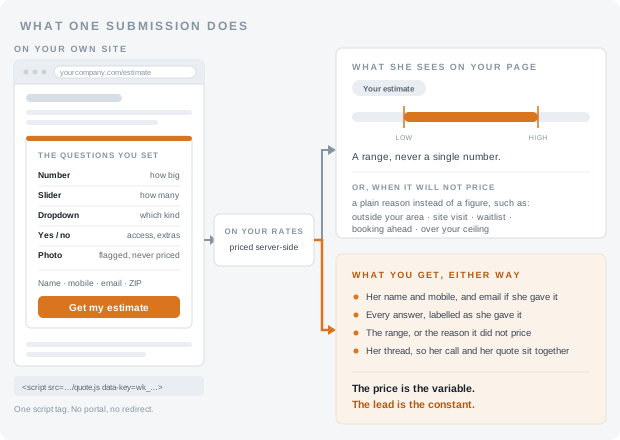
Five pick-ones, two yes-or-nos and a ZIP. You build the set once in the dashboard and every rate in it is a field you own — you can change a system price the month your distributor changes it without touching your website.
What she is trying to fix
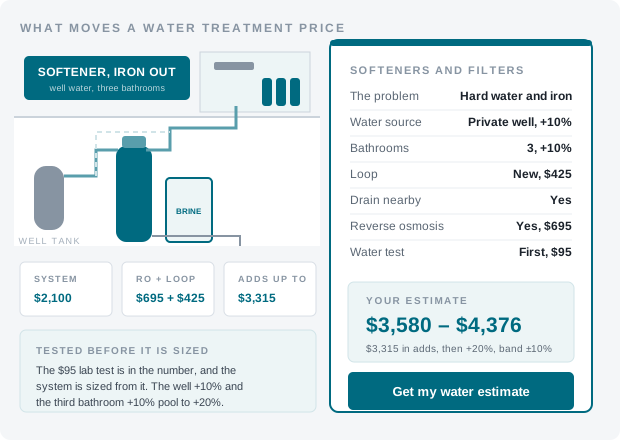
The system, chosen from the problem: hard water and a softener at $1,650, hard water with iron stains and a softener with iron removal at $2,100, a chlorine taste and a whole-house carbon filter at $1,250, sand and a sediment filter at $450. A pick-one that adds dollars once, with the equipment in it.
City water or a well
City water at the rate, a private well +10%. Well water is tested before anything is sized and gets a sediment prefilter, and she knows which she has.
How many bathrooms
One or two at the rate, three +10%, four or more +22%. A bigger house needs a bigger tank so the water stays treated through a morning of showers, and bathrooms are a number she knows without looking.
A place plumbed for it
Replacing an old unit at nothing, or a first install that needs a bypass loop at $425. "Not sure" prices as the first install, and the visit settles it.
A drain nearby
A yes or no that charges on No: a softener rinses itself into a drain, and no floor or laundry drain nearby adds $195 for a longer line or a small pump. A rule can fire on either answer, and this one fires on the answer that costs more.
Reverse osmosis
A yes or no at $695 on the demo for an under-sink system with its own faucet. The add-on she asks about once she knows the softener is not a drinking water filter.
The water test
A pick-one: lab results from the last year at nothing, or test it first with a certified lab at $95. It is on the form because the EPA's guide to choosing a treatment system says to test first, and because a system sized from a guess is a callback.
Travel zone
List your ZIPs by zone, whole ZIPs or three-digit prefixes, and the widget prices the trip from the ZIP she types, most specific match first, as a flat charge, a percentage, or both. Our demo company charges nothing in its home county and $95 out to the ring beyond it, so the same system comes back $3,580 to $4,376 at home and $3,666 to $4,480 in York. Set one zone to "outside my area" and it declines politely while still capturing the lead.
A real well-water softener, start to finish
Eight questions, about a minute. This is the exact sequence running on the instant service of our own water treatment demo account, answered for a softener with iron removal on a well in a three-bathroom house near Gettysburg — and the total at the bottom is what the live engine returns for these answers, not a figure anybody typed into this page.
| # | What she is asked | What she answers | What it does to the price |
|---|---|---|---|
| 1 | What are you trying to fix? | Hard water and orange iron stains (softener with iron removal) | A flat $2,100, the system included |
| 2 | City water or a private well? | Private well | +10% on the whole job |
| 3 | How many bathrooms? | 3 bathrooms | +10% on the whole job. 1 or 2 0%, 4 or more +22% |
| 4 | Is there already a spot plumbed for a softener? | No, this is the first one | A flat $425 for the bypass loop |
| 5 | Is there a floor drain or a laundry drain nearby? | Yes | Nothing. No adds $195 |
| 6 | Add reverse osmosis drinking water at the kitchen sink? | Yes | A flat $695 |
| 7 | Has your water been tested in the last year? | No: test it first (certified lab) | A flat $95 for the lab test |
| 8 | Got a photo of where the water comes into the house? | Offered | Nothing. A photo never moves the price |
| The arithmetic, in the order the engine runs it | $2,100 + $425 + $695 + $95 = $3,315, then the two percentage answers pool to +20% and apply once to all of it: → $3,978 | ||
| She sees | $3,580 – $4,376 | ||
| What lands in your inbox, the second she submits | Name, mobile, ZIP, all eight answers including whether the water has been tested, and the photo flag | ||
Every rate in that table belongs to the demo account, not to a Tailgate Office price list — you set all of them yourself, and you can change one without touching your website. What is not illustrative is the total: $3,580 to $4,376 is what the engine returns for those eight answers, for the system sized from the test and installed.
Would you rather try it than read about it? We keep a working example water treatment company website with NapkinPrice™ embedded — the real engine, quoting live, on a page that is not ours. Put in those eight answers and see the same number come back.
Try the live demo site (opens in a new tab)The system has a price. What is in the water has a test.
This is the one design decision that matters in water treatment, so here is the whole of it in plain words rather than a promise that it all just works.
The EPA’s WaterSense guide to choosing a treatment system says to test the water first and then to choose a system certified for what the test finds, and the question a homeowner should ask any water treatment company is exactly that: will my water be tested first, and is the system certified to treat what the test finds? A form that sells a softener without asking either question is the reason this trade has the reputation it has. So the demo asks, and the lab test is an answer on the form: $95 when she has no recent results, nothing when she does, and the disclaimer says the system is sized from the test and that she is told before anything is ordered if the test shows something it does not treat.
The words matter as much as the numbers. Nothing on the demo says a system makes water “safe” or “pure”; it says what the system treats. Bacteria, a rotten-egg smell, low pH and anything else a test turns up go to a site-visit service that asks what she is noticing and whether she has a report, shows no price at all, and takes her details so you can book the test. The percentage answers pool across the whole job, so the well and the third bathroom at +20% land on the loop, the reverse osmosis and the test too — about $243 of the $3,978 midpoint — and the help text says the house size is figured across the job.
Softeners and whole-house filters — quotes instantly
The system at $450 to $2,100 on the demo, chosen from the problem, a well and the bathrooms as percentages, $425 for a new loop, $195 when there is no drain nearby, $695 for reverse osmosis and $95 for the lab test. A $900 minimum is the floor under the final number, so a sediment filter on a well that works out at $495 comes back $900 to $990.
Well water problems: bacteria, sulfur and more — site visit, never priced
Site-visit mode captures the request and shows no number at all, which is the only honest answer to a result nobody has read yet. It asks what she is noticing, a test that found bacteria, a rotten-egg smell, blue-green stains or something else, and whether she has a recent lab report, which you read before you go.
A service that quotes will not go live until it carries a real base fee or a real minimum. That is deliberate: a service with neither would happily return $0 to a homeowner, and one bad number on your website costs more than a day of setup. The softener service carries no trip charge, so it is the minimum doing that job.
Nobody answers the phone from under a kitchen sink
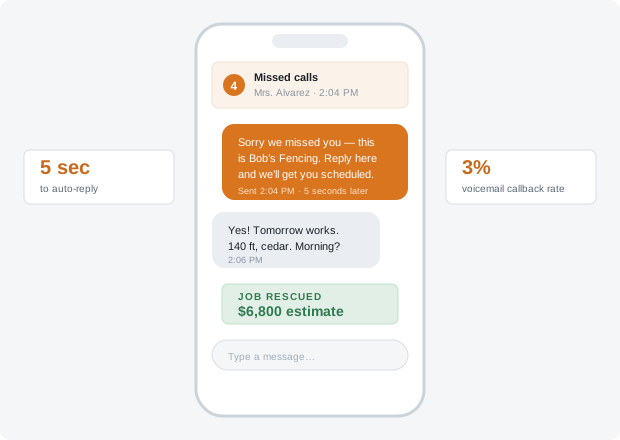
You are on your back under a sink with a reverse osmosis faucet in one hand, or in a basement carrying salt down the stairs. She has been scrubbing the same orange stain for a year, she has finally decided to fix it, and she is working down a list. The company that sends her something first is the one that gets to test her water, and the test is where the sale is made.
| What a missed water treatment call is worth | On the demo account |
|---|---|
| A softener with iron removal on a well, RO, the test | $3,580 – $4,376 |
| A whole-house carbon filter, four bathrooms, RO | $2,816 – $3,442 |
| A plain softener on city water, replacing an old one | $1,485 – $1,815 |
| A sediment filter on a well, at the minimum | $900 – $990 |
| One recovered well system pays for | 17 months of the bundle |
| One recovered softener pays for | 7 months |
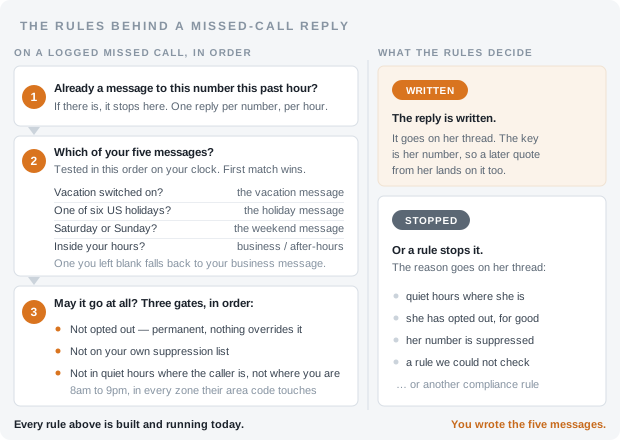
Once texting is switched on, CallMitt™ writes back by text with your business name in the first words, so she replies into the same thread as her quote. The message is picked by the hour and the day, against the hours you actually keep — the demo company answers 8 to 5, because installs are booked for when somebody is home to let you into the basement, so a 5:15 call gets the after-hours version rather than one claiming somebody is in the office — and every version asks the two things that sort your week: city water or a well, and what she is noticing.
Straight about where this stands. The forwarded-call hook is built and waits on your texting number, so today you log the missed call and nothing is sent: a reply queued now is retired rather than delivered when your carrier registration clears. Everything around it is built and running now: the five messages, the business-hours, weekend, holiday and vacation rules, the quiet hours, the opt-out handling, and the thread her reply lands in beside her quote.
How CallMitt Works Run Your Own NumbersA water treatment installer is hired on two questions, and the first one is about the stairs
The first is not a skill question at all. The job is forty-pound bags of salt and media carried down basement stairs, and a resin tank that weighs more than that, and a man who cannot do it all day is a man you will be replacing in a month. The second separates an installer from a helper: has he sweated copper or crimped PEX himself? Every softener is a plumbing job at the main, and a slow drip under a bypass valve is a ceiling you pay for.
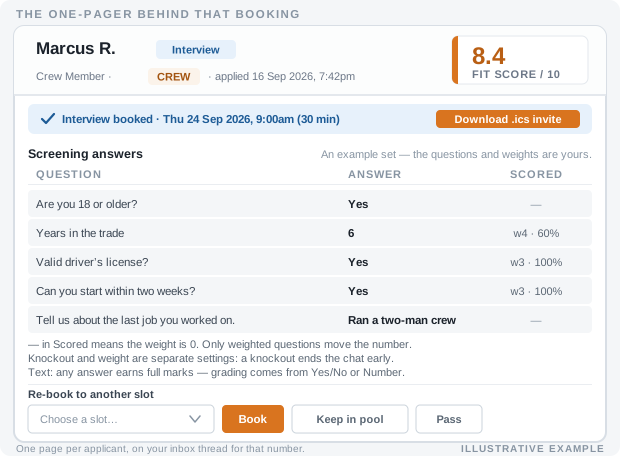
Put “Now hiring — text CREW to your texting number” on the van and the showroom door. CrewFunnel™ asks seven short questions: is he 18 or older, can he carry forty-pound bags of salt and media down basement stairs, has he sweated copper or crimped PEX himself, how many years has he done plumbing or water treatment work, how far out does he live, can he start inside two weeks, and what was the last job he worked on. Three are knockouts — under 18, not up for the carrying, or living further out than you will drive — and the rest come back as a weighted fit score, years in the trade heaviest, the start date next and the plumbing question after it.
Two things about that scoring are worth copying. Distance is a knockout and never a weight, because a number answer scores higher the bigger it is, so weighting miles would rank the man furthest away at the top. And free text carries no weight, because any non-empty answer scores full marks and a weighted text box inflates every candidate who typed anything. Both are set that way on our demo job, and all seven questions carry a Spanish translation.
One honest note on delivery. Text-to-apply waits on your texting number, so today he answers those seven questions on your screening page rather than by text — same questions, same knockouts, same scoring, same pool. The keyword on the van takes over the day your carrier registration clears.
See how CrewFunnel works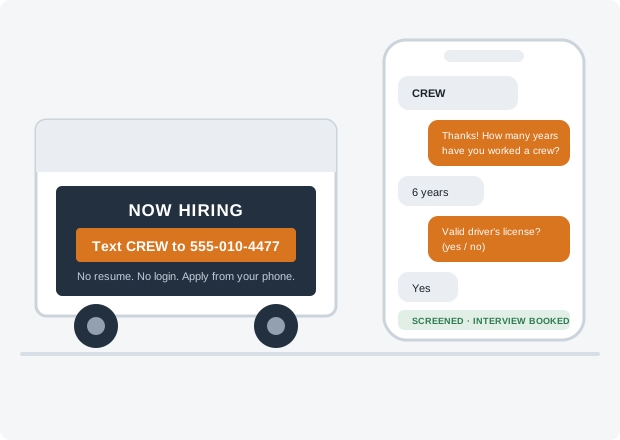
A softener gets its review the week the glasses come out clear
The system is in, the brine tank is full, and a week later her glasses come out of the dishwasher clear for the first time since they moved in. She runs a finger along the tub and there is no orange on it. That is the week she would write you a review. A month on, soft water is just how the house is, and nobody thinks to say so. The outfit with sixty reviews is not sixty times better than you; somebody there asks every customer, the week the stains stop coming back.
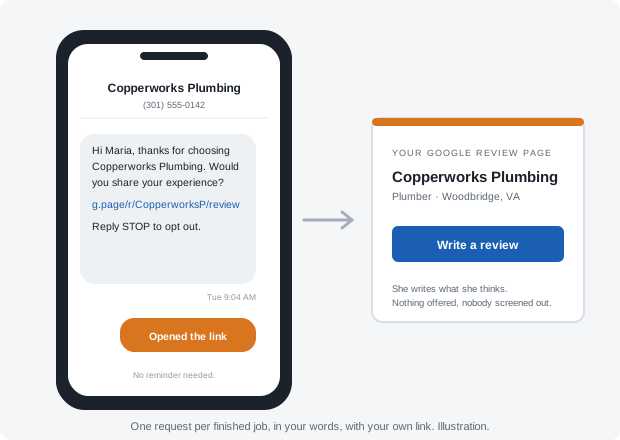
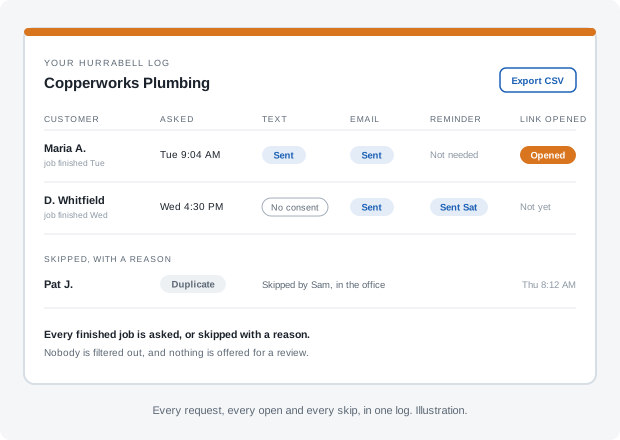
HurraBell™ does the asking. Once review requests are switched on, you mark the job done — from the inbox, from your phone, or from your job software through Zapier — and the customer gets one request in your words, with your own Google review link, after a delay you pick: an hour, unless you change it. Three days later, one email reminder, unless the link has been opened or the customer has since texted you, messaged you from your website or had a call logged on her thread.
Review requests aren’t switched on yet, so none is sent today. When they are, the request goes by email once your Google review link is saved on the HurraBell page and your mailing address on the Account page. A text goes as well where the customer ticked the box on your quote form or visit booking agreeing to a review-request text, and only once your carrier registration clears, the same wait as every text on this site; until then it is email only.
See how HurraBell worksOne recovered well system covers 17 months
A plain softener covers 7 of them. In a trade where the shopper has been scrubbing the same stain for a year, the arithmetic is not close.
The Tailgate Office Bundle
Instant quotes on your website, missed-call text-back and text-to-apply hiring (texts go out once texting is switched on), and, once switched on, a review request after every job, plus customers, jobs, estimates and invoices in one place. 30 days free, no credit card, no setup fee, cancel from the dashboard.
Start Free TrialOnly need one of the tools? After the trial you can keep just that one at its own price; the office stays with the Bundle.
Water treatment questions we get asked
You can price a range for the system she describes, and only a range — the widget never shows a single figure. The disclaimer under it is yours to write. On the demo it says every system is sized from a water test, that only systems certified for what the test finds are installed, and that if the test shows something this system does not treat she is told before anything is ordered. Salt, filters and service visits are not in the number.
Because the EPA's WaterSense guide to choosing a treatment system says to test first, and because the question a homeowner should ask is whether her water will be tested and whether the system is certified for what the test finds. Putting the test on the form, at $95 when she has no recent results, means nobody is sold a system sized from a guess, and the lead tells you which customers you are testing for.
Not on our demo, and we would not on yours. A treatment system treats what it is certified to treat, and that is what the demo says. Safe and pure are claims about everything in the water, including things nobody has tested for. Name the problem, name the system, name what it is certified for, and let the test do the rest.
Because the treatment depends on what the test found, how much of it and where it is coming from, and sometimes the answer is a well repair rather than a filter. The demo runs bacteria, sulfur, low pH and anything else a test turns up as a site visit that asks what she is noticing and whether she has a report, and shows no price.
Our demo says no, and its instant service carries no season. Softeners go in the same way in any month. The field is there if your costs genuinely swing, but inventing a season to fill the box is the fastest way to end up with a number you cannot defend.
Call it fifteen minutes for your text-back messages and your working hours, a minute, once review requests are switched on for your account, to paste your Google review link on the HurraBell page and your mailing address on the Account page, and about an hour to write the eight questions and load one rate card — your system prices, the well and bathroom percentages, the loop, the drain, reverse osmosis and the test. A service that quotes will not go live until it carries a real base fee or minimum, which is deliberate. No onboarding call, no setup fee and no contract: $199 a month buys all four tools.
Also service wells and pumps, or run a plumbing crew? See all the trade pages or ask us.
Quote the softener while she is still scrubbing the tub.
Set it up tonight. Free for 30 days, no card, no setup fee, cancel from the dashboard.