
A season is sold in September, from a driveway in daylight
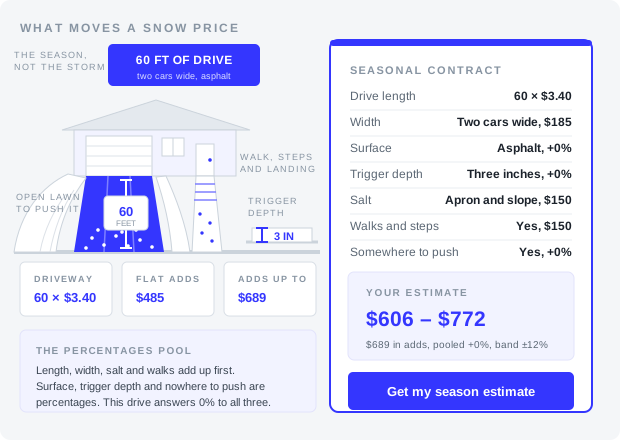
Everything that sets the price of a winter contract is visible from the kerb on a warm afternoon: how long the drive is, how wide, what it is made of, how deep it has to get before you turn out, whether the apron ices up, and whether the walk and the steps go with it. Not one of those answers needs snow on the ground to be true. That is why this trade can put a real number on a website months before the first flake — and why the shop that answers her in September has the contract before anybody else has printed a flyer.
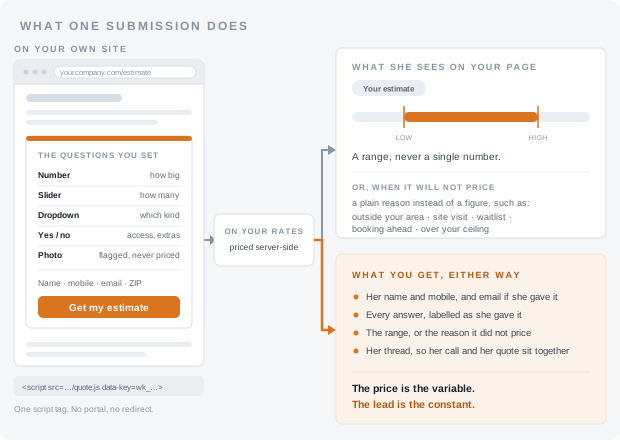
It is also the trade with the sharpest line in the estate between what a form can price and what it cannot, and the line is not where people expect it. The whole winter, quoted in advance: yes. One push, at four in the morning, with the county plow having just walled the end of the drive with four feet of slush: no, and no honest contractor would give you one either. What that job costs depends entirely on what is on the ground when the truck arrives, so our demo account takes the details, captures the lead in full and hands it to a route manager instead of inventing a figure.
NapkinPrice™ runs that shop as three services on one account. The seasonal contract asks nine questions and puts a range on the screen, the per-storm service takes the call without pricing it, and a commercial lot or an ice dam goes down a third path that never guesses a price at all.
The flow also asks for a photo of the drive from the road, and the lead tells you to ask for that picture on the callback. Attaching the image itself to the lead is on the roadmap, which is why it is not a tick in that list.
The nine things that set a season’s number
One measurement, four pick-ones, three yes/nos and a ZIP. Only the first one multiplies; everything else is a property of the contract rather than of each foot of tarmac, which is worth saying on the form so nobody expects the salt to be charged by the bag. You build the set once in the dashboard and every rate in it is a field you own.
Length of the drive
The base number and the only genuinely per-unit line on the whole service: her paced total times your per-foot rate, $3.40 on our own demo card. It multiplies because it is the only answer that is more work every single time it snows. The help text does the teaching — a stride is about three feet, a townhouse pad is 20 to 30, a subdivision drive with a two-car garage is 50 to 70, a house set back behind trees is 150 and up — because most people guess short by half. Set a floor and a ceiling on the answer, 20 to 400 feet on the demo, and the widget refuses a silly number instead of quietly clamping it.
How wide it is
A flat amount on a pick-one, added once for the contract: nothing for a single width, $185 for two cars wide, $340 for two cars plus a turnaround or a parking apron on the demo. Width is not more length — it is more passes and, on the last one, nowhere to put what you just cut. A turnaround is where the time actually goes, because the truck has to back and fill instead of driving through. Say out loud that it is priced once for the season and not per storm, because a flat adder is added once however long the winter turns out to be.
What the surface is
Asphalt or concrete, gravel or crushed stone, pavers or stamped concrete. A percentage rather than three rates, because the surface changes how you run the blade and how fast you can go rather than what you are pushing: on gravel the shoes come down, the blade floats an inch high, you leave a skim on purpose and you still regrade somebody's stone off the lawn in April. Nothing, plus 18% and plus 25% on the demo. The same 60-foot contract that quotes $606 to $772 on asphalt comes back $715 to $911 on gravel.
Trigger depth
The single biggest thing a homeowner controls, because it decides how many times you turn up all winter. Two inches means you come for nearly everything that falls, three inches is the standard, five inches means only the storms that would actually stop her leaving. Plus 20%, nothing and minus 15% on the demo — and that minus is the one discount on the card, because it is genuinely fewer visits. The help text has to say that the trigger is when you START and not how often you come, or the five-inch answer reads as being abandoned in a blizzard.
Salt or ice melt, as a tier
No salt, the apron and the slope, or the whole drive and the walks with it. A flat amount on a tier — nothing, $150, $395 — and not a per-bag rate, because the product being sold is a season and nobody wants an invoice in March because February was cold. A tier and not a yes/no for the same reason gutter guards are a tier: salting an apron and salting everything somebody walks on in the dark are two different jobs at two different margins. Plowing gets the snow off; it does nothing about the thaw on Tuesday and the sheet of ice on Wednesday, which is what actually puts somebody on their back.
Walks, steps and the path to the door
A plain yes/no with your own flat amount behind it, $150 for the season on the demo. It is separate from the plow line because a plow cannot do any of it: it is a person with a shovel and a blower, and it is the part of the visit that takes longest. Worth bounding in the help text — the front walk, the steps, the landing and the path from the drive to the door, and not a deck, a patio, a back stair or a flat roof, which are a site visit and a different conversation.
Somewhere to push it
The answer that costs you most in a heavy winter, and the only rule on the card that fires on NO rather than on yes. If both sides of the drive are a fence, a wall, a flower bed she cares about or the neighbour's tarmac, the snow has to be carried rather than pushed — stacked in a corner, then moved with a blower or a skid when the corner is full. Answering No adds 15% across the contract. Phrasing it positively and putting the rule on the negative answer is deliberate: the alternative is a double negative invented to keep the rule on yes, and a homeowner should not have to parse that.
Open before 6am, every time
The answer that raises the job MINIMUM to $675 and adds no dollars at all. Being on the route is one thing; being plowed before it has stopped snowing and again afterwards, because somebody has a shift at the hospital, is a staffing commitment you make whether or not she calls. So it lifts the floor rather than adding a fee — a plow-only two-car contract whose arithmetic is $389, and which quotes $345 to $436 on its own, comes back $675 to $756 with yes on this question, because the floor clamps the low end up rather than sitting under it.
Travel zone
List your ZIPs by zone — whole ZIPs or three-digit prefixes — and the widget prices the trip from the ZIP she types, most specific match first. A flat charge, a percentage, or both. These fees are larger against the ticket than any other trade on this site, and they should be: a sweep drives to one job and back, but a plow truck runs a ROUTE, and a drive twenty miles off it is not a longer drive, it is a second route with one customer on it at three in the morning. Set one zone to "outside my area" and it declines politely while still capturing the lead.
A whole winter, quoted in about a minute
Nine questions. This is the exact sequence running on our own snow demo account — a 60-foot two-car asphalt drive on a Winchester subdivision street, the standard three-inch trigger, salt on the apron and the slope, the front walk and steps cleared with it, open lawn at the edge to push the snow onto and nobody who has to be out before dawn — and the total at the bottom is what the live pricing engine returns for these answers and nothing else, not a figure anybody typed into this page.
| # | What she is asked | What she answers | What it does to the price |
|---|---|---|---|
| 1 | How long is the drive, from the road to where you park? | 60 ft | 60 × the per-foot rate — $3.40 on the demo, so $204. The only line that multiplies |
| 2 | How wide is it? | Two cars wide | A flat $185 for the contract. A turnaround or parking apron is $340 |
| 3 | What is the surface? | Asphalt or concrete | The standard case: +0%. Gravel is +18%, pavers +25% |
| 4 | How much snow before we come out? | Three inches | The standard trigger: +0%. Two inches is +20%, five inches is −15% |
| 5 | Salt or ice melt? | The apron and the slope | A flat $150 for the season. Salt everywhere, walks included, is $395 |
| 6 | Walks, steps and the path to the front door? | Yes | A flat $150 for the season. A plow cannot do any of it |
| 7 | Is there somewhere at the edge to push the snow? | Yes | Nothing. No would add 15% across the contract |
| 8 | Do you need it open before 6am, every time? | No | Nothing. Yes would not add a dollar either — it raises the job floor to $675 |
| 9 | Got a photo of the drive from the road? | Offered | Nothing. A photo never moves the price |
| The arithmetic, in the order the engine runs it | $204 drive + $185 width + $150 salt + $150 walks = $689, and all three percentage answers on this contract are zero, so nothing pools on top → $689.00 | ||
| She sees | $606 – $772 | ||
| What lands in your inbox, the second she submits | Name, mobile, ZIP, all nine answers, the photo flag, and the disclaimer she was shown | ||
The $3.40, the $185, the $150s and the percentages above belong to the demo account, not to a Tailgate Office price list — you set every one of them in the dashboard. Three things about that arithmetic are worth reading twice. This worked example is the rare one where the percentage pool comes to nothing, which makes the additive half easy to follow, but the pool is real the moment an answer moves: change the surface to gravel and the same contract is $715 – $911, and that 18% is figured across the salt and the walks as well as the plowing rather than on the plow line alone. The trigger depth is the lever with the widest swing, because it is the only one that changes how many times you turn out: two inches makes it $728 – $926 and five inches makes it $515 – $656. And every flat amount here is once per contract rather than once per visit, which is the sentence that stops a homeowner expecting to be billed per bag of salt in February. What is not illustrative is the total: $606 to $772 is what the engine returns for those nine answers, and you can reproduce it yourself on the demo in about a minute.
Would you rather try it than read about it? We keep a working example snow and ice contractor website with NapkinPrice™ embedded — the real engine, quoting live, on a page that is not ours. Put in those nine answers and see the same number come back, then try the per-storm service and watch it refuse to quote you.
Try the live demo site (opens in a new tab)The season quotes cleanly. The storm does not, and says so.
This is the one design decision that matters in this trade, so here is the whole of it in plain words rather than a promise that it all just works.
A winter contract is a known quantity in September. You know the length, the width, the surface, the trigger she wants and whether the walk goes with it, and those five answers really do carry the price. That is why the seasonal half of this trade sits at the honest end of the estate: nine questions produce $606 – $772 for the drive above, $345 – $436 for the same drive plowed and nothing else, $822 – $1,046 with salt on everything somebody walks on, and $1,527 – $1,943 for a 250-foot lane with a turnaround, salted everywhere and the walks done, all of which are numbers you would say on the phone in September.
A single push is not that, and the reason is worth saying properly. What a push costs is decided by what is actually on the ground when the truck gets there. Six inches of powder off a subdivision drive is fifteen minutes. The same drive after the county plow has banked four feet of frozen slush across the end of it is forty minutes and a shovel, and a drive that thawed on Tuesday and refroze on Tuesday night is a different job again. Nobody can answer that from a form at four in the morning, and a number given then is either a guess that is wrong or a ceiling high enough to be safe — which is just a wrong guess in the other direction.
So the per-storm service is set to winter mode, which never prices. The engine stops at the mode check and returns one fixed sentence — “We’re booking this for the season ahead — leave your details and we’ll reach out when it’s time” — and the lead is captured in full, every answer, exactly as it would be on a service that quoted. Not one question on it carries a pricing rule, and that is deliberate rather than unfinished: a rule on a routed service still computes a subtotal nobody is ever shown, which is configuration that looks live in the editor and is dead in the engine. This page prints no dollar figure for a push anywhere on it, because the fixture cannot compute one. That is the same discipline the chimney page keeps for a stainless reline.
Two seams in that are worth seeing once rather than discovering in January. Routing is checked in order — out of area first, then the mode — so the same per-storm service returns the polite out-of-area decline for a ZIP you do not serve and the winter message for every ZIP you do: one service, two different sentences, decided by the address. And the mode is a column on the service rather than a calendar, so it does not know what month it is. A real shop flips that service to instant in December and back in April, from the service editor, in about four seconds. A mode that carries its own dates is on the roadmap, and until it exists the demo shows the honest thing rather than a switch that pretends to throw itself.
Seasonal driveway contract — quotes instantly
The product this business actually sells, and the one that is sold in September. No trip charge and no per-visit fee, because a season is one number agreed before the first flake; instead it carries a job minimum, $345 on the demo, and twenty feet of townhouse pad plowed at a five-inch trigger comes back at that floor rather than at the $57.80 its arithmetic works out to. One answer lifts that floor without adding a dollar: a drive that has to be open before 6am every morning is a staffing commitment rather than a longer job, so the plow-only two-car contract whose arithmetic is $389 quotes $675 to $756 with yes on that question. And there is a ceiling above it all: 400 feet with a turnaround, gravel, a two-inch trigger, salt everywhere, the walks and nowhere to push it reaches a $3,434.85 midpoint, so past $2,400 the widget stops pricing and hands you the lead to quote by hand. The dearest it will still quote is $1,976 to $2,514.
Per-storm plowing, billed by the push — routes, never priced
Winter mode captures the whole call and shows no number at all, which is the only honest answer to a phone ringing at 4am. It still asks what needs clearing, roughly how long the drive is, whether this is for tonight or for the rest of the winter, whether a car is stuck or somebody is shut in, and whether it has thawed and refrozen or packed to ice — and not one of those answers moves money. They decide the route and the order of the callbacks, which is what actually matters at that hour: a car across the end of a drive is a shovel and a tow strap, not a plow. The length question says out loud that the answer is for the route and not for the price, which is the whole argument for this service in one sentence. She gets the booking-ahead message; you get a lead with the details on it and a rate agreed by somebody who has seen the drive.
Commercial lots, private lanes and ice dams — site visit, never priced
Site-visit mode, the third routing path, on the work nobody should quote from a form. A lot is not priced from its square footage but from where a winter of snow is going to go: the first storm fits anywhere, and the question is February, when the piles are eight feet high and the spaces the customer is paying for are underneath them. It asks what is being cleared, roughly how many spaces or feet of lane, what has to be open and by when, whether there is anywhere on site to stack it, and who carries the slip-and-fall liability — because a site log and timestamped salt records cost real time and are the only thing that answers a claim eighteen months later. This is also where the roof line is drawn: melting a dam off an eave is this trade's, and the gutter it tore loose and the shingles it lifted are handed to a gutter company and a roofer by name on the question.
The most seasonal trade on the site carries no seasonal rate at all, and that is the harder decision
A seasonal rate in this engine is a percentage on a date range. Ask what one would price here and there is no answer that survives being written down. The contract covers one whole winter for one flat number, and the work does not get more expensive because the day she signed happened to fall in November. What is real is an early-bird discount — sign before the middle of October and save — and that is a sales promotion rather than a rate: put it in the engine and it re-applies itself every year forever with nobody’s hand on it. The gutter page applied the same test to leaf fall and it passed, because leaf fall is a dated capacity crunch on deferrable work. A winter contract fails it, so the field stays empty and the disclaimer says out loud that there is no seasonal rate here and no surcharge for signing late.
On the per-storm service a seasonal percentage would be worse than unnecessary: it would be dead. The engine reads the mode and returns before the season is ever looked at, so the row would look live in the editor and price nothing at all. The trade’s seasonality is expressed by the mode instead, which is the thing that actually changes behaviour. The pool page puts the same mode on next spring’s openings, work that has not happened yet; this account puts it on work happening tonight that still cannot be priced, which is the harder half. The pleasant consequence of an empty season field is that every figure on this page is stable on any day of any year — run the same quote in July and in December and it is identical to the dollar.
The travel zones stack on top of all of it, and they are the same engine run on the same nine answers with nothing changed but the ZIP: Winchester 22601 is $606 to $772, over the Blue Ridge into western Loudoun is $659 to $839, across the Potomac into Frederick County, Maryland is $681 to $867, a ZIP in the catch-all ring is $778 to $990, and a ZIP outside every zone you serve gets no price at all — a polite decline, with the lead still captured. A service that quotes will not go live until it carries a real base fee or a real minimum. That is deliberate: a service with neither would happily return $0 to a homeowner, and one bad number on your website costs more than a day of setup.

On a storm morning every call is a missed call
This is the trade where that sentence is literal rather than dramatic. When there are eight inches down, every truck and every phone the business owns is out on a route, and the person who would answer the office line is driving one of them. Roughly 62% of contractor calls go unanswered, about 78% of jobs go to whoever responds first, and voicemail gets a callback around 3% of the time. A homeowner who wakes to a buried drive rings four contractors off the search results before breakfast and hires whichever one gets back to her — and on that particular morning all four are plowing.
| What a missed snow call is worth | On the demo account |
|---|---|
| A 60-foot two-car drive, apron salted, walks and steps in | $606 – $772 |
| The same drive plowed and nothing else | $345 – $436 |
| The same drive with salt on everything somebody walks on | $822 – $1,046 |
| A 250-foot lane with a turnaround, salted, walks in | $1,527 – $1,943 |
| Voicemail callback rate | ~3% |
| One recovered season contract pays for | 3 months of the bundle |
| One recovered lane pays for | 7 months |
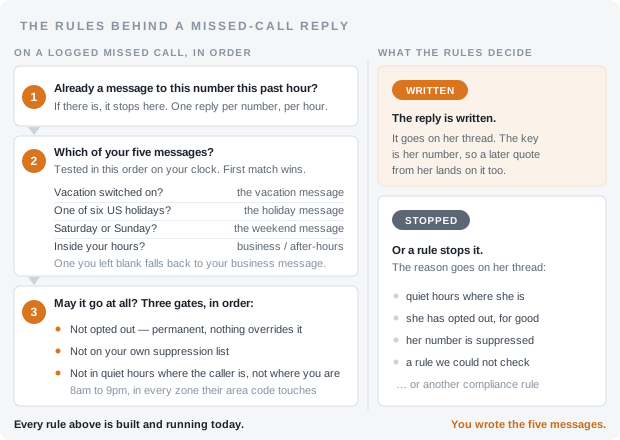
CallMitt™ writes back from your own texting number, a local number registered to your business and not a stranger’s 800 line, and the text opens with your business name, so she replies into the same thread as her quote. The message is picked by the hour and the day, against the hours you actually keep — the demo shop runs 7 to 5, and those are the hours somebody is at a desk rather than the hours the trucks run, which in a storm is all of them. The business-hours message says out loud that everything is on a route, because a message implying somebody is standing by is a lie the caller can see through from her own front window.
Straight about where this stands. Nothing on this platform delivers a text message yet: there is no SMS gateway and no carrier registration, so today you log the missed call and the reply becomes an outbox row marked queued and stops there — and a row still queued an hour later is retired as too old rather than sent late. Everything around it is built and running now: the five messages, the business-hours, weekend, holiday and vacation rules, the quiet hours, the opt-out handling, and the thread her reply lands in beside her quote.
How CallMitt Works Run Your Own NumbersA plow operator is hired on one question, and it is about one in the morning
This is not a job with shifts. From December to March it is a phone that goes at one in the morning, a twenty-hour day behind it, and then nothing at all for a fortnight. Plenty of people will tell you in October that they are fine with that. Finding out in the first real storm that they are not costs you the storm, and in this trade the storm is the revenue. The second thing a résumé never makes clear is whether somebody has actually run a blade and a spreader or has only ever ridden along with one.
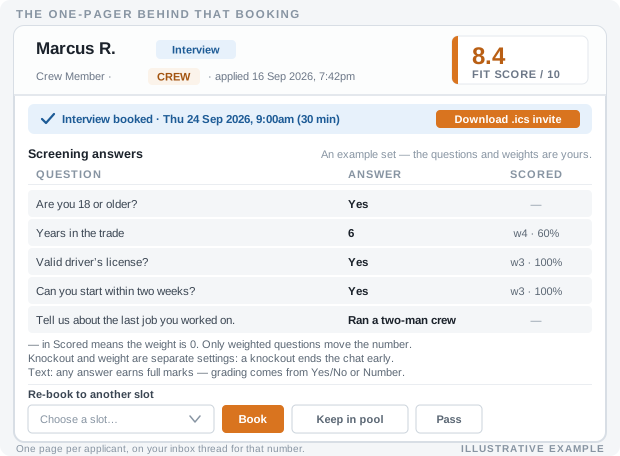
Put “Now hiring — text CREW to your texting number” on the truck door and the yard sign. CrewFunnel™ asks seven short questions: is he 18 or older, is he up for overnight on-call work from December to March in whatever the weather is doing, has he run a plow truck or a salt spreader before, how many winters has he plowed or salted for pay, how far out does he live, has he got a valid driver’s license, and what was the last job he worked on. Three of those are knockouts — under 18, not up for the overnight work, or living further out than you will drive — and three come back as a weighted fit score, winters in the trade heaviest and the licence next.
Two things about that scoring are worth copying. Distance is a knockout and never a weight, because a number answer scores higher the bigger it is, so weighting miles would rank the man furthest away at the top. And free text carries no weight at all, because any non-empty answer scores full marks and a weighted text box quietly inflates every candidate who typed anything. Both are set that way on our own demo job, and every question on it carries a Spanish translation, which in this trade is not decoration.
One honest note on delivery. There is no inbound SMS on our side yet, so today he answers those seven questions on your screening page rather than by text — same questions, same knockouts, same scoring, same pool. The keyword on the truck takes over the day your carrier registration clears.
See how CrewFunnel works
A plow contract gets its review after the first storm, not in April
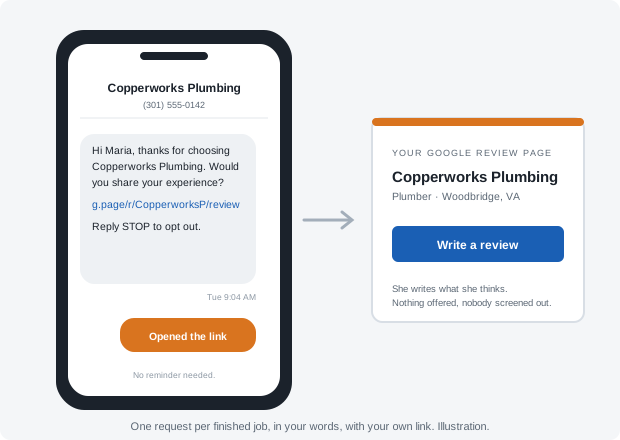
It came down all night, and before seven the drive is clear, the apron is salted, and she backs out for the school run without touching a shovel. That is the morning she would write you a review. By the fifth storm a clear drive is just what she pays for, and by April nobody is thinking about snow at all. The outfit with sixty reviews is not sixty times better than you; somebody there asks every customer, after the first storm of the contract.
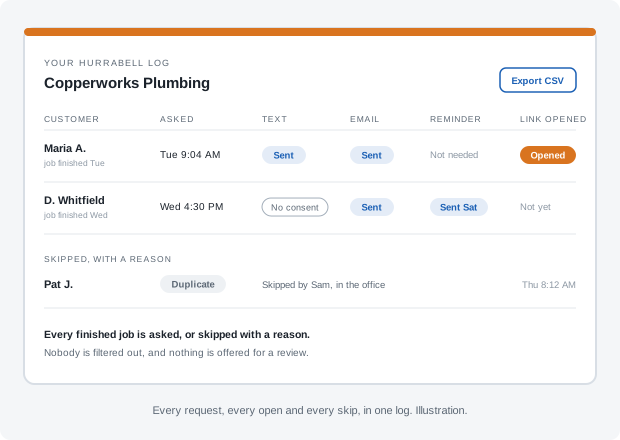
HurraBell™ does the asking. Mark the job done — from the inbox, from your phone, or from your job software through Zapier — and the customer gets one request in your words, with your own Google review link, after a delay you pick: an hour, unless you change it. Three days later, one email reminder, unless the link has been opened or the customer has got back in touch.
Review requests aren’t switched on yet, so none is sent today. When they are, the request goes by email once your Google review link is saved on the HurraBell page and your mailing address on the Account page. A text goes as well where the customer agreed to texts, and only once your carrier registration clears, the same wait as every text on this site; until then it is email only.
See how HurraBell worksOne recovered season contract covers 3 months
And a single recovered lane covers 7 of them. In a trade that earns its year in four months, the September contract you did not miss is the whole argument.
The Tailgate Office Bundle
Instant quotes on your website, missed-call text-back, text-to-apply hiring, review requests, and customers, jobs, estimates and invoices in one place. 30 days free, no credit card, no setup fee, cancel from the dashboard.
Start Free TrialOnly need one of the tools? After the trial you can keep just that one at its own price; the office stays with the Bundle.
Snow questions we get asked
You can price a range, which is all the widget ever shows. This trade is better at it than most, because the five things that set a season — length, width, surface, trigger depth and whether the walk goes with it — are all visible from the kerb in daylight and none of them is hidden under a layer of something else. The disclaimer underneath says the rest in your words: the number covers every storm all winter at the trigger she picked, you do not bill per visit and you do not stop coming because it has been a bad year, and you confirm it when you walk the drive and stake it out before the ground freezes — which is when you find the culvert, the slope and the wall nobody mentions on a form.
Because nothing honest can. A push is priced by what is on the ground when the truck arrives, and that is not knowable from a form: six inches of powder off a subdivision drive is fifteen minutes, the same drive after the county plow has banked the end of it is forty and a shovel, and a drive that thawed and refroze is a different job again. So that service runs in winter mode, which captures every answer and shows one fixed sentence instead of a number — leave your details and we will reach out — and the route manager comes back with a rate. Nothing on this page prints a per-push figure, because the demo account genuinely cannot compute one. A number invented for that box would be a guess or a ceiling, and you would have to defend it at four in the morning.
It is, and both sides know it, which is why saying so is better business than hiding it. In a heavy winter the contract is the cheaper answer by March; in a quiet one per-push is. The disclaimer on our demo account says exactly that in the customer's language, and the per-storm service says the other half: contract customers are cleared first, every storm, without exception. That is the honest reason to sign in September rather than a discount, and it is the sentence that sells the product. Both services live on one account and one widget, so she can read both and pick.
Because a seasonal rate in this engine is a percentage on a date range, and there is nothing here for one to price. The contract covers one whole winter for one flat number — it does not cost more because she signed in November. An early-bird discount is real, but it is a promotion rather than a rate: put it in the engine and it re-applies itself every year forever with nobody watching. And on the per-storm service a season row would be dead configuration, because the engine reads the mode and returns before it ever looks at a season. The seasonality of this trade is carried by the mode, which changes what the visitor sees, instead of by a percentage that would change a number nobody is shown. An empty season field is a decision you are allowed to make.
Because it is not more work, it is a different commitment, and the engine has a rule kind for exactly that. A minimum rule raises the floor on the final number and adds nothing — so a plow-only two-car contract whose arithmetic is $389, and which quotes $345 to $436 on its own, comes back $675 to $756 with yes on that question, because the floor clamps the low end up rather than sitting under it. Being on the route is one thing; being plowed before it has stopped snowing and again afterwards, because somebody has a shift at the hospital, means staffing for her whether or not she calls. A fee would say that costs a bit extra. The floor says it is a different product, which is the truth.
They can, and on this trade they should be larger against the ticket than anywhere else on this site — that is the shape of the work rather than greed. A sweep or a garage-door tech drives to one job and back. A plow truck runs a route, and a drive twenty miles off it is not a longer drive, it is a second route with one customer on it at three in the morning in the thing everybody else is staying home from. Our demo charges nothing at home in Winchester, a flat amount over the Blue Ridge into western Loudoun, more again across the Potomac into Maryland, and a percentage as well as a fee for everywhere else, because "anywhere else" from there means the far side of a mountain in a storm. Set one zone to outside your area and it declines politely while still capturing the lead.
Call it fifteen minutes for your text-back messages and your office hours, a minute, once review requests are switched on for your account, to paste your Google review link on the HurraBell page and your mailing address on the Account page, and about an hour to write the nine contract questions and load one rate card — your per-foot rate, your width steps, your surface percentages, your trigger bands, your salt tiers, your walks amount and your before-dawn floor. The per-storm service takes ten minutes after that, because it prices nothing: it is six questions and a mode. A service that quotes will not go live until it carries a real base fee or minimum, which is deliberate. No onboarding call, no setup fee and no contract: $199 a month buys all four tools, and ResponsiBid’s reported $400–600 setup, as published in August 2026, is not a thing here.
Mow and landscape the other eight months? See the landscaping page, all the trade pages, or call (301) 268-1943.
Sell the winter while the grass is still green.
Set it up tonight. Free for 30 days, no card, no setup fee, cancel from the dashboard.