

A manufactured home is priced by the section, the pier and the anchor
Most of the calls this trade gets are not a new home being set. They are a door that stopped latching, a crack over a doorway, a floor a marble rolls across, straps that rusted through, and skirting that blew off in the last storm. Every one of those is countable: the sections of the home, the piers to add or reset, the anchors to replace, the feet of skirting around it. A homeowner can answer them from her own yard, and you can price them from the answers.
So this page prices releveling and tie-downs, and skirting, as two instant services, with the trip inside the number on the first, and sends the one job that is not countable to a site visit: setting a new or moved home, which is priced from the site, the home’s installation instructions and the permit, and which ends with a signed installation certificate.
The flow also asks for a photo of the home and any cracks inside, and the lead tells you to ask for those pictures on the callback. Attaching the image itself to the lead is on the roadmap, which is why it is not a tick in that list.
The eight things that set a setup number
A base fee, two counts, two pick-ones, a yes or no, a second service and a ZIP. You build the set once in the dashboard and every rate in it is a field you own — you can change a per-anchor rate the month the anchors go up without touching your website.
The trip
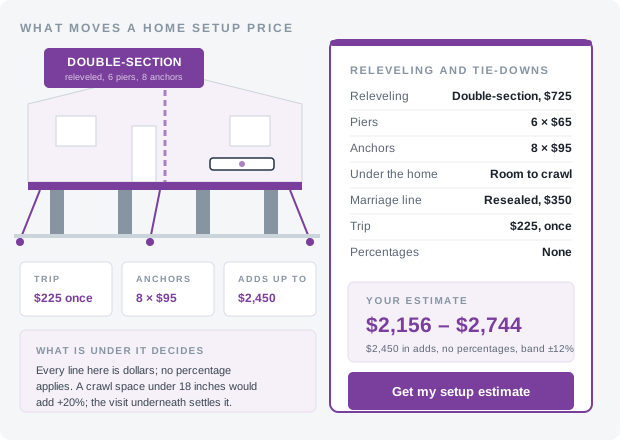
Not a question: the service's base fee, $225 on the demo, added once and inside every number. Most of this work is out on country roads, and the trip is the part of a small job nobody wants to meet on the invoice.
Releveling, by the section
A pick-one that adds dollars once: no releveling, a single-section home at $425, a double at $725, a triple at $1,050. Sticking doors, cracks over doorways and a floor that slopes are the signs, and the help text names them.
Piers to add or reset
Counted and multiplied: $65 a pier on the demo. A guess is fine and the help text says so; you count them when you are underneath.
Anchors and tie-down straps
Counted and multiplied: $95 an anchor on the demo, for rusted or loose straps and anchors that pulled out of the ground. Set to the home's installation instructions or HUD's installation standards, which the disclaimer says.
Room underneath
Enough to crawl comfortably at the rate, tight and under eighteen inches +20%. Every pier and every anchor is slower on your back in a tight space, which is why it is a percentage on the whole job.
The marriage line
A yes or no at $350 on the demo to reseal the seam where the sections meet, along the roof and under the floor. A multi-section home that has settled usually needs it.
Skirting, its own service
Linear feet around the home at $14 a foot in vinyl, insulated foam +18%, faux stone +55%, $150 to take the old skirting off and $45 a vent or access door. The help text gives the perimeter of a common single-wide and double-wide so the number she types is close.
Travel zone
List your ZIPs by zone, whole ZIPs or three-digit prefixes, and the widget prices the trip from the ZIP she types, most specific match first, as a flat charge, a percentage, or both, on top of the base fee. Our demo crew charges nothing in its home counties and $95 out to the ring beyond them, so the same job comes back $2,156 to $2,744 at home and $2,240 to $2,850 in Hagerstown. Set one zone to "outside my area" and it declines politely while still capturing the lead.
A real releveling job, start to finish
Six questions, under a minute. This is the exact sequence running on the releveling service of our own setup demo account, answered for a double-section home outside Martinsburg with sticking doors and rusted straps — and the total at the bottom is what the live engine returns for these answers, not a figure anybody typed into this page.
| # | What she is asked | What she answers | What it does to the price |
|---|---|---|---|
| — | (the service's base fee) | — | The $225 trip, added once before anything else |
| 1 | Does the home need releveling? | Yes, a double-section home | A flat $725 |
| 2 | How many piers to add or reset? | 6 | 6 × $65 = $390 |
| 3 | How many anchors or tie-down straps to replace or add? | 8 | 8 × $95 = $760 |
| 4 | How much room is there under the home? | Enough to crawl comfortably | Nothing. Tight, under 18 inches, +20% |
| 5 | Reseal the marriage line between the sections? | Yes | A flat $350 |
| 6 | Got a photo of the home? | Offered | Nothing. A photo never moves the price |
| The arithmetic, in the order the engine runs it | $225 + $725 + $390 + $760 + $350 = $2,450, and with no percentage answer picked there is nothing to apply: → $2,450 | ||
| She sees | $2,156 – $2,744 | ||
| What lands in your inbox, the second she submits | Name, mobile, ZIP, all six answers, and the photo flag | ||
Every rate in that table belongs to the demo account, not to a Tailgate Office price list — you set all of them yourself, and you can change one without touching your website. What is not illustrative is the total: $2,156 to $2,744 is what the engine returns for those six answers, the trip included.
Would you rather try it than read about it? We keep a working example manufactured home setup company website with NapkinPrice™ embedded — the real engine, quoting live, on a page that is not ours. Put in those six answers and see the same number come back.
Try the live demo site (opens in a new tab)Releveling and skirting quote. Setting a home ends with a signed certificate.
These are the decisions that matter in this trade, so here they are in plain words rather than a promise that it all just works.
Skirting is a different job from the jacks and the anchors, done by the foot from the outside, and it has its own instant service for the same reason the flooring page runs one service per material family: no rule multiplies one answer by another, so a material dropdown cannot change the releveling rate without making nonsense of both. On the skirting service the material is a percentage on that service alone: 184 feet of insulated foam panels around a single-wide, the old skirting off and five vents and doors, comes back $3,134 to $3,830; in vinyl, $2,656 to $3,246; in faux stone, $4,117 to $5,031.
Setting a new or moved home never gets a number online. Under HUD’s installation program the home is installed to its installation instructions by a licensed installer who certifies the installation, and the question a homeowner should ask is whether you are licensed to install homes in her state and whether she will get your signed installation certificate. The demo’s site-visit service asks what the home is and whether the site is ready, shows no price, and its disclaimer answers both questions in her words.
Releveling and tie-downs — quotes instantly
A $225 trip as the base fee, releveling at $425 to $1,050 by the section, $65 a pier, $95 an anchor, $350 for the marriage line and a tight crawl space at +20%. A $450 minimum is the floor under the final number, so a single anchor that works out at $320 comes back $450 to $504. Past $10,000 it stops pricing and hands you the lead.
Skirting — quotes instantly
$14 a foot in vinyl on the demo, insulated foam +18%, faux stone +55%, $150 to take the old skirting off and $45 a vent or access door. Its own $900 minimum and $8,000 ceiling, and the vents and the door the code asks for are in the question, not an afterthought.
Setting a new or moved home — site visit, never priced
Site-visit mode captures the request and shows no number at all. It asks whether it is a new single or multi-section home or a used one being moved, and whether the site has its pad or footings. The disclaimer says the installers are licensed and that she gets a signed installation certificate when the home is set.
A service that quotes will not go live until it carries a real base fee or a real minimum. That is deliberate: a service with neither would happily return $0 to a homeowner, and one bad number on your website costs more than a day of setup. The releveling service carries the trip as its base fee and a minimum under it; skirting carries a minimum alone.

Nobody answers the phone from under a home on a creeper
You are on your back under a floor with a bottle jack and a level, and the phone is in the truck. She is standing in a kitchen where the doors have stopped closing, or looking at skirting scattered across the yard after a storm, and she is working down a list. The crew that sends her something first is the one that gets to look underneath, and in a trade built on many modest jobs, every one you miss is a day of work.
| What a missed setup call is worth | On the demo account |
|---|---|
| A double-section home releveled, piers, anchors | $2,156 – $2,744 |
| The same job in a tight crawl space | $2,587 – $3,293 |
| 184 feet of insulated skirting, old skirting off | $3,134 – $3,830 |
| Four anchors in a tight crawl space | $639 – $813 |
| One recovered releveling pays for | 10 months of the bundle |
| One recovered skirting job pays for | 15 months |
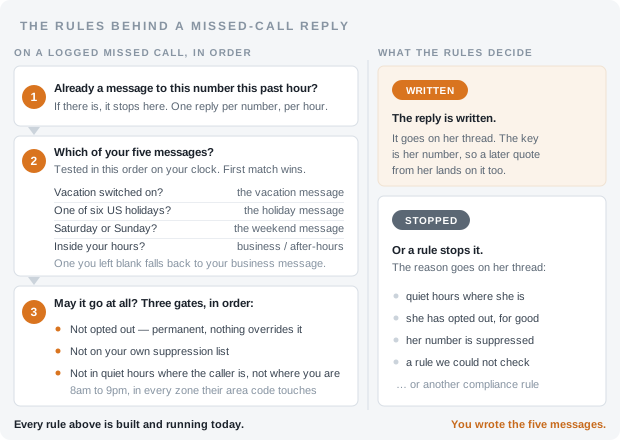
Once texting is switched on, CallMitt™ writes back by text with your business name in the first words, so she replies into the same thread as her quote. The message is picked by the hour and the day, against the hours you actually keep — the demo crew runs 7 to 5, because the first job is under a home by half past seven and the trailer is back by five, so a 5:20 call gets the after-hours version rather than one claiming somebody is in the office — and every version asks the one thing that sorts your week: sticking doors, skirting, or a new home.
Straight about where this stands. The forwarded-call hook is built and waits on your texting number, so today you log the missed call and nothing is sent: a reply queued now is retired rather than delivered when your carrier registration clears. Everything around it is built and running now: the five messages, the business-hours, weekend, holiday and vacation rules, the quiet hours, the opt-out handling, and the thread her reply lands in beside her quote.
How CallMitt Works Run Your Own NumbersA setup technician is hired on two questions, and the first one is about crawling
The first is not a skill question at all. The job is under homes in any weather, most days, on your back in the dirt with a jack and a light, and a man who has not done it does not know yet whether he will keep doing it. The second separates a technician from a helper: has he leveled a home with jacks and set piers himself? Lifting a home a little at a time, evenly, without cracking anything inside it, is a skill, and nobody learns it on a customer’s house.
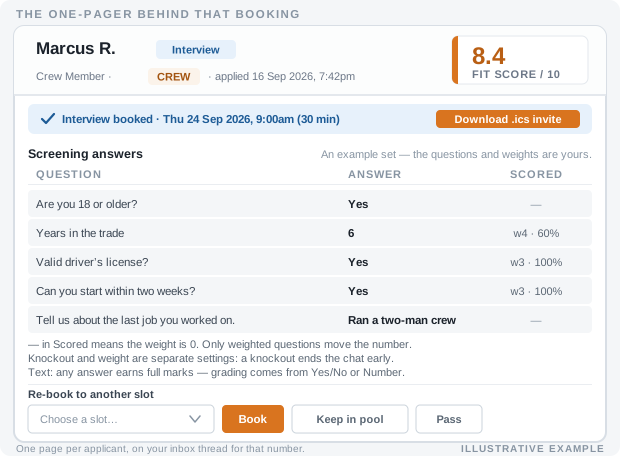
Put “Now hiring — text CREW to your texting number” on the truck and the trailer. CrewFunnel™ asks seven short questions: is he 18 or older, is he up for crawling under homes in any weather most days, has he leveled a home with jacks and set piers himself, how many years has he done manufactured home setup or repair, how far out does he live, can he start inside two weeks, and what was the last job he worked on. Three are knockouts — under 18, not up for the crawling, or living further out than you will drive — and the rest come back as a weighted fit score, years in the trade heaviest, the start date next and the leveling question after it.
Two things about that scoring are worth copying. Distance is a knockout and never a weight, because a number answer scores higher the bigger it is, so weighting miles would rank the man furthest away at the top. And free text carries no weight, because any non-empty answer scores full marks and a weighted text box inflates every candidate who typed anything. Both are set that way on our demo job, and all seven questions carry a Spanish translation.
One honest note on delivery. Text-to-apply waits on your texting number, so today he answers those seven questions on your screening page rather than by text — same questions, same knockouts, same scoring, same pool. The keyword on the truck takes over the day your carrier registration clears.
See how CrewFunnel works
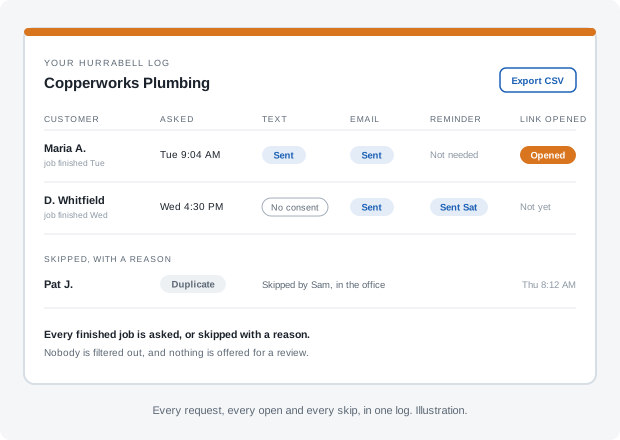
A releveled home gets its review the evening the doors close again
The jacks come out, the piers are set, and that evening the back bedroom door closes with a click for the first time in a year. She opens and closes it three times just to hear it. That is the week she would write you a review. A month on, the doors are just doors again, and the crew who spent a day on their backs under the house is a number in her phone. The outfit with sixty reviews is not sixty times better than you; somebody there asks every customer, the evening the doors close.
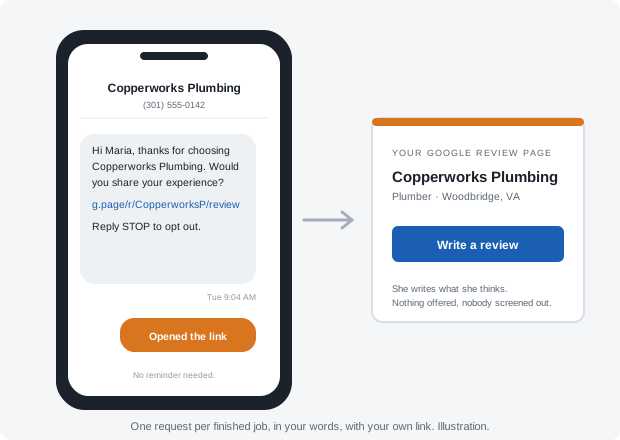
HurraBell™ does the asking. Once review requests are switched on, you mark the job done — from the inbox, from your phone, or from your job software through Zapier — and the customer gets one request in your words, with your own Google review link, after a delay you pick: an hour, unless you change it. Three days later, one email reminder, unless the link has been opened or the customer has since texted you, messaged you from your website or had a call logged on her thread.
Review requests aren’t switched on yet, so none is sent today. When they are, the request goes by email once your Google review link is saved on the HurraBell page and your mailing address on the Account page. A text goes as well where the customer ticked the box on your quote form or visit booking agreeing to a review-request text, and only once your carrier registration clears, the same wait as every text on this site; until then it is email only.
See how HurraBell worksOne recovered releveling covers 10 months
A skirting job covers 15 of them. In a trade built on many modest jobs a month, every one you keep matters, and the arithmetic is not close.
The Tailgate Office Bundle
Instant quotes on your website, missed-call text-back and text-to-apply hiring (texts go out once texting is switched on), and, once switched on, a review request after every job, plus customers, jobs, estimates and invoices in one place. 30 days free, no credit card, no setup fee, cancel from the dashboard.
Start Free TrialOnly need one of the tools? After the trial you can keep just that one at its own price; the office stays with the Bundle.
Manufactured home questions we get asked
You can price a range, and only a range — the widget never shows a single figure. The disclaimer under it is yours to write. On the demo it says the range includes the trip, that piers and anchors are set to the manufacturer's installation instructions or HUD's installation standards, and that a cracked footing, a rotted rim joist or water under the home is shown to her and agreed in writing before you fix it. Nothing is started until she has that written number.
Nobody does until they are underneath, and the help text says a guess is fine. The rates are per pier and per anchor, so a guess that is two out moves the number by a couple of hundred dollars, not by thousands. The lead records what she typed, and the visit underneath settles it.
Because it is priced from the site, the home's installation instructions, the permit and the utilities, and because under HUD's installation program it ends with a licensed installer certifying the installation. The question a homeowner should ask is whether you are licensed to install homes in her state and whether she gets your signed installation certificate; the demo's site-visit service says yes to both and shows no price.
Because it is a different job, done by the foot from the outside, and because the engine cannot multiply one answer by another, so a skirting material on the releveling form would mark up the anchors with it. On its own service the material is a percentage on the skirting alone, with its own minimum and ceiling.
Our demo says no, and neither instant service carries one. The work is the same in any month, if colder in some. The field is there if your costs genuinely swing, but inventing a season to fill the box is the fastest way to end up with a number you cannot defend.
Call it fifteen minutes for your text-back messages and your working hours, a minute, once review requests are switched on for your account, to paste your Google review link on the HurraBell page and your mailing address on the Account page, and about an hour to write the six questions and load one rate card — the trip, the releveling amounts, per pier, per anchor, the crawl space percentage and the marriage line. Then half an hour more for skirting. A service that quotes will not go live until it carries a real base fee or minimum, which is deliberate. No onboarding call, no setup fee and no contract: $199 a month buys all four tools.
Also build decks and steps, or do handyman work? See all the trade pages or ask us.
Quote the releveling while she is still watching the marble roll.
Set it up tonight. Free for 30 days, no card, no setup fee, cancel from the dashboard.