
Fencing is the easiest trade in America to quote online
Not because the work is simple. Because the price is almost entirely a function of things the homeowner already knows: how long the run is, what they want it made of, how tall, how many gates, and whether the old one has to come out.
Five answers. That is a range you can defend. Everything else — rock, roots, the neighbor’s survey, the HOA’s opinion about post caps — you sort out on the walk. But you have already got the appointment, and the tire-kickers already left.
The flow also asks her to flag the tricky spots with photos, so the lead tells you to ask for them on the callback. Attaching the image itself to the lead is on the roadmap, which is why it is not a tick in that list.
The seven things that move a fence number
This is the question set we recommend for fencing. You build it once in the dashboard — about twenty minutes — and every rate in it is a field you own.
Linear feet
The base number, multiplied by your per-foot rate. Homeowners know this within about 10% because they have walked the property line with a tape or paced it off. The widget takes their figure and shows a band around it — you set how wide that band is, per service, so the estimate covers the difference between what she paced and what you will measure.
Material
Cedar, pressure-treated pine, vinyl, chain link, aluminum, composite. Your per-foot rate is for your standard material; each other material moves the whole job up or down by the percentage you set (gates and tear-out included), because your material cost and your install labor both change; or build one service per material family if the gap is wide. Cedar privacy and 4-foot chain link are not the same business.
Height
4, 5, 6 or 8 foot. It is not linear: a 6-foot privacy fence is not 50% more than a 4-foot, because the post depth, the rail count and the wind load all change. Set a percent per height band, not a straight ratio.
Gates
Walk gates and drive gates, single and double. The single most under-charged item in fencing. A 12-foot double drive gate with drop rods and a cane bolt is most of a day. Price it as its own line, not as "included."
Tear-out and haul-away
Removing 140 feet of rotten pine with concrete footings is a day of labor and a dump fee before you install anything. Ask the question. Charge per foot for removal and a flat disposal fee, or watch your margin walk off in a trailer.
Terrain and slope
Flat and clear, moderate slope, steep or rocky. Stepped panels, raked rails, extra post depth, a hand-dug hole where the auger will not fit. A percent on the slope answer is the difference between a good week and a break-even one.
Post setting
Concrete-set, gravel-set, or driven. Different material cost, different labor time, different warranty conversation. Make it a visible option so the homeowner understands why your quote and the cheap guy’s are not the same product.
Travel zone
Anything past 25 minutes should carry a zone fee. List your ZIPs by zone — whole ZIPs or prefixes like 208 — and the widget applies the right one from the ZIP the homeowner types, most specific match first. A flat trip charge, a percentage, or both. Set one zone to "outside my area" and it declines politely instead of quoting. Every service also carries a minimum, so even inside your zone a small job 45 minutes out still pays for the drive.
A realistic quote flow, start to finish
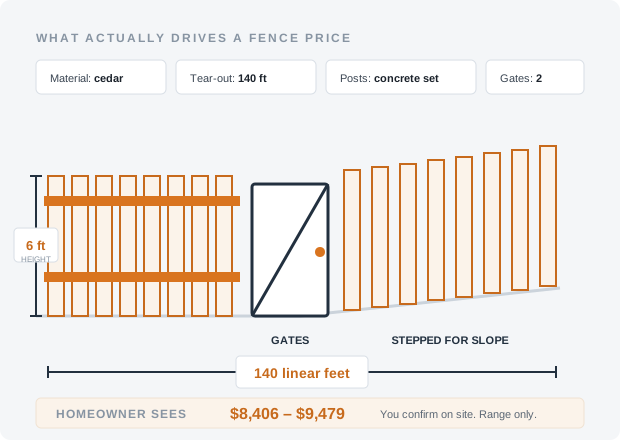
Sample numbers using placeholder rates, shown to explain the mechanics. Your rates and your market will produce different figures. What is not illustrative is the total: $8,406 to $9,479 is what the engine returns for these answers, and you can reproduce it yourself on the demo in about a minute.
9:14 PM — she clicks the button
"Get an instant fence price" on your homepage. No phone call. She is on the couch with the dog on her lap.
Q1: What are we fencing?
Back yard privacy. Four plain-English buttons, one tap — not a dropdown of jargon.
Q2: Roughly how many feet?
She types 140. Your band setting turns that into a range she can trust without you having measured anything.
Q3: Material and height
Cedar, 6 foot. Your cedar rate is $34/ft; the 6-foot option adds 15%.
Q4: Gates
One 4-foot walk gate, one 10-foot double drive gate. Adders: $340 and $1,150.
Q5: Anything there now?
Yes — old chain link, and all 140 feet of it has to go. Tear-out at $6/ft plus a $180 disposal fee.
Q6: Slope
Moderate slope adds 8%. Steep and rocky would have added more — you set each band.
9:19 PM — name, cell, then the number
She leaves her name, her mobile and her ZIP, and the range appears: $8,406–$9,479. Contact first is deliberate — you get the lead whether or not she likes the figure.
What lands in your inbox at 9:19 PM
New NapkinPrice™ lead — 140 ft cedar privacy, 6 ft, 1 walk + 1 double drive gate, chain-link tear-out 140 ft, moderate slope, concrete-set posts. Photo offered. Quoted $8,406–$9,479. Call back: (301) 555-0182, ZIP 20852.
You call at 7:40 the next morning already knowing the job. She has not spoken to another fence company, because nobody else on page one of Google gave her a number.
Would you rather try it than read about it? We keep a working example fence company website with NapkinPrice embedded — the real engine, quoting live, on a page that is not ours.
Try the live demo site (opens in a new tab)In fencing, a missed call is not a missed call. It is a missed week.
A residential fence job runs $2,500 to $9,500 in most markets. That is not a $180 service call you can shrug off. One 200-foot vinyl job is a crew’s entire week and a meaningful share of the month’s profit.
Now stack the numbers everyone in this trade already knows in their gut: about 62% of contractor calls go unanswered, roughly 78% of jobs go to whoever responds first, and voicemail gets a callback about 3% of the time.
You cannot answer the phone from the top of a post-hole digger. What you can do is write the reply once and stop composing it in your head at 4:30: “Sorry we missed you — this is Bob’s Fencing. Reply here with the address and roughly how many feet and we’ll get you on the schedule.” Business-hours, after-hours, weekend, holiday and vacation versions, with quiet hours and opt-outs enforced before anything is queued. Being straight about where that stands: there is no SMS gateway on our side yet, so today you log the missed call and nothing is sent: a reply queued now is retired rather than delivered when your carrier registration clears. Everything around it — the messages, the rules, the thread her reply lands in — is built and running now.
How CallMitt™ Works Run Your Own Numbers$4,500
An average residential fence job — a back-yard run with a gate. One phone call.
1 thread
Her call, her quote and her reply stitch together by phone number, so nobody re-asks what she already told you.
1 job
One recovered fence pays for 22 months of the entire suite.
Fence crews do not apply on Indeed. They apply from the passenger seat.
The people who can dig, set and hang a fence are already working — for a landscaper, a deck builder, a concrete crew, or the fence company two towns over. They are not sitting at a laptop building a resume. They see your truck at a red light.
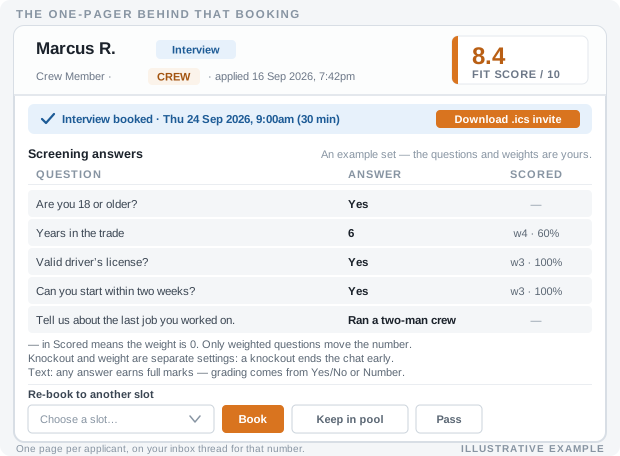
Put “Now hiring — text CREW to your texting number” on the tailgate and the yard sign. CrewFunnel™ asks your six questions: years of fence experience, comfortable running an auger, valid license, own hand tools, can lift 80 pounds repeatedly, available start date. Knockout rules drop the ones who fail a hard requirement; the rest come back with a weighted 0–10 fit score.
One honest note about the delivery. We have no SMS gateway yet, so today the applicant answers those questions on your screening page rather than over text — identical questions, identical knockouts, identical scoring, and they land in the same pool. The keyword on the tailgate takes over the day your carrier registration clears.
Anyone who answers all six has done more work than 90% of the applications you get from a job board. You get a screened list and book an interview in two taps, with a downloadable calendar invite. Compare that to Indeed — now pay-per-click, typically $150–300 a month for a shop your size — or Team Engine at $400–500 a month.
See how CrewFunnel works
Spring is when you need them and when nobody is free
Every outdoor trade in your county is hiring the same week the frost leaves the ground. The shop that can screen 20 people in a weekend wins. The one waiting on resumes is short-handed through May.
Turnover is real and nobody likes admitting it
Post-hole work is hard. People leave. A persistent applicant pool means the next time you are short a body, you text the six people who qualified in April instead of starting from zero.
Your best applicants come from your own trucks
A yard sign in front of a fence you just built is seen by every neighbor on that street, including the ones who work in the trades. That sign is already paid for. Add a keyword to it.
Nobody reviews a fence a month later. She reviews it the afternoon the dog goes out.
The last panel is hung, the gate swings true on the first try, and the dog is out in the yard without a leash for the first time. That is the afternoon she would write you a review. A week later it is just the back yard again, and the thought of writing anything has gone the way of the old chain link. The outfit with sixty reviews is not sixty times better than you; somebody there asks every customer, the afternoon the gate latches.
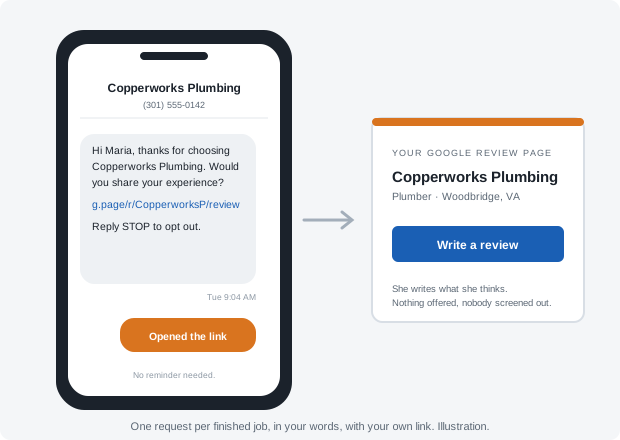
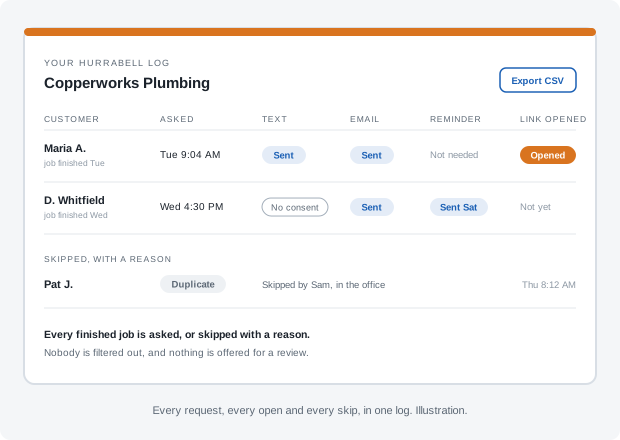
HurraBell™ does the asking. Mark the job done — from the inbox, from your phone, or from your job software through Zapier — and the customer gets one request in your words, with your own Google review link, after a delay you pick: an hour, unless you change it. Three days later, one email reminder, unless the link has been opened or the customer has got back in touch.
Review requests aren’t switched on yet, so none is sent today. When they are, the request goes by email once your Google review link is saved on the HurraBell page and your mailing address on the Account page. A text goes as well where the customer agreed to texts, and only once your carrier registration clears, the same wait as every text on this site; until then it is email only.
See how HurraBell works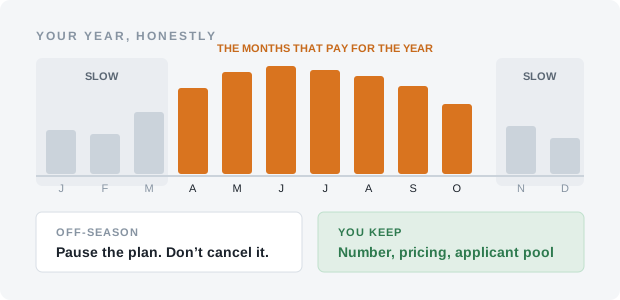
You do not build fence in February. Your software should know that.
Fencing runs on a calendar. The phone starts ringing when the ground thaws, goes flat out from April through October, and in most northern markets goes quiet enough by January that you are doing repairs and estimates for spring.
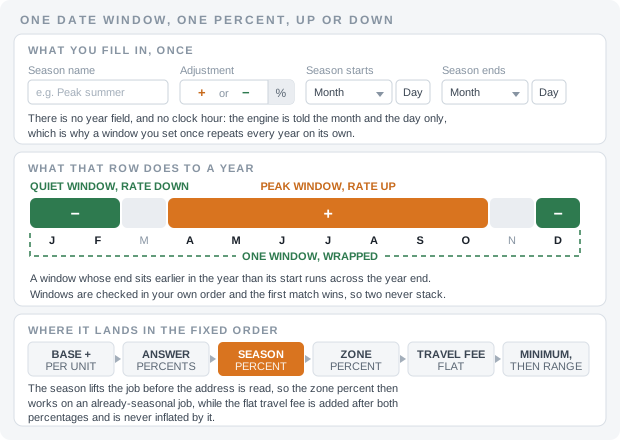
Two things follow from that. First, your rates should not be identical in June and November — set a seasonal date range on the service, say 1 April to 31 August at plus 10%, and every quote given inside those dates prices itself. Set it once; it repeats every year. The demo account runs exactly that range, so the same 140-foot cedar job priced on 15 June comes back $9,246 – $10,426 instead of the $8,406 – $9,479 above. Second, paying full freight for software in a month you are not installing is a bad deal, which is exactly why contractors cancel in the winter and then have nothing set up when spring hits.
Pause instead of cancelling. Your texting number stays on your account, your questions and rates stay built, your applicant pool stays in the system, and your lead history is still there when you come back. Unpause on your Billing page the week before the ground softens. No re-onboarding, no setup fee, no sales call.
What fencing contractors usually compare us to
All good products. Here is the honest difference, with public pricing as of August 2026.
| Tailgate Office | ResponsiBid | Podium | |
|---|---|---|---|
| Monthly | $199 all four | $179–229 (quoting only) | $399–999 |
| Setup fee | None | Reported $400–600 | Varies |
| Contract | Month to month | Month to month | Typically annual |
| Off-season pause | Yes, keep everything | Yes, reported $50/mo | Not on annual terms |
| Missed-call text-back | Included | No | Included |
| Screened crew hiring | Included | No | No |
Pricing from public pricing pages, August 2026. ResponsiBid setup-fee and pause figures are reported by third parties and may vary by plan. Compare in more detail on our alternatives page.
The Tailgate Office Bundle
Instant quotes on your website, missed-call text-back, text-to-apply hiring, review requests, and customers, jobs, estimates and invoices in one place. 30 days free, no credit card, no setup fee, cancel from the dashboard.
Start Free TrialOnly need one of the tools? After the trial you can keep just that one at its own price; the office stays with the Bundle.
Fencing questions
They usually do, by 10 to 20 feet. That is why the widget shows a range and never a fixed price, and why the lead records the footage they entered. If they said 140 and you measure 168, you tell them on the walk and the number moves. Nobody is surprised, because the widget already told them the final price comes after a look at the property.
Custom gates get their own dropdown with your prices per style, or you route them to a "call me about a custom gate" path that still captures the lead. Agricultural and horse fence usually needs a different question set than residential privacy — run both as services on one account and let the visitor pick first.
That is the argument for doing it. Everyone in your market makes the homeowner call for pricing, so the one company that answers the question at 9pm looks like the one that has its act together. You are not publishing a price list; you are giving a range on a specific job with the site visit still in front of you.
None of those belong in a quote widget. Add a flat permit allowance if your county charges one, and put "we handle the 811 locate and the permit; HOA approval is on you" in the disclaimer line that shows under every range. Those set expectations without pretending to price the unknowable.
Yes. Flip the service into waitlist mode. She still gets a real answer — your own "we are booking for spring, here is where you sit" message — and you still get the full spec and her number. What she does not get is a price, deliberately: quoting a number you cannot honour for four months is how you lose the job twice. Showing a range inside waitlist mode is on the roadmap. Better to book August in June than to lose the lead entirely and hope she remembers you.
Here is the honest state of it. The design is that your business line stays exactly where it is and keeps ringing as it does now. You turn on forwarding for unanswered calls once, with a code the setup guide gives you, and from then on a call nobody answers in about twenty seconds passes to your own texting number, a local number in your area code registered to your business. A short greeting, in place of your voicemail, tells the caller a text is on its way, and the reply goes out from that texting number. The caller dials one number and hears back from another. It works because the text opens with your business name and thanks them for calling. Forwarding to a mobile, a ring group or a second phone is no obstacle, because the text only fires when nobody picks up. Where the forwarding for unanswered calls gets switched on depends on how your phones are set up: on a mobile it is the code you dial, and on a desk line or an office phone system it is a setting you ask your phone company for. An answering service can keep its hours, because the forwarding is your own setting and can be switched off again. What is running today is the half that does not need a carrier: you log the missed call, CallMitt picks the right message for the hour and the day, checks quiet hours, opt-outs and your suppression list, and queues it. Automatic detection and actual delivery switch on for your account when its A2P 10DLC registration clears. We would rather you read that here than discover it in week two.
Most fencing contractors are quoting the same evening. Writing your questions and setting your per-foot rates and gate adders is the real work and it takes about twenty minutes if you know your numbers. A service that quotes will not go live until it has a real base fee or minimum on it, which is the point. Adding the script tag to your site is one line, and if your web guy is slow we will do it for you during the trial.
Another trade in the truck? See all the trade pages or call (301) 268-1943. We answer.
Set your per-foot rate tonight. Quote the 9pm shopper tomorrow.
30 days free, no credit card, no setup fee. Pause it in November and pick it back up in March.