
A pump is priced by the depth it hangs at, once you know it is the pump
A well pump replacement is the job in this trade that a homeowner can describe and needs priced now: which pump, how deep it hangs, whether the tank goes too. The pump is a flat amount, the depth is feet of pipe and wire pulled and reset, and the tank and a controller are flat lines. The one thing nobody can see from a form is whether it is the pump at all, because a dead pressure switch looks exactly like a dead pump from the kitchen sink.
So this page prices the pump replacement instantly, with the service call inside the number, and says in the disclaimer that you confirm it is the pump before you pull it; if it turns out to be the switch or the tank, she pays for that repair instead. A new well and an undiagnosed no-water call never get a number online: one is the geology’s answer, the other is a diagnosis.
The flow also asks for a photo of the tank, the well cap and the old control box, and the lead tells you to ask for those pictures on the callback. Attaching the image itself to the lead is on the roadmap, which is why it is not a tick in that list.
The eight things that set a pump number
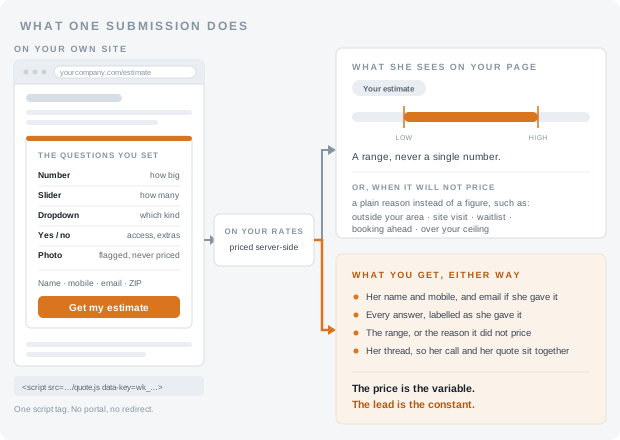
A base fee, a depth, three pick-ones, three yes-or-nos and a ZIP. You build the set once in the dashboard and every rate in it is a field you own — you can change a pump price the week your supplier changes it without touching your website.
The service call
Not a question: the service's base fee, $295 on the demo, added once and inside every number. It is the trip and the diagnosis, and putting it in the range means she never meets it for the first time on the invoice.
The pump
A pick-one that adds dollars once, with the pump itself in it: a half to one horsepower submersible at $1,350, one and a half to two at $1,850, a jet pump for a shallow well at $750. "Not sure" prices as the common one, and the visit settles it.
How deep it is set
Feet, multiplied: $6 a foot on the demo for pulling and resetting the pipe and the wire. The help text tells her where to find it, on the well log or the old pump paperwork, and that many wells in the area set the pump between 150 and 400 feet.
New drop pipe and wire
A yes or no that takes a percentage: +20% on the demo, figured across the job. Old pipe and splices are the next thing to fail once the pump is up, and asking now saves her a second call next spring.
The pressure tank
Keep the tank she has, or a new 20, 44 or 86-gallon tank at $450, $650 or $950. A waterlogged tank makes a pump start and stop constantly, which is often what killed the old one.
A constant-pressure controller
A yes or no at $1,100 on the demo: even pressure in every shower and a gentler start for the pump. The upgrade people ask about once they know it exists.
How soon
This week at the rate, or no water now, tonight or this weekend, +25%. The one percentage she chooses herself, said in her words, so the after-hours premium is something she agreed to and not something she found.
Travel zone
List your ZIPs by zone, whole ZIPs or three-digit prefixes, and the widget prices the trip from the ZIP she types, most specific match first, as a flat charge, a percentage, or both. Our demo company charges nothing in its home counties and $125 out to the ring beyond them, so the same pump comes back $4,140 to $5,268 at home and $4,250 to $5,408 in Warrenton. Set one zone to "outside my area" and it declines politely while still capturing the lead.
A real pump replacement, start to finish
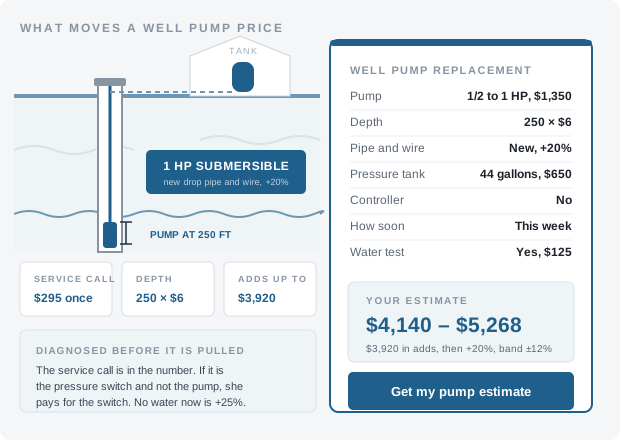
Eight questions, about a minute. This is the exact sequence running on the pump service of our own well demo account, answered for a 250-foot submersible and a new tank at a house outside Front Royal — and the total at the bottom is what the live engine returns for these answers, not a figure anybody typed into this page.
| # | What she is asked | What she answers | What it does to the price |
|---|---|---|---|
| — | (the service's base fee) | — | The $295 service call, added once before anything else |
| 1 | What kind of pump? | Submersible, 1/2 to 1 horsepower | A flat $1,350, the pump included |
| 2 | How deep is the pump set, in feet? | 250 | 250 × $6 = $1,500, pipe and wire pulled and reset |
| 3 | Replace the drop pipe and wire too? | Yes | +20% on the whole job |
| 4 | A new pressure tank? | New 44-gallon tank | A flat $650. 20 gallons $450, 86 gallons $950 |
| 5 | Add a constant-pressure controller? | No | Nothing. Yes adds $1,100 |
| 6 | How soon does the water need to be back on? | This week is fine | Nothing. No water now, tonight or this weekend, +25% |
| 7 | Test the water when we are done? | Yes | A flat $125: the well shocked and a sample to a lab |
| 8 | Got a photo of the tank and the well cap? | Offered | Nothing. A photo never moves the price |
| The arithmetic, in the order the engine runs it | $295 + $1,350 + $1,500 + $650 + $125 = $3,920, then the one percentage answer, new pipe and wire at +20%, applies once to all of it: → $4,704 | ||
| She sees | $4,140 – $5,268 | ||
| What lands in your inbox, the second she submits | Name, mobile, ZIP, all eight answers including how soon she needs water, and the photo flag | ||
Every rate in that table belongs to the demo account, not to a Tailgate Office price list — you set all of them yourself, and you can change one without touching your website. What is not illustrative is the total: $4,140 to $5,268 is what the engine returns for those eight answers, the service call included.
Would you rather try it than read about it? We keep a working example well and pump company website with NapkinPrice™ embedded — the real engine, quoting live, on a page that is not ours. Put in those eight answers and see the same number come back.
Try the live demo site (opens in a new tab)The pump quotes. The new well and the mystery outage are visits.
These are the decisions that matter in a well business, so here they are in plain words rather than a promise that it all just works.
The urgency question is the one place this page puts a premium in front of a homeowner, and it does it in her words: “No water now: tonight or this weekend” is +25%, so the same pump replacement comes back $5,002 to $6,366 instead of $4,140 to $5,268. She chooses it, she sees it, and nobody argues about an after-hours charge at the well cap. Like every percentage it pools across the whole job, the service call and the tank included, and the help text says so.
A new well never gets a number online. The depth is the geology’s answer, the county permit comes first, and the honest price is per foot with an estimate of the depth from the neighboring well logs, which is what the site-visit service sets up. A no-water call nobody has diagnosed is a second site visit, because the cause can be the pump, the pressure switch, the tank or the wiring, and pricing a pump for a dead switch is the fastest way to lose a customer for life. The question a homeowner should ask is whether she will get a copy of the well log and whether the water will be tested before she drinks it, and the demo answers yes to both.
Well pump replacement — quotes instantly
A $295 service call as the base fee, the pump at $750 to $1,850, $6 a foot of depth, new pipe and wire +20%, a tank at $450 to $950, a controller at $1,100, a water test at $125 and no-water-now at +25%. A $1,400 minimum is the floor under the final number, so a jet pump alone that works out at $1,045 comes back $1,400 to $1,568. Past $12,000 it stops pricing and hands you the lead.
New well drilling — site visit, never priced
Site-visit mode captures the request and shows no number at all. It asks whether it is a new lot, a dry well or a second well for a barn, and whether an old well needs sealing. You come out, read the neighboring logs and give her a written price per foot and an estimate of the depth.
No water, low pressure or an inspection — site visit
When the cause is not known, you find it before anybody prices a repair. The form asks what is happening and whether anyone is without water now, which changes how soon you go and not the price. A well inspection for a home sale comes in the same way.
A service that quotes will not go live until it carries a real base fee or a real minimum. That is deliberate: a service with neither would happily return $0 to a homeowner, and one bad number on your website costs more than a day of setup. The pump service carries both: the service call as its base fee and a minimum under it.
A household with no water does not leave a voicemail and wait
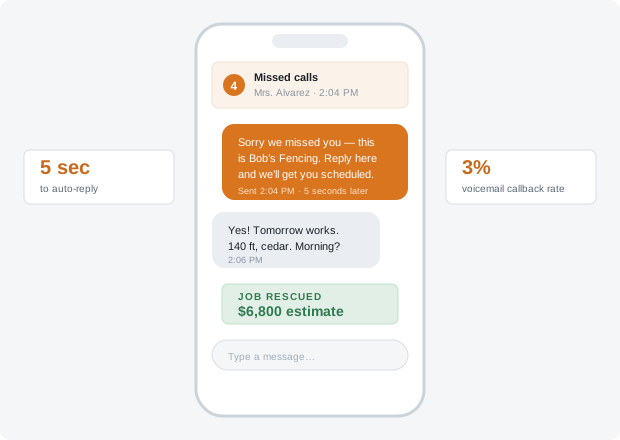
You are pulling 300 feet of pipe hand over hand, or down in a pump house with a meter on a control box. She has no water, two kids who need a bath and a list of well companies, and she is going down it until somebody answers. In this trade the missed call is not a lead that waits for Monday; it is the job, and it goes to whoever replies first.
| What a missed well call is worth | On the demo account |
|---|---|
| A 250-foot submersible, new tank, water test | $4,140 – $5,268 |
| The same pump, no water tonight | $5,002 – $6,366 |
| A deep 2-horsepower pump with a controller | $7,096 – $9,032 |
| A jet pump in a shallow well, at the minimum | $1,400 – $1,568 |
| One recovered pump pays for | 20 months of the bundle |
| One recovered jet pump pays for | 7 months |
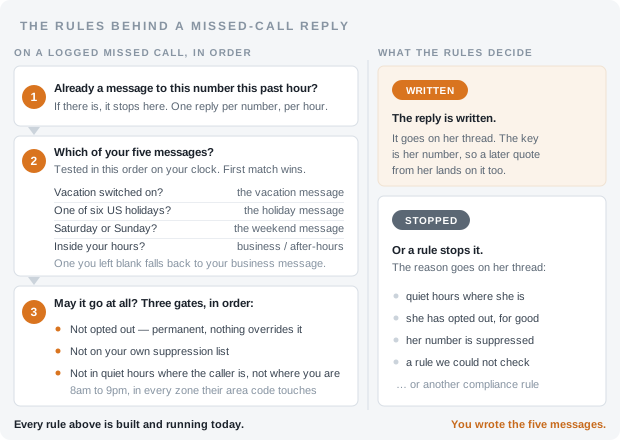
Once texting is switched on, CallMitt™ writes back by text with your business name in the first words, so she replies into the same thread as her quote. The message is picked by the hour and the day, against the hours you actually keep — the demo office answers 7 to 6, and outside those hours the reply says the office reads these rather than promising a time — and every version asks the first question that sorts your evening: does she have any water at all.
Straight about where this stands. The forwarded-call hook is built and waits on your texting number, so today you log the missed call and nothing is sent: a reply queued now is retired rather than delivered when your carrier registration clears. Everything around it is built and running now: the five messages, the business-hours, weekend, holiday and vacation rules, the quiet hours, the opt-out handling, and the thread her reply lands in beside her quote.
How CallMitt Works Run Your Own NumbersA pump technician is hired on two questions, and the first one is about Saturday night
The first is not a skill question at all. Water goes out on weekends and evenings like any other time, and a technician who will not take his turn on those calls is a technician you schedule around. Ask it first. The second separates a technician from a helper: has he pulled and set a submersible pump himself? Hand over hand, splice by splice, without dropping the pump down the well, is a skill, and nobody learns it on a customer’s well.
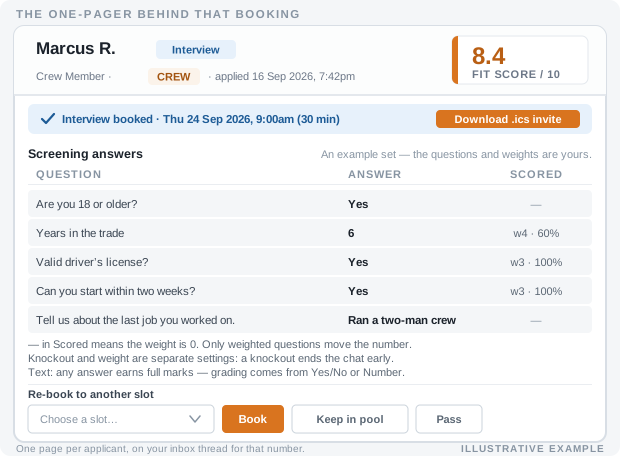
Put “Now hiring — text CREW to your texting number” on the pump truck and the yard sign. CrewFunnel™ asks seven short questions: is he 18 or older, can he take a turn on the evening and weekend no-water calls, has he pulled and set a submersible pump himself, how many years has he done well, pump or water system work, how far out does he live, can he start inside two weeks, and what was the last job he worked on. Three are knockouts — under 18, no to the on-call turn, or living further out than you will drive — and the rest come back as a weighted fit score, years in the trade heaviest, the start date next and the pump question after it.
Two things about that scoring are worth copying. Distance is a knockout and never a weight, because a number answer scores higher the bigger it is, so weighting miles would rank the man furthest away at the top. And free text carries no weight, because any non-empty answer scores full marks and a weighted text box inflates every candidate who typed anything. Both are set that way on our demo job, and all seven questions carry a Spanish translation.
One honest note on delivery. Text-to-apply waits on your texting number, so today he answers those seven questions on your screening page rather than by text — same questions, same knockouts, same scoring, same pool. The keyword on the pump truck takes over the day your carrier registration clears.
See how CrewFunnel works
A pump gets its review the first hot shower after a dry weekend
The pump is back down, the gauge climbs to pressure, and the first hot shower after two days of carrying jugs is the best one she has had all year. That is the evening she would write you a review. By the end of the month the water is just there again, the way it always was, and the crew who got it back is a number in her phone. The outfit with sixty reviews is not sixty times better than you; somebody there asks every customer, the day the water comes back.
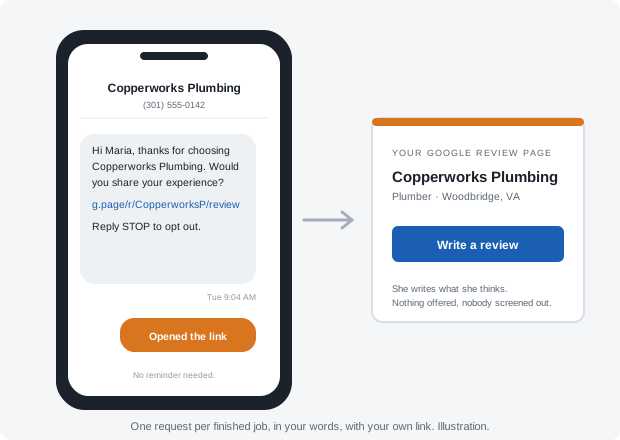
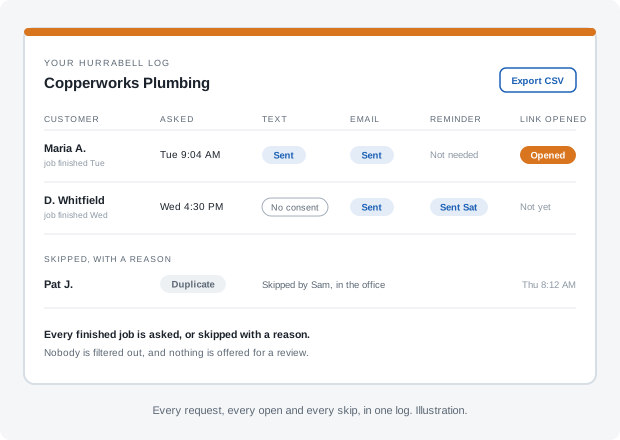
HurraBell™ does the asking. Once review requests are switched on, you mark the job done — from the inbox, from your phone, or from your job software through Zapier — and the customer gets one request in your words, with your own Google review link, after a delay you pick: an hour, unless you change it. Three days later, one email reminder, unless the link has been opened or the customer has since texted you, messaged you from your website or had a call logged on her thread.
Review requests aren’t switched on yet, so none is sent today. When they are, the request goes by email once your Google review link is saved on the HurraBell page and your mailing address on the Account page. A text goes as well where the customer ticked the box on your quote form or visit booking agreeing to a review-request text, and only once your carrier registration clears, the same wait as every text on this site; until then it is email only.
See how HurraBell worksOne recovered pump covers 20 months
Even a jet pump covers 7 of them. In a trade where the shopper has no water and is going down a list, the arithmetic is not close.
The Tailgate Office Bundle
Instant quotes on your website, missed-call text-back and text-to-apply hiring (texts go out once texting is switched on), and, once switched on, a review request after every job, plus customers, jobs, estimates and invoices in one place. 30 days free, no credit card, no setup fee, cancel from the dashboard.
Start Free TrialOnly need one of the tools? After the trial you can keep just that one at its own price; the office stays with the Bundle.
Well and pump questions we get asked
You can price a range, and only a range — the widget never shows a single figure. The disclaimer under it is yours to write. On the demo it says the range includes the service call, that you confirm it is the pump before you pull it, and that if it turns out to be the pressure switch or the tank she pays for that repair instead. The depth comes from her well log or the old pump, and the price is confirmed once the pump is up.
Most owners can find it on the well log or the paperwork from the last pump, and the help text tells her where to look and what is usual in the area. If she guesses, the lead records her guess, and the conversation at the well cap is about the difference. The depth is a per-foot rate, so a guess that is fifty feet out moves the number by a few hundred dollars, not by thousands.
It is fair when she chooses it and sees it. The demo asks how soon the water has to be back on, this week or tonight, and the faster answer is +25% on the whole job, in her words, before she submits. Nobody finds an after-hours premium on the invoice, and she can pick this week if she can manage on jugs until then.
No, and you should not. The depth is the geology's answer, the county permit comes first, and the honest price is per foot with an estimate of the depth. The demo runs new wells as a site visit that asks what kind of well and whether an old one needs sealing, shows no price, and takes the details for the visit where you read the neighboring logs.
Here is the honest state of it. The design is that a call nobody answers passes to your own texting number, and the reply goes out picked by the hour and the day, so a Saturday-night caller gets your weekend message, which on the demo asks whether she has any water and says the office reads these. What is running today is the half that needs no carrier: you log the missed call, CallMitt picks the right message, checks your quiet hours, opt-outs and suppression list, and queues it. Automatic detection and actual delivery switch on for your account when its A2P 10DLC registration clears.
Call it fifteen minutes for your text-back messages and your office hours, a minute, once review requests are switched on for your account, to paste your Google review link on the HurraBell page and your mailing address on the Account page, and about an hour to write the eight questions and load one rate card — the service call, your pump prices, per foot of depth, the pipe percentage, your tank and controller amounts, the urgency percentage and the water test. A service that quotes will not go live until it carries a real base fee or minimum, which is deliberate. No onboarding call, no setup fee and no contract: $199 a month buys all four tools.
Also install softeners and filters, or pump septic tanks? See all the trade pages or ask us.
Quote the pump while she is still holding the jug.
Set it up tonight. Free for 30 days, no card, no setup fee, cancel from the dashboard.