
Electrical is two businesses on one phone line, and one of them is in the dark
The first call is not shopping. Half the house has gone quiet, or something behind a wall is buzzing and smells hot, and she is working down the three electricians Google put at the top. She is hiring whoever picks up, and she is not leaving a voicemail to do it.
The second call has been coming for years. The panel is a crowded box with no spaces left, the car charger is already on order, and she wants to know whether that is two thousand dollars or twelve before she gives up a morning for an estimate. They are not the same customer and they should not share a form. NapkinPrice™ runs them as separate services on one account — the panel job asks eight questions and puts a range on the screen, the service call carries your trip and diagnostic charge inside the number instead of springing it at the door, and a rewire or a standby generator goes down a third path that never guesses a price at all.
The flow also asks for a photo of the panel with the door open and the meter outside, and the lead tells you to ask for those pictures on the callback. Attaching the image itself to the lead is on the roadmap, which is why it is not a tick in that list.
Every hour of this job is an hour you cannot answer the phone.
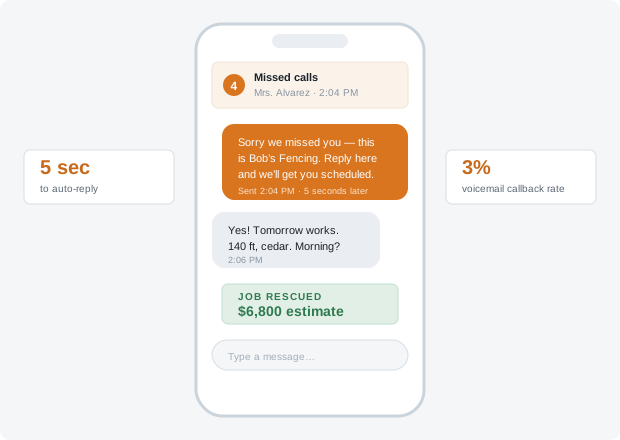
Not answering is not rudeness in this trade, it is procedure. Your hands are on conductors you have just proved dead, or you are on your back in a crawlspace, or the main is open and the meter is pulled — none of those is a position you take a call from, and the apprentice cannot take it either, because he is holding the other end of it. Then a line comes down overnight and the morning after is not one call, it is nine, all inside the same twenty minutes, and every one of them is ringing three other electricians as well.
| What a missed electrical call is worth | On the demo account |
|---|---|
| A 200-amp service upgrade, two new circuits and an EV charger | $4,798 – $5,632 |
| A breaker that keeps tripping, one device, next opening | $231 – $293 |
| The same call, wanted same-day, with half the house dark | $300 – $381 |
| One recovered panel job pays for | 24 months of the bundle |
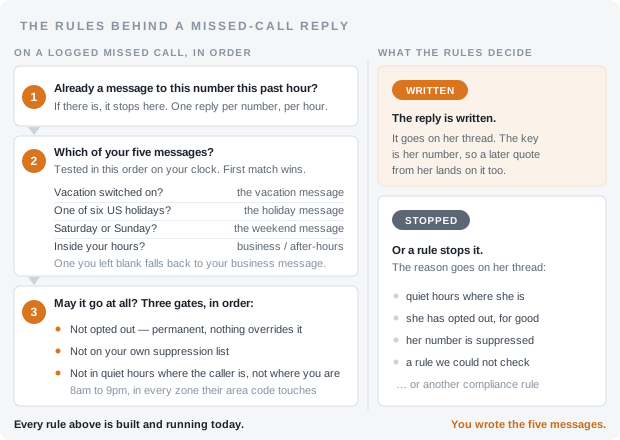
CallMitt™ writes back from your own texting number, a local number registered to your business and not a stranger’s 800 line, and the text opens with your business name, so she replies into the same thread as her quote. The message is picked by the hour and the day — the demo shop’s phone runs 7am to 5pm, so a call that arrives after the vans are back gets the after-hours version instead of one that says you are out on a job — and every version asks the question that sorts your morning: is anything hot, buzzing or burning? Here is what is already true at 6am tomorrow:
Every missed call, in order, with the hour on it
You log the call and it takes its place in a list you can read down at six in the morning — who rang, from what number, at what time, and what was composed back. Nothing to reconstruct off a phone that shows nine names and no times.
A blocked message says why it was blocked
When a rule stops a message it is recorded as blocked with the reason written out in plain English — quiet hours where the caller is, an opt-out, a suppressed number. You are never left guessing whether something went out.
Her call and her website quote in one thread
The key is the phone number, so the quote she filled in at nine last night and the call she made at ten past six this morning are one conversation on one screen, instead of two records nobody ever joins up.
A tally that leaves your own tests out
Every send is tagged with where it came from, and the dashboard count excludes the ones you fired at yourself while setting it up. What is on the screen is real calls, which is the only figure worth looking at.
Straight about where this stands. We have no SMS gateway on our side yet, so nothing we compose reaches a phone today — you log the missed call and the reply is written, compliance-checked and held in your outbox where you can read it. Everything around it is built and running now: the five messages, the business-hours, weekend, holiday and vacation rules, the quiet hours, the opt-out handling, and the thread her reply lands in beside her quote. Two things that wording usually leaves out, and both of them are permanent: texting runs 8am to 9pm where the caller is — we read that off their area code — and no setting on our side relaxes it, so a call outside that window is recorded as blocked with the reason rather than queued and nothing re-attempts it in the morning; and a reply held longer than an hour is retired rather than delivered when sending switches on, because nobody wants a month-old “sorry we missed your call” landing on a customer’s phone. The code that answers a forwarded call and texts the caller back is written, deployed and tested over signed webhooks — it has no phone number to answer on yet, which is a paperwork problem rather than a software one.
Do not take our word for it. Set the clock to a late evening on the example business and watch the same rules record it as blocked — try it on the demo (opens in a new tab) — or open that business’s real dashboard, no signup, at the example account’s own dashboard, then click CallMitt in the left menu and read its five text-back messages and its hours for yourself.
How CallMitt Works Run Your Own NumbersThe eight things that set an electrical number
What is happening at the panel
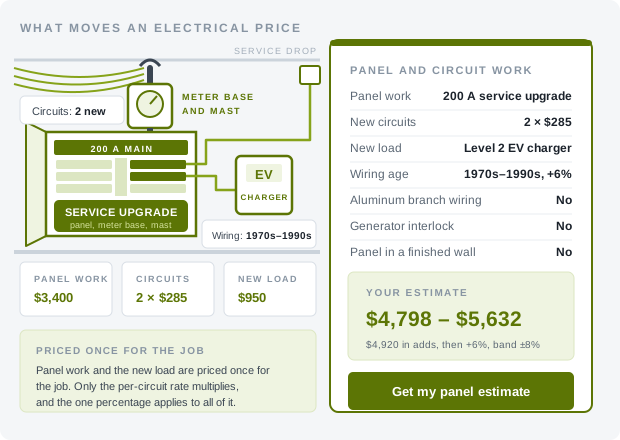
Nothing, a subpanel, a straight replacement at the same service size, a 200-amp upgrade with meter base and mast, or 400-amp service. A pick-one, with the money sitting on the option rather than on the rule — $0, $1,450, $2,200, $3,400 and $6,900 on the demo. Do not draw a per-unit distinction on a pick-one, because the engine has none: the option she chooses adds its dollars once for the job.
New circuit count
The one genuinely per-unit line on this service — your per-circuit rate multiplied by however many you are running, $285 each on the demo. Answer zero and nothing fires at all: not the rate, not a flat amount, not a percentage. That is the behaviour you want when the panel already has the spaces and she is only asking about the panel.
Age of the branch wiring
Knob and tube or cloth-wrapped, 1950s to 1960s, 1970s to 1990s, or 2000s and newer. This is a percentage on the whole job rather than a line item, because old wire changes the devices, the boxes, the labour and the inspection together. Zero, 6, 14 and 22 percent on the demo — set the ones your own inspector makes you earn.
Aluminum branch wiring
A yes/no that raises the job minimum instead of adding a fee, which is a rule kind worth understanding. Every device in the house gets pigtailed with approved connectors, so on the demo a yes means the quote never comes back under $3,800. It adds nothing to the arithmetic. It puts a floor under the finished number.
Generator interlock and inlet
A yes/no with your own flat amount behind it — $1,150 on the demo — priced once for the job. It is the cheapest standby answer there is and half your callers do not know it exists, which makes it a question worth asking on the form rather than in the driveway after the next outage.
A panel in a finished wall
Flush-mounted in drywall, or in a closet with nowhere to stand, means cutting, fishing and patching. That is labour rather than parts, so it belongs on a percentage — 14 percent on the demo — and it is the single most common reason an electrical quote gets revised standing in front of the thing.
What the house is being asked to carry
Capacity, not calendar. A Level 2 EV charger, a heat pump replacing a furnace, a range or dryer circuit, a hot tub — each one a pick-one carrying its own flat amount, $640, $950, $1,150 and $1,250 on the demo. This is the question that turns "the panel is full" into a number, and it is a dropdown rather than a guess.
Travel zone
List your ZIPs by zone — whole ZIPs or three-digit prefixes — and the widget prices the trip from the ZIP she types, most specific match first. A flat charge, a percentage, or both. Set one zone to "outside my area" and it declines politely while still capturing the lead. A job minimum backs it up, so a one-circuit call 40 minutes out still pays for the drive.
A real panel flow, start to finish
Eight questions, about a minute. This is the exact sequence running on our own electrical demo account — and the total at the bottom is what the live pricing engine returns for these answers, not a figure anybody typed into this page.
| # | What she is asked | What she picks | What it does to the price |
|---|---|---|---|
| 1 | What are we doing at the panel? | Full service upgrade to 200 amps: panel, meter base and mast | A flat $3,400 for the job — panel, meter base and mast together |
| 2 | How many new circuits are we running? | Two | 2 × the per-circuit rate — $285 each on the demo, so $570 |
| 3 | What is the biggest new thing the house has to carry? | A Level 2 EV charger | A flat $950, once for the job |
| 4 | How old is the wiring we are tying into? | 1970s to 1990s | A percent on the whole job: +6% |
| 5 | Did an insurance inspection flag aluminum branch wiring? | No | Nothing — the rule only fires on yes |
| 6 | Do you want a generator interlock and inlet? | No | Nothing — the rule only fires on yes |
| 7 | Is the panel in a finished wall or a tight space? | No | No tight-space percent on this one |
| 8 | Got a photo of the panel with the door open, and the meter outside? | Offered | Nothing. A photo never moves the price |
| The arithmetic, in the order the engine runs it | $3,400 + $570 + $950 = $4,920, then the one percentage answer applies once to all of it: +6% → $5,215.20 | ||
| She sees | $4,798 – $5,632 | ||
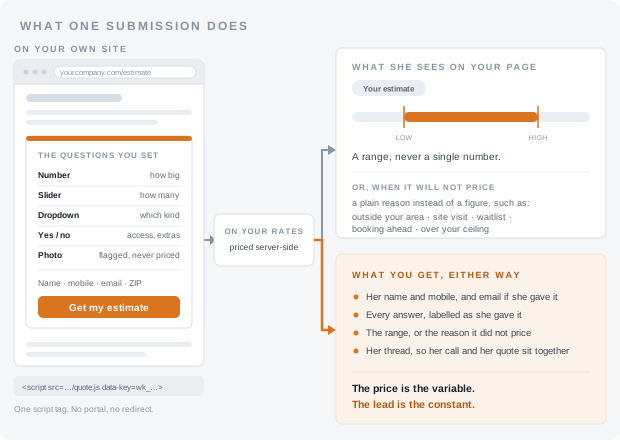
| What lands in your inbox, the second she submits | Name, mobile, ZIP, all eight answers, the photo flag, and the disclaimer she was shown | ||
The per-circuit rate, the panel options and the percentages above belong to the demo account, not to a Tailgate Office price list — you set every one of them in the dashboard and you can change a per-circuit rate without touching your website. What is not illustrative is the total: $4,798 to $5,632 is what the engine returns for those eight answers, and you can reproduce it yourself on the demo in about a minute.
Would you rather try it than read about it? We keep a working example electrical company website with NapkinPrice embedded — the real engine, quoting live, on a page that is not ours. Put in those eight answers and see the same number come back.
Try the live demo site (opens in a new tab)Three services, and only two of them ever show a price
A panel upgrade, a tripping breaker and a whole-house rewire are three different conversations. Running them through one form is how you end up quoting a rewire like a dead outlet.
Panel, service and circuit work — quotes instantly
No trip charge on this one: the visit sells the panel. It carries a job minimum instead, so a single added circuit never comes back under it — $1,800 on the demo, and the low end of the band is that floor rather than 8% below it. One question raises the floor on its own: answer yes to aluminum branch wiring and the minimum goes to $3,800, which is a floor and not a fee. It adds nothing to the arithmetic, it flattens the bottom of the range — the same job that quotes $2,145 to $2,519 with a no comes back $3,800 to $4,104 with a yes. Above the ceiling it stops pricing: past $13,800 on the demo the widget routes the lead to you rather than publishing a number that big off eight answers.
Troubleshooting and repair call — quotes instantly
The trip and diagnostic charge lives in the service base fee, so it is added once however many dead outlets you end up chasing and cannot be dodged by answering nothing to everything. On the demo that is $119, and it sits inside the range she sees rather than appearing at the door. A breaker that keeps tripping, one device, next opening quotes at $231 to $293. There is a job floor underneath and a ceiling above at $1,600, because past a certain number the honest answer is panel work rather than another hour of chasing a fault.
Rewires, generators and commercial — site visit, never priced
Site-visit mode captures the whole spec and shows no number at all, which is the right answer for a house that still has cloth-wrapped wire in the walls, a standby generator with a transfer switch, or three-phase service in a building that has to stay live while you work. The service still asks the building type, how many panels, what the service is today and whether it can be shut down — that last one moves no money, it just tells you whether this is a weekend. She gets your own "we will come and look" message; you get a lead worth bidding.
A service that quotes will not go live until it carries a real base fee or a real minimum. That is deliberate: a service with neither would happily return $0 to a homeowner, and one bad number on your website costs more than a day of setup.
An electrician is hired or lost on the ticket
You cannot put an unlicensed man on a service change, you cannot bill his hours out, and the inspector will know inside a minute. The scarce input in this trade is not a willing body, it is a ticketed tech — which changes the first question you ask and changes who you stop giving an afternoon to.
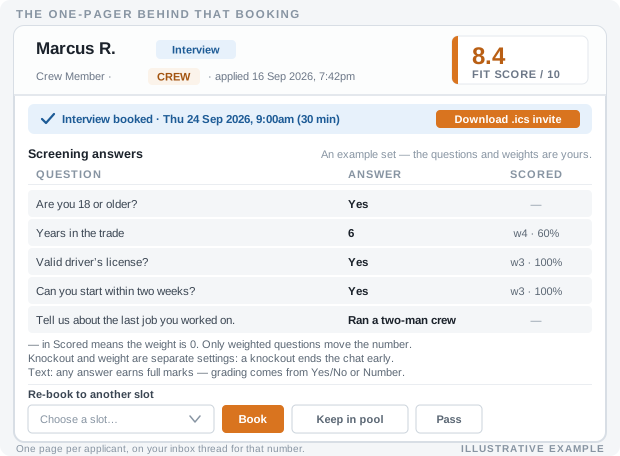
Put “Now hiring — text CREW to your texting number” on the van and the job box. CrewFunnel™ asks seven short questions: is he 18 or older, does he hold a current electrical license in your state, has he changed out a service panel and re-landed the circuits, how many years has he done electrical work, how far out does he live, can he start inside two weeks, and what was the last job he worked on. Three of those are knockouts — under 18, no current licence, or living more than a set distance away — and the rest come back as a weighted fit score.
Two things about that scoring are worth copying. Distance is a knockout and never a weight, because a number answer scores higher the bigger it is, so weighting miles would rank the man furthest away at the top. And free text carries no weight at all, because any non-empty answer scores full marks and a weighted text box quietly inflates every candidate who typed anything. Both of those are set that way on our own demo job, and every question on it carries a Spanish translation.
One honest note on delivery. There is no inbound SMS on our side yet, so today he answers those seven questions on your screening page rather than by text — same questions, same knockouts, same scoring, same pool. The keyword on the van takes over the day your carrier registration clears.
See how CrewFunnel works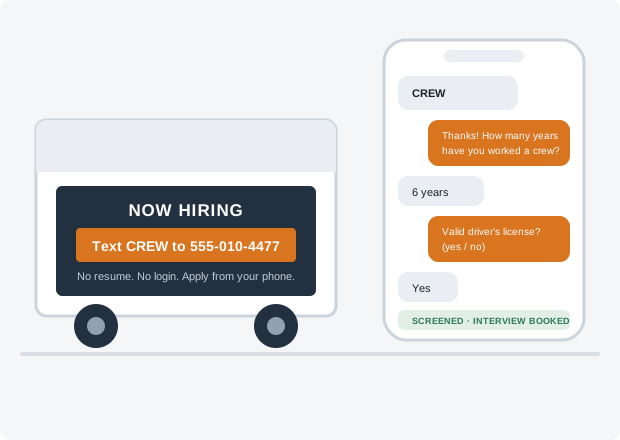
An electrician is remembered for exactly as long as the lights are off
The inspector signs off, the meter goes back in, and that evening every light in the house comes on at once and nothing trips. That is the day she would write you a review, and it is the last day she will think about the panel at all. By the weekend it is the box in the garage beside the car charger, and the electrician who spent two days on it has been forgotten the way good electrical work is always forgotten: nothing hums, nothing flickers, nothing to remember. The outfit with sixty reviews is not sixty times better than you; somebody there asks every customer, the day the inspection passes.
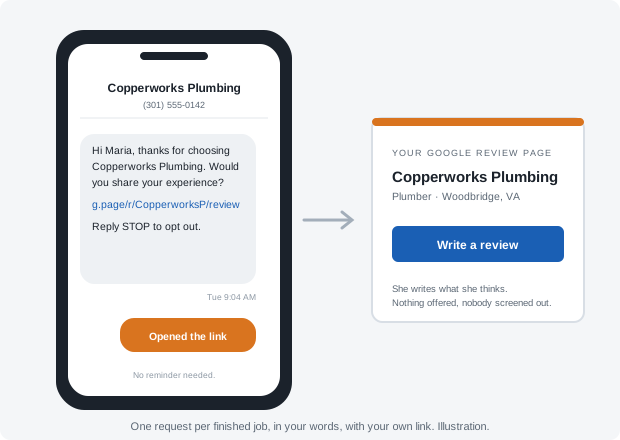
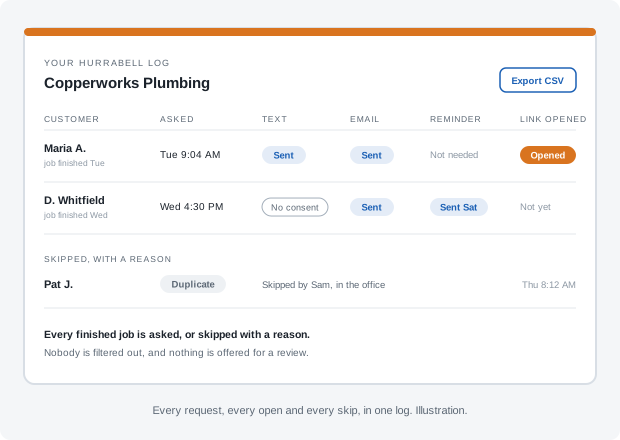
HurraBell™ does the asking. Mark the job done — from the inbox, from your phone, or from your job software through Zapier — and the customer gets one request in your words, with your own Google review link, after a delay you pick: an hour, unless you change it. Three days later, one email reminder, unless the link has been opened or the customer has got back in touch.
Review requests aren’t switched on yet, so none is sent today. When they are, the request goes by email once your Google review link is saved on the HurraBell page and your mailing address on the Account page. A text goes as well where the customer agreed to texts, and only once your carrier registration clears, the same wait as every text on this site; until then it is email only.
See how HurraBell worksOne recovered panel job covers 24 months
And a single recovered service call more than covers the month it happened in. This is a trade where the arithmetic is not close.
The Tailgate Office Bundle
Instant quotes on your website, missed-call text-back, text-to-apply hiring, review requests, and customers, jobs, estimates and invoices in one place. 30 days free, no credit card, no setup fee, cancel from the dashboard.
Start Free TrialOnly need one of the tools? After the trial you can keep just that one at its own price; the office stays with the Bundle.
Electrical questions we get asked
Here is the honest state of it. The design is that your business line stays exactly where it is and keeps ringing as it does now. You turn on forwarding for unanswered calls once, with a code the setup guide gives you, and from then on a call nobody answers in about twenty seconds passes to your own texting number, a local number in your area code registered to your business. A short greeting, in place of your voicemail, tells the caller a text is on its way, and the reply goes out from that texting number. The caller dials one number and hears back from another. It works because the text opens with your business name and thanks them for calling. A ring group or a second phone is no obstacle, because the text only fires when nobody picks up. An answering service is one or the other for any given hour, since an unanswered call can only forward to one place: the forwarding is your own setting, a code switches it off, and the service keeps whatever hours you give it. What runs today is the half that needs no carrier: you log the missed call, CallMitt picks the right message for the hour and the day, checks your hours, the quiet hours, your opt-outs and your suppression list, and the message is composed and held in your outbox where you can read it. The code that answers a forwarded call and does all of that without you touching it is written, deployed and tested over signed webhooks — it has no phone number to answer on yet. Better you read that here than find it out in week two.
It is recorded as blocked, with the reason, and that is the end of it. Texting runs 8am to 9pm where the caller is — read off their area code — and there is no setting on our side that relaxes it, so an eleven o’clock message is never queued in the first place. Nothing re-attempts it in the morning either: a blocked record is final by design rather than by accident. And a message that did queue and then sat is retired rather than delivered once it is more than an hour old, because a "sorry we missed your call" that lands the next afternoon does more harm than silence. What you do at six in the morning is read the list, see who rang and why nothing went out, and ring them back yourself.
It stops pricing and hands you the lead. Every instant service carries a ceiling, and on the demo the panel service is set at $13,800 — a 400-amp service with a heat pump and a dozen circuits goes straight past it, and she gets your own "this one needs an electrician standing in front of it" message instead of a number. The ceiling is tested against the midpoint before the range is ever drawn, so it is a decision about the job rather than about the top of a band. Set yours where you would stop quoting over the phone.
No, and we are not going to pretend otherwise. A seasonal rate in this engine is a date range that repeats every year forever, so encoding a storm premium would charge it on every quiet day of every summer and nothing at all for the February ice storm that actually buries you. There is no weather input, no event flag, and no way to switch a rate on for one week. What a storm changes is volume, not price — which is why the answer to a storm on this page is the phone rather than the rate card. The lever that does exist is a question on the form: how soon do you need us, with today priced above the next opening. That one is honest, it is yours to set, and it is on the demo.
You can price a range, and only a range. The widget shows a bracket and the disclaimer under it says the final number comes after somebody opens the panel, looks at the service entrance and the grounding, and finds out what the utility wants. Write that in your own words: permit and inspection in, drywall patching out, anything the inspector adds priced on the day. A homeowner who gets an honest bracket at nine at night stops calling down the list — and the person whose budget was never going to reach a service change finds that out on your website rather than on your morning, which is a kindness to both of you.
It works better. The whole point of a message picked by the hour and the day is that it can tell the truth: the after-hours version says when you actually start, and asks whether anything is hot, buzzing or burning, so the genuine emergency identifies itself and everything else waits until the morning instead of going somewhere else. A homeowner who cannot tell when you answer assumes the answer is never. One that gets a straight reply at half past nine at night will wait until seven.
Call it fifteen minutes for your five text-back messages and your hours, a minute, once review requests are switched on for your account, to paste your Google review link on the HurraBell page and your mailing address on the Account page, and about an hour to write the eight panel questions and load your per-circuit rate, your panel options, your wiring-age percentages and your travel zones. A service that quotes will not go live until it carries a real base fee or a real minimum, which is deliberate. No onboarding call, no setup fee and no contract: $199 a month buys all four tools.
Also run low-voltage, or sub to a builder? See all the trade pages, read the compliance page, or call (301) 268-1943.
Answer the 6:40 outage. Quote the panel she has put off for years.
Set it up tonight. Free for 30 days, no card, no setup fee, cancel from the dashboard.