
Every other trade on this site prices work at one address. Yours has two.
That is the whole of the difficulty and it is worth naming in the first paragraph rather than burying it. A roof, a furnace, a driveway and a chimney all sit at the address the homeowner types in. A move has an origin and a destination, the gap between them is a large share of the price, and the quote form takes one postal code.
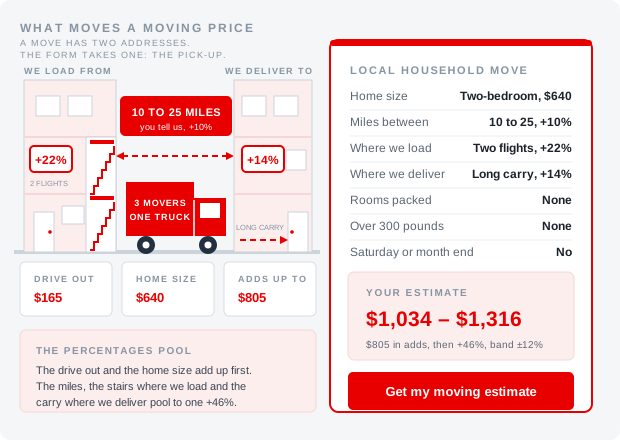
So this account decides two things out loud and never pretends otherwise. The ZIP the widget asks for is the address you load from, and the travel zone prices the one thing that ZIP genuinely decides — the deadhead run that gets a truck and three movers from your yard to her door before a single pad comes off. The distance to the other end is a declared mileage band on the form, and the help text tells her in her own words that you are asking because the form cannot work it out. That is the same move the plumbing page makes with urgency, and for the same reason: no hour of the day reaches the engine either, so the customer declares it.
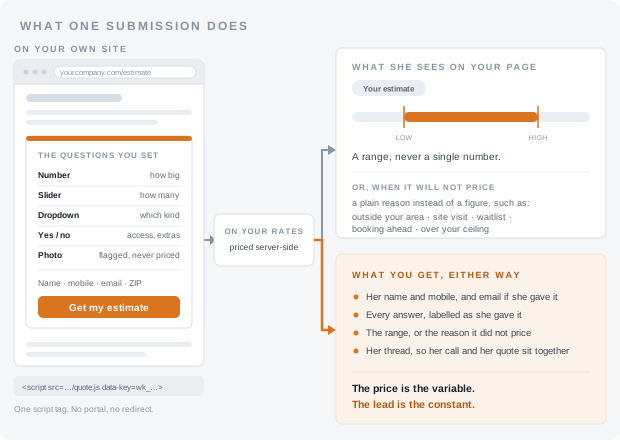
NapkinPrice™ runs that shop as three services on one account. The local move asks ten questions and puts a range on the screen, a piano or a gun safe on its own gets a tighter band and no season at all, and anything crossing a state line goes down a third path that never guesses a price.
The flow also asks for a photo of the fullest room and of the stairs, and the lead tells you to ask for those pictures on the callback. Attaching the image itself to the lead is on the roadmap, which is why it is not a tick in that list.
The eight things that set a moving number
One count, five pick-ones, two yes/nos and a ZIP. Not one of them asks a homeowner for a cubic foot, because nobody outside this trade has ever estimated one. You build the set once in the dashboard and every rate in it is a field you own.
How much there is to move
The base number, and a pick-one rather than a number box: a studio, a one-bedroom, a two-bedroom apartment or townhouse, a three-bedroom house, four bedrooms or bigger — $290, $455, $640, $980 and $1,420 on our own demo card. Asking for bedrooms as a NUMBER would be a bug rather than a style choice, and it is worth knowing why: the engine skips every pricing rule on a number question answered zero, correctly, so that "pack no rooms" costs nothing. A studio has zero bedrooms, so a studio would have priced at nothing at all. The studio is an option instead.
The miles between the two addresses
The declared band, and the answer to the whole problem on this trade. Same town under 10 miles, 10 to 25, 25 to 50, 50 to 100 and still one day — nothing, plus 10%, plus 22% and plus 45% on the demo. A percentage rather than a mileage fee, because drive time between the addresses is drive time for the whole crew: an extra half hour costs three times as much with three movers in the truck as it does with one, so a flat "$180 for the 25-to-50 band" would undercharge the big move and gouge the small one. Past 100 miles the question sends her to the long-distance service instead of guessing.
Access at the address you load from
Ground floor with the truck at the door, one flight, two or more flights with no elevator, or an elevator and a long carry — nothing, plus 10%, plus 22%, plus 14%. Stairs are the single biggest thing that turns a five-hour move into an eight-hour one, and they are labour rather than material, so they belong on a percentage. The help text does the teaching that matters: count from where the truck can actually stop, because fifty yards down the street is a long carry whatever floor she is on.
Access at the address you deliver to
The same four options, asked a second time, deliberately. The engine cannot take a second ADDRESS but it can perfectly well take answers ABOUT the second END, and carrying a sofa down two flights into a ground-floor house is a different day from the reverse. Averaging the two into one question would be wrong in both directions and a customer cannot honestly answer it anyway. If she has not been given the keys yet, the help text says to answer for what she was shown.
Rooms packed
The only genuinely per-unit line on the service: her room count times your rate, $135 a room on the demo. Leave it at 0 if she is packing her own boxes, which most people do, and answering 0 fires nothing at all. Count the kitchen as two — it is glass, it is heavy and it takes twice as long as a bedroom — and a garage full of tools as two more. This is also the one answer the mileage band should not be touching, and the section below measures exactly how much of the midpoint that costs rather than glossing it.
Anything over 300 pounds
A treadmill or a gun safe under 600 lb, an upright piano, or a grand piano, pool table or safe over 600 lb — $210, $425 and $850 on the demo. These are flat amounts, which means added ONCE for the job and not once per item, so a house with two uprights is trued up on the survey. Say that in the help text rather than letting her find out. A pool table has to come apart and the slate travels separately, which is most of why it is on the list at all.
A Saturday, or the turn of a month
The question the engine cannot ask itself. A seasonal date range is the only calendar the engine has and it works in months and days — there is no day of the week and no first-of-the-month anywhere in it. Those are the two most expensive days in this trade, so they are one yes/no the customer declares, plus 15% on the demo. Same discipline as the mileage band, same reason. The help text turns it into advice worth more than a discount: a Wednesday in the middle of a month is the cheapest move she will ever buy.
Travel zone
List your ZIPs by zone — whole ZIPs or three-digit prefixes — and the widget prices the trip from the ZIP she types, most specific match first. On this trade and no other, read that as the DEADHEAD: what it costs to get an empty truck to the address you load from, before the job starts. The demo yard in Charles Town charges nothing at home, $140 over the Blue Ridge into Loudoun, $165 over the Potomac into Frederick County, $285 down into Fairfax and Arlington, and 6% plus $425 for everywhere else. Set one zone to "outside my area" and it declines politely while still capturing the lead.
A real move, start to finish
Ten questions, about ninety seconds. This is the exact sequence running on our own moving demo account — a two-bedroom apartment in Charles Town going eighteen miles to a house outside Martinsburg, a second-floor walk-up at the pick-up and a long carry across a turning circle at the delivery, packing her own boxes, on a Tuesday in the middle of the month — and the total at the bottom is what the live pricing engine returns for these answers and nothing else, not a figure anybody typed into this page.
| # | What she is asked | What she answers | What it does to the price |
|---|---|---|---|
| 1 | How much is there to move? | A two-bedroom apartment or townhouse | A flat $640 for the job. A studio is $290, four bedrooms $1,420 |
| 2 | How far apart are the two addresses? | 10 to 25 miles | A percent on the whole job: +10%. The 50-to-100 band is +45% |
| 3 | At the address we are LOADING from, how do we get to the truck? | Two or more flights, no elevator | A percent on the whole job: +22% |
| 4 | At the address we are DELIVERING to, how do we get in? | An elevator, or a long carry to the door | A percent on the whole job: +14% |
| 5 | How many rooms do you want us to pack for you? | 0 | Nothing. Each room is $135 — the only line here that multiplies |
| 6 | Is there anything over 300 pounds? | No, nothing unusual | Nothing. An upright piano is a flat $425 for the job |
| 7 | Is the move on a Saturday, or the first or last two days of a month? | No | Nothing. Yes is +15% on the whole job |
| 8 | Does either building need a reserved elevator and a certificate of insurance? | No | Nothing. Yes would not add a dollar either — it raises the job floor to $1,150 |
| 9 | Is there anything to take apart and put back together? | No | Nothing. Yes adds a flat $145 and the tools come with us |
| 10 | Got a photo of the fullest room, or of the stairs? | Offered | Nothing. A photo never moves the price |
| The arithmetic, in the order the engine runs it | $165 drive out + $640 two-bedroom = $805, then the three percentage answers pool into one and +46% applies once to all of it → $1,175.30 | ||
| She sees | $1,034 – $1,316 | ||
| What lands in your inbox, the second she submits | Name, mobile, the pick-up ZIP, all ten answers, the photo flag, and the disclaimer she was shown | ||
The $165, the $640, the $135 and the percentages above belong to the demo account, not to a Tailgate Office price list — you set every one of them in the dashboard, and they were fitted so that this job lands where a mover in this corner would quote it, three movers and a truck at about $170 an hour for six or seven hours plus the drive out. Two things about that arithmetic are worth reading twice. The percentages pool rather than compound, so plus 10, plus 22 and plus 14 make plus 46 and not the plus 52.6 you would get by multiplying them out. And the pooled figure lands on the whole additive subtotal, base fee included, so the mileage band marks up the drive out as well — which is right, because a longer haul genuinely is more truck time. Where it is not right is packing, and the next section measures that rather than asserting it. What is not illustrative is the total: $1,034 to $1,316 is what the engine returns for those ten answers, and you can reproduce it yourself on the demo in about a minute.
Would you rather try it than read about it? We keep a working example moving company website with NapkinPrice™ embedded — the real engine, quoting live, on a page that is not ours. Put in those ten answers and see the same number come back.
Try the live demo site (opens in a new tab)A move has two addresses. The form takes one, and this page says which.
This is the one design decision that matters in this trade, so here is the whole of it in plain words rather than a promise that it all just works.
Here is exactly what the engine has. The widget collects one postal code, once, and that ZIP does a single thing: it picks the travel zone whose longest listed prefix matches, falling back to your catch-all. There is no question type that takes an address, no rule that could hold a route, and nothing anywhere in the platform that looks up a distance between two points. Pretending otherwise would be the one dishonest number on the account, so the fixture makes two decisions instead.
First: the ZIP is the origin. It is the address you load from, and the zone prices the deadhead — the empty truck and the three movers driving out before the job starts. Every zone name and every piece of help text on the demo says “we load from” or “pick up” and never “your address”, because on this trade those are two different places. You can watch it isolated: hold the ten answers above completely still and change nothing but the ZIP. Leesburg is $1,157 – $1,473, Frederick in Maryland is $1,179 – $1,501, Arlington is $1,285 – $1,636, and anything outside the listed prefixes falls to the catch-all at $1,470 – $1,871 — Columbia in Maryland and a ZIP in Texas return the identical figure, which is the clearest possible proof that the number is about your yard and not about her route. A ZIP outside every zone you serve gets no price at all, a polite decline, with the lead still captured.
Second: the distance is declared, not looked up. It is a dropdown of mileage bands on both priced services, and its help text tells her you are asking because the form cannot work it out. That is not a workaround dressed up; it is the same shape as urgency on a plumbing form. The bands carry a percentage rather than a fee for a reason worth copying: an hour of drive time is an hour for the whole crew, so it costs three times as much on a four-bedroom house as on a studio. And the bands bite harder on the single-item service — 0, 12, 30 and 60 per cent against 0, 10, 22 and 45 — because on a half-day job the driving genuinely is the job.
The third decision is where this account spends its cleverness, and it comes with a measurement rather than a claim. The engine cannot take a second address, but it can take answers about the second end, so stairs and carries are two questions rather than one averaged guess. Now swap them: take the ten answers above, move the long carry to the pick-up and the two flights to the delivery, and the quote comes back $1,034 – $1,316, identical, because the engine pools every percent and plus 22 then plus 14 is the same as plus 14 then plus 22. So the pair is not there to price the ends differently. It is there because a customer cannot honestly answer one question about two buildings, and because your dispatcher needs to know which end has the staircase. Flatten the pick-up to a ground floor and the same move is $878 – $1,118; flatten both ends and it is $779 – $992, which isolates the mileage band on its own.
And the seam that section does not paper over. A pooled percent lands on the whole additive subtotal, packing included, so the mileage band marks up the packing labour — and packing a kitchen takes the same two hours whether the new house is two miles away or forty. Measure it instead of arguing about it: four rooms packed on those same answers is $1,728 – $2,199, and dropping the mileage band alone to same-town pulls the midpoint from $1,963.70 to $1,829.20, of which about $54 is the band landing on the $540 of packing it has no business touching. The stairs bands arguably should reach it, because carrying packed cartons down two flights really is harder. The miles should not. The packing question’s help text says the rate is figured across the job rather than pretending otherwise, and the estimator trues it up.
Local move, house or apartment — quotes instantly
The work this business sells, and the service on which the two-address gap had to be solved rather than dodged. The drive out from the yard lives in the base fee — $165 on the demo — so it is added once however big the move is and cannot be answered around. Strip everything back to the rate on its own, a two-bedroom going across town with ground floors and the truck at the door at both ends, and you see it with no percentages at all: $708 to $902, a midpoint of exactly $165 plus $640. The smallest thing it will quote is a studio on the same terms, $400 to $510; the biggest plain one is a three-bedroom house, $1,008 to $1,282, and those two are the ends of the $400 to $1,500 local range this trade is usually given. Put the three-bedroom on the worked example above and it is $1,471 to $1,872. One answer lifts the floor without adding a dollar: a building wanting a reserved elevator and a certificate of insurance raises the job minimum to $1,150, so a studio across town that answers yes, whose arithmetic is $455, quotes at $1,150 to $1,288 — the low end IS the floor rather than 12% under it. And there is a ceiling: a four-bedroom going 50 to 100 miles with two flights, a long carry, six rooms packed, a grand piano, on a Saturday, with furniture to dismantle, reaches $5,847 to $7,442, just inside the $7,500 past which the widget stops pricing and hands you the lead.
One heavy item, or a few pieces — quotes instantly
The work that pays the light bill between household moves: one piano, one safe, a sofa somebody bought on Marketplace, a storage unit emptied. Its own $115 roll-out for two movers and a truck, its own $215 minimum, and a band of plus or minus 10% — TIGHTER than the household service on purpose, because a known number of known pieces is a known day where a house is however much is actually in the attic. An upright piano, one piece, twelve miles, ground floor out and one flight down into a basement, quotes at $523 to $640. One appliance across town with no stairs is $223 to $273; six pieces twelve miles away with a flight of stairs is $461 to $563; the same piano out of a two-flight walk-up with a door to take off is $843 to $1,030. The cheapest answer set possible floors at $215 to $237 rather than at its arithmetic. Its ceiling is $1,800, deliberately low: a grand piano plus eight pieces, 50 to 100 miles, two flights at both ends and a door off works out at $2,895.70 and routes, because at that point it is a household move and the other service prices it properly.
Long-distance, out-of-state and storage — site visit, never priced
Site-visit mode captures the whole spec and shows no number at all, which is the only honest answer to an interstate move. It is priced on the weight that actually goes on the truck and the real road miles between two addresses, and a form has neither. The service still asks where it is going, roughly how big the house is, whether the dates line up or it has to sit in storage, and whether a car is going as well — and not one of those answers moves money. The question worth copying is the mileage one: it carries NO pricing rule at all, and its help text says out loud that the answer changes nothing she is quoted and is only there to decide whether somebody comes out this week or next. She gets your own "we will come and look" message; you get a lead worth bidding. This page never prints an engine figure for a long-distance move, because the fixture cannot compute one.
One service carries the moving season. The other refuses it, and that is the harder decision.
Moving has the sharpest calendar of any trade on this site and it is not about the weather, which is exactly what makes it worth having. Leases turn over on the first of the month, the school year ends in June, and from the middle of May to the week after Labor Day every truck and every crew in this metro is spoken for. That is a dated, physical capacity constraint on scheduled work, which is the one thing a seasonal percentage can price honestly — the same test the gutter page applied to leaf fall and the chimney page to the first fire of the year. So the household service carries plus 14% from 15 May to 10 September, the disclaimer says out loud that it is a scheduling signal rather than a surcharge and that it comes off again on 11 September, and the same two-bedroom in October is 14% less because in October there is a truck. The worked example above comes back $1,179 – $1,501 booked in the middle of June, and the bare rate goes from $708 – $902 to $808 – $1,028.
The single-item service carries no season at all, and that is a decision rather than an empty field. Nobody schedules a piano around a lease. That work is steady every month of the year, and charging 14% more for it in July because other people are moving house would be a surcharge dressed up as a season. Run the piano job in the middle of June and it is still $523 – $640, to the dollar, and its disclaimer says so in words.
One consequence is worth watching once, because it is the engine behaving correctly in a way that surprises people. The ceiling is tested on the FINAL midpoint, after the season and the travel zone have both landed — so the biggest quotable move above, the one that comes back $5,847 to $7,442 in September, runs the identical answers in June at a midpoint of $7,574.62 and routes to you instead of pricing. One answer set, two months, and the widget does the right thing in both. A service that quotes will not go live until it carries a real base fee or a real minimum. That is deliberate: a service with neither would happily return $0 to a homeowner, and one bad number on your website costs more than a day of setup.
In June the phone rings all day and both hands are under a sofa
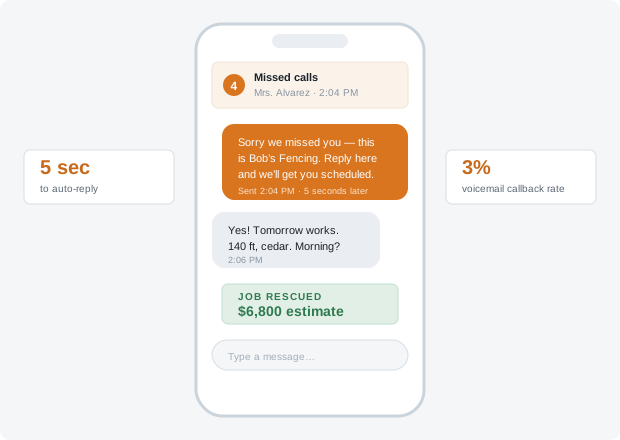
There is nowhere in this trade where answering a phone is a judgment call. You are on a staircase with a dresser, you are backing a 26-footer into a courtyard, or you are three hours into a day that has to finish before the building’s loading dock closes at six. Roughly 62% of contractor calls go unanswered, about 78% of jobs go to whoever responds first, and voicemail gets a callback around 3% of the time. In the sixteen weeks when every truck in the county is booked, those three numbers decide how much of the summer you actually keep.
| What a missed moving call is worth | On the demo account |
|---|---|
| A two-bedroom, eighteen miles, stairs at one end and a carry at the other | $1,034 – $1,316 |
| The same move out of a three-bedroom house | $1,471 – $1,872 |
| The same move with four rooms packed for her | $1,728 – $2,199 |
| One upright piano, twelve miles, one flight down | $523 – $640 |
| Voicemail callback rate | ~3% |
| One recovered two-bedroom pays for | 5 months of the bundle |
| One recovered piano pays for | 2 months |
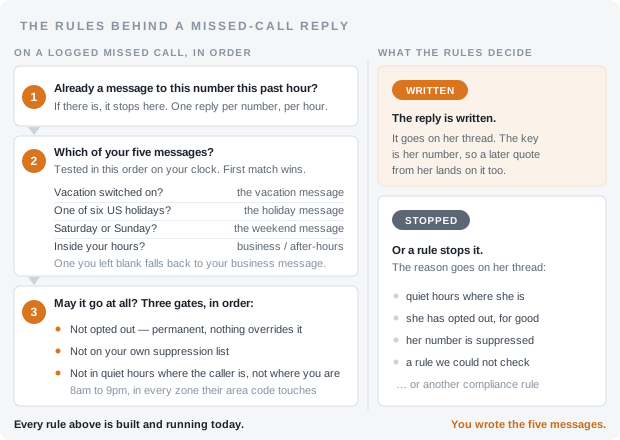
CallMitt™ writes back from your own texting number, a local number registered to your business and not a stranger’s 800 line, and the text opens with your business name, so she replies into the same thread as her quote. The message is picked by the hour and the day, against the hours you actually keep — the demo yard runs 7 to 7, the longest window on the site and a mover’s day rather than a copy of anybody else’s. The phone starts at seven because people ring about a Saturday before they leave for work, and it runs to seven because in June a crew that started at eight is still carrying beds up a staircase at half past six. A 7:30 PM call honestly gets the after-hours version instead of one claiming somebody is on a truck.
Straight about where this stands. Nothing on this platform delivers a text message yet: there is no SMS gateway and no carrier registration, so today you log the missed call and the reply becomes an outbox row marked queued and stops there. Everything around it is built and running now — the five messages, the business-hours, weekend, holiday and vacation rules, the quiet hours, the opt-out handling, and the thread her reply lands in beside her quote.
How CallMitt Works Run Your Own NumbersA mover is hired on one question, and it is about a staircase in July
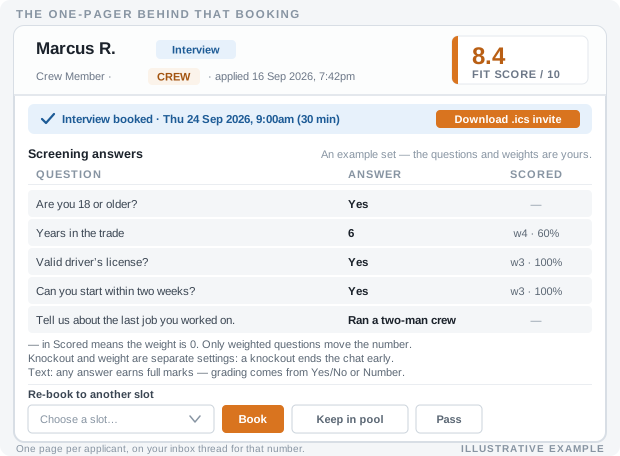
The job is seventy-five pounds up and down stairs all day, in the heat, for eight hours, and a man who finds that out at eleven o’clock on his first morning has cost you the move and the customer with it. Plenty of people will tell you they are fine with it in a January interview. Asking it in the words the day actually uses — and asking it before you give up an afternoon — is the whole of the screen.
Put “Now hiring — text CREW to your texting number” on the truck and the yard sign. CrewFunnel™ asks seven short questions: is he 18 or older, is he up for carrying seventy-five pounds up stairs all day in July, how far out does he live, does he hold a licence and can he drive a 26-foot box truck, how many years has he worked on a moving crew, can he start inside two weeks, and what was the last job he worked on. Three of those are knockouts and three come back as a weighted fit score, years on a crew heaviest and the start date next.
Three things about that scoring are worth copying, and one of them deliberately disagrees with another page on this site. Distance is a knockout and never a weight, because a number answer scores higher the bigger it is, so weighting miles would rank the man furthest away at the top. Free text carries no weight at all, because any non-empty answer scores full marks and a weighted text box quietly inflates every candidate who typed anything. And the driver’s licence is scored rather than a knockout — the gutter page knocks out on it, because the trailer goes with the crew. A moving crew is one driver and two helpers, so knocking out everybody who cannot drive a 26-footer would throw away two thirds of the people you actually need to hire. It carries a weight instead: worth having, not a gate. Which of the two is right depends entirely on the trade, and writing the reason down is the point.
One honest note on delivery. There is no inbound SMS on our side yet, so today he answers those seven questions on your screening page rather than by text — same questions, same knockouts, same scoring, same pool. The keyword on the truck takes over the day your carrier registration clears.
See how CrewFunnel works
The review is written on the floor of the new place, the night the truck leaves
The last box is in, the beds are put together, the truck has pulled away, and the family is sitting on the living-room floor eating out of a bag because nobody can find the plates. Nothing is broken and nobody is crying. That is the night she would write you a review. By the time the boxes are unpacked the move is a week she would rather forget, and your crew went with it. The outfit with sixty reviews is not sixty times better than you; somebody there asks every customer, the night the truck leaves.
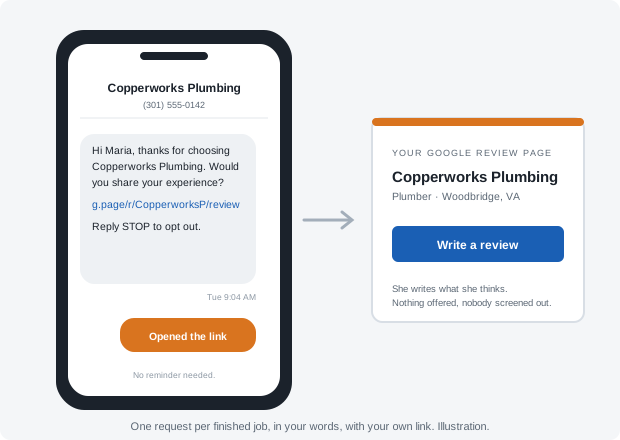
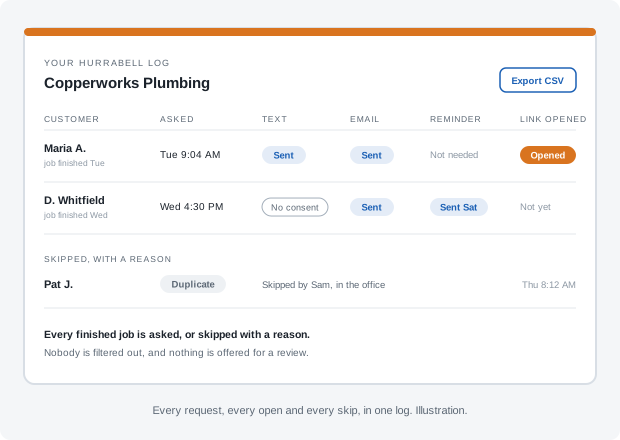
HurraBell™ does the asking. Mark the job done — from the inbox, from your phone, or from your job software through Zapier — and the customer gets one request in your words, with your own Google review link, after a delay you pick: an hour, unless you change it. Three days later, one email reminder, unless the link has been opened or the customer has got back in touch.
Review requests aren’t switched on yet, so none is sent today. When they are, the request goes by email once your Google review link is saved on the HurraBell page and your mailing address on the Account page. A text goes as well where the customer agreed to texts, and only once your carrier registration clears, the same wait as every text on this site; until then it is email only.
See how HurraBell worksOne recovered two-bedroom covers 5 months
And a single piano moved across town covers 2 of them. In a trade where the booking is decided by whoever answers first, that is the arithmetic that matters.
The Tailgate Office Bundle
Instant quotes on your website, missed-call text-back, text-to-apply hiring, review requests, and customers, jobs, estimates and invoices in one place. 30 days free, no credit card, no setup fee, cancel from the dashboard.
Start Free TrialOnly need one of the tools? After the trial you can keep just that one at its own price; the office stays with the Bundle.
Moving questions we get asked
By being honest about which one it takes and asking her for the rest. The ZIP is the address you LOAD from, and it decides one thing: the travel zone, which prices the empty truck getting to her before the job starts. The gap to the other end is a dropdown of mileage bands she answers herself, and the help text says in her own words that you are asking because the form cannot work it out. Nothing on the account implies a lookup — there is no per-mile rate anywhere in it, and the long-distance service’s mileage question carries no pricing rule at all and says so. What you get out is a real bracket on a real job: $1,034 to $1,316 for a two-bedroom going eighteen miles with a walk-up at one end, which is a number you would say on the phone.
Because the engine cannot, and shipping a form that looked like it could would be worse than a dropdown. There is no question type that takes an address, no rule that holds a route, and no distance lookup anywhere in the platform. A declared band is the same answer the plumbing demo gives for urgency: no hour of the day reaches the engine either, so the customer declares whether she needs somebody today or next week and the answer carries a percentage. Declared beats invented. It is also worth saying that she knows the answer — she has driven it, or she has looked at a map before signing a lease — and a rough band is all a range needs.
Because a move has two staircases and a customer cannot honestly answer one averaged question about two different buildings. Carrying a sofa down two flights into a ground-floor house is a different day from the reverse. Here is the part worth knowing before you copy it: because the engine pools every percentage into one figure, swapping the two answers gives an IDENTICAL quote — the worked example above is $1,034 to $1,316 either way round. So the pair is not there to price the ends asymmetrically. It is there for answerable accuracy and for dispatch: your crew leader wants to know which end has the stairs before the truck leaves, and that is worth a second dropdown on its own.
No, and the account says so on the question rather than guessing. An interstate move is priced on the weight that actually goes on the truck and the real road miles between two addresses, and a form has neither. So anything over about a hundred miles is a third service in site-visit mode: it captures where it is going, roughly how big the house is, whether the dates line up or it needs storage in between, and whether a car is going as well, and it shows no number at all. Its road-mileage question carries no pricing rule and its help text says the answer changes nothing she is quoted — it only decides whether an estimator comes out this week or next. That is the same discipline the chimney demo keeps for a reline and the masonry demo for natural stone: the engine has five kinds of pricing rule and none of them can carry a job whose cost lives on a scale ticket nobody has weighed yet.
That is a whole service, and it is the second one on the account. Its own $115 roll-out for two movers and a truck, its own $215 minimum, a tighter band of plus or minus 10% because a known number of known pieces is a known day, and its own mileage bands which bite harder than the household ones — 0, 12, 30 and 60 per cent — because on a half-day job the driving is the job. An upright, one piece, twelve miles, ground floor out and one flight down into a basement is $523 to $640; the same piano out of a second-floor walk-up with a door to take off is $843 to $1,030. On a full household move the heavy item is a flat amount instead, $425 for an upright — and flat means once for the job, so a house with two uprights is trued up on the survey and the help text says so.
It would be, if the season were weather. This one is a calendar and a capacity problem: leases turn on the first, the school year ends in June, and from mid-May to the week after Labor Day every truck and every crew in the county is spoken for. So the plus 14% is a scheduling signal, the disclaimer says both halves out loud including the date it comes off, and the same two-bedroom in October is 14% less because in October there is a truck. The part worth copying is where the season is NOT. The single-item service carries none at all, because nobody schedules a piano around a lease and charging 14% more for one in July would be a surcharge dressed up as a season. Run it in June and it is still $523 to $640. An empty season field is a decision you are allowed to make.
Call it fifteen minutes for your text-back messages and your working hours, a minute, once review requests are switched on for your account, to paste your Google review link on the HurraBell page and your mailing address on the Account page, and about an hour to write the ten local-move questions and load one rate card — your home-size amounts, your mileage bands, your two access bands, your per-room packing rate, your heavy-item amounts and your travel zones. Then half an hour for the single-item service, which has its own roll-out, its own minimum and a tighter band, and ten minutes for the long-distance service, which prices nothing and so needs no rates at all. A service that quotes will not go live until it carries a real base fee or minimum, which is deliberate. No onboarding call, no setup fee and no contract: $199 a month buys all four tools, and ResponsiBid’s reported $400–600 setup, as published in August 2026, is not a thing here.
Clearing the house out before the truck comes? See the junk removal page, all the trade pages, or call (301) 268-1943.
Give her the number before she rings the next mover.
Set it up tonight. Free for 30 days, no card, no setup fee, cancel from the dashboard.