

A re-coat is priced from the driveway. A repair is priced from behind the wall.
Re-coating sound stucco is square feet of wall times a rate, with the finish and the number of stories moving it, and a homeowner can describe it standing in her own yard. A repair is a different job wearing the same name. The stain under the window, the soft spot by the door, the crack that comes back every spring: each is water that got behind the wall, and the price of fixing it is what the moisture meter finds, not what the surface looks like.
So this page prices the re-coat instantly and the repair never. The instant service covers washing, routing and filling the cracks, masking every opening and the finish she picks, a fog coat, an elastomeric coat or a new acrylic finish. Anything soft, wet or cracked through goes to a site-visit service that starts with a moisture check, which is the question every homeowner should ask a stucco contractor before a patch goes on.
The flow also asks for a photo of each side of the house and close-ups of the cracks, and the lead tells you to ask for those pictures on the callback. Attaching the image itself to the lead is on the roadmap, which is why it is not a tick in that list.
The eight things that set a stucco number
An area, three counts, two pick-ones, a yes or no and a ZIP. You build the set once in the dashboard and every rate in it is a field you own — you can change a per-square-foot rate the season your coating costs go up without touching your website.
Square feet of wall
The length of each wall times its height, added up, with no deduction for the windows because the masking is counted separately. A two-story house is often 2,000 to 3,000, and the help text says so. On the demo, $4.25 a square foot to wash, prep and coat.
The finish
A fog coat to refresh the color at the rate, an elastomeric coating that bridges hairline cracks +30%, a new acrylic finish coat that changes the texture and the color +45%. A percentage on the whole job, because the finish is the material and most of the hours.
How many stories
One story at the rate, two +12%, three or more +25%. Above one story the wall is worked from scaffold that goes up and comes down around the whole house, and it slows every square foot at once.
Cracks wider than a credit card
Counted and multiplied: $65 a crack on the demo, each routed out and filled before the finish goes on. Hairline cracks are in the rate. The credit card is in the question because it is the test she can actually do.
Trim bands and foam molding
Linear feet, multiplied: $12 a foot on the demo for the raised bands around the windows and along the floor line, each detailed by hand.
Windows and doors
Counted and multiplied: $25 an opening on the demo. Each one is masked, and the joint around it is checked and sealed, which is where water gets in on most houses.
Plantings and the patio
A yes or no with a flat amount behind it: $200 on the demo for tarps, plant ties and a rinse of the patio when the crew is done, added once for the job.
Travel zone
List your ZIPs by zone, whole ZIPs or three-digit prefixes, and the widget prices the trip from the ZIP she types, most specific match first, as a flat charge, a percentage, or both. Our demo crew charges nothing in its home county and $125 out to the ring beyond it, so the same house comes back $16,205 to $19,806 at home and $16,318 to $19,944 in Fairfax. Set one zone to "outside my area" and it declines politely while still capturing the lead.
A real two-story re-coat, start to finish
Eight questions, about a minute. This is the exact sequence running on the instant service of our own stucco demo account, answered for an elastomeric coat on a two-story Ashburn house — and the total at the bottom is what the live engine returns for these answers, not a figure anybody typed into this page.
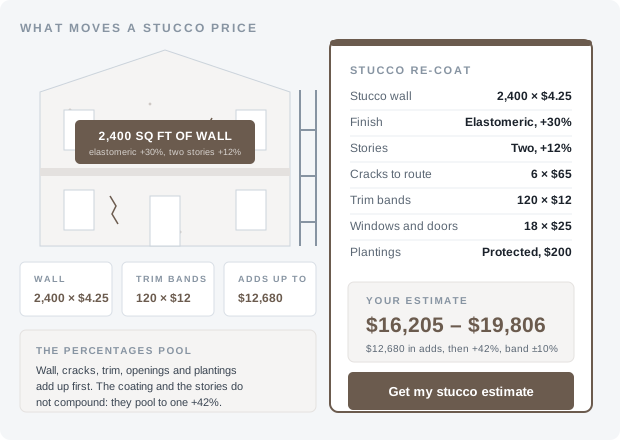
| # | What she is asked | What she answers | What it does to the price |
|---|---|---|---|
| 1 | How many square feet of stucco wall? | 2,400 | 2,400 × $4.25 = $10,200. This is THE base number |
| 2 | Which finish? | Elastomeric coating | +30% on the whole job. Fog coat 0%, a new acrylic finish coat +45% |
| 3 | How many stories? | Two stories | +12% on the whole job. One 0%, three or more +25% |
| 4 | How many cracks wider than a credit card? | 6 | 6 × $65 = $390, each routed and filled |
| 5 | How many linear feet of trim bands and foam molding? | 120 | 120 × $12 = $1,440 |
| 6 | How many windows and doors on those walls? | 18 | 18 × $25 = $450, masked and sealed |
| 7 | Are there plantings or a patio right against the walls? | Yes | A flat $200 for the job |
| 8 | Got a photo of the house? | Offered | Nothing. A photo never moves the price |
| The arithmetic, in the order the engine runs it | $10,200 + $390 + $1,440 + $450 + $200 = $12,680, then the two percentage answers pool to +42% and apply once to all of it: → $18,005.60 | ||
| She sees | $16,205 – $19,806 | ||
| What lands in your inbox, the second she submits | Name, mobile, ZIP, all eight answers, and the photo flag | ||
Every rate in that table belongs to the demo account, not to a Tailgate Office price list — you set all of them yourself, and you can change one without touching your website. What is not illustrative is the total: $16,205 to $19,806 is what the engine returns for those eight answers, for re-coating sound stucco.
Would you rather try it than read about it? We keep a working example stucco and plaster company website with NapkinPrice™ embedded — the real engine, quoting live, on a page that is not ours. Put in those eight answers and see the same number come back.
Try the live demo site (opens in a new tab)The re-coat quotes. The repair starts with a moisture meter, and the weather moves the date.
These are the decisions that matter in stucco, so here they are in plain words rather than a promise that it all just works.
A stucco repair is priced on what is behind the wall, and nothing on a form can see it. The homeowner’s question to any stucco contractor is whether the wall will be checked for moisture before it is patched, and what happens to the price if there is rot. Our demo answers it the only honest way: repairs, cracks that keep coming back and EIFS are a site-visit service that asks what she is seeing and whether it is hard stucco or EIFS, shows no price at all, and takes her details so you can book the moisture check. Interior and Venetian plaster is a second site visit, priced with the sample boards in hand.
The instant service carries no season, and that is a decision rather than an empty field. Several demos on this platform run a winter discount, and the commercial logic would apply here too: the schedule empties in January. It is declined because stucco and finish coats have a temperature floor for application and curing, so a published winter price would advertise work the crew should be rescheduling. The disclaimer says it in her words: a cold snap moves the date, not the price.
The percentage answers have one seam worth knowing. They pool and apply once to everything additive, so the elastomeric coat and the second story at +42% land on the crack repairs, the trim, the masking and the plantings as well as on the wall — on the example above that is about $1,042 of the $18,006 midpoint. The help text says the finish and the height are figured across the whole job, and the visit is where it is trued up.
Stucco re-coat and color coat — quotes instantly
$4.25 a square foot on the demo, with the finish and the stories moving the job, $65 a crack, $12 a foot of trim band, $25 an opening and $200 for the plantings. A $2,500 minimum is the floor under the final number, so a 300 square foot wall that works out at $1,325 comes back $2,500 to $2,750. Past $45,000 it stops pricing and hands you the lead.
Stucco and EIFS repairs, cracks and moisture — site visit
Site-visit mode captures what she is seeing, cracks that come back, stains under the windows, a soft spot, impact damage or a home inspector's note, and whether it is hard stucco or EIFS. It shows no number at all and takes her details so you can book the moisture check, which is where every honest stucco repair price begins.
Interior and Venetian plaster — site visit
Polished plaster, lath-and-plaster repairs and plaster ceilings are priced on the finish she picks from the sample boards, so the form asks what she is thinking about and roughly how many square feet, which moves no money and only tells you how long to book the visit.
A service that quotes will not go live until it carries a real base fee or a real minimum. That is deliberate: a service with neither would happily return $0 to a homeowner, and one bad number on your website costs more than a day of setup. The re-coat service carries no trip charge, so it is the minimum doing that job.

Nobody answers the phone from the top of a scaffold
You are two stories up with a hawk and a trowel, and the finish is going off faster than you would like. She is not in a hurry, but she is thorough: she has photographed every crack and she is working down a list, and the contractor who sends her something first is the one who gets to walk the house. In a trade where one house is a five-figure job, the call you could not take is a month of work.
| What a missed stucco call is worth | On the demo account |
|---|---|
| A two-story house, elastomeric, 2,400 sq ft | $16,205 – $19,806 |
| The same house, a new acrylic finish coat | $17,917 – $21,898 |
| The same house, a fog coat | $12,781 – $15,622 |
| A one-story ranch, fog coat, 1,600 sq ft | $6,507 – $7,953 |
| One recovered re-coat pays for | 81 months of the bundle |
| One recovered ranch pays for | 32 months |
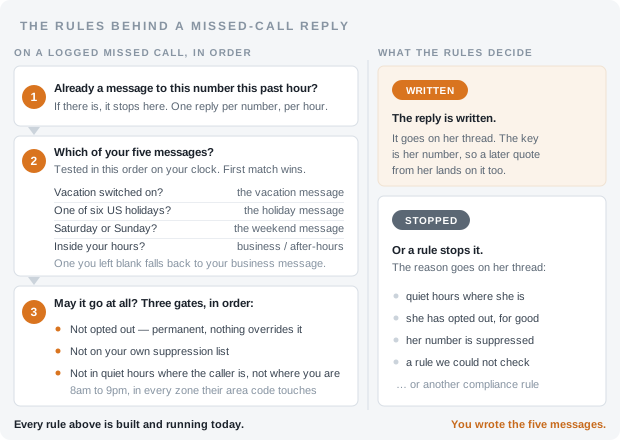
Once texting is switched on, CallMitt™ writes back by text with your business name in the first words, so she replies into the same thread as her quote. The message is picked by the hour and the day, against the hours you actually keep — the demo crew runs 7 to 4, because the finish goes on early, before the sun is full on the wall, so a 4:30 call gets the after-hours version rather than one claiming somebody is on site — and every version asks the one thing that sorts your week: a re-coat or a repair.
Straight about where this stands. The forwarded-call hook is built and waits on your texting number, so today you log the missed call and nothing is sent: a reply queued now is retired rather than delivered when your carrier registration clears. Everything around it is built and running now: the five messages, the business-hours, weekend, holiday and vacation rules, the quiet hours, the opt-out handling, and the thread her reply lands in beside her quote.
How CallMitt Works Run Your Own NumbersA plasterer is hired on two questions, and the first one is about height
The work is on scaffold two and three stories up for most of the day, in August and in October, and a man who has not done it does not yet know whether he can. That is the first question, and it is not about skill at all. The second one is: has he run a finish coat on a whole wall himself, start to finish? Anybody can patch a crack. A wall with no laps and no lines, finished before it skins over, is a skill, and you cannot teach it on a customer’s house.
Put “Now hiring — text CREW to your texting number” on the truck and the scaffold. CrewFunnel™ asks seven short questions: is he 18 or older, is he comfortable on scaffold two and three stories up, has he run a finish coat on a whole wall himself, how many years has he done stucco or plaster work, how far out does he live, can he start inside two weeks, and what was the last job he worked on. Three are knockouts — under 18, not up for the height, or living further out than you will drive — and the rest come back as a weighted fit score, years in the trade heaviest, the start date next and the finish coat after it.
Two things about that scoring are worth copying. Distance is a knockout and never a weight, because a number answer scores higher the bigger it is, so weighting miles would rank the man furthest away at the top. And free text carries no weight, because any non-empty answer scores full marks and a weighted text box inflates every candidate who typed anything. Both are set that way on our demo job, and all seven questions carry a Spanish translation.
One honest note on delivery. Text-to-apply waits on your texting number, so today he answers those seven questions on your screening page rather than by text — same questions, same knockouts, same scoring, same pool. The keyword on the truck takes over the day your carrier registration clears.
See how CrewFunnel works


A re-coated house gets its review the week the whole street notices
The scaffold comes down, the masking is pulled, and for the first time in years the house is one even color from the driveway to the roofline. For about a week everyone who walks past says so. That is the week she would write you a review. After that it is just what the house looks like, and the crew that spent ten days on it has faded with the old chalky gray. The outfit with sixty reviews is not sixty times better than you; somebody there asks every customer, the week the scaffold comes down.
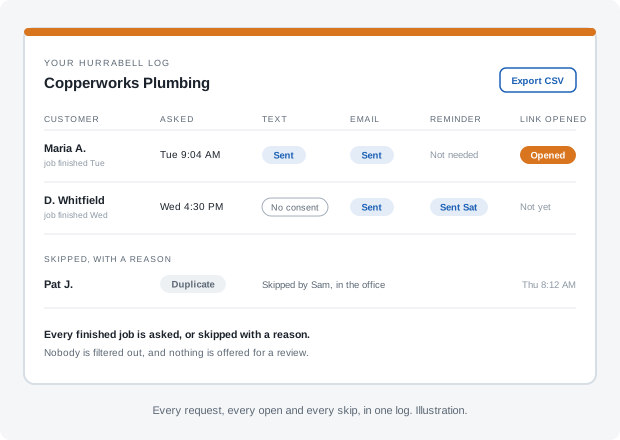
HurraBell™ does the asking. Once review requests are switched on, you mark the job done — from the inbox, from your phone, or from your job software through Zapier — and the customer gets one request in your words, with your own Google review link, after a delay you pick: an hour, unless you change it. Three days later, one email reminder, unless the link has been opened or the customer has since texted you, messaged you from your website or had a call logged on her thread.
Review requests aren’t switched on yet, so none is sent today. When they are, the request goes by email once your Google review link is saved on the HurraBell page and your mailing address on the Account page. A text goes as well where the customer ticked the box on your quote form or visit booking agreeing to a review-request text, and only once your carrier registration clears, the same wait as every text on this site; until then it is email only.
See how HurraBell worksOne recovered re-coat covers 81 months
A single ranch covers 32 of them. In a trade that lives on a handful of five-figure jobs a month, the arithmetic is not close — it is barely arithmetic.
The Tailgate Office Bundle
Instant quotes on your website, missed-call text-back and text-to-apply hiring (texts go out once texting is switched on), and, once switched on, a review request after every job, plus customers, jobs, estimates and invoices in one place. 30 days free, no credit card, no setup fee, cancel from the dashboard.
Start Free TrialOnly need one of the tools? After the trial you can keep just that one at its own price; the office stays with the Bundle.
Stucco questions we get asked
You can price a re-coat, as a range, and only a range — the widget never shows a single figure. The disclaimer under it is yours to write. On the demo it says the range covers re-coating sound stucco, that soft, cracked-through or wet stucco needs a repair first, priced after a moisture check, and that a cold snap moves the date, not the price. Nothing is started until she has that written number.
Because a stucco repair is priced on what is behind the wall: wet sheathing, failed paper, rot around a window. The question a homeowner should ask any stucco contractor is whether the wall will be checked for moisture before it is patched and what happens to the price if there is rot, and a number on a form cannot answer it. Our demo runs repairs and EIFS as a site visit that takes her details so you can book the moisture check.
Because stucco and finish coats have a temperature floor for application and curing, and a crew should not be working below it. A published winter price would advertise work you should be talking her out of in the months you should be talking her out of it. Every figure on this page is the same figure in any month, and the disclaimer says the weather moves the date.
They do better when the help text tells them how: the length of each wall times its height, added up, with no deduction for the windows. It also tells her a two-story house is often 2,000 to 3,000 square feet, which is enough for her to catch a typo. The lead records what she typed, so the conversation at the house is about the difference rather than the whole number.
Not on the demo: EIFS has foam behind it, and the expensive failures are water trapped behind that foam, so it goes to the site-visit service with every other repair. If you re-coat sound EIFS regularly, give it its own instant service with its own rate, so a homeowner never gets a hard-stucco price for a wall that needs a different job.
Call it fifteen minutes for your text-back messages and your working hours, a minute, once review requests are switched on for your account, to paste your Google review link on the HurraBell page and your mailing address on the Account page, and about an hour to write the eight questions and load one rate card — per square foot, your finish and story percentages, per crack, per foot of trim, per opening and your plantings fee. A service that quotes will not go live until it carries a real base fee or minimum, which is deliberate. No onboarding call, no setup fee and no contract: $199 a month buys all four tools.
Also paint exteriors, or do siding? See all the trade pages or ask us.
Quote the re-coat while she is still photographing the cracks.
Set it up tonight. Free for 30 days, no card, no setup fee, cancel from the dashboard.