
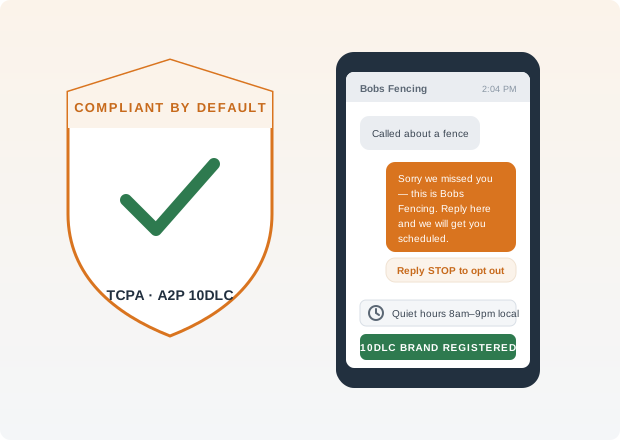
Two different things, and people mix them up constantly
There are two separate rulebooks in play when a business sends a text message, and almost every contractor we talk to has them tangled together.
TCPA is the law. It is a federal statute about who you are allowed to contact and when. Getting it wrong is a legal problem.
A2P 10DLC is the carriers’ rulebook. It is not a law — it is what AT&T, Verizon and T-Mobile require before they will carry business texts on a normal 10-digit number. Getting it wrong is a delivery problem, and a quiet one: your messages simply stop arriving and nobody tells you.
Where we actually are, today
This page describes how we built the product and what we take on for you. Two of those things run right now: consent scoping — the platform will not text a stranger or a list — and quiet hours, enforced on every automated send before it is queued.
The rest waits on one thing. Our SMS gateway and carrier account are not live yet, so no registration has been filed for anyone and nothing texts. Messages your account produces are recorded and held in an outbox rather than sent, and inbound texting — which is what auto-answers STOP and HELP — switches on with the same build. Your quote widget does not touch any of this and works from day one. We would rather you read that here than find it out in week three.
What the TCPA actually says
Stripped of the lawyering, it comes down to one idea: do not send automated messages to people who did not ask to hear from you.
They contacted you first
In every one of those, the person handed you their number expecting to hear back about that specific thing. Replying is what they wanted. This is the only category our products operate in.
You went and found them
This is where contractors get in trouble, and it is essentially never the missed-call text-back. It is the moment somebody sells them a spreadsheet. Our platform will not send to an uploaded list.
Why we only text people who just contacted you
It is not caution for its own sake. It is a design decision that removes most of the risk before you ever log in.
The trigger is the inquiry itself
A CallMitt™ text exists only because a missed call was recorded against your account — today by you or your office logging it, later by the carrier feed. The trigger is always an inbound call, never a list. The consent and the trigger are the same event.
The message stays on topic
Existing-inquiry consent covers the thing they asked about. So the text is about that: sorry we missed you, reply here and we will get you scheduled. It is not a promotion, and the product will not let you turn it into one. The one promotional text the platform can send is a NapkinPrice™ follow-up asking whether a customer wants to book the estimate they got, and that needs its own written consent: a separate box on your quote form that starts unticked, that nobody has to tick to get a price, and that says exactly what they are agreeing to.
There is no list import
People ask for it. We do not build it. A bulk upload button is the single feature most likely to end with a contractor getting a demand letter and a dead phone number, so it does not exist.
You are identified in the first line
Every automated message should name your business up front, and the template editor flags any message that does not. Anonymous business texting is both against carrier rules and the fastest way to get reported as spam by someone who forgot they called you.
Nothing sends at midnight
Automated sends are held to roughly 8am–9pm in the recipient's local time. You cannot override this into someone's dinner, and there is no setting that lets you.
One reply, not a campaign
The text-back is a single message opening a conversation, not a sequence. If they do not reply, no second text-back follows. A quote gets at most one follow-up, and only if you switch follow-ups on (they start off): one email, a text as well only for a customer who ticked the box, and it is cancelled if they text or call the number we answer for you, or you reply from your inbox first, or you press the stop link in the email telling you about the lead. Nagging people who ignored you is exactly the behavior the rules exist to stop.
A2P 10DLC: the part nobody explains
If your texts have ever “sent” and never arrived, this is almost certainly why.
A2P stands for application-to-person — a message sent by software rather than typed by a human. 10DLC means a standard ten-digit long code, which is to say a normal phone number like yours.
Since 2021 the US carriers have required every business sending A2P traffic over a 10-digit number to register: who the business legally is, what kind of messages it sends, and examples of the actual message text. Registered traffic gets delivered at proper speed. Unregistered traffic gets filtered, throttled, or dropped.
Dropped is the dangerous one. Your dashboard says sent. The customer never sees it. Nobody bounces anything back. This is how a contractor spends four months believing his missed-call system is running while every message quietly evaporates.
Which is exactly why we hold messages instead of pretending. Until our carrier account is live there is nothing to register against, so nothing is filed and nothing sends — and your dashboard says held, not sent. Here is what the filing looks like when we submit yours.
We register the brand
Your legal business name, EIN or sole-proprietor details, address and website go to the carrier registry as a verified brand. This is filed in your business name, not ours — it is your identity on the network.
We register the campaign
A "campaign" is a use case: missed-call reply, quote follow-up, hiring screening, review request. Each gets submitted with real sample messages and a written description of how consent is collected.
The carriers review it
They check that the business is real, the use case is legitimate, and the consent story holds up. This is the step where sloppy submissions get rejected and have to go around again.
Your texting number goes live
Once approved, you get your own texting number: a local number in your area code, registered to your business and linked to the approved campaign, and messages flow at full throughput. Your business line stays exactly where it is and keeps ringing as it does now.
How long it takes
Published carrier turnaround is anywhere from one day to about three weeks. We wish we could give you a tighter number, but the review sits with the carriers and it is not on a schedule we control — and we have not filed one yet, so this is the published range rather than our own observed experience.
Typical published carrier turnaround
| Clean submission, common trade, EIN on file | 1–3 days |
|---|---|
| Typical small contractor | 3–10 days |
| Sole proprietor, extra verification needed | 1–3 weeks |
| Rejected once and resubmitted | add 3–7 days |
Two commitments about how we run it, from the day our carrier account is live. First, we file it for you during onboarding, not after your trial ends. Second, if it gets rejected we fix and resubmit it ourselves and tell you what happened. You never get handed a carrier rejection code and told good luck.
Meanwhile, nothing else is blocked. Your quote widget works from day one and needs no registration: it sends no text at all unless you switch on follow-up texts, a customer ticks the box for one, and your registration covers them. The texting features are the part that waits — they are built, they enforce every rule on this page, and they hold messages until delivery is live. Your 30-day trial extends itself: if your carrier registration is still pending near the end, or you have not had a real quote or call yet, it gets more time automatically and your dashboard says why. If that still leaves you short, say so and a person will extend it. We have never said no.
What we need from you
This is the entire list. It takes about five minutes to gather and you only do it once.
Sole proprietors
No EIN is fine — there is a dedicated path for it. It needs a one-time code sent to your personal mobile to confirm you are you, review runs a bit longer, and carriers apply lower daily message limits. For a contractor answering missed calls, those limits are not close to binding.
Opt-outs and quiet hours
The two operational rules you would otherwise have to police yourself. We run both for you, and you cannot switch them off.
STOP means stop, instantly
You cannot text an opted-out number from our platform. Not by accident, and not deliberately — the check runs before a message is ever queued, so a blocked message is recorded as blocked and never leaves.
Nothing sends in the middle of the night
That last point matters more than it sounds. Work near a state line and “8pm” is two different times depending on who you are texting. You should not have to think about that, and with us you do not.
Misuse it and we shut it off
We would rather say this plainly now than in an email later. If an account starts texting people who never contacted the business, we disable the texting features. Not a warning tier, not a fine — off.
This is not us being precious. Carrier campaigns are shared infrastructure and a single spam complaint pattern can get a campaign killed, which takes down delivery for the whole account and sometimes takes weeks to unwind. The damage does not stay in one place.
We will call you first if there is time. The disable is not negotiable, and the same rule applies to accounts that come through an agency partner.
What gets an account switched off
Why this page exists at all
Because “compliance is handled” is a sentence a lot of vendors say and very few will put detail behind.
| Feature | With us | Doing it yourself |
|---|---|---|
| Who files 10DLC registration | We do, per customer, at signup — from the day our carrier account is live | You, through a carrier portal |
| Who fixes a rejection | We do, and we tell you why | You, from an error code |
| Registration cost | The carriers’ fees, at cost — we add nothing and charge no setup fee | The same carrier fees, plus your time |
| STOP handling | Permanent and unoverridable, included | However you built it |
| Quiet-hour enforcement | Send blocked and recorded, by recipient time zone — always on, running today | Your own discipline |
| Bulk list uploads | Not possible | One button away from trouble |
| Consent records | Logged with timestamps | A spreadsheet, probably |
Questions we get every week
Replying to somebody who dialed your business number, about the thing they called about, is ordinary business communication and it is what our product does. It is not marketing to a stranger. The consent and the trigger are the same event, seconds apart. That said — see the disclaimer at the bottom of this page; we are describing how we built the product, not giving you legal advice.
Not the one the customer dialed. It comes from your own texting number: a local number in your area code, registered to your business through the filing described above. Your business line stays exactly where it is and keeps ringing as it does now. US carriers do not let texting software send from a number on a mobile plan, which is where most contractors keep their business line. So the caller dials one number and hears back from another. It works because the text opens with your business name and thanks them for calling. A text from a toll-free line or an unfamiliar area code reads as spam and gets ignored or reported, which is bad for you and bad for the carrier campaign.
Sole proprietors have a dedicated registration path. It needs a one-time verification code sent to your personal mobile, review takes a little longer, and the carriers apply lower daily message limits. For missed-call replies and hiring screening those limits are nowhere near binding.
When one is rejected we fix it and resubmit, and we tell you what the rejection actually said. Most rejections are boring — a business name that does not match state records, an address typo, a website that does not mention the business. You do not get handed an error code.
Not through our platform. Marketing to a list, even a list of your own past customers, is a different consent category with different requirements, and it is not what this product is for. If that is what you want, talk to a lawyer and use a tool built for it. A review request after a job you did is not a promotion, and it is what HurraBell™ sends once review requests are switched on for the account: one request to that customer in your words, by email and, only where they agreed to texts about the job, by text.
No. NapkinPrice works from the first day, whatever your registration is doing: quotes, the estimate email to the customer, the email telling you about the lead, and the follow-up email all go without it. The one text it can ever send is an optional follow-up to a customer who ticked a box asking for it, and that one waits for your registration to cover marketing texts. Every new lead is emailed to you and lands in your dashboard inbox, which is where you go to work it.
You do. Every inquiry, every message and every opt-out is timestamped and exportable. If you ever leave us you take the full record with you — that is exactly the sort of thing you want in a file if anyone ever asks a question about it.
We do, per contractor, in that contractor's legal business name — from the day our carrier account is live, same as for a direct customer. You collect the business details from your client as part of onboarding; we handle the submission, the follow-up and any resubmission. Details are on the partner program page.
Yes, regularly — both the FCC rules and the carrier requirements move. That is a good argument for having somebody else responsible for tracking them. We update our handling when they change and we do not charge extra for it.
This is not legal advice
We build software, we are not lawyers, and nothing on this page is legal advice or a legal opinion. It is a plain-English description of how our product is designed and what we do on your behalf, written to be useful rather than exhaustive.
Federal rules and state rules both change, and state texting law in particular varies a lot. Using our platform does not transfer legal responsibility for your messages to us, and it is not a defense. If you are running a large SMS program, doing anything beyond replying to inbound inquiries, or you have already received a complaint, talk to a lawyer who practices in this area. Questions about how our handling works: (301) 268-1943 or support@tailgateoffice.com.
We file the paperwork. You answer the fence lady.
Consent scoping and quiet hours run today; we file your carrier registration, you pay the carriers’ own fees for it at cost, and STOP handling is built in when texting switches on. 30-day trial, no card.