
Nobody wants to call a cleaning company
The person shopping for a house cleaner is embarrassed about the state of the house, unsure what it should cost, and not at all interested in describing her bathrooms to a stranger. She will absolutely tell a dropdown menu, at 11pm, in her pajamas.
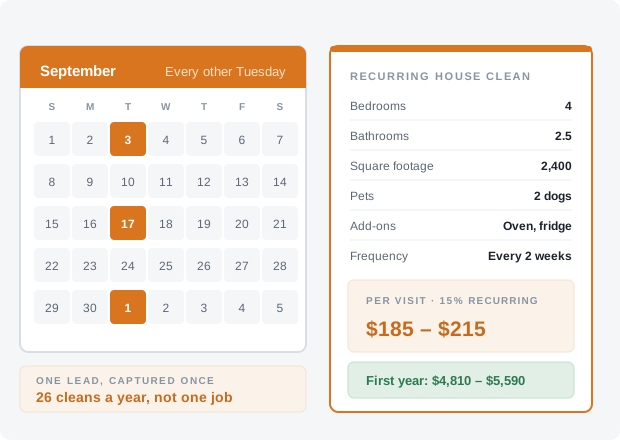
NapkinPrice™ asks the five things you would ask — beds, baths, square footage, pets, how often — and shows a per-visit range with the recurring discount already applied. She picks the biweekly plan because the biweekly number is the one that looked cheap, and that choice comes through on the lead so you can book it on the callback.
What actually drives a cleaning price
Bathrooms and frequency do most of the work. The rest are modifiers you already apply in your head.
Bedrooms
The base unit almost everyone prices on. Also the number a homeowner can answer without getting up off the couch, which matters more than accuracy.
Bathrooms
The real labor. A half bath is not a full bath and should not price like one — allow half-steps, because a 2.5-bath house is a different afternoon than a 2.
Square footage
Four bedrooms in 1,800 sq ft and four bedrooms in 3,600 sq ft are two different jobs. Use it as a percent band on top of the bed/bath base — "over 3,000 sq ft, add 20%" — not as the base itself.
Deep clean vs. recurring
A first-time deep clean is typically 1.5–2× a maintenance visit. Quote it separately and say why: baseboards, inside cabinets, grout, ceiling fans, the stuff nobody has touched in two years.
Pets
Two shedding dogs is an extra vacuum pass in every room and a filter change. It is a legitimate line item and homeowners are not offended by it — they know.
Add-ons
Inside oven, inside fridge, interior windows, blinds, laundry, garage. One yes/no each, with your own flat fee behind it. This is where an $170 visit quietly becomes $235.
Frequency
Weekly, every two weeks, every four weeks, one-time. Put the discount in the option label — "Every 2 weeks (save 15%)" — so she reads it as she picks, and watch how many people move up a tier to save $25.
Travel zone
Drive time is real cost. List your ZIPs by zone and set a surcharge on the far ones — a flat trip charge, a percentage, or both. Or mark a zone "outside my area" and the widget declines politely and still captures the lead.
The frequency ladder does your selling
Same house — 4 bed, 2.5 bath, 2,400 sq ft, two dogs. Here is what your rate card produces at each frequency, and why the option labels are worth writing carefully.
| How often | Per visit | Discount | Visits/year | First-year value to you |
|---|---|---|---|---|
| One-time deep clean | $385 – $445 | — | 1 | $385 – $445 |
| Every 4 weeks | $205 – $235 | 8% | 13 | $2,665 – $3,055 |
| Every 2 weeks | $185 – $215 | 15% | 26 | $4,810 – $5,590 |
| Weekly | $165 – $190 | 24% | 52 | $8,580 – $9,880 |
Illustrative rates on an example rate card — not Tailgate Office pricing and not a claim about your market. You set the base, the per-bath rate, the pet fee and every discount tier yourself. Most cleaners run a deep clean first and roll into recurring on visit two.
Would you rather try it than read about it? We keep a working example house cleaning company website with NapkinPrice embedded — the real engine, quoting live, on a page that is not ours.
Try the live demo site (opens in a new tab)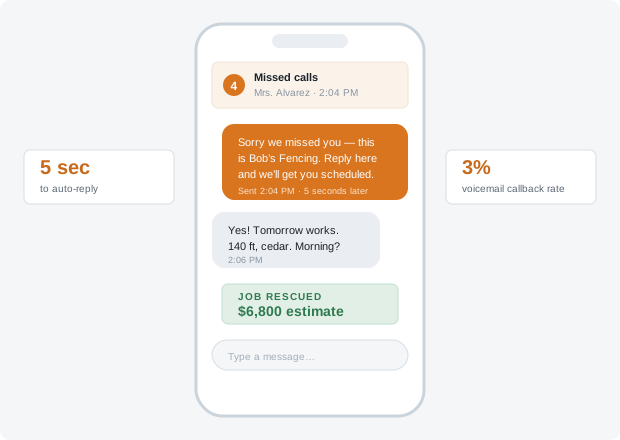
A missed call in cleaning is not a $200 mistake
Everyone in this trade prices the loss wrong. You did not lose one $185 visit. You lost the client, and the client was worth roughly $5,000 over the next twelve months — more if she stays two years, more again when she refers her sister.
| What a missed cleaning call is worth | Typical figure |
|---|---|
| One biweekly visit | ~$200 |
| That client’s first year | ~$5,200 |
| Voicemail callback rate | ~3% |
| Calls you miss while inside a house with the vacuum on | Most of them |
| One recovered recurring client pays for | 2+ years of the bundle |
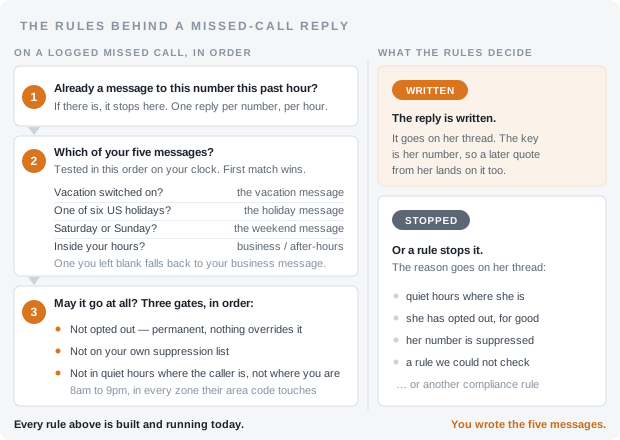
This is the trade where you literally cannot answer the phone. You are inside somebody’s house, gloves on, vacuum running. CallMitt™ is where the reply from your own texting number, a local number in your area code registered to your business, gets written once, with separate versions for business hours, after hours and the week you are away, and quiet hours and opt-outs enforced before anything is queued. Straight about the timing: there is no SMS gateway on our side yet, so today you log the missed call and nothing is sent: a message queued now is retired rather than delivered when your carrier registration clears. When she does reply, it lands in the same thread as everything else she has sent you.
The four moments that make or break a cleaning business
The 11pm search
She is not calling. She is comparing three websites on her phone after the kids are down. The one that gives her a number without a phone call is the one she books.
The unanswerable hour
Between 9am and 4pm you are in houses. That is also when people call cleaners. A text-back is not a nice-to-have in this trade, it is the only way to be reachable.
The cancellation spiral
A client who skips two visits usually never comes back. The shared reply thread catches the “can we move to next week” before it becomes a “we are all set, thanks” — snooze it, assign it, mark it won, and nothing sits unanswered because everyone assumed somebody else had it. Automated reminders are on the roadmap.
The turnover treadmill
Cleaning has the ugliest staff turnover in home services. If hiring is a project you start when someone quits, you are always one no-show from losing a route.
Hiring cleaners is a permanent job, so make it a cheap one
You are not hiring once. You are hiring continuously, because routes grow and people leave, and the gap between a full team and a short team is a route you have to cancel on a client who took a year to earn.
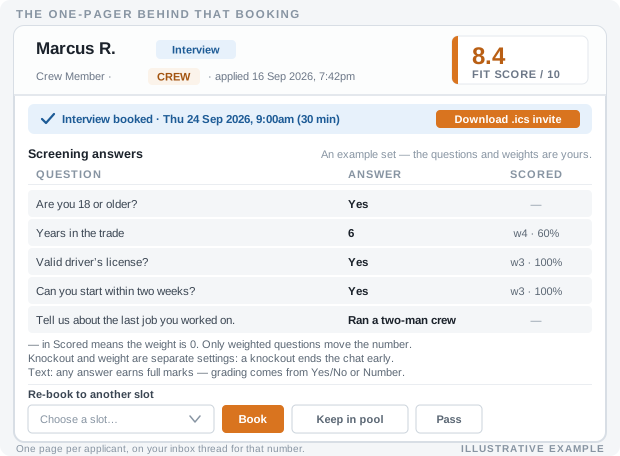
CrewFunnel™ turns applying into five questions instead of a resume. “Text CREW to your texting number” on your car magnet, your flyer, your Facebook post. Applicants answer reliable transportation, weekday availability, experience, background-check consent and earliest start — and you only look at the ones who finished.
How that runs today: no SMS gateway is live on our side yet, so an applicant answers on your screening page rather than over text. Same five questions, same knockout rules, same weighted score, same pool. The keyword takes over when your carrier registration clears.
See how CrewFunnel works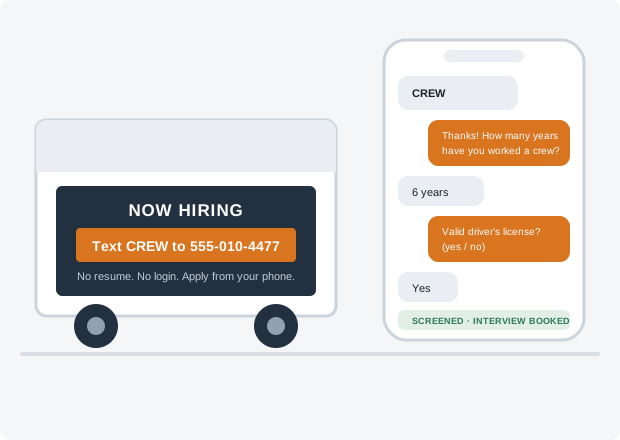
The review is earned on the first clean, not the twentieth
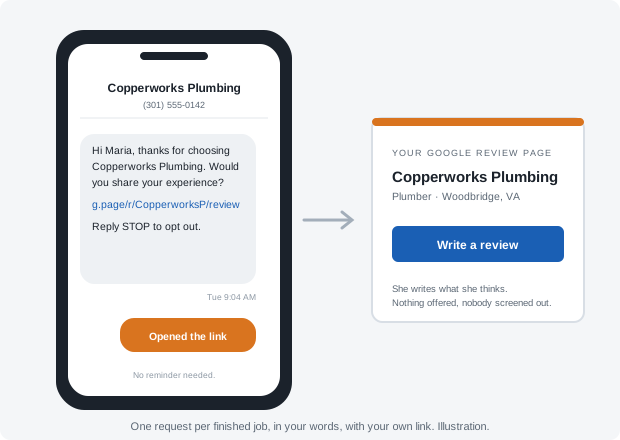
Cleaning is the trade where the job is never finished, so nobody is sure when to ask. The answer is the first visit. She comes home to a house that has not looked like this since she moved in, and that evening is the one she would write about. By the twentieth visit a clean house is just what Tuesday looks like, and nobody writes a review about Tuesday. The outfit with sixty reviews is not sixty times better than you; somebody there asks every customer, after the first clean.
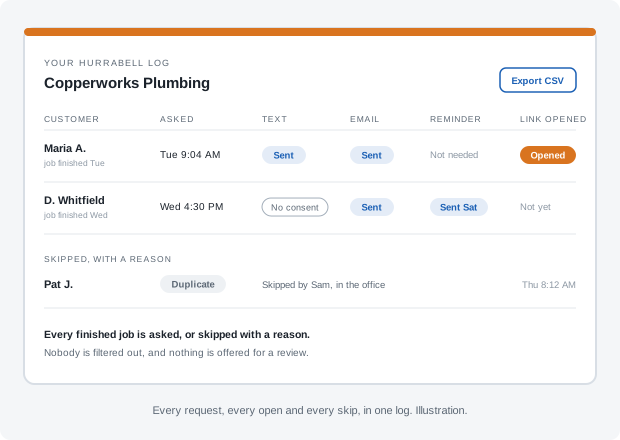
HurraBell™ does the asking. Mark the job done — from the inbox, from your phone, or from your job software through Zapier — and the customer gets one request in your words, with your own Google review link, after a delay you pick: an hour, unless you change it. Three days later, one email reminder, unless the link has been opened or the customer has got back in touch.
Review requests aren’t switched on yet, so none is sent today. When they are, the request goes by email once your Google review link is saved on the HurraBell page and your mailing address on the Account page. A text goes as well where the customer agreed to texts, and only once your carrier registration clears, the same wait as every text on this site; until then it is email only.
See how HurraBell worksOne recurring client covers 26 months
The Tailgate Office Bundle
Instant quotes on your website, missed-call text-back, text-to-apply hiring, review requests, and customers, jobs, estimates and invoices in one place. 30 days free, no credit card, no setup fee, cancel from the dashboard.
Start Free TrialOnly need one of the tools? After the trial you can keep just that one at its own price; the office stays with the Bundle.
Cleaning company questions
Yes, with one honest caveat: the result screen shows a dollar range, not an hours range. So set your hourly rate as a per-unit amount off beds and baths — the dollars come out right — and put the hours in the disclaimer line underneath: “typically 3 to 4 hours for a house this size.” She reads both, which is what you wanted. Homeowners understand “3–4 hours, $185–$215” perfectly well.
That is what the deep-clean path and the range are for. The widget says the first visit is quoted after a walkthrough, and you can add a photo question on the one-time deep clean flow. You are never bound to a number you gave sight unseen.
It mostly does the opposite. The people who wanted $80 a house find that out on their own and never call. What is left in your inbox is people who already saw $200 and kept going.
Yes, by ZIP. Group your ZIP codes into travel zones — whole ZIPs or prefixes like 208 — and mark the far one “outside my area.” Anything matching it gets a polite decline instead of a price, and you still capture the lead in full in case you expand or want to refer it out. Zones that do quote can add a flat trip charge, a percentage, or both. There is no radius and no map: you type the list, which is why there is no geocoding bill buried in your price.
A reply to someone who just called you is existing-inquiry consent, not marketing — that is the only kind of message CallMitt composes. Carrier A2P 10DLC registration is filed for your business before any of it is delivered, and until it clears nothing goes out — a message queued in the meantime is retired rather than delivered late. We would rather say that plainly here than let you find it out in week two. Quiet hours, opt-outs and your suppression list are checked before a message is even queued. Details on our compliance page.
Podium runs $399–999/mo on an annual contract and sells you a whole platform. We do four things for $199/mo with no contract. If you want review monitoring and replies, payments and a full inbox, Podium is genuinely better. If you want your missed calls answered, we are $200 a month under their entry price and $800 under the top of their range.
Also run a lawn or window crew? See all the trade pages or call (301) 268-1943.
Stop losing five-thousand-dollar clients to voicemail.
Free for 30 days, no credit card, no setup fee, cancel from the dashboard.