
A route is priced off the water, and the water is knowable from the kitchen table
Gallons, what you want doing on each visit, how often you come, what sanitizes it, whether there is a spa on the same pad, and what is hanging over the surface. Six answers, all of which a homeowner can give without anybody driving out there, and between them they carry the whole monthly price. That is why this trade quotes honestly off a form — and why the woman with the green water gets a real bracket at nine at night instead of a callback she has already stopped waiting for.
Every figure on this page is a month, not a visit. The engine returns dollars and has no opinion about the unit, so the words around it have to do that work: the service is called “monthly”, the disclaimer says it in its first sentence, and every band below carries “a month” beside it. A $189 weekly visit would be the easiest wrong number on the site to publish, and it is why the demo is written the way it is.
NapkinPrice™ runs that shop as four services on one account, and only one of the four ever shows a price. The weekly route quotes instantly. The closing goes on a list, because in October the question is a date and not a number. The opening is held for next spring’s book. And a noisy pump, a tired liner or a pool that has gone over gets a visit. Three different ways of saying “not a number”, and the engine has a mode for each of them — which no account in this estate had ever used until this one.
The flow also asks for a photo of the pool and the equipment pad, and the lead tells you to ask for those pictures on the callback. Attaching the image itself to the lead is on the roadmap, which is why it is not a tick in that list.
The eight things that set a pool route’s monthly number
Two flat steps, four pick-ones, a yes/no that moves a floor rather than a price, and a ZIP. Nothing on the form asks a homeowner to measure anything, and the one question people genuinely cannot answer — gallons — is the one whose help text tells her to guess and says you will correct it on the first visit. You build the set once in the dashboard and every rate in it is a field you own.
How big the pool is
Gallons in four bands rather than a number box, because a homeowner who has to type a figure will either look it up on the liner invoice or abandon the form. Nothing, $35, $70 and $115 a month on our own demo card — chemicals scale with water, so this is the base step. The help text does the teaching a number box cannot: it says where the figure usually is written down, and it says that if she has no idea she should pick the middle band and you will measure it on the first visit and correct the price. Guessing is allowed when the guess is cheap to fix.
What each visit covers
Three tiers, not a checklist: chemistry only, chemistry plus the skimmer and pump baskets, or full service with the brushing, the vacuuming and a filter check. Nothing, $45 and $95 a month on the demo. Tiers beat tick-boxes here because the work is cumulative rather than modular — nobody vacuums a pool without emptying the baskets first — and because the third tier is the one almost everybody ends up on by August, when the brushing has quietly stopped happening. A flat step, so it is added once a month however many visits are in it.
How often you come
A percentage, and the only place in the estate where the middle option carries dates in the LABEL. Once a week is the baseline at nothing; twice a week, June through August, is plus 55%; every other week is MINUS 38% and the saving is written into the option so she reads it rather than working it out. That last number is not half, deliberately: fortnightly is half the visits and nothing like half the work, because the water gets a fortnight to do as it likes between you. Set your own figure and let the label say it out loud.
How the water is sanitized
The other negative band: chlorine tabs or liquid at nothing, a saltwater generator at MINUS 8%, bromine or a mineral system at plus 10%. A salt cell makes its own chlorine, so there is less to carry and less to dose, and that pool genuinely is cheaper to run a route on. Pricing that honestly rather than pocketing it is worth more than the eight per cent: a salt-pool owner knows perfectly well she is cheaper to serve, and a quote that agrees with her is the one she believes.
A spa or a water feature
A yes/no with a flat $25 a month behind it. A spillover spa, a sheer descent or a set of bubblers is a second body of water on the same pad with its own chemistry, tested and balanced separately, and it is the same work whether the pool beside it is 12,000 gallons or 40,000 — which is exactly what a flat amount is for. Added once for the month, not once per visit, and the help text says so.
What is over the water
Open sky, trees near the fence, or the pool sits under trees — nothing, plus 8% and plus 18%. Leaves, pollen, seed pods and needles are the single biggest thing between a pool that stays clear and one that does not, and it is a percentage rather than a fee because it lands on everything: more skimming, more vacuuming, more filter, more chemistry. It is figured across the whole month rather than onto one visit, because the tree does not drop everything on a Tuesday.
A Saturday or Sunday stop
The answer that raises the monthly MINIMUM to $185 and adds no dollars at all. A route runs Monday to Friday on fixed loops; a weekend visit is a trip made for one pool, and pricing it as a percentage of a small ticket would not cover the drive. So the smallest pool on the card — under 15,000 gallons, chemistry only, weekly, chlorine, open sky — whose arithmetic is $95 and which normally floors at $110 to $119 a month, comes back at $185 to $200 the moment she says yes. A bigger pool is already above that floor and never notices it.
Travel zone
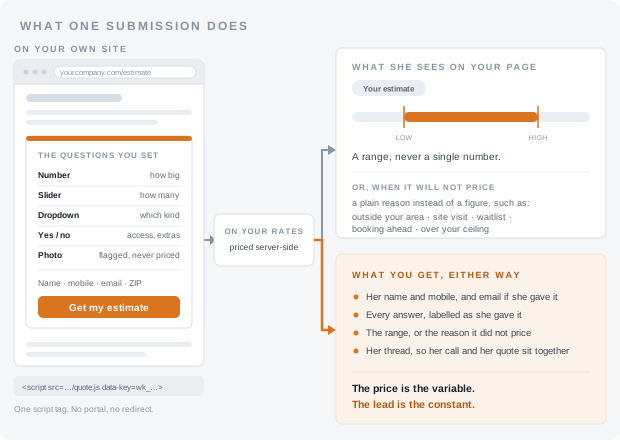
List your ZIPs by zone — whole ZIPs or three-digit prefixes — and the widget prices the trip from the ZIP she types, most specific match first. On a route business this is the question, because a pool company lives or dies on stops per mile, and the fees are MONTHLY like everything else here: nothing on the home loop, $18 across the river, $35 on the long legs, and $55 plus 6% for everywhere else you would build a route to. Keep them small and honest. Set one zone to "outside my area" and it declines politely while still capturing the lead.
A real pool, start to finish
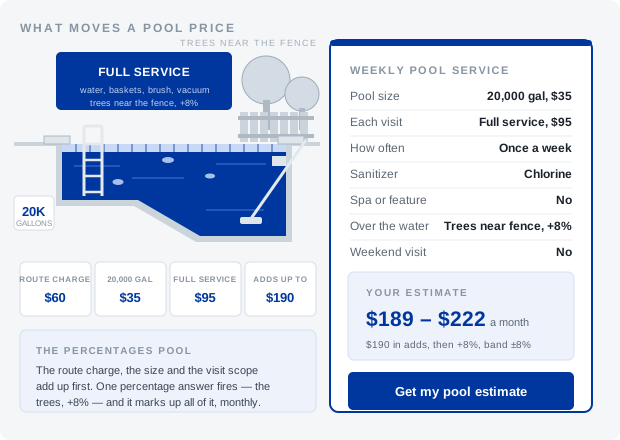
Eight questions, about a minute. This is the exact sequence running on our own pool demo account — a 20,000-gallon vinyl-liner pool in Severna Park on chlorine tabs, full service once a week, no spa, with a few trees near the fence — and the total at the bottom is what the live pricing engine returns for these eight answers and nothing else, not a figure anybody typed into this page.
| # | What she is asked | What she answers | What it does to the monthly price |
|---|---|---|---|
| 1 | How big is the pool? | 15,000 to 24,000 gallons | A flat $35 a month. Under 15,000 is nothing, over 40,000 is $115 |
| 2 | What should we do on each visit? | Full service: water, baskets, brush, vacuum, filter check | A flat $95 a month. Chemistry only is nothing, water and baskets is $45 |
| 3 | How often should we come? | Once a week, through the season | The baseline: +0%. Twice a week June–August is +55%, every other week is −38% |
| 4 | How is the water sanitized? | Chlorine, tabs or liquid | The baseline: +0%. A salt cell is −8%, bromine or minerals +10% |
| 5 | Is there a spa or water feature plumbed in? | No | Nothing. Yes adds a flat $25 a month for the second body of water |
| 6 | What is over the water? | Trees near the fence, some leaf drop | A percent on the whole month: +8%. Under trees is +18% |
| 7 | Do you need a Saturday or Sunday visit? | No | Nothing. Yes would not add a dollar either — it lifts the monthly floor to $185 |
| 8 | Got a photo of the pool and the equipment pad? | Offered | Nothing. A photo never moves the price |
| The arithmetic, in the order the engine runs it | $60 route charge + $35 for the size + $95 for full service = $190 a month, then the one percentage answer that fires — the trees, +8% — applies once to all of it → $205.20 | ||
| She sees | $189 – $222 a month | ||
| What lands in your inbox, the second she submits | Name, mobile, ZIP, all eight answers, the photo flag, and the disclaimer she was shown | ||
The $60, the $35, the $95 and the percentages above belong to the demo account, not to a Tailgate Office price list — you set every one of them in the dashboard. Three things about that arithmetic are worth reading twice. The base fee sits inside the pool, so the $60 route charge is marked up 8% along with everything else, which is right: a leafy pool is a longer stop and the drive is part of the stop. The percentages pool rather than compound, which matters most on the two negative bands — the engine adds a salt cell and an every-other-week route together and applies minus 46% once, rather than taking one discount off the other’s remainder, so the saving you advertised is the saving she gets. And the floor is a floor on the final number and not a starting point: the same 20,000-gallon pool asking for chemistry only, whose arithmetic is $102.60, comes back at $110 – $119 a month. What is not illustrative is the total: $189 to $222 a month is what the engine returns for those eight answers, and you can reproduce it yourself on the demo in about a minute.
Would you rather try it than read about it? We keep a working example pool service website with NapkinPrice™ embedded — the real engine, quoting live, on a page that is not ours. Put in those eight answers and see the same number come back, then pick the closing service and watch it refuse to quote.
Try the live demo site (opens in a new tab)A shut season is not a discount. It is a different conversation.
This is the one design decision that matters in this trade, so here is the whole of it in plain words rather than a promise that it all just works.
Every other seasonal trade on this site reaches for a percentage, and every one of them is right to. Leaf fall makes a gutter crew busier for eight weeks; the first cold weekend books every sweep in the county until Christmas. The work is still there in July, there is simply more competition for the slot, and a percentage is exactly the right shape for “same job, scarcer week”. The gutter page and the chimney page both argue that case from their own side.
A pool opening in December is not that. It is not a dearer opening or a cheaper one — there is no opening to sell, because there is no pool to open until the water comes back above sixty degrees. No percentage can express “there is nothing here to buy today, but there is a place in the spring book”. A mode can, and it is the only thing in the engine that can.
So this account uses two of them that nothing in the estate had ever used. The quote engine has known four service modes for as long as it has existed — instant, site visit, waitlist and winter — the service editor has always offered all four, and across the twenty-two accounts and fifty-nine services that came before this one, every single service was instant or site visit. A routing mode is checked before the ceiling and before the price is assembled, so it never produces a figure at all: it captures the lead and returns one fixed sentence. Below is which service carries which, and why.
Weekly pool service — quotes instantly
The route, the money and the only service on the account that shows a number. Monthly, always: the service name says so, the disclaimer says so in its first sentence, and every band it returns is a month of visits with the chemicals in it. The route charge — $60 a month on the demo — lives in the base fee, so it is added once and cannot be dodged by answering "nothing else" to everything. The pool this route runs more than any other, 20,000 gallons on chlorine with full weekly service and a few trees near the fence, is $189 to $222 a month. Swap the chlorine for a salt cell and it is $175 to $205; move it to every other week and it is $122 to $144; put it under the trees instead of beside them and it is $206 to $242; add a spillover spa and it is $214 to $251; take it to twice a week through high summer and it is $285 to $334. A 25,000 to 40,000 gallon pool under trees on full weekly service is $244 to $287. And there is a ceiling: a 40,000-gallon pool, twice a week, on bromine, with a spa and under trees reaches a $539.85 midpoint against a $450 ceiling, so the widget stops pricing and hands you the lead to quote by hand — which is correct, because at that size it is a contract and not a route slot.
Pool closing and winterizing — booked from a list, never priced
Waitlist mode, and the first one in the estate. There are about five usable weeks between the last swim and the first hard freeze in this county; three trucks get through perhaps twenty pools a day inside them; and the book for those weeks is full by the end of September. A homeowner ringing on 1 October is not asking what it costs. She is asking whether anyone will reach her before the water freezes in the skimmer and splits it — and that is a date, not a number. So the service asks the six things that decide how long you are there and which truck comes, carries no pricing rule on any of them, and returns the engine's own sentence: "We've added you to the list — we'll be in touch with timing and pricing." Which is, word for word, what a pool company says on the phone in October. Printing a price with no date attached to it would have been the dishonest option, and this page never prints one.
Pool opening, booked for next season — held for the spring book
Winter mode, and the other first. From the day the cover goes on until the first warm week of April there is nothing to sell, and the visitor is told exactly that: "We're booking this for the season ahead — leave your details and we'll reach out when it's time." The lead is captured in full. That is the entire point, because the spring book is the book a pool company actually fills over the winter, and a December caller genuinely is ahead of a May one. The questions are shaped for the call in March rather than for a price: what is on it over the winter, whether you closed it yourself last autumn, when she wants to be swimming, and — the one that earns its place — anything she already knows needs fixing, because a part ordered in December is in stock and a part ordered in May costs three weeks.
Equipment, liner and green-pool recovery — site visit, never priced
Site-visit mode, the routed service every account in the estate carries, and here it covers the three things a form genuinely cannot answer. A pump, a filter or a heater is diagnosed at the pad, not from a description. A liner or a plaster surface is priced off the water and a tape measure. And a green pool is not a visit at all — it is a programme, with the filter running around the clock for days and a number of return trips the water decides rather than the homeowner. The service asks what is going on, how old the pad is, whether it is losing water, how long since it was built or resurfaced and whether anyone can swim in it right now, and not one of those answers moves money. She gets your own "we will come and look" message; you get a lead worth bidding.
Nothing flips a mode by date, and we would rather say so than let you find out in April
A mode is a column on the service. A season is a percentage, and the engine reads it after it has already checked the mode — so no seasonal row anywhere can turn a routing service into a pricing one. That is a real gap and it has this trade’s name on it in our own roadmap. What it costs the owner of a pool account is two edits, twice a year: in April you open the service editor, flip the opening to instant and the closing to winter, and in September you flip them back. Thirty seconds each. It is worth closing and it is on the list, but it is a small gap, and a demo that hid it behind an invented percentage would be lying about the product.
Which is why this account carries no seasonal rate at all — not one row, and that is a decision rather than an empty field. The seasonality of this trade is a shut season, and a shut season belongs in the mode column. The one place a date does land inside a service that prices is an option label: “Twice a week, June through August”, spelled out on the dropdown because a season is a percentage on the whole service and cannot reach a single answer. Saying the months out loud on the option is the honest version of that limit, and it costs nothing. A pleasant side effect is that every figure on this page is the plain case: run any of them on any day of the year and the same number comes back.
The travel zones stack on top of all of it, and they are the same engine run on the same eight answers with nothing changed but the ZIP: Severna Park 21146 on the home loop is $189 to $222 a month, Annapolis 21401 across the Severn is $205 to $241, Catonsville 21228 on the long legs is $221 to $259, a ZIP in the catch-all ring is $251 to $294, and a ZIP outside every zone you serve gets no price at all — a polite decline, with the lead still captured. A service that quotes will not go live until it carries a real base fee or a real minimum. That is deliberate: a service with neither would happily return $0 to a homeowner, and one bad number on your website costs more than a day of setup. The three routing services need neither, because they never quote.
You are on pool eleven of fifteen and it is ninety-four degrees
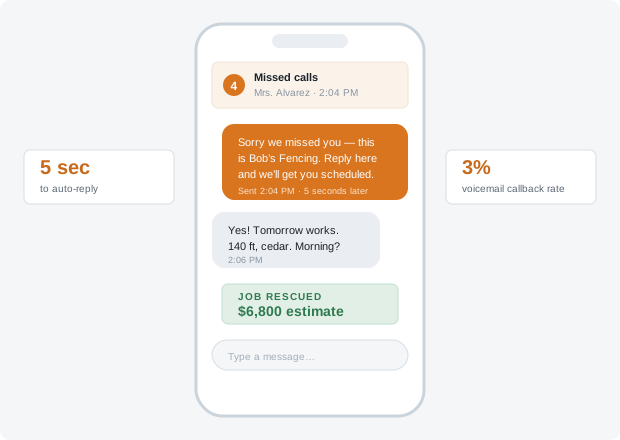
There is nowhere in this trade where answering a phone is a judgment call: you are kneeling on a hot deck with a pole in one hand and a test kit open on the coping. Roughly 62% of contractor calls go unanswered, about 78% of jobs go to whoever responds first, and voicemail gets a callback around 3% of the time. The difference in this trade is what a recovered call is worth: it is not a job that pays once, it is a stop on a route that bills again in thirty days, and again after that, until the cover goes on.
| What a missed pool call is worth | On the demo account |
|---|---|
| 20,000 gal, full service weekly, chlorine, trees near the fence | $189 – $222 a month |
| A 25,000 to 40,000 gal pool sitting under trees | $244 – $287 a month |
| The same 20,000 gal pool, twice a week through high summer | $285 – $334 a month |
| The smallest pool on the card, chemistry only | $110 – $119 a month |
| Voicemail callback rate | ~3% |
| One recovered twice-a-week account pays for | 1 month of the bundle — and then does it again next month |
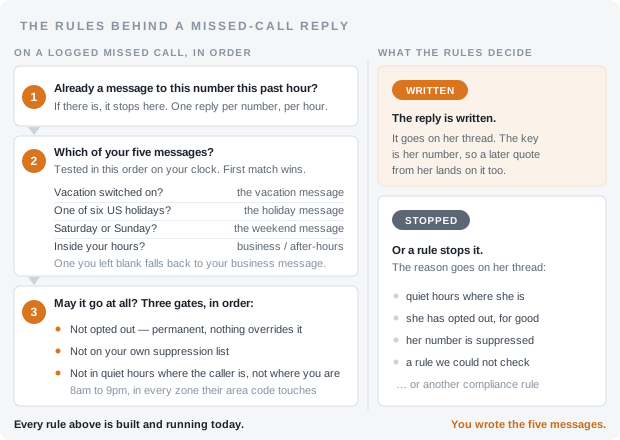
CallMitt™ writes back from your own texting number, a local number registered to your business and not a stranger’s 800 line, and the text opens with your business name, so she replies into the same thread as her quote. The message is picked by the hour and the day, against the hours you actually keep — the demo shop runs 7 to 5, because the only way to get fifteen pools done in July is to start before the heat, and by five the truck is rinsed and the drums are back in the yard. A 5:20 call honestly gets the after-hours version instead of one claiming somebody is standing beside a pool. And every message asks about the water rather than about “your enquiry”, because the reply worth having from a pool customer is a colour and a smell.
Straight about where this stands. We have no SMS gateway yet and there is no automatic missed-call detection, so today you log the missed call and nothing is sent: a reply queued now is retired rather than delivered when your carrier registration clears. Everything around it is built and running now: the five messages, the business-hours, weekend, holiday and vacation rules, the quiet hours, the opt-out handling, and the thread her reply lands in beside her quote.
How CallMitt Works Run Your Own NumbersA pool tech is hired on one question, and it is about the chemicals
This job is liquid chlorine and muriatic acid out of the back of a truck, every day, in July, alone. The two of them together make chlorine gas, and that is how this trade hurts people. Somebody who finds out on day two that he is not up for it costs you the day, the fifteen pools behind it, and possibly a great deal more. Plenty of people will say they are fine with it in an interview in March.
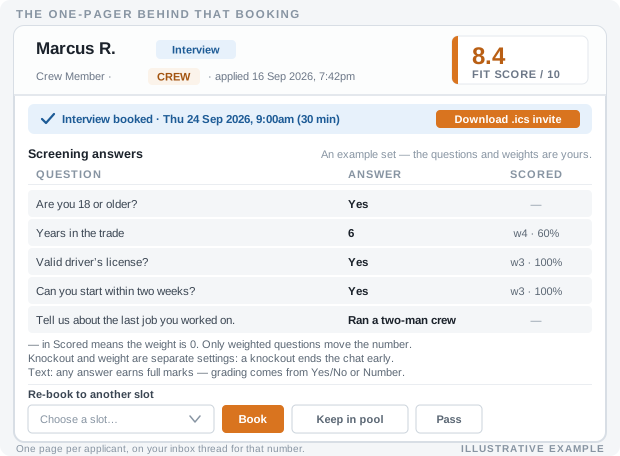
Put “Now hiring — text CREW to your texting number” on the truck and the yard sign. CrewFunnel™ asks seven short questions: is he 18 or older, is he up for handling liquid chlorine and muriatic acid every day on his own, has he ever run a pool route unsupervised, how many years has he done pool work, how far out does he live, can he start inside two weeks, and what was the last job he worked on. Three of those are knockouts — under 18, not up for the chemicals, or living further out than you will drive — and three come back as a weighted fit score, years in the trade heaviest and the start date next.
The one worth copying is the route question. A résumé never makes it clear whether somebody has actually been alone with fifteen pools and a schedule, and that is the whole difference between a technician and a helper: a tech on his own all day is making judgment calls about water nobody is checking behind him. Distance is a knockout and never a weight, because a number answer scores higher the bigger it is and weighting miles would rank the man furthest away at the top. And free text carries no weight at all, because any non-empty answer scores full marks. Both are set that way on our own demo job, and every question on it carries a Spanish translation — which in this trade is not a nicety.
One honest note on delivery. There is no inbound SMS on our side yet, so today he answers those seven questions on your screening page rather than by text — same questions, same knockouts, same scoring, same pool. The keyword on the truck takes over the day your carrier registration clears.
See how CrewFunnel works
A pool gets its review on the first swim, not on the invoice
The cover is off, the water has gone from green to clear, and on the first hot Saturday the kids are in it before she has finished her coffee. That is the day she would write you a review. By July a clear pool is just what the pool looks like, and the tech who got it there is a truck out front once a week. The outfit with sixty reviews is not sixty times better than you; somebody there asks every customer, the week of the first swim.
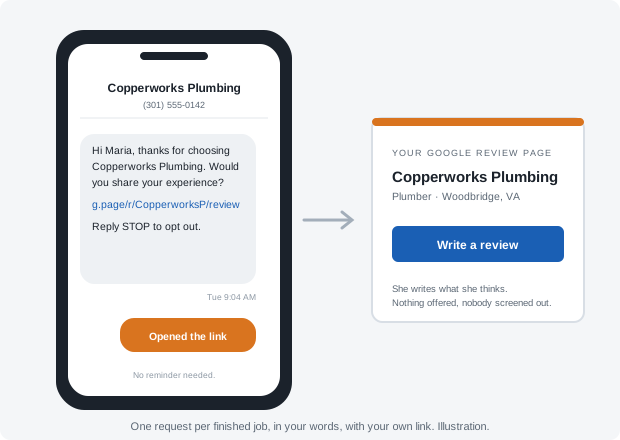
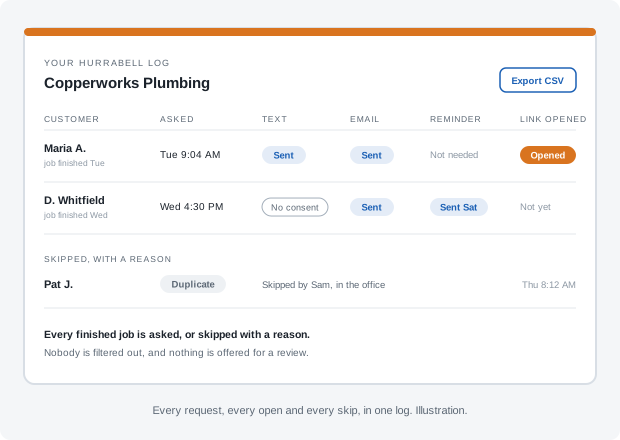
HurraBell™ does the asking. Mark the job done — from the inbox, from your phone, or from your job software through Zapier — and the customer gets one request in your words, with your own Google review link, after a delay you pick: an hour, unless you change it. Three days later, one email reminder, unless the link has been opened or the customer has got back in touch.
Review requests aren’t switched on yet, so none is sent today. When they are, the request goes by email once your Google review link is saved on the HurraBell page and your mailing address on the Account page. A text goes as well where the customer agreed to texts, and only once your carrier registration clears, the same wait as every text on this site; until then it is email only.
See how HurraBell worksOne pool kept on the route, and the front office pays for itself every month
The bundle is $199 a month. A single recovered weekly account on the demo card is $189 to $222 a month, for as long as it stays on the truck. In a trade of recurring tickets, that is the arithmetic that matters.
The Tailgate Office Bundle
Instant quotes on your website, missed-call text-back, text-to-apply hiring, review requests, and customers, jobs, estimates and invoices in one place. 30 days free, no credit card, no setup fee, cancel from the dashboard.
Start Free TrialOnly need one of the tools? After the trial you can keep just that one at its own price; the office stays with the Bundle.
Pool questions we get asked
A month, and it is the question this page works hardest to answer because it is the easiest thing in the estate to get wrong. The pricing engine returns dollars and has no opinion about the unit — whether a figure is per visit, per month or per season is decided entirely by the words around it. So on our demo account the service is named "Weekly pool service (monthly)", the disclaimer opens by saying every figure is a monthly price covering a full month of visits with the chemicals in it, the travel zones are monthly figures too, and every band on this page carries "a month" beside it. If you build a pool card of your own, spend the extra minute on those words. $189 a visit is four times the price you meant to publish, and nobody reading it will stop to ask.
You can price a range, which is all the widget ever shows. On this trade the range is tighter than most — plus or minus 8% rather than the 10 or 15 a repair trade needs — because a recurring route is a known quantity: the same pool, the same day, the same loop, fifty-two times. The six things that set the number are all things a homeowner can answer at her kitchen table, and the only one she genuinely may not know is gallons, which is why the help text tells her to pick the middle band and says you will measure it on the first visit and correct the price. The disclaimer says the rest in your words: an estimate for planning, confirmed on the first visit when you have seen the filter, the pump and how the water actually behaves.
Because in October the question is not what it costs. There are about five usable weeks between the last swim and the first hard freeze in this county, three trucks get through perhaps twenty pools a day inside them, and the book for those weeks is full by the end of September. What she wants to know is whether anyone will reach her before the water freezes in the skimmer and splits it — and that is a date. So the closing runs in waitlist mode: it asks the six things that decide how long you are there and which truck comes, it carries no pricing rule on any of them, and it returns "We've added you to the list — we'll be in touch with timing and pricing." Then you come back with the date and the price together, usually inside two business days. A number with no date attached to it would have been the easy option and the wrong one, and this page never prints one for a closing.
Because the spring book is the book a pool company fills over the winter, and the lead is worth having months before the job is. Winter mode captures the whole enquiry and tells the truth on the confirmation screen: "We're booking this for the season ahead — leave your details and we'll reach out when it's time." A December caller genuinely is ahead of a May one, and the questions are shaped for the call you will make in March rather than for a price — what is on it over the winter, whether you closed it yourself, when she wants to be swimming, and anything she already knows needs fixing. That last one is the one that pays: a pump ordered in December is in stock and a pump ordered in May costs three weeks.
It is the trade that needs seasonal BEHAVIOUR, which is a different thing, and the distinction is worth the paragraph. A seasonal rate is a percentage — the right shape for work that is still there all year but scarcer in a given month, which is what a gutter clean in October or a sweep in November actually is. A pool opening in December is not scarcer, it does not exist. A percentage cannot say that and a mode can, so the seasonality of this account lives in the mode column and the seasonal table is empty on purpose. The honest consequence, which we would rather print than hide: nothing flips a mode by date. The owner opens the service editor twice a year and swaps the opening and the closing over, in April and in September. Two edits, thirty seconds each. It is a gap in the engine, it has this trade's name on it in our roadmap, and a fixture that papered over it with an invented percentage would have been the only dishonest number in the file.
They route, and that is the same discipline every trade page here keeps for the job its engine cannot carry. A pump, a filter or a heater is diagnosed at the pad rather than guessed at from a description. A liner or a plaster surface is priced off the water and a tape measure. And a green pool is not a visit at all — it is a programme, with the filter running around the clock for days and a number of return trips the water decides rather than the homeowner — so telling her what it will take before you start it is worth far more than a number that turns out to be wrong twice. The service still asks five things and not one of them moves money: what is going on, how old the pad is, whether it is losing water, how long since it was built or resurfaced, and whether anyone can swim in it today. That last one decides which day you go, which is the only scheduling that matters in July.
Call it fifteen minutes for your text-back messages and your working hours, a minute, once review requests are switched on for your account, to paste your Google review link on the HurraBell page and your mailing address on the Account page, and about an hour for the weekly service — seven questions and one rate card: your route charge, your gallon steps, your visit tiers, your frequency and sanitizer percentages, your spa amount, your tree bands and your weekend floor. The other three services are quicker than that put together, because none of them carries a rate at all: you write the questions, set the mode, and the engine handles the rest. A service that quotes will not go live until it has a real base fee or minimum, which is deliberate; a routing service needs neither. No onboarding call, no setup fee and no contract: $199 a month buys all four tools.
Run a lawn route off the same truck? See the landscaping page, all the trade pages, or call (301) 268-1943.
Give her the monthly number before she calls the next one.
Set it up tonight. Free for 30 days, no card, no setup fee, cancel from the dashboard.