Written for the person holding the nail gun

We build software for home-service contractors. Each article here answers one practical question about the business side of a trade. Every article published since 20 October 2026 is written from named public sources (government agencies, the laws and codes themselves, published studies, cost guides and companies’ own price pages), listed at its foot, and its facts are checked against those sources. Every number we cite either names where it comes from (the publisher, the year and a link) or says plainly that it is our own example or assumption. Competitor prices also say the month we checked them (“checked October 2026”), link to the competitor’s own price page, and are re-checked every three months; a price we cannot re-check comes off. Nothing here requires you to buy anything.

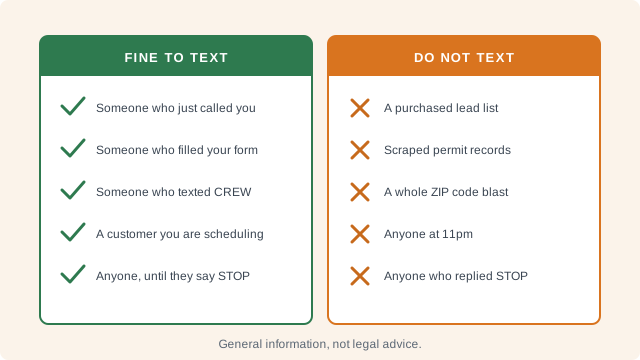
A two-column checklist of contractor texts that are fine to send and texts that are not
Compliance

Contractor Registration in Washington: L&I, the Bond and Insurance

Washington requires nearly every contractor to register with Labor & Industries, carry a $30,000 or $15,000 bond and liability insurance. General or specialty, how to apply, the separate electrical and plumbing licenses, the customer notice, and what working unregistered costs.

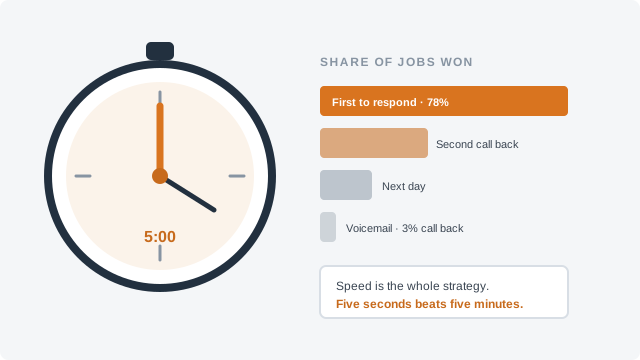
A stopwatch stopped at five minutes beside three things that can happen to a call: you answer, it goes to voicemail, or nobody picks up and the caller rings the next name
Lead Response

The Auto-Reply That Goes Out Seconds After a Form

An automatic email the moment a homeowner sends your form tells them it arrived, what happens next and by when. What to put in it, what to leave out so it stays a reply and not an ad, and how to set it up so it lands in the inbox instead of spam.

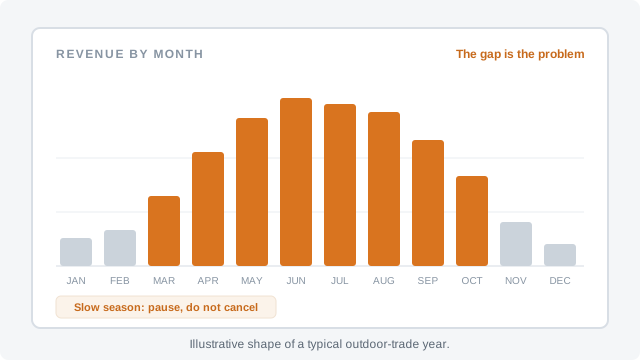
A twelve-month bar chart of contractor revenue with a tall summer peak and a deep winter trough
Business

Cash or Accrual Books for a Contractor

Your accountant's question is about timing: in which year a job's money counts as income and a supplier's bill as an expense. What each method counts, the gross receipts test that lets most small trade businesses choose, the construction contract rule, and how to change later.

A two-column checklist of contractor texts that are fine to send and texts that are not
Compliance

Contractor Licensing in Virginia: Class A, B and C

Virginia licenses the business, by job size and yearly volume: Class C, B or A, each with a classification or specialty. The dollar limits since July 2025, what each class requires, the tradesman licenses, the residential contract rules and the Recovery Fund.

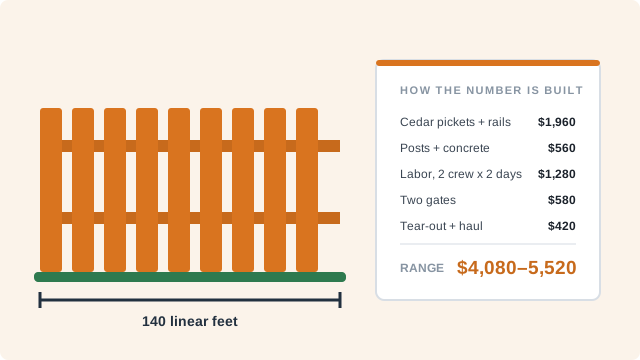
A 140-foot cedar fence line beside a price breakdown of material, posts, labor, gates and tear-out
Pricing

Marking Up Subcontractor Work

Your sub's price is your cost, not your price. What the sub's invoice leaves out (coordination, callbacks, risk), a worked way to set the markup, when to show it on the estimate, and the paperwork to collect from every sub.

A work truck with a Now Hiring, text CREW decal on the door beside an applicant screening conversation by text message
Hiring

When a Worker Gets Hurt: The First 24 Hours

Care first, then the reports: OSHA's 8- and 24-hour deadlines, your comp carrier's deadline in your state, notes while the facts are fresh, no retaliation for reporting, and light duty that fits the doctor's restrictions.

An example contractor website analytics view showing 214 visitors and only 3 form submissions, with a flat line of leads under tall bars of traffic
Websites

One Page per Service: Pages That Answer the Job

Which of your services deserve their own page, the four answers every service page owes the homeowner (what is included, a price range, how long, what you need from her), and how to link the pages so people and Google can find them.

A stopwatch stopped at five minutes beside three things that can happen to a call: you answer, it goes to voicemail, or nobody picks up and the caller rings the next name
Lead Response

Answering "Are You Licensed and Insured?" With Proof

Homeowners are told to check your license and ask for a current certificate of insurance. Answer before they have to: one message with your license number and where to look it up, a certificate naming them, and a straight answer on workers' comp.

A two-column checklist of contractor texts that are fine to send and texts that are not
Compliance

New Jersey's Home Improvement Contractor Registration

New Jersey's rules for working on homes: yearly registration with the Division of Consumer Affairs, the $500,000 liability policy, workers' comp and the compliance bond, the contract and its three-day cancel notice, and the licensing law waiting on its board's rules.

A twelve-month bar chart of contractor revenue with a tall summer peak and a deep winter trough
Business

Starting a Trade Business: The First-Year Tax Rules

Going out on your own: the start-up cost deduction under Section 195, when an EIN is required and why many owners get one anyway, the first year's estimated payments, the choices your first return locks in, and the records to keep from day one.

A 140-foot cedar fence line beside a price breakdown of material, posts, labor, gates and tear-out
Pricing

Break-Even: How Much Work Before You Make a Dollar

The SBA's break-even formula in a contractor's terms: monthly fixed costs divided by gross margin, turned into a weekly sales figure and a job count, and what a price rise, a discount or a new truck does to the number.

A two-column checklist of contractor texts that are fine to send and texts that are not
Compliance

Pennsylvania's Home Improvement Contractor Registration

Pennsylvania's home improvement law in plain words: who registers with the Attorney General, the $100 fee and the insurance minimums, what every contract must say, the one-third deposit cap and the three-day cancel right, and Philadelphia's own rules.

Field Notes by email

The first email goes out on Monday, February 1, 2027, then one a week with the week's Field Notes. Unsubscribe in one click. We never sell or share your address.

We email you a link to confirm first. What we keep, and for how long.

What we write about

Six subjects, because those are the six places we watch contractors lose money.

What you will find here

  • Real arithmetic you can check, with the assumptions labelled
  • Advice that works whether or not you ever buy from us
  • Competitor pricing quoted from public pages, with the date on it
  • Short posts. Most run five to eight minutes, written to be read at lunch

What you will not

  • Invented customer quotes or made-up success metrics
  • “10 Growth Hacks” posts written to catch a search phrase
  • Statistics with no source and a suspiciously round number
  • A pop-up asking for your email before you have read a sentence

Got a question we should answer?

If something on the business side of your trade is costing you money and nobody has written it down clearly, send it over. We would rather write the post you actually need than guess at a topic. No email capture required — just ask.

Reading about it is step one.

Step two takes about thirty minutes: instant quotes on your site, and every missed call logged and answered from one inbox. Free for 30 days, no card.