

Drywall is two businesses that share a truck
A basement, an addition or a garage is square feet of board times a rate, with the finish level, the ceiling height and the texture moving it. A doorknob hole is nothing like that. It is a trip, a patch, three coats of mud on three different days and a texture match, and it is priced by the hole, not by the square foot. A single rate card gets one of them wrong every time.
So this page prices them the way you already think about them: whole rooms by the square foot, and patches by the hole with the trip inside the number. And it keeps two jobs off the form entirely: a popcorn ceiling, which in an older house is tested for asbestos before anyone scrapes it, and water damage, which is only worth fixing once the leak is.
The flow also asks for a photo of the space, and the lead tells you to ask for those pictures on the callback. Attaching the image itself to the lead is on the roadmap, which is why it is not a tick in that list.
The eight things that set a drywall number
Two areas, four pick-ones, a yes or no and a ZIP. You build the set once in the dashboard and every rate in it is a field you own — you can change a per-square-foot rate the week board goes up without touching your website.
Wall board
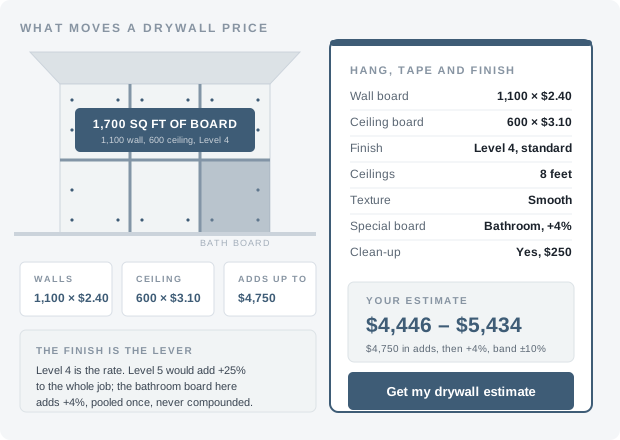
The length of the walls times the ceiling height, added up, with no deduction for doors and windows because the cutting is in the rate. Tell them that in the help text and the numbers they type come out close. On the demo, $2.40 a square foot, board, mud, tape and bead included.
Ceiling board
Length times width, room by room, at its own higher rate, because every sheet goes up overhead on a lift or on two people's heads. On the demo, $3.10 a square foot.
The finish level
Level 4 ready for paint at the rate, Level 3 for a garage or under a texture at minus 12%, Level 5 with a skim coat over everything at plus 25%. A percentage on the whole job, because the finish is the hours. Say what each level is in her words, or every customer asks for Level 5 at a Level 4 price.
Ceiling height
Eight feet at the rate, nine or ten feet +8%, vaulted or a stairwell over twelve feet +20%. Scaffold, a lift and a lot more cutting, spread across every sheet in the room.
Texture
Smooth at the rate, orange peel +6%, knockdown +10% on the demo. Matching a texture on a patch is a bigger percentage on the repair service, because there the match is most of the work.
Special board
Standard board throughout, some moisture-resistant board in a bathroom or a laundry +4%, or fire-rated board on a garage wall the house shares +6%. A small percentage, but a question that tells you the house before you see it.
Clean-up and haul-away
A yes or no with a flat amount behind it: $250 on the demo for the offcuts, the empty mud boxes and a swept floor, added once for the job.
Travel zone
List your ZIPs by zone, whole ZIPs or three-digit prefixes, and the widget prices the trip from the ZIP she types, most specific match first, as a flat charge, a percentage, or both. Our demo crew charges nothing in its home county and $75 out to the ring beyond it, so the same basement comes back $4,446 to $5,434 at home and $4,514 to $5,517 in Fairfax. Set one zone to "outside my area" and it declines politely while still capturing the lead.
A real basement finish, start to finish
Eight questions, about a minute. This is the exact sequence running on the whole-room service of our own drywall demo account, answered for a basement with a small bathroom in a Manassas house — and the total at the bottom is what the live engine returns for these answers, not a figure anybody typed into this page.
| # | What she is asked | What she answers | What it does to the price |
|---|---|---|---|
| 1 | How many square feet of wall board? | 1,100 | 1,100 × $2.40 = $2,640. This is THE base number |
| 2 | How many square feet of ceiling board? | 600 | 600 × $3.10 = $1,860 |
| 3 | What finish do you need? | Level 4, ready for paint (standard) | Nothing. Level 3 −12%, Level 5 +25% |
| 4 | How high are the ceilings? | 8 feet | Nothing. 9 or 10 feet +8%, vaulted or a stairwell +20% |
| 5 | What texture? | Smooth | Nothing. Orange peel +6%, knockdown +10% |
| 6 | Any moisture-resistant or fire-rated board? | Some, in a bathroom or laundry | +4% on the whole job. Fire-rated in a garage +6% |
| 7 | Should we haul away the scraps and clean up? | Yes | A flat $250 for the job |
| 8 | Got a photo of the space? | Offered | Nothing. A photo never moves the price |
| The arithmetic, in the order the engine runs it | $2,640 + $1,860 + $250 = $4,750, then the one percentage answer, the bathroom board at +4%, applies once to all of it: → $4,940 | ||
| She sees | $4,446 – $5,434 | ||
| What lands in your inbox, the second she submits | Name, mobile, ZIP, all eight answers, and the photo flag | ||
Every rate in that table belongs to the demo account, not to a Tailgate Office price list — you set all of them yourself, and you can change one without touching your website. What is not illustrative is the total: $4,446 to $5,434 is what the engine returns for those eight answers, for board hung, taped, finished and sanded ready for primer.
Would you rather try it than read about it? We keep a working example drywall company website with NapkinPrice™ embedded — the real engine, quoting live, on a page that is not ours. Put in those eight answers and see the same number come back.
Try the live demo site (opens in a new tab)Rooms by the square foot, patches by the hole, and the popcorn ceiling on a visit
This is the one design decision that matters in drywall, so here is the whole of it in plain words rather than a promise that it all just works.
A patch is mostly a trip. The board and the mud for a fist-sized hole cost almost nothing; the drive out, and back for the second coat, and back again to sand and match the texture, is the job. Priced by the square foot it comes out at a few dollars, which is a number nobody can do it for. So our demo runs it as its own instant service with the trip as the base fee: $195, added once, before anything else, and inside the number she sees rather than added at the door. Each spot is $85, the biggest hole adds a flat amount for its size, a water-stained ceiling adds $150, and matching orange peel or knockdown is +15% or +20%, because on a patch the match is half the work. Three spots, the biggest up to two feet across, on an orange-peel wall: $557 – $754.
Two jobs stay off the form. A popcorn ceiling in a house built before the 1980s may contain asbestos, and the honest answer is a test before anybody scrapes it, not a price. Water damage depends on what is wet behind the board and whether the leak is fixed. Both run as a site visit that shows no number at all, and the visit is where you find out which job it really is.
Hang, tape and finish — quotes instantly
$2.40 a square foot of wall and $3.10 of ceiling on the demo, board, mud, tape and bead included, with the finish level, the ceiling height, the texture and any special board moving the job. A $1,100 minimum is the floor under the final number, and past $30,000 it stops pricing and hands you the lead.
Patches and repairs — quotes instantly
A $195 trip charge as the base fee, $85 a spot, a flat amount for the size of the biggest hole and $150 for a water-stained ceiling, with the texture match as a percentage. A $295 minimum and a $3,000 ceiling, and a 15% band, because a patch is three visits whose timing depends on the mud drying.
Popcorn ceilings and water damage — site visit, never priced
Site-visit mode captures the request and shows no number at all. It asks what it is and whether the house was built before 1980, because a textured ceiling in an older house is tested for asbestos before anyone touches it. She gets a plain "we like to see it first" note; you get a lead worth bidding.
A service that quotes will not go live until it carries a real base fee or a real minimum. That is deliberate: a service with neither would happily return $0 to a homeowner, and one bad number on your website costs more than a day of setup. The patch service carries the trip charge as its base fee; the whole-room service has none, so there it is the minimum doing that job.

You cannot answer the phone with a hawk in one hand and a knife in the other
Nobody in this trade misses calls on purpose. You miss them halfway up a stilt with a box of mud, or because the sander is running and you would not hear it anyway. They are finishing a basement on their own schedule and working down a list, and the crew that sends them something first is the one that gets to look. The patch customer is worse: she wants it gone before the weekend, and she will not wait for a callback on a few-hundred-dollar job.
| What a missed drywall call is worth | On the demo account |
|---|---|
| A basement: 1,700 sq ft, Level 4, a bathroom | $4,446 – $5,434 |
| The same basement at a Level 5 skim coat | $5,515 – $6,740 |
| A garage wall, fire-rated, Level 3 | $1,287 – $1,573 |
| Three patches on an orange-peel wall | $557 – $754 |
| One recovered basement pays for | 22 months of the bundle |
| One recovered garage pays for | 6 months |
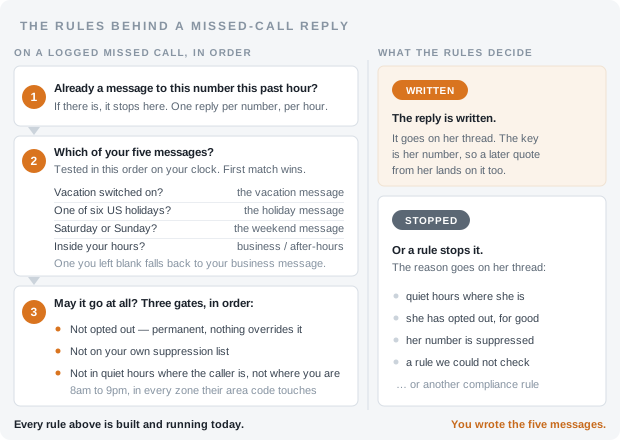
Once texting is switched on, CallMitt™ writes back by text with your business name in the first words, so she replies into the same thread as her quote. The message is picked by the hour and the day, against the hours you actually keep — the demo crew runs 7 to 4, because the first coat goes on at seven so it can dry before the next one, so a 4:30 call gets the after-hours version rather than one claiming somebody is on site — and every version asks the one thing that sorts your week: a patch or a whole room.
Straight about where this stands. The forwarded-call hook is built and waits on your texting number, so today you log the missed call and nothing is sent: a reply queued now is retired rather than delivered when your carrier registration clears. Everything around it is built and running now: the five messages, the business-hours, weekend, holiday and vacation rules, the quiet hours, the opt-out handling, and the thread her reply lands in beside her quote.
How CallMitt Works Run Your Own NumbersA finisher is hired on one question, and it is about the last coat
Hanging board is heavy work that a strong helper learns in a week. Finishing is the trade, and the last coat is where it shows: a wall that looks flat under a ceiling light and shows every joint when the sun comes through the window. Can he finish a wall to a Level 5 skim coat? A man who can tells you how he does it in a sentence. The first question is the plainer one: can he carry a sheet up a flight of stairs and work overhead all day, because that is the job before the finishing starts.
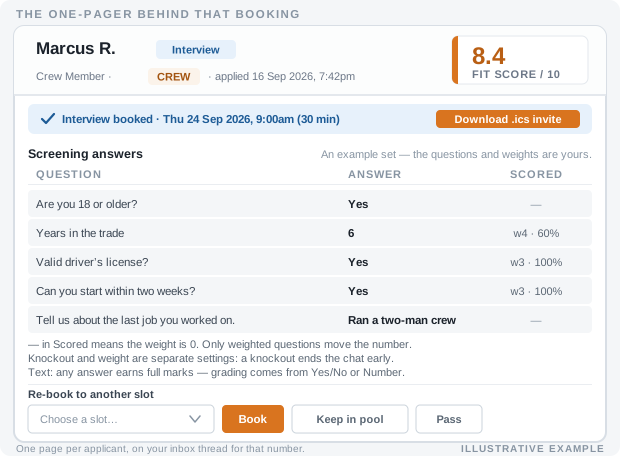
Put “Now hiring — text CREW to your texting number” on the truck and the job-site sign. CrewFunnel™ asks seven short questions: is he 18 or older, can he carry a sheet of drywall up a flight of stairs and work overhead all day, can he finish a wall to a Level 5 skim coat, how many years has he hung or finished drywall, how far out does he live, can he start inside two weeks, and what was the last job he worked on. Three are knockouts — under 18, not up for the carrying, or living further out than you will drive — and the rest come back as a weighted fit score, years in the trade heaviest, the start date next and the Level 5 question after it.
Two things about that scoring are worth copying. Distance is a knockout and never a weight, because a number answer scores higher the bigger it is, so weighting miles would rank the man furthest away at the top. And free text carries no weight, because any non-empty answer scores full marks and a weighted text box inflates every candidate who typed anything. Both are set that way on our demo job, and all seven questions carry a Spanish translation.
One honest note on delivery. Text-to-apply waits on your texting number, so today he answers those seven questions on your screening page rather than by text — same questions, same knockouts, same scoring, same pool. The keyword on the truck takes over the day your carrier registration clears.
See how CrewFunnel works
A finished basement gets its review the weekend the furniture goes down
The last coat is sanded, the primer is on, and the weekend the couch comes down the stairs the basement is a room for the first time. That is the week they would write you a review. Once the paint and the carpet are in, the walls are just walls, and the crew that made them flat is the part nobody remembers. The outfit with sixty reviews is not sixty times better than you; somebody there asks every customer, the week the room is finished.
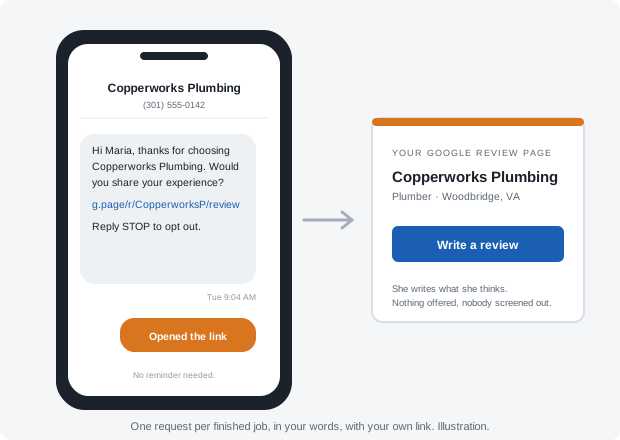
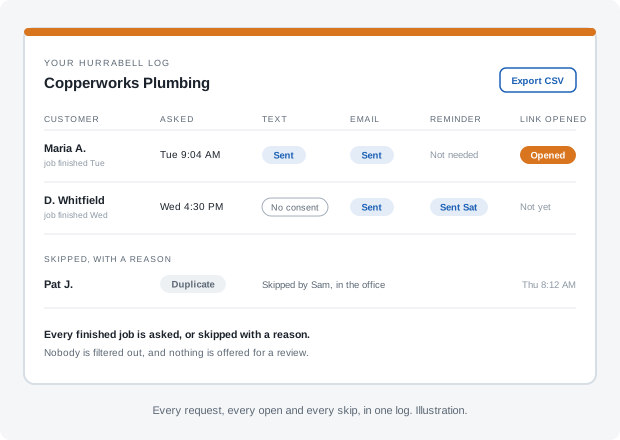
HurraBell™ does the asking. Once review requests are switched on, you mark the job done — from the inbox, from your phone, or from your job software through Zapier — and the customer gets one request in your words, with your own Google review link, after a delay you pick: an hour, unless you change it. Three days later, one email reminder, unless the link has been opened or the customer has since texted you, messaged you from your website or had a call logged on her thread.
Review requests aren’t switched on yet, so none is sent today. When they are, the request goes by email once your Google review link is saved on the HurraBell page and your mailing address on the Account page. A text goes as well where the customer ticked the box on your quote form or visit booking agreeing to a review-request text, and only once your carrier registration clears, the same wait as every text on this site; until then it is email only.
See how HurraBell worksOne recovered basement covers 22 months
A single garage covers 6 of them. In a trade where the shopper is adding up square feet on a calculator at 9pm, the arithmetic is not close.
The Tailgate Office Bundle
Instant quotes on your website, missed-call text-back and text-to-apply hiring (texts go out once texting is switched on), and, once switched on, a review request after every job, plus customers, jobs, estimates and invoices in one place. 30 days free, no credit card, no setup fee, cancel from the dashboard.
Start Free TrialOnly need one of the tools? After the trial you can keep just that one at its own price; the office stays with the Bundle.
Drywall questions we get asked
You can price a range, and only a range — the widget never shows a single figure. The disclaimer under it is yours to write. On the demo it says the range is board, mud, tape, corner bead and labor, hung, finished and sanded ready for primer, that framing, insulation and painting are not included, and that the price is confirmed after you see the space. Nothing is started until they have that written number.
Because a patch is mostly the trip, and priced by the square foot it comes out at a few dollars. The repair service carries the trip as its base fee, added once and inside the number she sees, then a rate per spot, a flat amount for the size of the biggest hole and a percentage for matching the texture. It also carries its own minimum, its own ceiling and a wider band, because three visits a few days apart are harder to promise than one.
Because a textured ceiling in a house built before the 1980s may contain asbestos, and the honest answer is a test before anyone scrapes it, not a price. Our demo asks whether the house was built before 1980 and sends her a plain "we like to see it first" note. If it tests positive, it is a job for a licensed abatement firm before it is a job for you.
They do better than you expect when the help text tells them how: the length of the walls times the ceiling height, with no deduction for the doors. The lead records exactly what she typed, so when you count 1,240 square feet against her 1,100 the conversation is about the difference rather than the whole number.
Not on the demo, and the disclaimer says so: the walls are finished and sanded ready for primer. If you prime or paint, add it as a yes or no with a per-square-foot amount, or as its own service, so the drywall number stays the drywall number.
Our demo says no, and neither instant service carries one. Board goes up indoors and the crew works the same way in February as in July. The field is there if your costs genuinely swing, but inventing a season to fill the box is the fastest way to end up with a number you cannot defend.
Call it fifteen minutes for your text-back messages and your working hours, a minute, once review requests are switched on for your account, to paste your Google review link on the HurraBell page and your mailing address on the Account page, and about an hour to write the eight questions and load one rate card — wall and ceiling per square foot, the finish, height, texture and board percentages and your clean-up fee. Then half an hour more for the patch service. A service that quotes will not go live until it carries a real base fee or minimum, which is deliberate. No onboarding call, no setup fee and no contract: $199 a month buys all four tools.
Also paint, or take down popcorn ceilings that test positive? See all the trade pages, including asbestos abatement, or ask us.
Quote the basement while they are still adding up the square feet.
Set it up tonight. Free for 30 days, no card, no setup fee, cancel from the dashboard.