
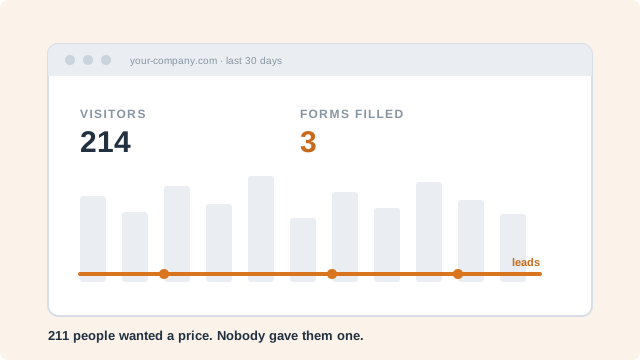
“Is an FAQ page worth it?” Yes, if it is built from the questions your phone, inbox and estimate visits already bring you, answered plainly. No, if it is ten questions somebody made up to fill a page. The usability firm Nielsen Norman Group (NN/g) has warned against made-up FAQ questions since its 2002 list of top web-design mistakes, and puts the fix in one line: “If you’re listening to your users, you know what their questions are.” This article is about building the first kind, and about one thing an FAQ page no longer does for you in Google.
What Google changed
For a few years, FAQ structured data could earn a page an FAQ rich result in Google’s search results. That is over, in two steps:
What that means for a contractor: there is no search trick left in an FAQ page. If an agency offers to add FAQ markup for better search results, there is no FAQ rich result left for it to get. If your site already has the markup, leave it or remove it; Google said in 2023 that structured data that is not being used “does not cause problems for Search, but also has no visible effects in Google Search.” The page itself is still an ordinary page; NN/g notes that FAQ content “can also be usefully indexed by search engines.” Its real job was always the person reading it.
Collect the questions first
Do not start by writing answers. Start with a list, built over a few weeks from what people actually ask:
Write each one down in the customer’s words, not yours. NN/g’s advice is that questions “should reflect the vocabulary and phrasing of your visitors.” In its words: “People don’t search for your solution, they search for their problem.” A homeowner asks “why is my AC blowing warm air,” not “do you offer refrigerant diagnostics.” Keep the questions that come back again and again; a question asked once is not frequent. In a small shop the best source is often you: NN/g notes that every good salesperson “can probably dictate the FAQs you need to publish.”
Answer with numbers and limits
People read an FAQ to decide whether to trust you. NN/g lists the silent questions behind the visible ones, among them: “Do the answers seem factual and frank or more like marketing hype?” “Does the FAQ openly acknowledge the problems or limitations that everyone knows about?” and “Can I dismiss all my concerns before spending money?” So:
- Answer in the first sentence. Then explain.
- Give a number where you have one: a price range, a number of days, a distance, a deposit.
- Say what moves the number. “It depends” is only useful followed by what it depends on.
- Say what you do not do. A clear no saves both of you a visit.
Say a fence company gets asked about cost, area and licensing all the time. The answers below are examples, with made-up figures; use your own:
| The filler answer | The useful answer |
|---|---|
| Every job is different. Contact us for a free estimate! | Most of our backyard wood privacy fences run $X to $Y per foot installed. What moves it: the height, the wood, gates, removing an old fence, and rock or roots where the posts go. Send the length and a photo for a range in a day. |
| We serve the greater area. | We work within about 30 miles of our shop: these towns by name. Farther out, we take jobs over a set size, with a travel charge on the estimate. |
| We are fully licensed and insured. | License number, the state board’s lookup link, and a certificate of insurance sent on request before we start. |
Questions most trades get, worth checking against your own list: what it costs and what changes the price; the deposit and how you take payment; how soon you can start and how long the job takes; where you work; license, insurance and permits (see The About Page); the warranty; what the customer needs to do before you arrive; what happens with weather; and clean-up.
Where the answers go
An FAQ page is not the only home for an answer. A question about one service belongs on that service’s page, next to its price and photos, where the person deciding on that job will see it; that is why The Website Pages a Contractor Needs lists an FAQ of filler among the pages to cut. The FAQ page holds the questions that cut across services (payment, area, scheduling, licensing), plus a short line and a link for each service question, pointing to the page that answers it in full.
Keep the format plain. NN/g says the traditional list of questions followed by the questions and answers “is still the best underlying design for short and medium-length” FAQs, and that for longer ones a list of questions leading to separate answer pages works best. Either way, make the questions easy to scan: bold or as headings, grouped by topic, so a reader can rule out most of the page at a glance. Put a link to it in the footer of every page, and keep each answer short enough to read on a phone at a job site.
Keep it alive
“How fresh is the latest information?” is on NN/g’s list of things readers judge you by. A page that still quotes last year’s lead time is worse than no page. Three habits keep it current:
If some form of “how much?” tops your list, and you would rather answer it before anyone has to ask, NapkinPrice™ puts an instant price range on your website, built from your own prices.