
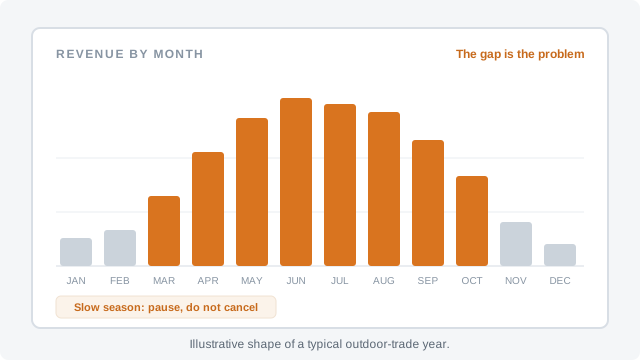
A twelve-month bar chart of contractor revenue with a tall summer peak and a deep winter trough

“What should I do before the year ends to save on taxes?” Most tax work happens in the spring, but a handful of things only count if they happen by December 31, and a few January deadlines are far easier if you start them now. Here is the list for the last weeks of 2026, each with the IRS rule behind it and the article that covers it in full. These are federal rules for a business filing on the calendar year; your state’s tax may differ.

Before December 31

1. Equipment: in service, not just on order

A tool, machine or truck is deducted for the year it is placed in service, and IRS Publication 946 defines that as the day it is “ready and available for a specific use,” not the day you paid. Its own examples make the point. A machine delivered last year but not installed and operational until this year is placed in service this year. A building contractor’s truck that needed lifting equipment installed was placed in service on January 10, the day the finished truck was delivered. So a truck ordered in December with an upfit finished in January is a 2027 asset.

For 2026 the section 179 limit is $2,560,000, reduced once the property you place in service passes $4,090,000. The limit that matters to a small shop is the other one: section 179 cannot exceed your taxable income from the active conduct of a business that year; the excess carries to the next year. How section 179, bonus depreciation and the de minimis rule fit together is in Expensing Tools, and the vehicle caps are in Writing Off the Truck. One caution: a deduction saves you your tax rate on the price, not the price. Buy what the business needs.

2. Timing income and bills on the cash method

If you keep your books on the cash method, Publication 538 sets the rules:

  • Income counts when you receive it, actually or constructively. Money credited to your account or made available to you is received even if you have not touched it. And: “You cannot hold checks or postpone taking possession of similar property from one tax year to another to postpone paying tax on the income.” A check in hand on December 30 is 2026 income, deposited or not.
  • Expenses count in the year you pay them. Paying the accountant, the phone bill or a repair invoice on December 28 instead of January 5 moves that deduction into 2026.
  • Materials are the exception. The Schedule C instructions say that in most cases you deduct materials and supplies only as you actually use them in the business. Lumber paid for in December for a January job is not a 2026 deduction because of when you paid.
  • Prepaying has a limit. An expense paid in advance is deductible only in the year it applies to, unless it meets the 12-month rule: the benefit does not extend beyond the earlier of 12 months after it begins or the end of the next tax year. A one-year policy paid in December can qualify; a three-year policy paid up front is spread over the years it covers.

If your books are on the accrual method, these rules work differently; ask your preparer before moving anything.

3. The retirement plan dates

Each plan type has its own deadline, and only one of them falls in December (Publication 560):

  • Solo 401(k): as the owner-employee, your deferrals “must be elected by the end of the tax year” and can then be paid in by the filing deadline, including extensions. Since 2023, a sole proprietor with no employees may also adopt a new 401(k) after year-end, by the filing deadline without extensions; the first year’s deferrals must then be paid in before that deadline.
  • SEP: no December deadline. You can set one up, and fund it, as late as your return’s due date, extensions included.
  • SIMPLE IRA: too late for 2026. A first SIMPLE plan can take effect on any date from January 1 through October 1 of a year, with an exception for a business that started after October 1.

Which plan fits a small crew, and the 2026 contribution limits, are in Retirement for a Small Contractor.

4. Close the mileage log, in two halves

The IRS changed its business standard mileage rate in the middle of 2026: 72.5 cents a mile for January 1 to June 30, and 76 cents from July 1 to December 31. If you use the standard rate, you need your business miles for each half separately. Say your log shows 9,000 business miles in the first half and 10,000 in the second:

9,000 miles × 72.5 cents (January to June)$6,525
10,000 miles × 76 cents (July to December)$7,600
Deduction$14,125

The same 19,000 miles at 72.5 cents throughout would be $13,775, $350 less. Publication 463 says the record for car expenses includes the mileage for each business use, the date, and the total miles for the year, so read the odometer on December 31 and photograph it.

In December, so January is easy

5. W-9s for the new 1099 line

The IRS instructions for Forms 1099-MISC and 1099-NEC (December 2026 revision) say the reporting threshold rose to $2,000 for tax years beginning after 2025. So the forms you file in early 2027 cover payees you paid $2,000 or more in 2026. Form 1099-NEC is due January 31, and when that falls on a weekend the due date is the next business day: January 31, 2027 is a Sunday, so the date is Monday, February 1, 2027. Total each sub’s payments now, and get a Form W-9 from anyone you do not have one from while they still answer your messages. Who gets a form and who does not is in 1099-NEC for Your Subcontractors.

6. W-2s for your crew

The 2026 W-2 instructions put the due date for filing with the Social Security Administration at February 1, 2027, and employees must have their copies by the same day. Check every employee’s address and Social Security number in December, while you can still ask at the job site.

7. The fourth estimated payment

The 2026 Form 1040-ES puts the last payment for the 2026 tax year on January 15, 2027. You may skip it if you file your 2026 return by February 1, 2027 and pay the entire balance with it. Look at your year-to-date profit in December and size that payment now, before the holiday slow-down empties the account; the safe harbor rules are in Quarterly Estimated Taxes.

The one-page version

  • Anything you want deducted for 2026 is installed, ready and available by December 31.
  • Bills you mean to deduct are paid (materials count when used); customer checks in hand are counted as 2026 income.
  • Solo 401(k) deferral elected by December 31, if you have or want one.
  • Mileage totaled for January to June and July to December; odometer photographed.
  • W-9 on file for every non-corporate payee at $2,000 or more; 1099-NEC and W-2 by February 1, 2027.
  • January 15 payment sized and the money set aside.
  • Receipts and logs kept with the year’s books (how long is in How Long to Keep Business Records).

General information, not legal or tax advice. Rules change and vary by state; check with the agency named above or a professional for your situation.

Sources

  1. Publication 946 (2025), How To Depreciate Property, Internal Revenue Service (accessed October 22, 2026)
  2. Instructions for Schedule C (Form 1040) (2025), Internal Revenue Service (accessed October 22, 2026)
  3. Publication 538 (01/2022), Accounting Periods and Methods, Internal Revenue Service (accessed October 22, 2026)
  4. Publication 560 (2025), Retirement Plans for Small Business, Internal Revenue Service (accessed October 22, 2026)
  5. Publication 463 (2025), Travel, Gift, and Car Expenses, Internal Revenue Service (accessed October 22, 2026)
  6. Standard mileage rates, Internal Revenue Service (accessed October 22, 2026)
  7. Instructions for Forms 1099-MISC and 1099-NEC (12/2026), Internal Revenue Service (accessed October 22, 2026)
  8. General Instructions for Forms W-2 and W-3 (2026), Internal Revenue Service (accessed October 22, 2026)
  9. Form 1040-ES (2026), Estimated Tax for Individuals, Internal Revenue Service (accessed October 22, 2026)

Where this comes from

Written by the team at Tailgate Office, LLC. Every figure comes from the sources listed above, as of the day each was accessed; prices and rules change without warning. Nothing here is legal, tax or financial advice.

Field Notes by email

One email a week with the week's Field Notes. Unsubscribe in one click. We never sell or share your address.

We email you a link to confirm first. What we keep, and for how long.

Keep reading

A twelve-month bar chart of contractor revenue with a tall summer peak and a deep winter trough
Business

Expensing Tools: The De Minimis Safe Harbor and Section 179

A $1,800 tool can usually be written off the year you buy it. The four routes (supplies, the $2,500 de minimis safe harbor, bonus depreciation and section 179), what each one asks of you, and the records that hold it up.

A twelve-month bar chart of contractor revenue with a tall summer peak and a deep winter trough
Business

Buying or Leasing the Work Truck

Compare a truck loan and a lease over the same three years, with the mileage cap, turn-in charges and resale value in the math, then the tax rules that differ: lease payments, the inclusion amount, the standard mileage rate on a lease, and Section 179 on a purchase.

A twelve-month bar chart of contractor revenue with a tall summer peak and a deep winter trough
Business

Check Fraud and Stolen Mail: Protecting Customer Payments

A customer mails your check and someone else cashes it. How the mail-theft check scheme works, what FinCEN and the Postal Inspection Service report, the habits that keep your payments out of the mail, and what to do, step by step, when a check goes missing.

The office your truck never had.

Set it up tonight. It quotes tomorrow's leads, and every missed call you log gets answered from one inbox. Free for 30 days, no card required.