
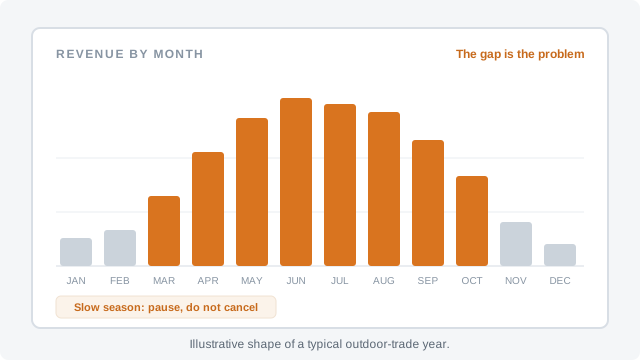
When a homeowner pays you, nobody takes tax out of the check. An employer would have withheld income tax, Social Security and Medicare from every paycheck; as the owner, that job is yours. IRS Publication 505 puts it in one line: “The federal income tax is a pay-as-you-go tax.” The same publication says people in business for themselves will generally pay their tax by estimated payments, and for a year that means four of them.
Do you have to pay?
The 2026 Form 1040-ES gives the general rule. You must pay estimated tax if both of these are true:
- You expect to owe at least $1,000 in tax for the year after subtracting your withholding and refundable credits.
- You expect your withholding and refundable credits to be less than the smaller of 90% of this year’s tax or 100% of last year’s tax, from a return that covered all 12 months.
If your adjusted gross income last year was more than $150,000 ($75,000 if you are married filing separately), the 100% becomes 110%. And if you were a US citizen or resident for all of last year and had no tax liability for that full year, you do not have to pay estimated tax this year. The rules come from the Internal Revenue Code, 26 U.S.C. §6654.
What the payments cover
Two taxes, not one: income tax, and self-employment tax, which is your Social Security and Medicare with no employer paying half. Publication 505’s worksheet figures self-employment tax as 92.35% of your expected net profit, times 2.9% for Medicare, plus 12.4% for Social Security on earnings up to $184,500 for 2026. Below that cap, it comes to about 14.1% of net profit before a dollar of income tax. Half of it is deducted when you figure your adjusted gross income, which softens the income tax a little. That is how a first-year contractor who set aside “a little for taxes” can end up owing more than he expected.
The four dates, and why they are not quarters
| Income earned | Payment due (2026 tax year) |
|---|---|
| January 1 to March 31 | April 15, 2026 |
| April 1 to May 31 | June 15, 2026 |
| June 1 to August 31 | September 15, 2026 |
| September 1 to December 31 | January 15, 2027 |
Look at the periods in Publication 505’s table: three months, then two, then three, then four. The June payment comes two months after April’s, not three, so plan for it.
If a due date lands on a Saturday, Sunday or legal holiday, a payment on the next business day is on time. You may skip the January 15, 2027 payment if you file your 2026 return by February 1, 2027 and pay the whole balance with it. As this is written, the next payment due is January 15, 2027, for the 2026 tax year.
The safe harbor: the simple way to stay clear of the penalty
Under §6654, each of the four required payments is 25% of a “required annual payment,” which is the smaller of 90% of this year’s tax or 100% of last year’s (110% above the $150,000 line). The second test is the one a contractor can actually use, because last year’s number is already printed on last year’s return.
Say last year’s Form 1040 showed total tax of $16,000 and adjusted gross income under $150,000. Pay $4,000 by each of the four dates and no underpayment penalty applies this year, even if business doubles. You will still owe the difference when you file. The safe harbor protects you from the penalty, not from the bill. If last year’s adjusted gross income was over $150,000, the payments become 110% of $16,000 divided by four: $4,400 each.
If this year is clearly slower than last, the 90% test may ask for less. Estimate this year’s tax on the worksheet in Form 1040-ES and pay 90% of it in four parts. The risk is that a good autumn pushes the real tax above your estimate and leaves your payments short of 90%. The last-year test has no such risk.
Seasonal work: the annualized method
Publication 505 says that if your income does not come in evenly through the year, your required payment for one or more periods may be less than the even split. Its own example is a repair shop whose income “is much larger in the summer than it is during the rest of the year.” The annualized income installment method figures the tax on what you have actually earned through the end of each period, so a business that earns most of its money in a few months can pay less in the periods before that money arrives. If you use it, file Form 2210 with Schedule AI with your return.
What the penalty actually is
The §6654 penalty works like interest. The IRS applies the underpayment rate to the amount you were short, for the days it stayed unpaid, figured separately for each payment period. For individuals the rate is the federal short-term rate plus 3 percentage points, reset each quarter. For the quarter that began October 1, 2026, the IRS announced it unchanged, at 7% a year for individuals’ underpayments.
Say you came up $3,000 short on September 15, 2026 and caught up on December 15. That is 91 days at 7%, about $52. A penalty that size is not what hurts. What hurts is April: a full year of income tax and self-employment tax due at once, after the money has already gone into materials, payroll and the truck.
A set-aside percentage for every deposit
The safe harbor tells you what to send. A set-aside percentage makes sure the money is there when you send it.
- Open a separate savings account just for tax.
- Find last year’s total tax on your Form 1040 and last year’s gross receipts on Schedule C, line 1.
- Divide the tax by the receipts. Say $16,000 ÷ $210,000 = 7.6%. Round up to 8%.
- Every time a customer pays, move that percentage into the tax account the same day. If your state taxes income, add its share.
- Pay each installment from that account. If it runs short before a due date, your percentage is too low; raise it.
Use gross receipts rather than profit because that is the number in front of you when a payment lands. It is the same habit as the winter float in Seasonal Cash Flow: the money moves before anyone can spend it.
How to pay
Form 1040-ES lists the ways: your IRS Online Account; IRS Direct Pay, which moves money from a checking or savings account at no cost to you; the Electronic Federal Tax Payment System (EFTPS), which needs enrollment; a debit or credit card, for which the card processor charges a fee; or a check or money order with the payment voucher. Keep the confirmation for every payment. If you also draw a paycheck from a job, the same form notes that asking your employer to withhold more, on a new Form W-4, may let you avoid estimated payments on your other income.
Finally, check whether your state’s revenue department expects its own estimated payments. Its dates and thresholds are its own.
Put the four dates in your calendar today, work out the safe-harbor payment from last year’s return, and set the percentage on the next deposit. April gets a lot quieter.
General information, not legal or tax advice. Rules change and vary by state; check with the agency named above or a professional for your situation.