
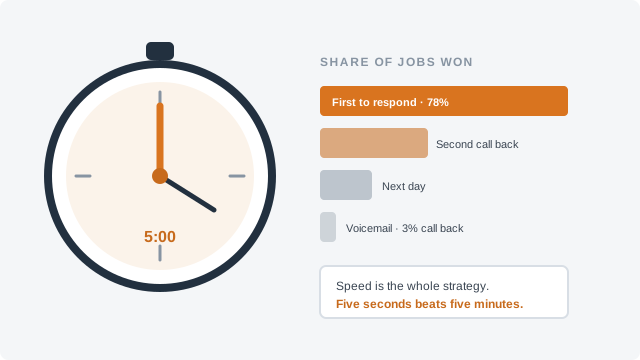
An estimate visit that ends at a locked gate costs you twice: the drive out and back, and the slot another customer could have had. A no-show is not always rudeness. The customer may have forgotten, her plans may have changed with no easy way to tell you, someone else may have come sooner, or the visit never felt firm to her in the first place. Each of those has a fix, and most of the fixes happen in the two minutes before you hang up.
Make it firm before you hang up
An appointment feels real when both sides have said the same details out loud. Before the call or the message thread ends, settle these:
Then read it back in one sentence and send the written confirmation right away, while she is still holding the phone. If the lead came in through a call, the first sixty seconds of a lead call covers the questions that come before the booking.
Windows people can plan around
“Sometime Thursday” asks her to give up a day. A two-hour window asks for a morning. The first visit of the day can usually be a fixed time, because nothing runs late ahead of it. For later visits, keep the window and send a short “on my way” message when you leave the previous stop, with a rough arrival time. If you are going to miss the window, say so before it closes, not after.
Two scheduling habits cut no-shows on their own. Book closer in when you can: a visit set for tomorrow has less time to be forgotten or replaced than one set two weeks out. And do not stack estimate visits so tightly that one long site walk makes you late for the next three.
A reminder schedule
Here is a simple pattern to start from and adjust:
- At booking: the written confirmation with the day, window, address and how to reschedule.
- Three days before, only for visits booked more than a week out: a short check that the time still works.
- The day before, in the afternoon: the reminder, with an easy way to confirm or move it.
- On the day: the “on my way” message.
Each message goes by the channel she picked. A customer who asked for email and gets three texts is more likely to tune you out than to show up.
The consent each reminder needs
A reminder about a visit she asked for is about as welcome as business messages get. The federal rules still draw lines, and they differ for calls, texts and email.
Calls and texts
The FCC’s rule bars calls to a cell phone made with an “automatic telephone dialing system or an artificial or prerecorded voice” unless the call is for an emergency or is made “with the prior express consent of the called party” (47 CFR §64.1200(a)(1)). A call made that way that includes an advertisement or is telemarketing needs more: “prior express written consent” (§64.1200(a)(2)). Texts are inside these lines too: the rule’s revocation paragraph speaks of “calls or text messages” (§64.1200(a)(10)). Texting customers in 2026 covers those rules in full, including the opt-out rules and how they are changing; here is how they apply to a reminder.
States can add their own rules on top. Florida’s telephone solicitation law, for one, counts a text message as a “telephonic sales call” and bars an unsolicited one made with an automated dialing system without the person’s prior express written consent (Fla. Stat. §501.059(1)(j) and (8)(a)). Check your own state before you text anything that sells.
So the line that matters is between a reminder and a sales message. CTIA makes the same split in its Messaging Principles and Best Practices, a set of voluntary practices its wireless member companies developed for business texting. It puts appointment reminders in its “informational” category, where the customer gives a business her number and asks to be contacted, and expects her express permission first, which she can give “over text, on a form, on a website, or verbally.” It also warns that “adding a call-to-action (e.g., a coupon code to an informational text) may place the message in the promotional category,” where it expects written permission. Keep the reminder about the visit. Leave the gutter-guard special out of it.
A text you type and send yourself is the plainest case. Whether a given texting tool counts as an autodialer is a legal question, so do not guess at it; the simplest protection is the consent you already asked for at booking. CTIA suggests keeping a record of it: when she gave it, how, the wording, and the number. A line in the job notes (“OK to text reminders, said on the call, 14 Oct”) is a start.
When she says stop
If she replies STOP, or anything a reasonable person would read as a request to stop, stop texting her that day, and if the visit is still on, send any remaining reminder by the channel she has not refused. How quickly the rule says you must honor the request, and the one confirmation text you may send, are in the texting article linked above. Watch one word in particular: “cancel” is on the rule’s list of replies that revoke consent (§64.1200(a)(10)). If she replies “cancel” to a reminder, treat it as both a cancelled visit and the end of your texts until she says otherwise.
The CAN-SPAM Act sorts email by its primary purpose. The FTC’s guide lists “transactional or relationship” messages, starting with one that “facilitates, completes, or confirms a commercial transaction that the recipient already has agreed to.” Such a message “may not contain false or misleading routing information, but is otherwise exempt from most provisions of the CAN-SPAM Act.” A mixed message is treated as commercial if the subject line reads like an ad or the transactional part “does not appear mainly at the beginning of the message.” A reminder about a visit she booked sits closest to that first kind. Put the visit in the subject line and the opening lines, keep promotions out, and it reads as what it is.
Three messages you can adapt
The confirmation, at booking:
Hi [first name], this is [your name] from [business]. You’re booked for [day, date] between [9 and 11] at [address] to look at [the job]. It takes about [30 minutes]. Need a different time? Reply here and we’ll move it.
The day-before reminder:
Hi [first name], a reminder that [your name] from [business] is coming tomorrow between [9 and 11] to look at [the job]. Reply YES to confirm or tell me a better time. Reply STOP to stop texts.
On the way:
Hi [first name], [your name] from [business] here. On my way, there in about [20] minutes.
The STOP line follows CTIA’s guidance that a message should say how and with what words to opt out. For email, put your business name and address in the signature.
When nobody answers the door
- Wait ten minutes and send one short message: “I’m at [address] for our [time] visit. Running late, or should we pick another day?”
- If there is no answer, leave and say so once: “Sorry we missed each other today. Reply whenever you’d like to set a new time.” No guilt, no second chaser that day.
- Offer one new time if she replies. If she misses the second one too, ask her to reach out when she is ready, and close the file.
- Log it: the lead source, how far ahead it was booked, whether the reminder went out and whether she confirmed.
If you want a trip charge for missed visits, say so at booking and put it in the confirmation; a fee she first hears about afterward is an argument, not a fee. Should you charge for estimates? weighs the wider question.
Read the log after a month
The log turns a vague complaint into something you can fix. Look for the pattern. Are the no-shows mostly visits booked far out? Book closer, or add the three-day check. Mostly from one lead source? Compare it with the others before you renew it; the lead services compared may help. Mostly visits where the reminder never went out? That is a habit to fix, not a customer problem. And the visits that did happen lead to the next step: following up the estimate.
It also helps if the visit lives where you will see it. If you track jobs in the office, give the job a next step on the visit’s day: its calendar feed puts each job’s next step into Google Calendar, Apple Calendar or Outlook, next to everything else on your phone.
General information, not legal or tax advice. Rules change and vary by state; check with the agency named above or a professional for your situation.