
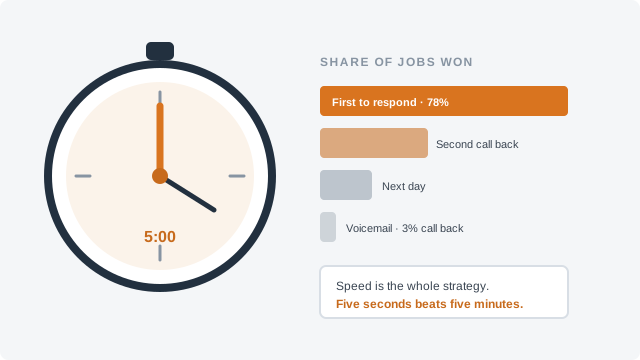
“What should I say when a new customer calls?” Much of the advice about lead calls stops at picking up the phone. Picking up matters, but it is only the door. What you say in the next minute decides whether the caller hangs up with a booked visit or with a plan to call the next company on the list.
This is a one-minute structure you can use from the truck, the questions that keep you from driving to a job you will never get, and what the published numbers say about where home-service calls go wrong.
Where calls go wrong: the benchmark
Invoca, which sells call-tracking software, published its Home Services Lead Conversion Benchmarks Report 2026 in July 2026, drawn from calls it tracks for its customers across nine home-service sub-industries. Its averages: 38% of calls answered by a person are leads, and 45% of those leads convert on the call. Its headline finding for this article: “55% of home services businesses don’t ask leads to buy or book the job.”
The report’s call handling chart scores the businesses on six measures across the phone leads it analyzed:
| What the business did | How often |
|---|---|
| Gave a proper greeting | 81% |
| Gave a proper closing | 72% |
| Obtained the caller’s information | 62% |
| Call scored as excellent | 58% |
| Converted the lead to a booked job | 45% |
| Asked for the sale or appointment | 45% |
Read it top to bottom. Most businesses say hello well. Fewer get the caller’s name and how to reach them. Fewer than half ask for the appointment. These are one vendor’s averages across its own customers, not a law of nature, but the shape is the useful part: the call falls apart after the greeting, not before it.
The sixty seconds, in five parts
| Seconds | What you find out | What it sounds like |
|---|---|---|
| 0 to 10 | Who you are | “[Business name], this is [your first name]. How can I help?” |
| 10 to 20 | Who they are and how to reach them | “Who am I speaking with? And what’s the best number to reach you if we get cut off?” |
| 20 to 35 | What and where | “Tell me what’s going on.” Then: “What’s the address, or at least the town?” |
| 35 to 45 | How soon | “Is this something that needs someone today, this week, or are you planning ahead?” |
| 45 to 60 | The next step, booked | “Jobs like this usually run [your range], depending on [the one or two things that move it]. I can come look Thursday at ten or Friday at two. Which works?” |
The order is deliberate. The name and callback number come second, not last, because a call that drops at second forty with no number is a lead you cannot get back. The address comes before the long description, because if the house is outside your area, the kindest thing for both of you is to say so in the first half-minute. And the last line asks for a time with two choices, which is the step Invoca found most businesses skip.
The price question will come early. Have a range ready
Callers are often shopping something large. The Census Bureau’s 2023 American Housing Survey found that 51.6 million of the nation’s 86.9 million homeowners made improvements between 2021 and 2023, and it reports median spending for selected projects: about $10,000 for roofing, $8,000 for a kitchen remodel, $5,500 for HVAC, $5,000 for a bathroom remodel, $3,000 for flooring, paneling or ceiling tiles, and $2,800 for doors and windows. Among owners who made improvements, the most common were water heater, dishwasher or garbage disposal work (32%), HVAC (25%) and flooring, paneling or ceiling tiles (21%).
So a caller may already have a number in mind. A firm price over the phone for a job you have not seen is a promise you may have to break. A range, with the one or two things that move it, is honest and useful: it lets the caller who cannot afford the job leave politely, and it tells the one who can that you know your trade. Write down your ranges for your three most common jobs before the next call, not during it.
The same survey found that of 140 million projects, 64% were done by professionals and 36% by do-it-yourselfers. Some of your callers are deciding between you and a weekend of their own; a clear range and a near date answer that too.
The questions that save a wasted trip
Once the visit is booked, take another minute for the questions that decide whether the visit is worth the drive. Pick the ones that fit your trade:
A card for the dash
“[Business], this is [name]. Who am I speaking with? Best number if we get cut off? What’s going on, and where is the house? Today, this week, or planning ahead? Jobs like this usually run [range], depending on [what moves it]. I can be there [day and time] or [day and time]. Which works?”
Tape it where you take calls. The first ten times it feels scripted; after that it is just how you answer.
Four things to leave out of the first minute
- The company history. The caller wants to know whether you can help, not how long you have been in business. Save it for the visit.
- A firm price, sight unseen. Give the range and what moves it.
- “I’ll call you back with a time.” Book it now. A callback is another call someone else can answer first.
- A time you cannot keep. Offer only slots you are sure of. The first appointment is the first promise the customer sees you keep or break.
After you hang up
Write down the five facts before the next thing distracts you: name, how to reach them, what and where, how soon, and the booked time. Then confirm the appointment the way the customer asked you to; booking estimate visits that do not no-show covers the confirmation and the reminder. For the calls you could not answer at all, start with your voicemail greeting, and to find out how many that is, run the one-week answer-rate audit.
The price conversation also gets easier when the caller has seen a range before dialing. NapkinPrice™ puts your own price ranges on your website, so a caller can arrive already knowing roughly what the job costs and ready to ask when you can come.