
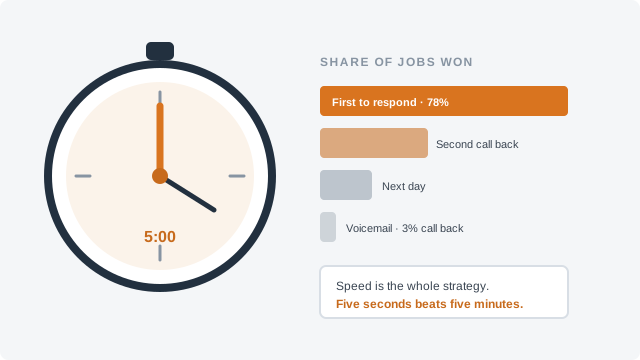
Count the calls you missed last week, then count the voicemails. If the second number is a small fraction of the first, your box is working the way it works for almost everyone. Invoca, which sells call-tracking software and publishes figures from its platform, reported in 2024 that “less than 3% of callers who get pushed to voicemail leave a message.”
How many of your callers reach the box in the first place is worth knowing too; Your Answer Rate shows how to count it in a week and what to compare it with.
That changes what a greeting is for. It is not there to collect messages, because almost nobody leaves one. It is there for the few seconds a caller spends deciding whether to wait for you or try someone else, and to give them something to do besides hang up.
Listen to yours first
Call your business number from another phone, let it ring out, and listen the way a stranger would. Note five things:
If you never recorded a greeting, callers hear your carrier’s default. If the first thing they hear is not your business name, that is today’s fix.
Four things a greeting has to say
- That they reached the right business. Your business name, first. A caller who searched “roofer near me” and tapped three numbers in a row needs to know which one this is.
- Why nobody answered. One honest clause: on a job, with a customer, closed for the day.
- When they will hear back. Name a time you keep every day. “Before six today” tells a caller whether waiting is worth it; “as soon as possible” tells them nothing. Never promise a time you will miss.
- A faster path than waiting. The request form or the price page on your website, or a text to this number if your line takes texts. Say the web address once, slowly.
Ask for the message last, and ask for what you need to call back usefully: name, town or address, and the job. A caller who knows what happens next has a reason to leave it.
Leave out what callers do not need: “your call is very important to us,” a menu of options for a one-truck business, a list of every service you offer, a slogan. Each extra sentence is more time for the caller to decide to hang up.
Three greetings to copy
These are examples. Swap in your own name, hours and web address, and only keep the promises you can keep.
Working hours. “You’ve reached [business name]. We’re out on a job and couldn’t get to the phone. We return every call before six today. If you want a price range right now, it’s on our website at [web address]. Or leave your name, your town and what you need done, and we’ll call you back.”
Evenings and weekends. “You’ve reached [business name]. We’re closed until seven tomorrow morning, and the first thing we do is return tonight’s calls. You can request an estimate any time at [web address]. Or leave your name, your town and the job, and we’ll call you in the morning.” If you offer emergency service, this is where the caller hears exactly how to reach it.
A storm or the busy season. “You’ve reached [business name]. After this week’s storm we’re returning calls in the order they came in, and every caller hears back by [day]. For the fastest spot on the list, fill out the form at [web address] and add photos of the damage. Or leave your name, your address and what was damaged.”
Record it somewhere quiet, not in the truck with the engine running, and listen to it once before you hang up. Then change it the day your hours or your situation change: a holiday, a vacation, a storm, the start of the season. And keep the hours in the greeting the same as the hours on your Google profile; the profile side is in Google Business Profile for Contractors.
A full box takes no messages
Carrier mailboxes are small. Verizon says its basic voicemail holds “up to 20 stored messages.” AT&T says that with basic voicemail on its mobile phones “you can store up to 20 messages for a period of 14 days,” and with Visual Voicemail up to 40 messages for 30 days. AT&T’s help page for its Unified Messaging service states what a full box does: “When your mailbox is full, callers won’t be able to leave messages until you free up space in your mailbox.”
Other carriers and business phone systems set their own limits, so look up yours in your account or your carrier’s help pages. Twenty slots is not many for a busy week when old messages are never cleared. The fix is a daily habit, not a bigger box.
The daily check
Pick a fixed time, at lunch or at the end of the day, and do the same five steps:
- Play every new message and write down the name, number, job and time it came in.
- Return them, oldest first.
- When you reach someone, ask for the next step: a visit, a time, a booking. Invoca’s 2026 home-services benchmarks report found that “55% of home services businesses don’t ask leads to buy or book the job.”
- Delete or save what you have handled, so the box never fills.
- Open the call log and look at the missed calls with no message. A number that rang during working hours and is not a supplier or a known spam caller is worth one call back.
When your callback reaches their voicemail, say your business name, what they called about and how to reach you. They may not recognize your number, and a message that names the job they asked about is easy to tell from a sales call.
Measure the change
Run the one-week audit in Your Answer Rate before you change the greeting, then again a month after. Compare how many missed callers left a message, sent the web form the same day or called back. Those are the jobs your greeting is responsible for. How quickly you call back matters as much as what the greeting says, which is the subject of The Five-Minute Rule.
If your greeting sends callers to your website for a price, the website has to show one. NapkinPrice™ puts an instant price range on the site you already have, from the pricing rules you set, so the caller who would not leave a message can still get a number and send you the details.