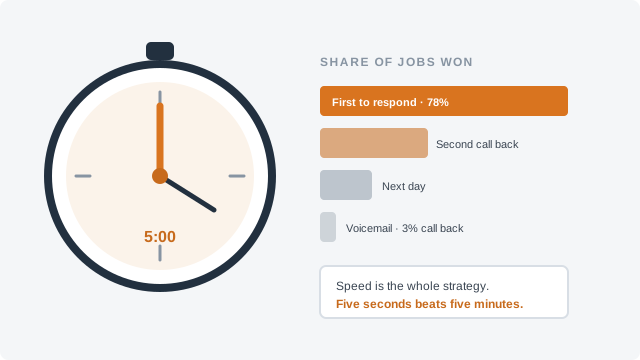
There is one statistic in home services that should reorganize your entire week, and most contractors have never heard it: roughly 78% of jobs go to the company that responds first.
Not the cheapest. Not the one with 200 five-star reviews. Not the one with the nicest truck wrap. First.
That is brutal if you think about it for a second, because it means the thing that decides most of your revenue is not craftsmanship. It is a race you are running from the top of a ladder with your phone in the cupholder of a truck forty feet away.
Why the first responder wins
It is not that homeowners are lazy or disloyal. It is that the moment somebody decides to fix the fence, they are in a very specific state of mind: motivated, slightly stressed, and wanting the problem gone. That state has a half-life of about an hour.
The first person who responds gets to define what the process looks like. He sets the expectation, he asks the questions, he books the visit. By the time company number two calls back on Thursday, the homeowner has already spent an emotional deposit on company number one, and calling three more people now feels like homework she did not sign up for.
There is also a rawer version: responding fast is the only signal of reliability a stranger can observe before hiring you. She cannot inspect your post depth. She can absolutely observe that you called back in four minutes and the other guy took two days. She will extrapolate from that, and honestly she is not wrong to.
The math nobody wants to look at
Roughly 62% of calls to home-service businesses go unanswered. Not ignored — unanswered, because the owner is doing the actual work he was hired for. That is not a character flaw. It is the structural problem of a business where the salesman and the labor are the same person.
And when the call rolls to voicemail, about 3% of people leave one and get a callback that turns into anything. Three percent. That is your current lead-recovery system. If a machine on your job site ran at 3% efficiency you would have thrown it in the dumpster years ago.
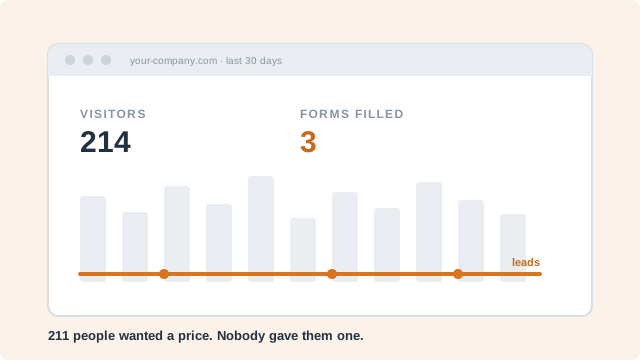
Put those two together for a company taking 40 calls a month. Twenty-five of those calls go unanswered. Under one gets recovered. Twenty-four people who wanted to give you money went somewhere else, and none of them show up in any report you look at. That is the whole reason slow months feel mysterious.
“I call everyone back at the end of the day”
We hear this constantly, and it is genuinely conscientious. It is also six hours too late. By 5:30pm, the 2:04pm caller has spoken to two other companies and one of them is coming Saturday morning.
Response time does not decay gently. It falls off a cliff. Five minutes is a completely different business than one hour, and one hour is a completely different business than tomorrow morning. You are not competing on a curve, you are competing on a step.
The four honest options
1. Answer the phone yourself. The best option, and the one you cannot do, because you are the one holding the nail gun. If you could answer every call you would not be reading this.
2. Hire someone to answer. Works, and works well. Costs $2,500–$4,000 a month fully loaded, and they go home at five and take vacations. For a lot of companies this is genuinely the right answer once you are past a certain size.
3. An answering service. Cheaper, around $200–$500 a month depending on volume. The trade-off is that a stranger with a script is now the first impression of your business, and homeowners can hear it instantly.
4. Text them back automatically. The missed call triggers a text from your own texting number, a local number in your area code, within a few seconds: “Sorry we missed you — this is Ridgeline Fence. Reply here and we’ll get you on the schedule.” No script, no stranger, no salary. It costs less than one job a year.
Why a text works better than a callback
This surprises people, so it is worth spelling out. A text beats a fast callback in three ways that matter.
What to actually do this week
Pull your call log. Count the missed calls from the last thirty days. Multiply by your average job value, then take 20% of that as a very rough recovery ceiling. For most contractors that number is somewhere between four and forty thousand dollars a year, and it is sitting there whether or not anyone does anything about it.
Then pick one of the four options above and actually do it. Which one matters much less than the fact that the 2:04pm call currently hits nothing at all.