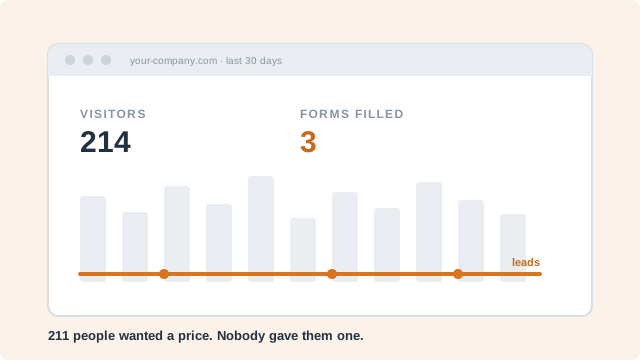
Here is the report we run for almost every contractor who calls us annoyed about his website. Two numbers. Visitors last month, and forms filled out last month. It usually reads something like 214 and 3.
The owner looks at that and concludes one of three things: the website is broken, the SEO guy is lying, or the whole internet is a scam. Usually none of them is true. The traffic is real. Those 214 people were, overwhelmingly, homeowners in his county typing “fence company near me” at nine o’clock at night with a tape measure still sitting on the kitchen counter. They are exactly the people he wants.
They left because the site never answered the only question they actually had.
Everybody arrives with the same question
Nobody browses contractor websites for pleasure. A person lands on your site with one question already loaded: roughly what is this going to cost me? Everything else — your reviews, your gallery, how long you have been in business, whether you are insured — is a tiebreaker they will get to after they know whether they can afford you at all.
And what does the site say? “Call for a free estimate.” “Contact us for a custom quote.” “Request a consultation.”
Read that the way a homeowner reads it. It says: put your phone number into a form so a salesman can call you, and then wait, and then be told a number you cannot compare against anything. That is not a small ask. That is asking somebody to take on a phone call with a stranger in exchange for information they think should be free.
Most people are not going to do that at 9pm. They are going to open a second tab.
The three objections, and why they are wrong
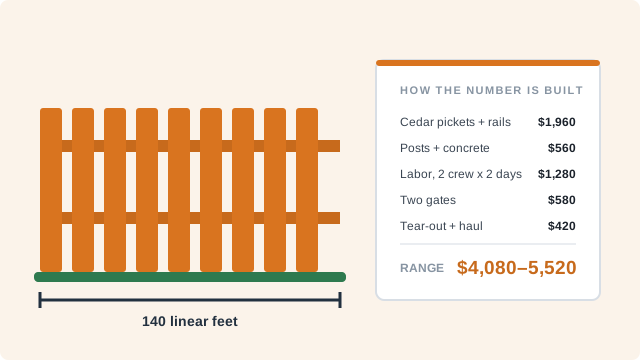
“Every job is different, I can’t price it online.” Every job is different. But you already price them in your head in about fifteen seconds on the phone: linear feet, material, gates, tear-out, access, whether the yard is on a hill. You are not doing calculus. You are running four or five rules and adding a fudge factor. Those rules can live on a web page. A range is not a bid — it is what you would have told them on the phone anyway, minus the phone call.
“If I publish prices my competitors will undercut me.” Your competitors already know what you charge. They bid against you every week and they lose jobs to you and hear the number. The person your price is currently hidden from is the customer.
“I’ll get tire kickers.” You will get fewer, and that is the point. Somebody who sees $4,200–$4,900 and leaves was never going to buy a $4,500 fence. You just saved yourself a forty-minute round trip to find that out. The ones who see the number and still hand over their phone number have pre-qualified themselves in a way no contact form has ever managed.
What actually happens when you put a number on the page
Three things change at once, and only the first one is obvious.
More people convert. Obviously. A price is the thing they came for. But the second and third effects are the ones that change your week.
The leads arrive pre-spec’d. When someone answers five questions to get a range, you receive the answers. Not “interested in fencing” — 140 linear feet, cedar, six foot, two gates, existing chain link to tear out, and the access noted. You now know whether it is worth driving to before you drive to it, and your first phone call sounds like a professional who has read the file instead of a stranger starting from zero.
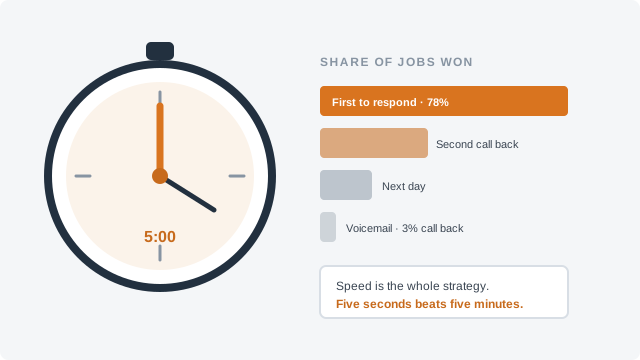
You stop being one of four bids. The homeowner who got a number from you at 9:04pm has a mental anchor now, and it is yours. When the other two companies call back on Thursday, they are comparing themselves to you. That is a much better position than being the third quote in a spreadsheet.
You do not need a new website
This is the part people get wrong. They hear “my site doesn’t convert” and go buy another site. Then they have a prettier brochure with the same sentence on it.
The site you have is probably fine. It ranks, it loads, it looks decent on a phone. What it is missing is one button that gives the visitor the number they came for, and one system that captures them when they hand over their details. That is a widget, not a rebuild. It took us about thirty minutes to install on the last one.
Two hundred and fourteen people came to your business last month. Three of them got helped. Fixing that is the cheapest growth available to you, and it does not involve buying a single additional click.