
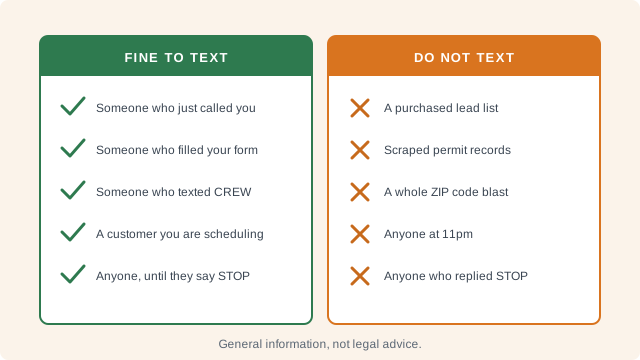
Contractors hear “TCPA” and picture a lawsuit. Then they either stop texting customers entirely, which costs them jobs, or they ignore it completely, which is worse. The actual rule of thumb is simpler than the fear around it.
General information for contractors, not legal advice. If you are running a large SMS program or you have already had a complaint, talk to a lawyer who does this for a living.
The one-sentence version
If they contacted you first, texting them back about the thing they contacted you about is normal business communication. If you went and found them, you need real permission.
That is the whole shape of it. The rules exist to stop mass unsolicited marketing to strangers — the robotexts everyone hates. They were never designed to stop a fence company from replying to someone who just dialed their number.
What “they contacted you first” covers
In each case the person handed you their number with the obvious expectation of hearing back. Replying to that is what they wanted.
What it does not cover
This is where contractors get in trouble, and it is almost never the missed-call text-back. It is the moment somebody sells them a spreadsheet.
Keep the reply on-topic
Existing-inquiry consent is scoped to the inquiry. Someone called about a fence, so text them about the fence. That same consent does not authorize a spring gutter-cleaning promotion six months later. If you want to run actual marketing campaigns to past customers, that is a different consent, collected separately, in writing, with the marketing purpose stated plainly.
STOP means stop, immediately and forever
STOP, UNSUBSCRIBE, CANCEL, QUIT, END. If somebody sends one of those, texting has to end right then, automatically, without anyone at your company deciding whether they meant it. Any decent platform handles this for you and keeps the suppression permanently. If yours does not, you have the wrong platform.
Quiet hours
Do not send automated texts outside roughly 8am to 9pm in the recipient’s local time, and check your state — several are stricter, and a few restrict Sundays. Note the phrase “recipient’s local time.” If you are in Maryland working a job near a state line, that matters.
People will tell you a genuine immediate reply to someone who called at 9:40pm is a different animal from a scheduled marketing blast, and there is an argument there. We built on it only for a reply to a text the person sent moments before: the answer to HELP, and the next question to a candidate who has just texted a hiring keyword. Every other automated text to a customer or applicant is held to 8am to 9pm in the recipient’s time zone, the missed-call reply included, and there is no switch to turn that off. A quiet window you can override is not a quiet window.
A2P 10DLC: the part nobody explains
Separate from TCPA, and it is a carrier requirement rather than a law. Since 2021, business texting from ordinary 10-digit US numbers has gone through registration with The Campaign Registry: who the business is, what kind of messages it sends, and sample message content. That is A2P 10DLC. Since 3 February 2025 unregistered traffic has been blocked altogether (Telnyx, 2026 (opens in a new tab)).
That is the dangerous part: depending on the tool you send from, a blocked text can look as if it went, and nobody tells you it never arrived.
Registration needs your legal business name, your EIN (or, for a business with none, the carriers’ sole-proprietor path, in your own name with a code texted to your mobile), your business address and your website. The carriers’ review usually takes a few business days, with no guaranteed date, depending on the carriers and how clean the submission is. Once filing opens, filing it for each customer who wants their own number is our job, not yours (nothing has been filed for anybody yet) — the whole process, and exactly where we are with it, is on our compliance page.
The short checklist
Follow those six and you are doing what a careful business does. The homeowner who called you at 2pm and got a text back at 2:00:05 is not going to sue you. She is going to reply.