Ask a fence builder what he charges and you get “well, it depends.” Ask him to quote a 140-foot cedar privacy fence with two gates and a chain-link tear-out and he will give you a number in about fifteen seconds.
So it does not depend. There is a formula. It is just living in his head instead of on paper, which means it can never be delegated, automated, or put on a website.
Get the formula out of your head
Take the last ten jobs you priced. For each one, write down what actually drove the number. In fencing it is almost always this short list:
That is seven inputs. Seven inputs is a spreadsheet, and a spreadsheet is a thing a website can run.
A worked example
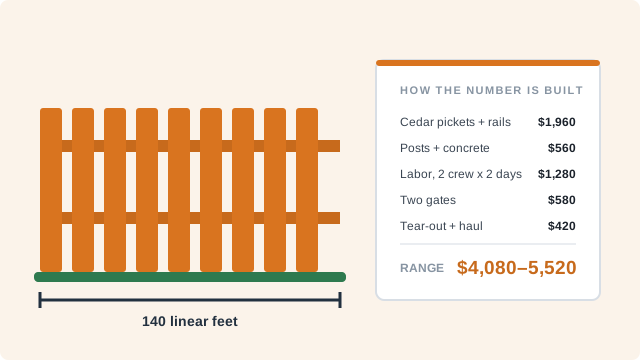
140 feet of 6-foot cedar privacy, two walk gates, tear out 140 feet of chain link, flat yard, twelve miles out:
| Cedar pickets, rails, hardware — $14/ft | $1,960 |
| Posts and concrete — $4/ft | $560 |
| Labor, two crew, two days | $1,280 |
| Two walk gates at $290 | $580 |
| Tear-out and haul — $3/ft | $420 |
| Adds up to | $4,800 |
| Quoted range — 15% either way | $4,080 – $5,520 |
Those unit numbers are illustrative — yours will be different, and cedar moves. The structure is what transfers.
Always quote a range
A single number online is a promise you have not inspected the site to make. A range is the truth: “based on what you told me, this lands here, and I will confirm when I see it.” Fifteen percent either way is a sane spread for most trades. It gives you room for the buried stump and the neighbor’s retaining wall without you having to eat it or have an awkward conversation.
It also does something useful psychologically. A range reads as an honest professional estimate. A suspiciously precise number reads as a sales tactic.
Stop discounting to win the phone call
Most of the discounting contractors do happens on the phone, live, under mild social pressure, because the customer said “the other guy quoted less.” When your price comes from a written rule set instead of your mood, that conversation changes. You are not defending a number you made up. You are explaining a formula.
And when a homeowner has already seen the range before she ever spoke to you, she is not calling to negotiate. She is calling because the number worked.
Then put it where the customer is
Once the rules are written down, they can run without you — on your website at 9pm, while you are asleep, for the homeowner who was never going to fill out a contact form. That is the entire idea behind NapkinPrice: you set the rules with sliders, the website runs them, and you get the lead with the full spec attached.
But write the formula down either way. Even on paper in the truck, it is worth more than the fifteen seconds it currently takes you.