
“Should I stop giving free estimates?” It is a fair question after a week of driving to houses where the owner wanted a number to compare, not a contractor to hire. The honest answer is that for small, standard jobs a fee is the wrong fix, and for a few kinds of job it is exactly right. The trick is telling the two apart, and doing something about the visits you should never have made.
What a free estimate really costs
Work it out with your own numbers. Say a painter does six estimate visits a week, each taking an hour and a half with the drive, and wins two of them. That is nine hours a week, and six hours of it are spent on the four jobs that went elsewhere. Multiply those hours by your loaded hourly cost (working out labor burden shows how) and you have the weekly bill for free estimates, paid by the jobs you do win.
That bill is the real question. Charging for the visit is one way to cut it. Making fewer wasted visits is the other, and for small jobs it is the one this article recommends.
What typical jobs cost
The size of the typical job sets how much friction a fee can carry. In the Census Bureau’s 2023 American Housing Survey, which covers 2021 to 2023, owners spent a median of $6,500 on improvements, and the median spending on single projects looked like this:
| Project | Median spent |
|---|---|
| Plumbing fixtures | $500 |
| Electrical wiring and fuse boxes | $1,000 |
| Doors and windows | $2,800 |
| Driveways and walkways | $2,900 |
| Flooring, paneling and ceiling tiles | $3,000 |
| Porch, deck, patio or terrace | $4,800 |
| Bathroom remodels | $5,000 |
| HVAC | $5,500 |
| Kitchen remodels | $8,000 |
| Roofing | $10,000 |
The same survey counted 140 million projects, 64% of them done by professionals. On a $2,800 window job, an estimate fee is a large share of the decision, and the owner can simply call the next company instead.
The big jobs are a different market. Harvard’s Joint Center for Housing Studies reports that owners spending at least $50,000 accounted for 44% of the improvement market in 2023, and that professionally installed improvements reached $340 billion, 84.1% of improvement spending on owner-occupied homes. Those are the jobs where the work before the price is real work: measuring, design, selections, sometimes an engineer.
When a fee makes sense
And when it does not: small, standard jobs that you could price from a few answers and a photo. Charging for those risks sending the owner to the next name on the list. The fix there is fewer visits, below.
How to charge it without losing the job
- Say what they get for it. A scaled drawing, a fixed price good for 30 days, a materials list, a second meeting to adjust. A fee for “coming out” feels like a toll; a fee for a design they can hold feels like a purchase.
- Credit it to the job. “The design fee is credited in full against the contract if you go ahead within 60 days” turns the fee into a deposit on the decision. The owner who hires you pays nothing extra; the one shopping your drawings to a cheaper crew paid for them.
- Put it in writing before the visit. The amount, what it covers, the credit, how long the credit lasts and who may use the drawings.
- Check your state’s deposit rules before you treat a credited fee as a down payment. Some states cap what you may take up front: Massachusetts, for one, limits a deposit to the greater of one-third of the contract price or the cost of special-order materials (G.L. c.142A §2). How Big a Deposit Can You Legally Ask For? covers the others.
If your ads say “free estimates”
Your truck, your website and your Google profile may promise free estimates. Change them the day you start charging, and if estimates stay free for some jobs and not others, say which, right next to the word. The FTC’s guide on the word “free” says all the terms and conditions of a free offer “should be set forth clearly and conspicuously at the outset of the offer,” and that a footnote marked with an asterisk “is not regarded as making disclosure at the outset” (16 CFR 251.1(c)). “Free estimates on repairs; design visits charged and credited to your project” is clear. “Free estimates*” with the catch at the bottom is not.
The other fix: fewer wasted visits
When the owner has no idea what the job will cost until you stand in the yard, every budget mismatch costs you a trip.
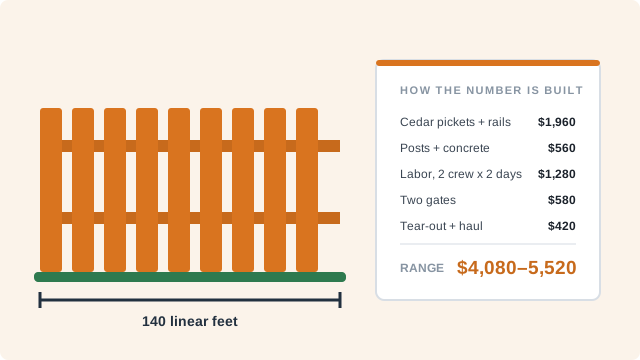
The Journal of Light Construction makes a related point about sales conversations. Writing about the 2025 Cost vs. Value report, it suggests that instead of leading with their prices, remodelers can “first deliver a generalized cost” that demonstrates the project will provide a return, and later “reveal the specific price for the project at hand.” A general number first, the exact one later: a range on your website gives the owner the general number before anyone books a visit. The owner whose budget is a third of your range leaves without costing you a morning; the one who books has already seen your numbers.
Showing Prices on Your Website Without a Quote Tool gives three ways to do it this week with your own invoices. For jobs with more variables than a table can hold, NapkinPrice™, our tool, shows an instant price range on your own website from pricing rules you set, and the owner who wants the visit leaves their details with their answers attached. You still confirm the final number on site.
A quick decision
General information, not legal or tax advice. Rules change and vary by state; check with the agency named above or a professional for your situation.