
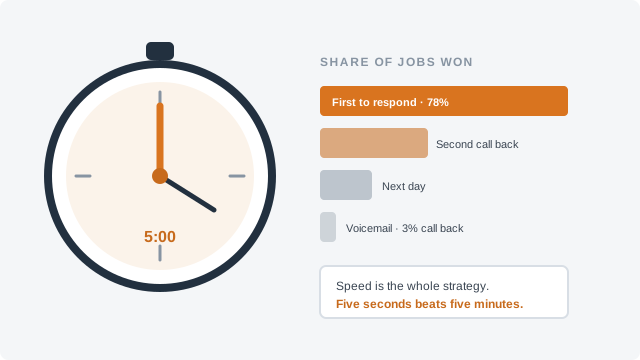
“The customer went quiet after my estimate. Now what?” Silence is not a no. She may be waiting on a spouse, a second bid or a paycheck; the number may have surprised her; or the email may be sitting unread. You only find out by asking. It is easy either to ask once and give up, or to keep asking with no plan until it turns into pestering. Here is a plan: a schedule by job size, the rules for each way of reaching her, three messages you can adapt, and the point where you stop.
Make the estimate easy to answer first
Follow-ups go better when the estimate itself gives her something to answer. Three things help:
A schedule by job size
A bigger job is a bigger decision, so the gaps grow with the job. Treat these as a starting point and adjust them to how long your own customers usually take:
| Job | Check-in | Nudge | Close the file |
|---|---|---|---|
| Small: a repair or a job under a day | Next business day | Day 4 | Day 10 |
| Medium: a fence, a deck, a roof repair | Day 2 | Day 7 | Day 21 |
| Large: a roof, a remodel, a week or more | Day 3 | Day 10 | Day 30, or a week before the price expires if that comes first |
Three touches, then stop. Each schedule above ends within a month of the estimate, so as long as the estimate went out promptly it finishes inside three months of her request, which matters for the calling rules below.
Which channel each step may use
She asked you for the estimate, so hearing back about it is what she expects. The federal rules still draw some lines, and they are different for calls, texts and email.
Calls you dial yourself
The FCC’s do-not-call rule bars “telephone solicitations” to numbers on the national registry (47 CFR §64.1200(c)(2)). But the rule’s definition of a telephone solicitation leaves out a call to someone who gave “prior express invitation or permission,” or someone with whom you have an “established business relationship” (§64.1200(f)(15)). Her inquiry about your services creates that relationship for the three months after it; a purchase creates one for 18 months (§64.1200(f)(5)). So a call about the estimate she asked for, made within three months, sits outside the registry rule. After that, a sales call to a registered number needs her permission.
Two more lines from the same rule are worth keeping for every follow-up call. Telephone solicitations are barred before 8 a.m. and after 9 p.m. at her location (§64.1200(c)(1)). And if she asks you to stop, the rule for telemarketing calls says to honor that request within a reasonable time, not more than ten business days, and to keep honoring it for five years (§64.1200(d)(3) and (d)(6)).
Texts
The FCC’s rule applies its do-not-call sections to text messages sent to cell phones (§64.1200(e)), so the three-month window above applies to texts too. A text you type and send yourself is the plainest case. Automated follow-up sequences raise a harder question: a message that encourages the sale and is sent by an autodialer needs the customer’s “prior express written consent,” a signed written agreement (an electronic signature can count) that names the number and tells her she does not have to agree in order to buy (§64.1200(a)(2) and (f)(9)). Whether a given texting tool counts as an autodialer is a legal question; do not guess at it. Send follow-ups by hand, or get that written consent first. States can add rules of their own: Florida’s law, for one, has its own written-consent rule for unsolicited sales calls and texts that involve “an automated system for the selection and dialing of telephone numbers” (Fla. Stat. §501.059(8)(a)), so check your state’s telemarketing law too.
The rule also lists “stop,” “quit,” “end,” “revoke,” “opt out,” “cancel” and “unsubscribe” as replies that revoke consent, says other words count if a reasonable person would read them that way, and allows at most ten business days to honor them (§64.1200(a)(10)). Simplest practice: any of those words, or “no thanks,” ends the follow-up the day you see it. The TCPA in plain English covers the rest of texting customers.
The CAN-SPAM Act sorts email by its primary purpose. The FTC’s guide lists “transactional or relationship” messages, which are exempt from most of the law, and the first item on that list is a message that “facilitates, completes, or confirms a commercial transaction that the recipient already has agreed to.” An estimate she has not accepted is not one she has agreed to, so a follow-up whose main point is to win the job can count as a commercial message. The guide’s requirements for commercial email are short, so meet them in every follow-up:
The FTC puts the penalty at up to $53,088 for each email that breaks the law, which is a lot to risk over a footer.
Three messages you can adapt
1. The check-in. Short, and about her, not you:
Hi [first name], it’s [your name] from [business]. Just making sure the estimate for [the job] came through and made sense. If anything in it is unclear, reply here and I’ll explain.
2. The nudge. Give her something new that helps her decide:
Hi [first name], a quick note on your [job] estimate: the price holds until [date], and my next open start is the week of [date]. If the scope or the budget needs to change, tell me what and I’ll rework it.
3. Close the file. Polite, final, and easy to answer:
Hi [first name], I haven’t heard back, so I’ll take it you’ve gone another way or put the job off, and I’ll close your file on [date]. If you’d like it kept open, just reply. Thanks for considering us.
For email, add your business name, your postal address, and one line under the signature: “Reply ‘no more’ and I won’t follow up again.”
When to stop
- She says no, or asks you to stop, in any words. Stop that day and note it.
- You have sent the last message on the schedule.
- The price has expired. Send a new estimate only if she asks for one.
- Three months have passed since her request, for calls and texts to a number on the registry, unless she has invited you to check back later.
Keep a one-line log for each estimate: the dates, the channel, what you sent and what she said. It is your proof of what you did, and it shows you which step actually brings the answers.
Keep the list where you will see it
The schedule only works if the open estimates are in one place. A whiteboard or a spreadsheet will do. If you send estimates from the office, each one goes by email with a link she accepts from, the job does not move to accepted until she does, and opens are counted while the estimate can still be accepted, so you can see whether she has even looked before you write. And when a follow-up turns into a finished job, the next message is the review request; asking for reviews within Google’s and the FTC’s rules covers that one.
General information, not legal or tax advice. Rules change and vary by state; check with the agency named above or a professional for your situation.