
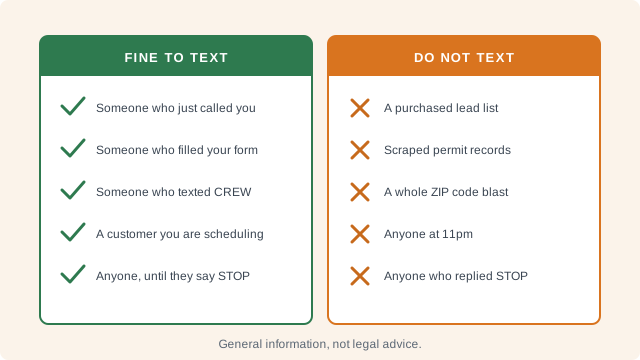
A two-column checklist of contractor texts that are fine to send and texts that are not

“What changed about texting customers?” Less than the headlines suggest, and more than most contractors have heard. The basics in TCPA in Plain English still stand. What changed since 2024 are the rules for how a customer takes consent back, a rule about how consent is given that a federal appeals court threw out, and, on October 1, 2026, a new FCC order that rewrites the take-back rules again before part of the old ones ever took effect. Here is the timeline, then what to do.

Which texts these rules are about

The Telephone Consumer Protection Act generally requires the recipient’s prior express consent for calls made with an autodialer or an artificial or prerecorded voice, absent an emergency or an exemption (47 U.S.C. §227(b)). The FCC treats a text message as a call, as the Eleventh Circuit noted in 2025. If a text sent that way includes an advertisement or is telemarketing, it needs prior express written consent (47 CFR §64.1200(a)(2)). Anyone who gets a text in violation can sue for actual losses or $500 per violation, whichever is greater, and a court may raise that to as much as three times the amount for a willful or knowing violation (§227(b)(3)). The revocation rules below apply to those consent-based texts.

2024: revoke any reasonable way, stop within ten business days

The FCC adopted its consent-revocation order, FCC 24-24, on February 15, 2024, and its rules took effect April 11, 2025, except for one part described below. As §64.1200(a)(10) to (12) read today:

  • A customer may revoke consent by any reasonable method that clearly says they do not want more texts.
  • A reply of “stop,” “quit,” “end,” “revoke,” “opt out,” “cancel” or “unsubscribe” is reasonable by definition, and so is an automated opt-out on a call or a website or phone number you designate for opt-outs.
  • Other words count if a reasonable person would read them as a request to stop. “Please quit texting me about the deck” is an opt-out.
  • You may not make one method the only way to opt out.
  • A revocation must be honored within a reasonable time, no more than ten business days after you receive it.
  • A voicemail or email asking you to stop creates a rebuttable presumption that consent was revoked.
  • You may send one confirmation text that only confirms the request and carries no marketing, as the only message after it. Sent within five minutes, it is presumed to fall within the customer’s consent. If the customer had agreed to several kinds of texts, it may ask which ones they meant.

The “revoke all” part that never took effect

The 2024 rule also said that once consent is revoked, the caller may not send additional robocalls and robotexts, which would make a STOP to one kind of message stop every message from that business, on unrelated matters too. The FCC’s Consumer and Governmental Affairs Bureau delayed that requirement twice: on April 7, 2025, to April 11, 2026 (DA 25-312), and on January 6, 2026, to January 31, 2027 (DA 26-12).

October 2026: the FCC rewrites the opt-out rules

On September 30, 2026, the FCC adopted FCC 26-67, released October 1. It changes three things for a business that texts customers:

  • You may name your opt-out method. A sender may designate one or more of three methods as the exclusive way to revoke: an automated voice or key-press opt-out on a call, a reply with any of the seven standard words, or a website or phone number it designates. The method must be disclosed clearly and conspicuously on the call or in the text. A texter can meet that by including at least one standard word in each text, such as “Reply STOP to opt out,” as long as it accepts all seven. A sender that designates a method need not process requests made any other way; one that does not must still honor any reasonable method.
  • A STOP to an informational text can stay in its lane. A revocation sent in reply to an informational message, one with no advertising or telemarketing, may be treated as covering only that category of informational messages. The FCC’s own example: someone who opts out of payment reminders may still want fraud alerts or appointment reminders.
  • A STOP to a marketing text stops all marketing. A revocation sent in reply to an advertisement or telemarketing message revokes consent to all future advertising and telemarketing calls and texts from that sender.

The ten-business-day deadline and the five-minute confirmation text stay. The changes take effect 30 days after the order is published in the Federal Register, and the FCC says it will announce the exact date in a public notice; at that point they replace the delayed “revoke all” requirement. Until then, the 2024 rules above apply. The same order asks for comment on going further: cutting the ten business days (a joint industry and consumer-group letter it cites suggests seven), ending the option of one-way texting, and requiring a one-step way to revoke everything. So the rules may move again.

For a contractor, the line between the two kinds of message is usually easy to see. “Your estimate visit is Tuesday at 9” is informational. “Book spring gutter cleaning by Friday and save 10%” is an advertisement, which needs prior express written consent before you send it by autodialer (§64.1200(a)(2)).

The one-to-one consent rule a court threw out

In 2023 the FCC adopted a rule, Part III.D of that year’s order, saying a consumer could consent to telemarketing robocalls and robotexts only from one seller at a time, and only on subjects “logically and topically associated” with the interaction that prompted the consent. The court described the lead-generation industry, the businesses that collect a consumer’s details and consent and sell the lead to the businesses that sell the service, as the one the rule affected most. On January 24, 2025, the Eleventh Circuit held in Insurance Marketing Coalition v. FCC that the FCC had exceeded its authority, because those limits conflicted with the ordinary meaning of “prior express consent,” and vacated that part of the order.

The decision removed a blanket rule; it did not approve every lead form. The rule’s definition of prior express written consent, in §64.1200(f)(9), still requires a signed written agreement that clearly authorizes the seller to send advertisements or telemarketing messages by autodialer or prerecorded voice to a stated number. Whether a form you bought a lead from clearly authorized your business is still the question. What the FTC’s HomeAdvisor case tells you about buying leads covers the questions to ask a lead seller.

Courts now read the statute themselves

One more change shapes how all of this plays out in a lawsuit. In McLaughlin Chiropractic Associates v. McKesson, decided June 20, 2025, the Supreme Court held that district courts in enforcement proceedings are not bound by the FCC’s interpretation of the TCPA: they decide what the statute means under ordinary principles of interpretation, while giving appropriate respect to the agency’s view. The FCC’s reading of the statute is weighty, but in a private suit it is not the last word on what the statute means. The safest practice is one that satisfies both the FCC’s rule and a plain reading of “consent.”

What to keep doing

  • Text only people who agreed to that kind of message, and get written consent before any promotion.
  • Put “Reply STOP to opt out” in your texts. It is good practice now, and it is one way a texter can disclose an exclusive method once the 2026 order takes effect.
  • Until then, treat any of the seven words and any plain request to stop, by text, voicemail or email, as an opt-out.
  • Send at most one confirmation, with no marketing in it, within five minutes.
  • Stop well inside ten business days. A system that suppresses the number automatically stops at once.
  • Keep reminders, invoices and promotions as separate kinds of message, so an opt-out can be applied to the right one.
  • Keep a record of when and how each customer gave consent, the wording they agreed to, and every opt-out.
  • Check the FCC’s public notice for the 2026 order’s effective date before you change your opt-out process.

This article covers only the federal rules; check your state’s as well. Our compliance page explains how we scoped texting around rules like these, and says plainly that our texting is not sending messages yet.

General information, not legal or tax advice. Rules change and vary by state; check with the agency named above or a professional for your situation.

Sources

  1. Report and Order and Further Notice of Proposed Rulemaking, FCC 24-24, CG Docket No. 02-278 (adopted February 15, 2024; released February 16, 2024), Federal Communications Commission (accessed October 22, 2026)
  2. 47 CFR 64.1200, Delivery restrictions, Legal Information Institute, Cornell Law School (accessed October 22, 2026)
  3. Order, DA 25-312, CG Docket No. 02-278 (April 7, 2025), Federal Communications Commission, Consumer and Governmental Affairs Bureau (accessed October 22, 2026)
  4. Order, DA 26-12, CG Docket No. 02-278 (January 6, 2026), Federal Communications Commission, Consumer and Governmental Affairs Bureau (accessed October 22, 2026)
  5. Report and Order and Further Notice of Proposed Rulemaking, FCC 26-67, CG Docket No. 02-278 (adopted September 30, 2026; released October 1, 2026), Federal Communications Commission (accessed October 22, 2026)
  6. Insurance Marketing Coalition Ltd. v. FCC, No. 24-10277 (11th Cir. January 24, 2025), U.S. Court of Appeals for the Eleventh Circuit (accessed October 22, 2026)
  7. McLaughlin Chiropractic Associates, Inc. v. McKesson Corp., No. 23-1226 (June 20, 2025), Supreme Court of the United States (accessed October 22, 2026)
  8. 47 U.S.C. 227, Restrictions on use of telephone equipment, Legal Information Institute, Cornell Law School (accessed October 22, 2026)

Where this comes from

Written by the team at Tailgate Office, LLC. Every figure comes from the sources listed above, as of the day each was accessed; prices and rules change without warning. Nothing here is legal, tax or financial advice.

Field Notes by email

One email a week with the week's Field Notes. Unsubscribe in one click. We never sell or share your address.

We email you a link to confirm first. What we keep, and for how long.

Keep reading

A two-column checklist of contractor texts that are fine to send and texts that are not
Compliance

Pennsylvania's Home Improvement Contractor Registration

Pennsylvania's home improvement law in plain words: who registers with the Attorney General, the $100 fee and the insurance minimums, what every contract must say, the one-third deposit cap and the three-day cancel right, and Philadelphia's own rules.

A two-column checklist of contractor texts that are fine to send and texts that are not
Compliance

Contractor Licensing in New York: No State License, but Local Ones

New York has no statewide home improvement license, but New York City and five counties do, and one state contract law covers jobs over $500. Who licenses what, the fees and insurance in the city, Nassau, Suffolk and Westchester, and the contract and escrow rules.

A two-column checklist of contractor texts that are fine to send and texts that are not
Compliance

Contractor Licensing in Maryland: The MHIC License

Maryland licenses home improvement work through its Home Improvement Commission. What counts as home improvement, who needs a contractor or salesperson license, the exam, the $500,000 insurance rule and the fees, the separate trade boards, the Guaranty Fund, and what every contract must say.

The office your truck never had.

Set it up tonight. It quotes tomorrow's leads, and every missed call you log gets answered from one inbox. Free for 30 days, no card required.