
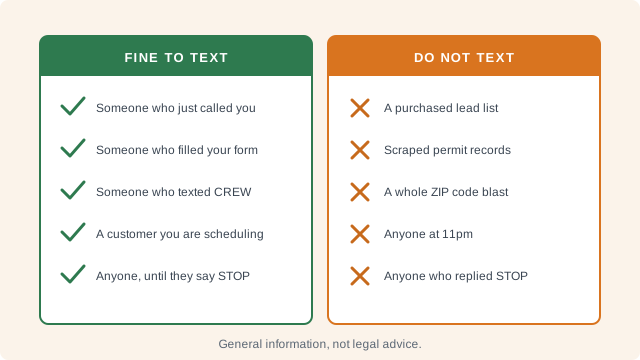
A two-column checklist of contractor texts that are fine to send and texts that are not

New York does not license home improvement contractors statewide. The Department of State’s building codes division says plainly that licensing of contractors or electricians is not something it handles; every city, town, village and county enforces the building code inside its own borders. Licensing happens closer to home. The Attorney General lists the places where a home improvement contractor must be licensed: New York City, and Suffolk, Nassau, Westchester, Putnam and Rockland counties. On top of both sits one state law, Article 36-A of the General Business Law, that governs the contract and the customer’s money on home improvement jobs over $500 anywhere in the state. Here are the three layers, and what each one asks of you.

Who licenses what

  • Home improvement work: a license from the city or county where the job is, in the six places above. Each county’s law covers work in that county, so a Long Island contractor who works on both sides of the county line needs both licenses. Some cities inside the counties add their own; Westchester’s application warns that the City of Yonkers has additional licensing requirements.
  • Plumbing and electrical: licensed locally, and kept out of the home improvement licenses. New York City’s consumer agency says its license does not cover new home construction, plumbing or purely electrical work; the city’s Department of Buildings licenses master plumbers and master electricians. Suffolk’s definition of home improvement excludes the electrical and plumbing fields, which the county licenses separately. Nassau requires every subcontractor except plumbers and electricians to hold a Nassau home improvement license.
  • A few state licenses that apply anywhere: businesses that work with asbestos need a license from the State Department of Labor, and installers of security and fire alarm systems are licensed by the Department of State’s Division of Licensing Services.

Outside those places, check the town or city where the job is before you start: ask the building department that issues the permit whether the town licenses contractors. The general method is in Do I Need a Contractor License?

New York City: the DCWP license

The Department of Consumer and Worker Protection (DCWP) requires a Home Improvement Contractor license for construction, repair, remodeling or other home improvement work that costs more than $200 to any residential building. Its checklist names basements, driveways, fences, garages and landscaping among the work covered. To get it:

  • The exam. One owner, officer or shareholder with 10% or more passes it: 30 questions, 21 correct to pass, within 60 days of appearing in the testing system. The application fee covers two attempts; two more cost $50.
  • The money behind your customers. Join the Home Improvement Business Trust Fund for $200, or file a $20,000 surety bond.
  • The paperwork. A workers’ compensation certificate naming DCWP as certificate holder, or the exemption attestation; your EPA lead certifications or a signed affirmation that they do not apply (see EPA’s Lead Paint Rule); fingerprints; and a sales tax ID.
  • The fee and term. Licenses run two years and expire February 28 of odd years. The fee depends on where in that cycle you file: $200 for a full 24 months, and from $50 for six months to $250 for 30 months at other points.

In the city, salespeople no longer need a license of their own. Local Law 31 of 2020 eliminated the home improvement salesperson license as duplicative of the contractor license, and DCWP repealed its salesperson rules to match.

Nassau County

Nassau’s Department of Consumer Affairs is blunt about timing: the license must be in your possession before any work, advertising or solicitation. Filing the application is not permission to operate. Its instructions (August 2024) list:

  • $650 for a two-year license, plus a one-time $50 payment to the Restitution Fund and $110 for each additional location.
  • One owner or officer with at least five years of recent, verifiable experience, shown by W-2s, 1099s or a license from another municipality.
  • Liability insurance of $250,000/$500,000 for bodily injury and $100,000 for property damage, with each kind of work you do spelled out on the certificate. “General Contracting”, “Remodeling”, “Carpentry” and “Home Improvement” are not accepted as descriptions.
  • A one-time fingerprint background check, about $90, and a New York State business location; an out-of-state company needs a Certificate of Authority and a contact person who lives in New York.

Suffolk County

Chapter 563 of the Suffolk County Code licenses home improvement on one- and two-family houses, and its list is long: painting, carpentry, fencing, driveways, exterminating, flooring, heating and air-conditioning ductwork, masonry, roofing, siding, pools and spas, waterproofing, landscaping and tree work. The main rules:

  • A written test on the requirements of the county law (§563-17).
  • A $200 application fee and a license fee of $200 a year, on two-year licenses (§§563-19, 563-6). An unincorporated applicant whose net income from the business is $20,000 a year or less pays half the license fee (§563-24).
  • Certificates of liability insurance, which the county may require at $500,000 per occurrence, and of workers’ compensation (§§563-11, 563-17), and a business establishment in New York State.
  • Your county license number in all advertising, and on the contract or receipt you give the customer (§§563-17, 563-15.1).
  • Unlike the city, Suffolk still requires a salesperson who sells for you away from your place of business, other than the person who signed the license application, to carry a county identification card, $50 a year (§§563-18, 563-19, 563-23).

Working without the license is a misdemeanor punishable by a fine of up to $5,000, up to a year in jail, or both, each violation a separate offense (§563-12). A contract signed while unlicensed cannot be enforced by the contractor, and the customer may void it (§563-8).

Westchester County

Westchester’s Department of Consumer Protection licenses home improvement on homes of up to three units. The county’s list reaches past remodeling to landscaping and gardening, arboriculture, excavation, HVAC, and power or pressure washing. Since January 1, 2026 the license costs $750 for two years, plus $10 for each vehicle decal; processing takes about 60 business days, or seven for an extra $100. You file a liability insurance certificate naming the department, and workers’ compensation and disability certificates or the exemption form. Two rules show on every job: the license number on all advertising, stationery, proposals, change orders, invoices and contracts (§863.319), and your name and address on both sides of any vehicle parked at the site, legible from 50 feet (§863.326). Operating without a license is a Class A misdemeanor (§863.320). Where a city, village or town licenses home improvement itself, the county law steps aside there (§863.321). Putnam and Rockland run their own programs; check with the county before the first job.

The state contract law that applies everywhere

Licensed county or not, Article 36-A covers home improvement contracts over $500, made by a contractor whose home improvement contracts total more than $1,500 in any 12 months (§770), and no city or county may pass a law inconsistent with its contract section (§775). Section 771 says the contract must be in writing, signed, legible and in plain English, with a signed copy given to the owner before any work is done. It must include:

  1. Your name, address, telephone number and license number, if you have one.
  2. The approximate dates the work will begin and be substantially completed, with any contingencies that would materially change the finish date, and whether you and the owner have agreed that a definite completion date is of the essence.
  3. A description of the work and the materials, with make, model number or other identifying information, and the agreed price.
  4. A notice in bold type that unpaid contractors and suppliers may have a lien claim against the property.
  5. A notice of how you will protect the owner’s payments (below).
  6. If there are progress payments, a schedule giving each amount in dollars and the stage of work it pays for, bearing a reasonable relationship to the work, materials or expenses at that point.
  7. The owner’s right to cancel until midnight of the third business day after signing. The only exception is a bona fide emergency where the owner contacted you first, with a dated, signed statement in the owner’s own handwriting waiving the right.
  8. Before work starts, the property or casualty insurance policy covering your work, with the insurer’s contact details.

The money rule is the one contractors from other states miss. Under Lien Law §71-a(4), payments you receive before substantial completion go into an escrow account at a bank in New York within five business days, and you tell the owner in writing where it is within ten business days of the deposit. Instead of escrow, you may post a bond, contract of indemnity or irrevocable letter of credit. Payments for work already done and billed by the hour are exempt. This sits beside the Lien Law trust rule covered in Construction Trust Fund Laws.

The penalties are modest per contract and add up across a year of jobs: up to $100 for a technical violation, and for missing escrow or bond protection or a compliant written contract, the greater of $250 per violation or 5% of the contract price, capped at $2,500 per contract (§773). A contractor who shows the violation was not intentional and was a bona fide error despite reasonable procedures avoids the higher tier. An owner induced to sign by false written statements may recover $500, attorney’s fees and damages (§772). What other states put on their lists is in What a Home Improvement Contract Must Say.

Before your first New York job

  • Find the county and city of the job, and get the license there before you advertise.
  • Leave plumbing and electrical to holders of the local license for that trade.
  • Open the New York escrow account, or arrange the bond, before the first deposit arrives.
  • Build one contract template that meets §771, and put your license number on it and on your ads (more in Your License Number in Ads).
  • Coming from New Jersey or Connecticut? Nassau and Suffolk both require a New York location; the rest of crossing a state line is in Working Across a State Line.

General information, not legal or tax advice. Rules change and vary by state; check with the agency named above or a professional for your situation.

Sources

  1. New York General Business Law section 770, Definitions, The New York State Senate (accessed October 22, 2026)
  2. New York General Business Law section 771, Contract provisions, The New York State Senate (accessed October 22, 2026)
  3. New York General Business Law section 772, Penalty for fraud, The New York State Senate (accessed October 22, 2026)
  4. New York General Business Law section 773, Civil penalty, The New York State Senate (accessed October 22, 2026)
  5. New York General Business Law section 775, Applicability, The New York State Senate (accessed October 22, 2026)
  6. New York Lien Law section 71-a, Trust accounting and deposits, The New York State Senate (accessed October 22, 2026)
  7. Hiring a home-improvement contractor, New York State Attorney General (accessed October 22, 2026)
  8. Division of Building Standards and Codes Frequently Asked Questions, New York State Department of State (accessed October 22, 2026)
  9. Get a Security or Fire Alarm Installer License, New York State Department of State (accessed October 22, 2026)
  10. Asbestos Handling License, NYC MyCity Business (accessed October 22, 2026)
  11. License Checklist: Home Improvement Contractor, NYC Department of Consumer and Worker Protection (accessed October 22, 2026)
  12. Wall of Shame! Department of Consumer and Worker Protection 'Nails It' To Unlicensed Home Improvement Contractors (September 4, 2024), NYC Department of Consumer and Worker Protection (accessed October 22, 2026)
  13. Notice of Adoption: Repeal of Requirements for Home Improvement Salespersons, NYC Department of Consumer and Worker Protection (accessed October 22, 2026)
  14. Obtain a Master Plumber License, NYC Department of Buildings (accessed October 22, 2026)
  15. Master Electricians and Special Electricians, NYC Department of Buildings (accessed October 22, 2026)
  16. General Instructions for a Home Improvement License (8-2024), Nassau County Department of Consumer Affairs (accessed October 22, 2026)
  17. Suffolk County Law Regarding Home Improvement License (Suffolk County Code Chapter 563), Suffolk County Department of Labor, Licensing and Consumer Affairs (accessed October 22, 2026)
  18. Home Improvement Fact Sheet (revised 10/16/24), Suffolk County Department of Labor, Licensing and Consumer Affairs (accessed October 22, 2026)
  19. Home Improvement Contractors, Westchester County Department of Consumer Protection (accessed October 22, 2026)
  20. Westchester County Home Improvement License Application, with the Laws Governing Westchester County Home Improvement Contractors (rev. 1-2026), Westchester County Department of Consumer Protection (accessed October 22, 2026)

Where this comes from

Written by the team at Tailgate Office, LLC. Every figure comes from the sources listed above, as of the day each was accessed; prices and rules change without warning. Nothing here is legal, tax or financial advice.

Field Notes by email

One email a week with the week's Field Notes. Unsubscribe in one click. We never sell or share your address.

We email you a link to confirm first. What we keep, and for how long.

Keep reading

A two-column checklist of contractor texts that are fine to send and texts that are not
Compliance

Pennsylvania's Home Improvement Contractor Registration

Pennsylvania's home improvement law in plain words: who registers with the Attorney General, the $100 fee and the insurance minimums, what every contract must say, the one-third deposit cap and the three-day cancel right, and Philadelphia's own rules.

A two-column checklist of contractor texts that are fine to send and texts that are not
Compliance

Contractor Licensing in Maryland: The MHIC License

Maryland licenses home improvement work through its Home Improvement Commission. What counts as home improvement, who needs a contractor or salesperson license, the exam, the $500,000 insurance rule and the fees, the separate trade boards, the Guaranty Fund, and what every contract must say.

A two-column checklist of contractor texts that are fine to send and texts that are not
Compliance

The Home Energy Tax Credits Ended: What to Tell Customers

Public Law 119-21 ended the federal tax credits for heat pumps, insulation, windows and solar for work after 2025. What ended and when, what a customer may still get from state and utility programs, and the sales lines to retire now.

The office your truck never had.

Set it up tonight. It quotes tomorrow's leads, and every missed call you log gets answered from one inbox. Free for 30 days, no card required.