
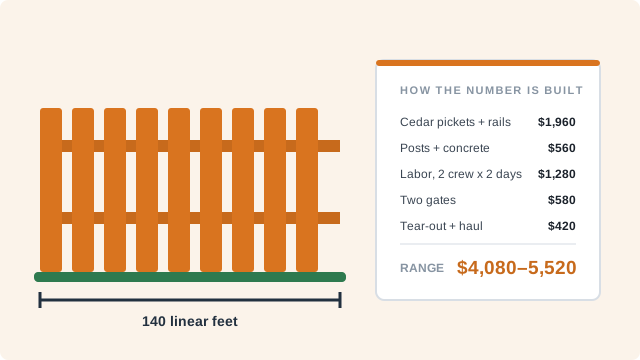
“How do I tell customers my prices are going up?” The answer that keeps customers is a plain one: work out exactly how much you need, check it against the public numbers, pick a date, tell people plainly, and keep every promise already made. Here it is in that order.
Step 1: Work out your own number
The increase you need is not the increase in your material bill. It is whatever keeps your margin where it was. The arithmetic is in Markup vs. Margin: The Pricing Mistake That Eats Your Profit; here is how it plays out when costs rise.
Say a fence company sells a typical job for $10,000: $4,000 of materials, $3,000 of labor, and $3,000 left to cover overhead and profit, a 30% gross margin. Materials go up 10%, to $4,400. Two ways to respond:
| Old price | Pass on the $400 | Keep the 30% margin | |
|---|---|---|---|
| Materials and labor | $7,000 | $7,400 | $7,400 |
| Price | $10,000 | $10,400 | $10,571 |
| Left for overhead and profit | $3,000 | $3,000 | $3,171 |
| Gross margin | 30.0% | 28.8% | 30.0% |
Passing on the dollar amount looks fair and quietly shrinks the margin, because the same $3,000 now sits on a bigger price. Keeping the margin means dividing the new cost by one minus the margin: $7,400 ÷ 0.70 = $10,571, a 5.7% increase. And if your overhead rose too (insurance, fuel, the shop lease, your helper’s raise), that $3,000 is not enough any more either, so add those increases before you divide.
Do this for your three or four most common jobs. That tells you whether you need 3% or 12%, and whether it is the same across the board or concentrated in one line of work.
Step 2: Check it against the public numbers
Your supplier invoices are your best evidence. The Bureau of Labor Statistics gives you a second, public one, which helps both your own confidence and the conversation with a customer.
These figures come from the latest releases as of October 2026, and BLS publishes new ones on a regular schedule, so they will soon be out of date. To look up the current materials figure yourself, open the BLS series page in the sources below and compare the latest month’s value with the same month a year earlier. If your own increase is well above what the indexes show, look again at your costs before you blame the market. If it is well below, check that you counted every cost that rose.
Step 3: Pick the date, and give notice
A price change lands best when it has a date on it and arrives before the customer is ready to buy, not in the middle of a job. For seasonal trades that means before the season: a lawn or pool service tells its regulars in late winter, a snow service tells them before the first storm, a roofer or painter before the spring booking rush. Pick an effective date a few weeks out, so the customer has time to read it and book at the old price if they want to. Anyone who does is booking work with you, which is a fair trade for the goodwill.
Step 4: Keep every promise already made
Step 5: Write the letter
Regular customers should hear it from you, by letter or email, before they see it on an invoice. One-time customers simply get the new price on their next estimate. Keep the letter short: what is changing, from when, why in one sentence, what stays the same, and thanks. An example to adapt:
Thank you for trusting us with your lawn over the past seasons. Starting March 1, our weekly mowing price goes from $45 to $49 a visit. What we pay for fuel, equipment and wages has gone up over the past year, and this keeps the same crew coming on the same day with the same care. Anything booked before March 1 stays at the current price. If you have questions, reply to this email and I will answer personally.
Notice what it does not do. It does not apologize three times, it does not list every cost line, and it does not argue. Customers who ask for more can get the index figures above, which do the arguing for you. Avoid slipping the increase in as a new fee or a fuel surcharge instead of a price: a surprise line on an invoice raises exactly the question the letter was written to answer.
Step 6: Say it the same way to everyone
The phone call where a regular says “my neighbor’s guy is cheaper” will come. Decide beforehand what you will say, and say it the same way each time: the new price, what it includes, and that you understand if they need to shop. If you discount for one customer who complains, the ones who did not complain are paying more for the same work. If a regular truly cannot pay the new price, offering less frequent visits or a smaller scope keeps the relationship without cutting your rate.
Then watch what happens. Count how many regulars leave in the three months after the change and how many new estimates you win at the new price. That is your real evidence for the next increase, and it is better than any guess.
Update every place your price appears
On the effective date, change the price everywhere at once: your estimate templates, your price sheet, your service agreements for renewal, and your website. A homeowner who sees one number online and another on the estimate starts the job with a question. If your website shows instant price ranges with NapkinPrice™, change its rates the same day, so the range a visitor sees already carries the new price and your margin.