
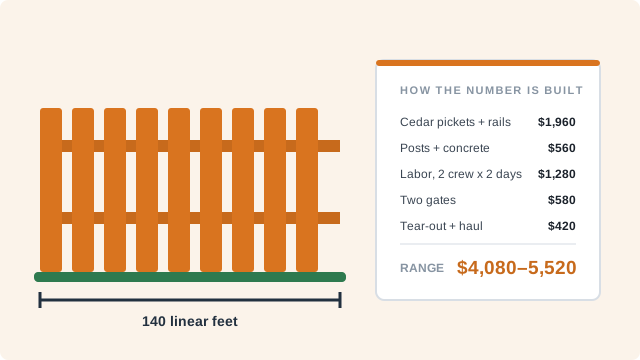
A 140-foot cedar fence line beside a price breakdown of material, posts, labor, gates and tear-out

You price a deck in January, the customer signs, and the job slips to June. By the time you order, the lumber on the supplier's counter costs more than the lumber in your estimate. That gap between the price you wrote and the price you pay is what a material price escalation clause is for. On a small residential job it is not always the right tool, though, and a badly written one can cost you the sale. Here is when to use one, how to tie it to a number the customer can check, and the simpler fixes that often do the job better.

What material prices did in the past year

The Bureau of Labor Statistics publishes producer price indexes for the materials contractors buy, every month, free to anyone. Comparing September 2025 with September 2026:

BLS index (series)Sep 2025Sep 2026Change
Lumber (WPU081)259.750282.340+8.7%
Softwood lumber (WPU0811)252.782288.562+14.2%
Iron and steel (WPU101)317.520383.330+20.7%
Copper and brass mill shapes (WPU102502)642.679835.342+30.0%
Copper wire and cable (WPU10260314)464.522607.705+30.8%
Inputs to residential construction, goods (WPUIP2311001)323.904355.225+9.7%

The September 2026 values are preliminary; BLS notes that all its indexes are subject to monthly revisions up to four months after original publication. How the wider building-materials figures read, and how to use them when you raise prices for new work, is in raising your prices without losing your customers.

These are national producer prices, not your supplier's counter price. They tell you the direction and the size of a move, and they have one property your supplier's invoice does not: the customer can look them up.

Try the cheaper fixes first

  • A quote that expires. Print how long the price holds, in days, on every estimate, and keep it short for copper-heavy or steel-heavy work, so a customer who waits two months gets a fresh price instead of last season's.
  • Buy at signing. Take the deposit and order the materials the same week, and the price risk ends there. Before you rely on this, check what your state lets you take up front: how big a deposit you can legally ask for covers it.
  • An allowance for the volatile line. Price the item you cannot lock, such as cabinets or a specific fixture, as an allowance that is adjusted to the actual cost, and say so in writing.
  • A held supplier price. Ask your supplier in writing how long its quote to you holds. If it holds 30 days, your quote to the customer should not hold 60.

When an escalation clause is worth it

A clause earns its place when three things line up: weeks or months will pass between the signature and the purchase, materials are a large share of the price, and the materials are the kind that are moving, which in the table above means copper wire, steel and lumber. A job whose imported materials face a tariff change on a known date belongs on the list too (more on that below).

It is not worth it on a service call, a repair you will buy for this week, or any job where the explaining takes longer than the risk is worth. Every extra sentence on an estimate is one more thing for a homeowner to question, and a clause the customer does not understand can read like a way to raise the price later.

Tying the clause to a published index

A clause tied to your own supplier's invoices invites the question of whether you shopped around. A clause tied to a public index answers it in advance. Five parts make it work:

  1. The index. Name the BLS series by its title and its ID, for example “Softwood lumber, series WPU0811”, so there is no question which number counts.
  2. The two months. Compare the index for the month the customer signed with the index for the month you order, and say which published value counts (the first one published, for example), so a later revision does not reopen a paid invoice.
  3. A trigger. No adjustment unless the index moved more than a set percentage, such as 5 percent. Small moves stay your problem, as they always were.
  4. A base. The clause applies only to the materials amount written on the estimate, never to labor or the whole price.
  5. Both directions and a cap. If the index falls past the trigger, the customer gets the credit. Above a cap, the customer may cancel on terms the contract states.

A worked example. Say a fencer prices a privacy fence at $14,000, with $6,000 shown on the estimate as materials. The clause uses the softwood lumber index, a 5 percent trigger, adjusts only for the part of the change above the trigger, rounds the change to one decimal place and caps the adjustment at 10 percent of materials, $600. The customer signs in January 2026, when the index stood at 259.987, and the job slips until the fencer orders in May, when it stood at 284.485 (both values as BLS shows them today). That is a rise of 9.4 percent, 4.4 points above the trigger, and 4.4 percent of $6,000 is $264. The new price is $14,264, under the cap. Had the index risen 3 percent, nothing would change; had it fallen 7 percent, the customer would get 2 percent of $6,000, $120, back.

On the estimate itself, the clause can be short. An example of the wording, to adapt and have checked, not to copy as legal language:

The materials amount of $6,000 is tied to the BLS producer price index for softwood lumber (series WPU0811). If the first published index for the month we order differs from the index for the month you signed by more than 5%, the materials amount changes by the part of the change above 5%, up or down, up to $600. If the increase would pass $600, you may cancel instead.

How tariffs reach your price

Tariffs under Section 232 of the Trade Expansion Act are set by presidential proclamation, published in the Federal Register with the date they start. That date is what makes them useful to you: it tells you in advance which jobs will buy materials after a change.

  • Wood. Proclamation 10976 (September 29, 2025) put a 10 percent duty on imported softwood timber and lumber and 25 percent on upholstered wooden products and on kitchen cabinets and vanities, for goods entered from October 14, 2025, with lower caps for wood products from the United Kingdom (10 percent) and from the European Union and Japan (15 percent including the regular duty). It scheduled cabinets and vanities to rise to 50 percent and upholstered products to 30 percent on January 1, 2026. Proclamation 11000 (December 31, 2025) moved both increases to January 1, 2027, and left the 10 percent lumber rate as it was.
  • Metals. Proclamation 10947 raised the steel and aluminum tariffs from 25 to 50 percent from June 4, 2025 (goods from the United Kingdom stayed at 25 percent). Proclamation 10962 put a 50 percent tariff on semi-finished copper products and intensive copper derivative products from August 1, 2025. Proclamation 11021, signed April 2, 2026, reworked the steel, aluminum and copper tariffs again for goods entered from April 6, 2026.

Say a remodeler quotes a kitchen in November 2026 with imported cabinets that will be ordered after New Year. For cabinets from most countries, the duty on those entering the country from January 1, 2027 is scheduled to double, from 25 to 50 percent, unless another proclamation changes it first. That is a known, dated risk, and it belongs in an allowance or a clause, not in your margin. Ask the cabinet supplier in writing whether its price holds past that date.

Writing it so the customer says yes

  • Put the clause on the face of the estimate, next to the materials amount, not in fine print.
  • Explain it in one sentence when you hand over the price: the clause protects both of you, and the customer can check the index on the BLS website.
  • Keep the money moving both ways, so the clause shares a risk instead of passing it one way.
  • Check your state's rules. What a written home improvement contract must say about the price is set state by state; read what a home improvement contract must say and have a lawyer in your state look at the clause before you use it.

An escalation clause covers the materials in a job already sold. Raising your prices for the next season's work is a different conversation, covered in the price-rise article linked above, and work the customer adds mid-job belongs in a signed change order, priced at the day's cost.

If you send estimates from the office in our tools, each one states how long it holds, so the expiry date is in front of the customer from the first email.

General information, not legal or tax advice. Rules change and vary by state; check with the agency named above or a professional for your situation.

Sources

  1. PPI Commodity data for Lumber and wood products-Lumber, not seasonally adjusted (series WPU081), U.S. Bureau of Labor Statistics (accessed October 22, 2026)
  2. PPI Commodity data for Lumber and wood products-Softwood lumber, not seasonally adjusted (series WPU0811), U.S. Bureau of Labor Statistics (accessed October 22, 2026)
  3. PPI Commodity data for Metals and metal products-Iron and steel, not seasonally adjusted (series WPU101), U.S. Bureau of Labor Statistics (accessed October 22, 2026)
  4. PPI Commodity data for Metals and metal products-Copper and brass mill shapes, not seasonally adjusted (series WPU102502), U.S. Bureau of Labor Statistics (accessed October 22, 2026)
  5. PPI Commodity data for Metals and metal products-Copper wire and cable, not seasonally adjusted (series WPU10260314), U.S. Bureau of Labor Statistics (accessed October 22, 2026)
  6. PPI Commodity data for Inputs to residential construction, goods, not seasonally adjusted (series WPUIP2311001), U.S. Bureau of Labor Statistics (accessed October 22, 2026)
  7. Proclamation 10976 of September 29, 2025, Adjusting Imports of Timber, Lumber, and Their Derivative Products Into the United States, 90 FR 48127, Federal Register, via GovInfo (U.S. Government Publishing Office) (accessed October 22, 2026)
  8. Proclamation 11000 of December 31, 2025, Amendments to Adjusting Imports of Timber, Lumber, and Their Derivative Products Into the United States, 91 FR 1039, Federal Register, via GovInfo (U.S. Government Publishing Office) (accessed October 22, 2026)
  9. Proclamation 10947 of June 3, 2025, Adjusting Imports of Aluminum and Steel Into the United States, 90 FR 24199, Federal Register, via GovInfo (U.S. Government Publishing Office) (accessed October 22, 2026)
  10. Proclamation 10962 of July 30, 2025, Adjusting Imports of Copper Into the United States, 90 FR 37727, Federal Register, via GovInfo (U.S. Government Publishing Office) (accessed October 22, 2026)
  11. Proclamation 11021 of April 2, 2026, Strengthening Actions Taken To Adjust Imports of Aluminum, Steel, and Copper Into the United States, 91 FR 18201, Federal Register, via GovInfo (U.S. Government Publishing Office) (accessed October 22, 2026)

Where this comes from

Written by the team at Tailgate Office, LLC. Every figure comes from the sources listed above, as of the day each was accessed; prices and rules change without warning. Nothing here is legal, tax or financial advice.

Field Notes by email

One email a week with the week's Field Notes. Unsubscribe in one click. We never sell or share your address.

We email you a link to confirm first. What we keep, and for how long.

Keep reading

A 140-foot cedar fence line beside a price breakdown of material, posts, labor, gates and tear-out
Pricing

Break-Even: How Much Work Before You Make a Dollar

The SBA's break-even formula in a contractor's terms: monthly fixed costs divided by gross margin, turned into a weekly sales figure and a job count, and what a price rise, a discount or a new truck does to the number.

A 140-foot cedar fence line beside a price breakdown of material, posts, labor, gates and tear-out
Pricing

Overhead per Billable Hour: The Number Under Every Price

The truck, the insurance and the phone never show up on a job, so they have to ride on every hour you sell. How to total a year of overhead from your Schedule C, divide it by the hours you really bill, and why the busy season has to carry the slow one.

A 140-foot cedar fence line beside a price breakdown of material, posts, labor, gates and tear-out
Pricing

Moving Estimates: Binding, Non-Binding and Not-to-Exceed

For a move across a state line, federal rules allow two written estimates, binding and non-binding, and cap what a non-binding one collects at delivery at 110%. What each commits you to, the papers the customer gets, how Texas and California handle local moves, and pricing the hourly job.

The office your truck never had.

Set it up tonight. It quotes tomorrow's leads, and every missed call you log gets answered from one inbox. Free for 30 days, no card required.