
“How do I know if I can make payroll in six weeks?” Not from the bank balance. The balance tells you about today. Whether payroll clears in week six depends on which customers pay before then, which bills land first, and whether a quarterly tax payment falls in the gap. A one-page forecast, updated every Monday, answers the question early enough to change the answer.
The squeeze is common. In the Federal Reserve Banks’ 2025 survey of small employer firms, published in March 2026, 54% said paying operating expenses (the survey’s examples are payroll, rent and inventory) had been a financial challenge in the prior twelve months, and 50% named uneven cash flow, which the survey says includes collecting on receivables. The cushion is often thin: the JPMorgan Chase Institute’s study of 597,000 small businesses with Chase business accounts, using their transactions from February to October 2015, found the median construction business held about 20 days of outflows in cash. Twenty days does not ride out a slow month on its own.
Why 13 weeks
Thirteen weeks is a quarter. It is long enough to show the things that ambush you, such as a quarterly tax payment, an annual insurance renewal or the slow stretch at the end of the season, and short enough that you can make an honest guess about each week. Past a quarter, you are mostly guessing at work not yet sold; inside it, much of the money is already signed or invoiced.
The forecast counts money when it moves, not when it is earned. The SBA describes the difference in accounting terms: “The accrual method puts transactions on the books immediately upon completing the sale. The cash method only records this once payment has been received.” Your books can use either. The forecast always works the cash way: an invoice you sent is not money until the day you expect it in the bank.
The page
One sheet, a column for each of the next 13 weeks, and these rows:
Filling in the money coming in
Signed jobs first. For each job, put the deposit in the week it will be signed and the progress and final payments in the weeks the work will reach those points. If your payment schedule is vague, the forecast will be too; getting paid faster covers tying payments to work the customer can see.
Open invoices at their real dates. Use how each customer actually pays, not the due date printed on the invoice. A customer who has paid three weeks late twice is a three-weeks-late line.
Open estimates on a separate line, and never in the total. They are not money yet. Work out your close rate from last quarter: say you sent 20 estimates and 6 were accepted, so 30%. Then three open estimates worth $26,000 together suggest about $7,800 of work, at some point. Write that on its own line under the forecast as a hint of what may come. Make the payroll decision on signed work only.
Filling in the money going out
A worked example
Say a deck builder with a two-person crew sits down on Monday, 2 November. The business account holds $14,000. Payroll with its taxes runs about $4,800 a week, the monthly bills about $2,400, and the fourth-quarter estimated tax payment due 15 January is about $4,500. The owner sets a floor of $6,000. Every figure here is made up for the example; the shape is the point.
| Week of | Cash in | Cash out | End of week | What moves |
|---|---|---|---|---|
| 2 Nov | $9,500 | $10,200 | $13,300 | Final payment, job A; payroll; monthly bills; materials for job B |
| 9 Nov | $4,000 | $4,800 | $12,500 | Deposit, job C |
| 16 Nov | $6,500 | $7,300 | $11,700 | Progress payment, job B; materials for job C |
| 23 Nov | $0 | $4,800 | $6,900 | Payroll only |
| 30 Nov | $11,000 | $7,200 | $10,700 | Final payment, job B; monthly bills |
| 7 Dec | $5,000 | $4,800 | $10,900 | Progress payment, job C |
| 14 Dec | $0 | $4,800 | $6,100 | Payroll only |
| 21 Dec | $7,500 | $4,800 | $8,800 | Final payment, job C |
| 28 Dec | $2,500 | $5,400 | $5,900 | Repair invoices; short holiday payroll; monthly bills |
| 4 Jan | $3,500 | $4,800 | $4,600 | Repair invoices |
| 11 Jan | $3,000 | $9,300 | −$1,700 | Estimated tax due 15 Jan |
| 18 Jan | $4,000 | $4,800 | −$2,500 | Deposit, job D |
| 25 Jan | $5,000 | $7,200 | −$4,700 | Repair invoices; monthly bills |
The bank balance on 2 November looks fine, and for six weeks it stays fine. The forecast says otherwise: the balance brushes the floor in late November and mid-December, drops under it at the end of December, and goes negative in the week the estimated tax is due. The owner sees it ten weeks ahead, with time to act:
- Sign job D in December instead of January and take its deposit then, which moves $4,000 forward.
- Sell indoor or repair work for January, when the deck crew would otherwise be thin.
- Bill job C’s final payment the day the work is done, and follow up the slow payers before the holidays, not after.
- Move a planned tool purchase past January, or lower the owner’s draw for those weeks.
- If a gap is still left, arrange financing now, while the books look healthy, rather than in the week the account goes negative. Line of credit, SBA loan or equipment financing compares the options.
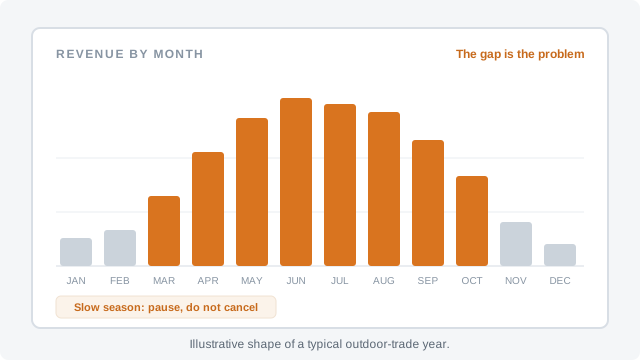
The winter hole itself is no surprise to an outdoor trade; seasonal cash flow is about planning the slow months. The forecast is what tells you exactly which week the hole begins and how deep it is.
The early warnings
Keep it rolling
Every Monday, take fifteen minutes: put in what actually came in and went out last week, fix the dates that moved, and add a new week 13 at the far end. Compare last week’s forecast with what happened. Where you were wrong, it is almost always the same lines, usually customer payment dates, and correcting them makes every later forecast better. Over a season, it also shows which jobs paid for the weeks they used; job costing takes that question further.
The forecast is only as good as the list of what is open. If you send estimates and invoices from the office, the estimates list filters to sent and accepted, and the invoice list shows each invoice’s status and due date, which gives you most of the cash-in rows in one sitting.
General information, not legal or tax advice. Rules change and vary by state; check with the agency named above or a professional for your situation.