
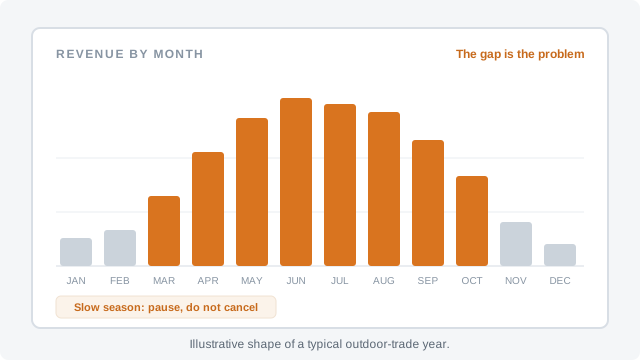
“Where do I get money for a second truck?” Start with what the money is for, because small contractors borrow for two different jobs. One is timing: you buy materials and pay the crew this week, and the customer pays in thirty days. The other is equipment: a truck, a trailer or a machine that earns its keep over years. A line of credit is built for the first. A term loan, including an SBA loan, or equipment financing is built for the second. Mix them up and you pay too much or run short at the wrong moment. Here is each one, what it asks of you, and how small employers fared applying for them last year.
What small firms applied for, and what they got
The Federal Reserve Banks’ Small Business Credit Survey asked 6,525 employer firms about their borrowing in fall 2025 and published the results in March 2026. Among firms that applied for a loan, a line of credit or a merchant cash advance, 43 percent applied for a business line of credit, 32 percent for a business loan, 20 percent for an SBA loan or line, and 12 percent for an auto or equipment loan. The results by product were far apart:
| Product | Fully approved | Partly approved | Denied |
|---|---|---|---|
| Auto or equipment loan | 71% | 17% | 11% |
| Business line of credit | 45% | 31% | 24% |
| Business loan | 37% | 35% | 28% |
| SBA loan or line of credit | 32% | 29% | 40% |
Where you apply matters as well. Applicants at small banks (under $10 billion in assets) were the most likely to be fully approved, at 57 percent, against 43 percent at large banks. Among firms with less than $1 million in revenue, 76 percent of small-bank applicants were at least partly approved, against 64 percent at large banks.
The line of credit: for gaps, not for trucks
A line of credit lets you draw what you need, when you need it, up to a limit, and pay it back as jobs pay you. That matches the reasons most firms gave for seeking money: 56 percent of applicants in the survey wanted to meet operating expenses, and 42 percent wanted credit available for future use.
The habit that keeps a line healthy is simple: every draw has a job attached that will pay it back. Draw $8,000 for materials on a job that pays in five weeks, repay it in week five. A line that never comes back down is funding a loss or a purchase it was not built for. A rolling forecast shows when each draw comes back; Cash Flow for Contractors: A 13-Week Forecast on One Page builds one, and Seasonal Cash Flow covers the slow months.
The SBA has a line-of-credit version too, the 7(a) Working Capital Pilot, with lines up to $5 million and a maximum maturity of 60 months. The SBA describes it for firms in industries “like manufacturing, wholesale, or professional services” with at least a year of operating history that can produce “timely and accurate financial statements, accounts receivable and accounts payable agings, and inventory reports.” In the survey, most bank applicants (61 percent at large banks, 62 percent at small ones) said they chose where to apply because of an existing relationship, so the bank that already holds your business account is a natural first conversation.
SBA loans: a guarantee, not a government check
The SBA does not lend you the money in its main program. “You will always work directly with your lender and not with SBA,” its 7(a) page says. The agency guarantees part of the loan, a guarantee that, in the SBA’s words, allows lenders “to provide financial help for small businesses with special requirements.” The terms that matter:
The SBA’s Lender Match tool connects you with participating lenders. Keep the survey’s numbers in mind: SBA applicants had the lowest full-approval rate and the highest denial rate of the eight products it reported.
Microloans for smaller amounts
For up to $50,000, the SBA’s microloan program lends through nonprofit community-based intermediaries. The SBA says the average microloan is about $13,000, the maximum term is seven years, and rates “generally” run between 8 and 13 percent, set by the lender. The money can go to working capital, supplies, machinery and equipment, but not to paying existing debts or buying real estate.
Equipment financing: the truck pays for the truck
An equipment loan or lease is tied to one vehicle or machine, from a bank or from a finance company; the survey’s own definition of finance companies names equipment dealers and auto finance companies among them. It was the most approved product in the survey, with 71 percent of applicants fully approved. Fourteen percent of all firms said they use a lease regularly.
Approval is not the same as a good price. The survey asked borrowers whether the total cost, “including interest, fees, penalties, and any other charges,” matched what they expected. At finance companies, 44 percent said it came in higher; at online lenders, 60 percent; at small banks, 37 percent; at large banks, 32 percent. Ask every lender for the total of all payments and every fee in writing, and compare those numbers, not the monthly payment. How the truck is then written off at tax time is its own decision, covered in Writing Off the Truck: Mileage, Actual Costs or Section 179.
When the credit card is the expensive mistake
Cards are everywhere: 62 percent of firms in the survey use one regularly, and of those, 8 percent use only a personal card and 34 percent use both business and personal cards. As a way to pay, a card that is cleared every month costs nothing in interest. As a way to borrow, it costs more than the SBA caps and the microloan rates above. The Federal Reserve’s consumer credit release puts the average rate on bank card accounts that were charged interest at 22.36 percent in August 2026. That figure covers consumer cards, not business cards, so read your own statement for your rate.
The arithmetic is short. Every $10,000 carried for a year at 22.36 percent costs about $2,236 in interest. At the 13.5 percent SBA cap worked out above, the same balance would cost at most about $1,350. Say a pressure-washing company puts a $15,000 trailer rig on a card and carries it for a year: that is roughly $3,350 in interest, against at most about $2,025 at the capped SBA rate. The rig earns the same either way.
What lenders look at
The survey asked applicants who were turned down for some or all of what they sought why. The answers most often given were that lender requirements were too strict (46 percent), the business already had too much debt (37 percent), a low credit score (30 percent), and, at 29 percent each, not enough collateral, weak sales, and lenders not approving financing for businesses like theirs. And expect to stand behind the loan yourself: 59 percent of firms with debt had secured it with a personal guarantee, and 38 percent with the owner’s personal assets.
The SBA notes that what a loan application asks for varies with the size of the loan and the lender’s process. Clean books make all of it easier, starting with a separate business account; Separate Business and Personal Money covers the setup. Then match the money to the job: a line for the gaps, a term or equipment loan whose length fits the truck, and the card only for what you will pay off when the statement comes.