
“How much should I pay myself?” is two questions. The first is how the money gets from the business to you, and your business structure and the tax law decide that. The second is how much, and it is tempting to answer it by looking at the bank balance on Friday. There is a better way: pay yourself a wage for the hours you work, put that wage into the price of every job, and treat profit as a separate line that is not your pay.
How the money reaches you, by structure
| Structure | How you are paid | What the IRS says |
|---|---|---|
| Sole proprietor, or one-owner LLC under the default rules | Draws from the business account; no paycheck | The LLC’s activity goes on the owner’s Schedule C, and the owner owes self-employment tax “in the same manner as a sole proprietorship” |
| Partnership, or LLC with two or more owners under the default rules | Guaranteed payments and your share of the profit | “Partners are not employees” and get a Schedule K-1, not a Form W-2 |
| S corporation | A W-2 wage through payroll, then distributions | Officers are employees; payments for their services are wages, and the wage must be reasonable |
| C corporation | A W-2 wage; dividends from what is left | An officer is generally an employee, with wages that “should generally be commensurate with your duties” |
The sources are the IRS pages on single-member LLCs, partnerships and paying yourself, and IRS fact sheet FS-2008-25 for S corporation officers. Choosing among these is its own question, covered in LLC, Sole Proprietor or Corporation. Whether an S corporation is worth it, and what “reasonable” means, is in Should Your LLC Elect S Corporation Status?. This article stays on the part every structure shares: deciding the amount.
The sole proprietor’s trap: draws do not lower the tax
If you file a Schedule C, there is no deduction for paying yourself. The instructions for line 26, wages, say not to include “amounts paid to yourself.” So your draws are not an expense, and the profit you pay tax on is the same whether you took out every dollar or left it all in the account.
That profit is also where self-employment tax starts. The rate is 15.3 percent, which the IRS splits into 12.4 percent for Social Security, charged only up to a yearly earnings cap, and 2.9 percent for Medicare. It comes on top of income tax once your net earnings from self-employment, which Schedule SE works out from the profit, reach $400. The money for those taxes has to come out before the draw, not after. How much to set aside, and when to send it, is in Quarterly Estimated Taxes.
How much: price your own hours as a wage
Your hours fall into two kinds. Field hours are time on jobs: the same work you would pay an employee to do. Office hours are estimating, scheduling, ordering, chasing invoices and keeping the books. Both are work, and both deserve a wage.
For the rate, start with what the market pays someone to do your field work. The Bureau of Labor Statistics put the median wage for electricians at $63,190 a year, or $30.38 an hour, in May 2025, and its Occupational Outlook Handbook gives a median for most other trades too. That is one reference point, not a rule. A master with twenty years in the trade can set a higher rate, but set it on purpose and write it down.
Then put it in the price. Field hours go into each job’s labor cost at that rate, exactly as an employee’s hours would. Office hours go into your overhead budget, which every job’s markup has to recover; the arithmetic is in Markup vs. Margin, and the loaded cost of an employee’s hour in Your Real Hourly Cost. Leave your own wage out of the job cost and two things happen: the job looks more profitable than it is, and the day you hire someone to take over those hours, the “profit” disappears, because it was your unpaid wage all along.
A worked example
Say an electrician runs a two-person shop as a one-owner LLC filing a Schedule C. He works 1,500 field hours and 600 office hours a year, and pays himself $31 an hour for both, close to that BLS median. The figures below are illustrative, not anyone’s books.
| Line | Amount |
|---|---|
| Revenue | $350,000 |
| Materials | −$120,000 |
| Helper’s wages and payroll costs | −$70,000 |
| Owner’s field hours, 1,500 × $31 (in job costs) | −$46,500 |
| Overhead: truck, insurance, tools, phone, software | −$60,000 |
| Owner’s office hours, 600 × $31 (in overhead) | −$18,600 |
| Profit after the owner’s wage | $34,900 |
| Net profit on Schedule C (no deduction for the owner’s pay) | $100,000 |
The tax return says the business made $100,000. It did not, in the sense that matters for running it. $65,100 of that was pay for 2,100 hours of work, about $1,252 a week, and $34,900, roughly 10 percent of revenue, was profit. Income tax and self-employment tax are figured from the full Schedule C profit, not from the $34,900, which is why the tax set-aside has to come out of both. If the profit line were zero, the business would be paying its owner a fair wage and nothing for the risk, the slow months or the next truck.
Pay yourself like a payroll
- A fixed draw on a fixed day. Pick the weekly or every-other-week amount from your wage and pay it on schedule, whatever came in that week. A big deposit is not a raise.
- Taxes off the top. Move a set share of every deposit into a separate tax account before you draw. Separate accounts are covered in Separate Business and Personal Money.
- Profit on a schedule. Take profit quarterly, after the tax set-aside and a cash reserve. A 13-week cash flow forecast shows whether the cash is there.
- Raise the wage when the jobs carry it. Check finished jobs against their estimates, with your own hours in, as in Job Costing. If jobs cover your rate with profit left, raise it; if they do not, the fix is in your prices, not your draw.
- In an S corporation, the wage runs through payroll with withholding, and the profit line is what may come out as distributions, after a reasonable salary.
A seasonal business: smooth the draw
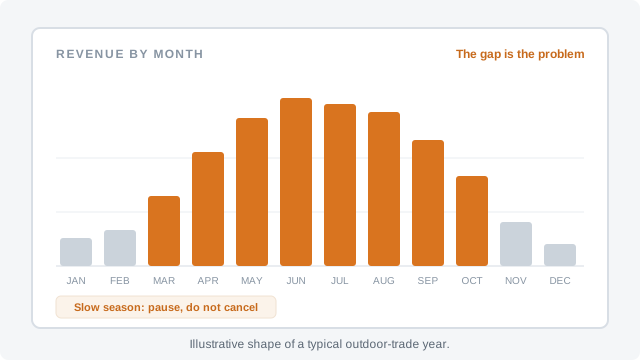
If your trade is seasonal, pay the wage over 52 weeks anyway. In the example, $65,100 a year is $1,252 a week in January as well as July. That works only if the busy months set the slow months’ pay aside. Say the shop expects twelve slow weeks: 12 × $1,252 is $15,024, and that has to be sitting in a reserve before the slowdown starts, separate from the tax money. The cash flow forecast shows the week by which the reserve must be full. If it cannot be filled, the season is telling you that the prices or the off-season work need to change. It is not telling you to pay yourself double in July and nothing in February.
Start with the amount you need to live on if the business cannot yet pay a full wage, but keep the full wage in your prices anyway. The gap between the two is money the business owes you, and the prices are what will close it.
General information, not legal or tax advice. Rules change and vary by state; check with the agency named above or a professional for your situation.